On this page
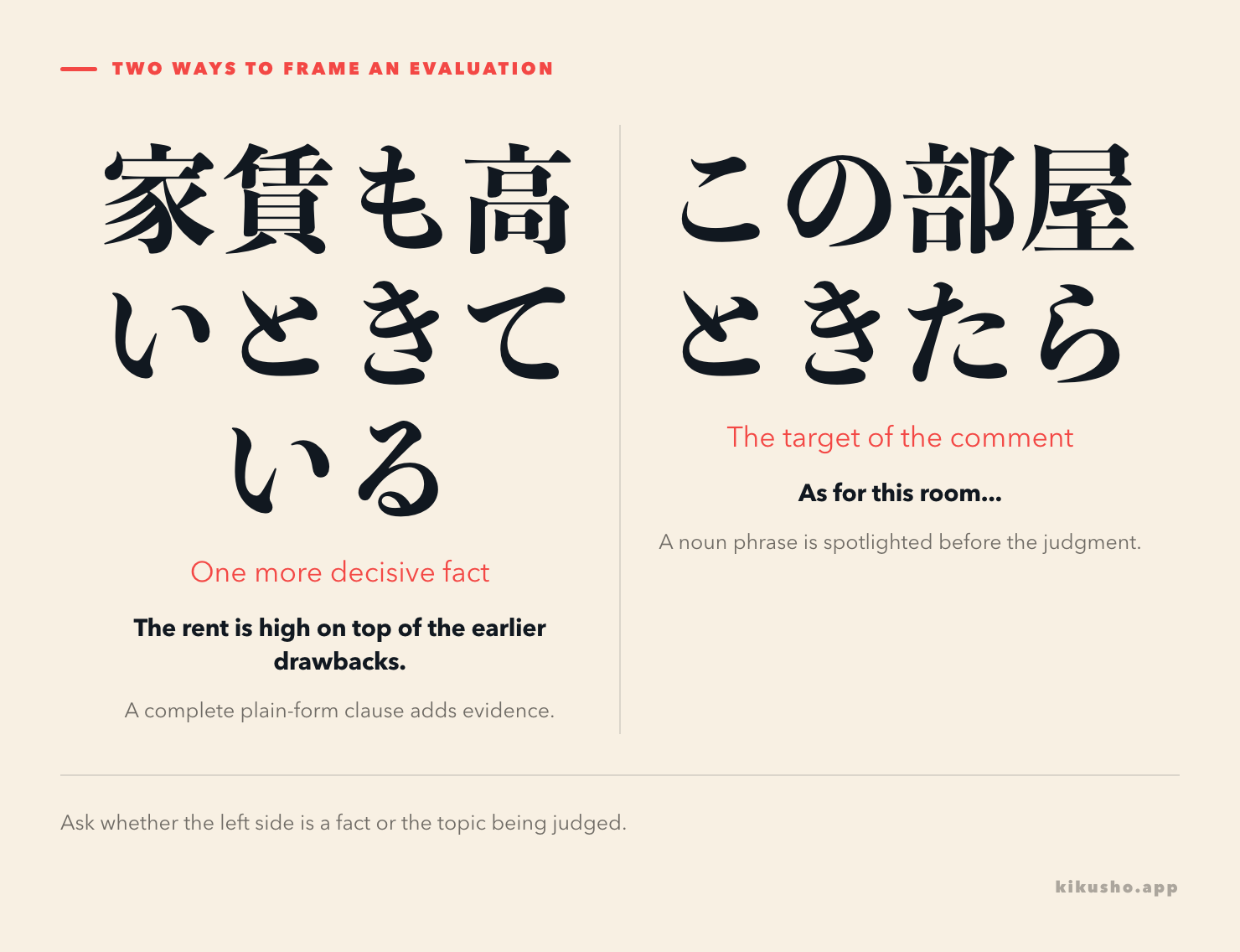
ときている adds a decisive fact to circumstances already on the table, while ときたら selects a noun as the target of an evaluative comment. Both can sound emotional, but they organize the sentence differently: one completes a list of evidence; the other announces what or whom the speaker is about to judge.
この部屋は狭いうえに、日当たりも悪いときている。
この へやは せまい うえに、ひあたりも わるいときている。
This room is small, and to make matters worse, it gets little sunlight.
この部屋ときたら、昼でも暗くて気が滅入る。
この へやときたら、ひるでも くらくて きが めいる。
As for this room, it is gloomy even in the daytime.
The first sentence stacks 日当たりも悪い on top of 狭い. The second points at この部屋 as its topic and then voices a reaction. Translating both as “when it comes to” hides the distinction that matters on an N1 question.
This lesson verifies inventory items g-40e8fc588225, ときている, and g-a91a35337c88, ときたら. JLPT Sensei records ときている at N1 and shows it followed by consequences with から and ので. J-nihongo describes its core as adding a conspicuous circumstance to facts already stated. Bunpro records noun attachment and casual register for ときたら. The inventory and these independent references agree on N1 placement for the two assigned uses.
ときている makes the last fact complete the case
With ときている, the speaker has normally mentioned at least one relevant circumstance before reaching the marked clause. That clause feels like the fact that clinches the evaluation.
この仕事は責任が重く、給料も低いときているから、応募する人が少ない。
この しごとは せきにんが おもく、きゅうりょうも ひくいときているから、おうぼする ひとが すくない。
The job carries heavy responsibility and, on top of that, the pay is low, so few people apply.
The logic has three parts:
- 責任が重い establishes one circumstance.
- 給料も低いときている adds the decisive circumstance.
- 応募する人が少ない presents the resulting judgment or outcome.
The useful English rendering changes with context: “on top of that,” “to make matters worse,” “what is more,” or sometimes simply “and.” The construction does more than mean “because.” A bare 給料が低いので can supply one reason on its own; ときている presents its clause as part of an accumulation.
Positive facts can accumulate too:
駅に近く、家賃も手頃ときているので、この物件はすぐ借り手が決まる。
えきに ちかく、やちんも てごろときているので、この ぶっけんは すぐ かりてが きまる。
It is close to the station and the rent is reasonable too, so this property finds a tenant quickly.
The grammar supplies emphasis, not negativity. Negative examples are memorable because “and to make matters worse” maps neatly onto them, but praise can be just as coherent when several advantages explain a result.
Attach a complete plain-form clause before ときている
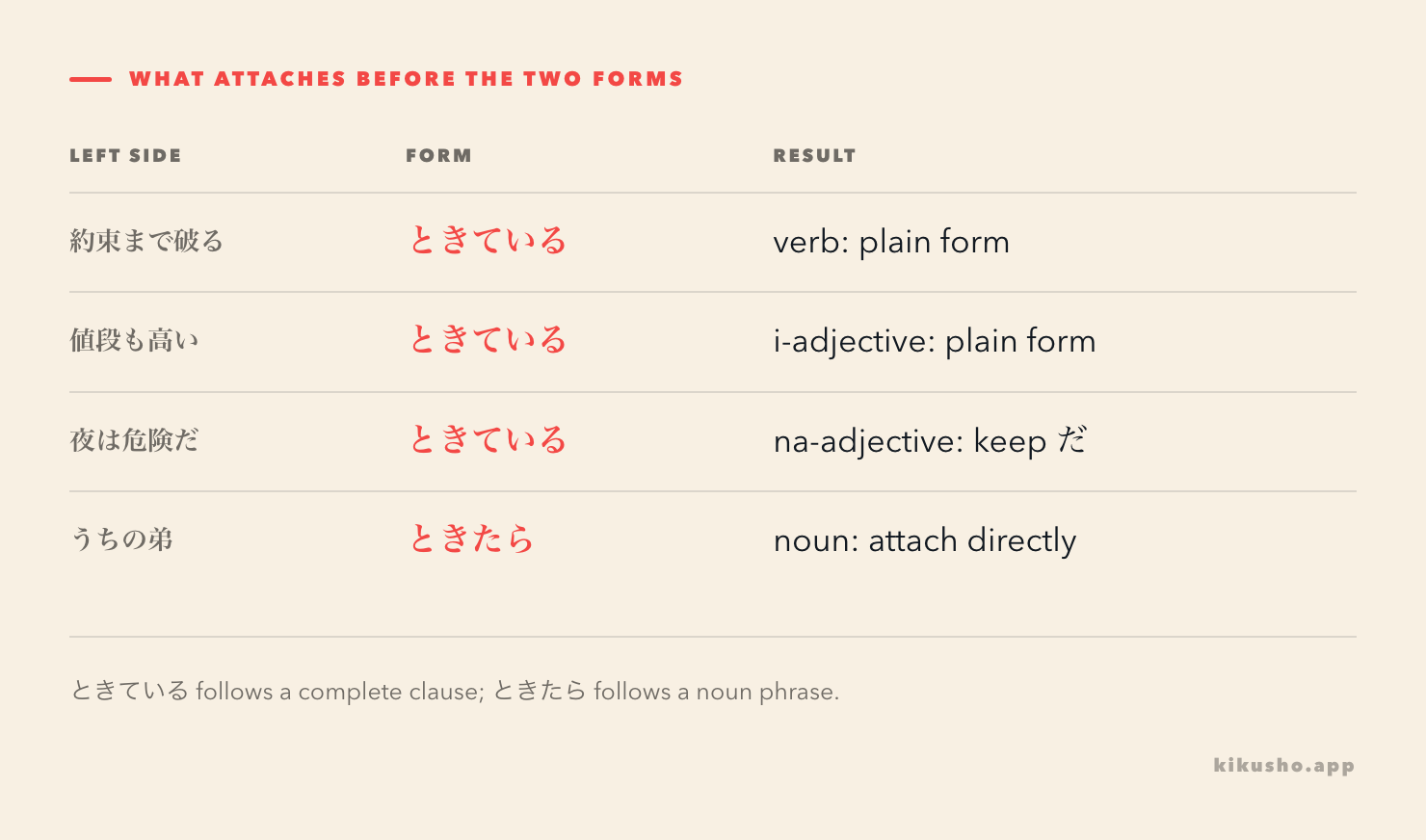
Verbs and i-adjectives use their ordinary plain forms. Nouns and na-adjectives use the copula だ.
| Word class | Required shape | Model phrase |
|---|---|---|
| action or state verb | dictionary or negative style + ときている | 約束まで破るときている |
| い-predicate | unchanged い-form + ときている | 値段も高いときている |
| な-predicate | stem + だ + ときている | 夜は危険だときている |
| nominal predicate | noun + だ + ときている | 原因は人手不足だときている |
彼は締め切りを守らず、連絡しても返事をしないときている。
かれは しめきりを まもらず、れんらくしても へんじを しないときている。
He misses deadlines and, what is more, does not reply even when contacted.
道が複雑なうえ、案内表示まで不親切だときている。
みちが ふくざつな うえ、あんないひょうじまで ふしんせつだときている。
The roads are complicated and, on top of that, the signs are unhelpful.
Markers such as うえ(に), し, だけでなく, も and まで often make the accumulation explicit. A following から, ので or ため can then connect the whole bundle to its consequence.
ときたら turns a noun into an expressive topic
Noun + ときたら roughly means “as for N” or “when it comes to N,” but the speaker is rarely neutral. It commonly introduces annoyance, disbelief, criticism or affectionate exasperation.
うちの弟ときたら、目覚ましを三つかけても起きない。
うちの おとうとときたら、めざましを みっつ かけても おきない。
As for my brother, he will not wake up even with three alarms.
あのプリンターときたら、急いでいる時に限って紙が詰まる。
あの プリンターときたら、いそいでいる ときに かぎって かみが つまる。
That printer—it always jams precisely when I am in a hurry.
The noun phrase is complete before ときたら: うちの弟, あのプリンター, 最近のニュース, この暑さ. Do not insert だ. The rest of the sentence supplies the judgment.
Because the construction carries the speaker's stance, it fits conversation, personal narration and expressive prose. A neutral report would usually choose は, については or a more explicit evaluative phrase. Using 部長ときたら in a formal report would sound as though the writer were complaining about the manager.
Praise is possible when the comment supports it
The negative tendency is strong, but it is not a grammatical ban. The following predicate can turn surprise into admiration:
佐藤さんの記憶力ときたら、一度会った人の名前を十年後でも覚えている。
さとうさんの きおくりょくときたら、いちど あった ひとの なまえを じゅうねんごでも おぼえている。
Sato's memory is something else—she remembers the names of people she met even ten years ago.
北海道の夏ときたら、空気が爽やかで、夜も過ごしやすい。
ほっかいどうの なつときたら、くうきが さわやかで、よるも すごしやすい。
Summer in Hokkaido—the air is fresh and even the nights are comfortable.
The evaluative force remains. The speaker has simply moved from complaint to impressed emphasis. This also explains why translating ときたら as “that awful…” is too narrow: the continuation decides the direction.
The fastest test is to ask what sits on the left
When the left side is a fact that completes a list, choose ときている. When it is a noun being selected for comment, choose ときたら.
| Intended move | Natural frame |
|---|---|
| add “the rent is high” to other disadvantages | 家賃も高いときている |
| complain about this apartment | この部屋ときたら |
| add “the explanations are clear” to other strengths | 説明も明快だときている |
| admire the teacher's explanations | 先生の説明ときたら |
The surface sequence とき can tempt learners to search for a time clause, but neither assigned form means “when” in the ordinary temporal sense. In 忙しいとき, とき is the noun “time.” Here the forms are fixed discourse patterns built around 来る.
Do not confuse ときたら with といったらない, which intensifies a degree: 試験前の緊張といったらなかった means the tension was beyond description. The lesson on といったらない and のなんのって covers that separate construction.
Two similar scenes show the different jobs
Suppose a speaker is reviewing a hotel.
部屋は狭いうえ、壁まで薄いときているから、ゆっくり休めなかった。
へやは せまい うえ、かべまで うすいときているから、ゆっくり やすめなかった。
The room was small and, on top of that, the walls were thin, so I could not rest properly.
Here 壁まで薄い is evidence added to 部屋は狭い. The two facts jointly explain the result.
あのホテルときたら、夜中でも廊下が騒がしくて眠れなかった。
あの ホテルときたら、よなかでも ろうかが さわがしくて ねむれなかった。
That hotel—the corridors were noisy even at midnight, and I could not sleep.
Here あのホテル is the object of complaint. Nothing before ときたら states the bad fact; that information arrives afterward.
This contrast also separates ときている from ordinary list forms. 狭くて壁も薄い reports two properties. Adding ときている signals that the second one clinches the speaker's case. Similar inclusive-list constructions such as といい~といい organize examples differently; see the comparison of inclusive lists.
Practice: evidence or expressive topic?
Question 1 — grammar choice. Complete the sentence: この店は駅から遠いうえ、値段も高い__、客が少ない。
① ときたら
② ときているから
③ といったらない
④ とき
Question 2 — grammar choice. Complete the complaint: うちの猫__、私が仕事を始めると必ずキーボードに乗ってくる。
① ときている
② だときている
③ ときたら
④ からといって
Question 3 — attachment. Which is correct before ときている: サービスも丁寧ときている or サービスも丁寧だときている? Explain why.
Question 4 — interpretation. In 彼は経験が豊富で、判断も速いときているので、現場で頼りにされている, what two facts support the result, and which one receives the marked emphasis?
Question 5 — register. A formal report currently says 営業部長ときたら、数字の確認が遅い. Replace the expressive topic marker with a neutral form.
Question 6 — contrast. Choose the form for each blank: この物件は日当たりがよく、駅にも近い__、人気がある。こんな便利な立地__、なかなか見つからない。
Question 7 — production. Write two original sentences about one restaurant. In the first, use ときている to stack a final advantage or disadvantage. In the second, use ときたら to frame the restaurant or one of its features as an expressive topic.
Answers and explanations
Resolution 1
Use ② ときているから. 値段も高い is the final disadvantage added to 駅から遠い, and から connects the accumulated circumstances to the lack of customers.
Resolution 2
Use ③ ときたら. The noun phrase うちの猫 is selected as the target of an affectionate complaint. ときている would require a preceding clause expressing a fact, not a topic noun in this position.
Resolution 3
Use サービスも丁寧だときている. 丁寧 is a na-adjective, so its plain predicative form includes だ before ときている.
Resolution 4
The supporting facts are 経験が豊富だ and 判断が速い. The second fact, fast judgment, is marked by ときている as the addition that completes the favorable case; together they explain why he is trusted at the work site.
Resolution 5
A neutral revision is 営業部長は、数字の確認が遅い. は keeps the manager as the topic without building the writer's irritation into the topic marker. 営業部長については would also work when contrasting departments or people.
Resolution 6
Use ときているので in the first blank and ときたら in the second: この物件は日当たりがよく、駅にも近いときているので、人気がある。こんな便利な立地ときたら、なかなか見つからない. The first adds proximity to an existing advantage and leads to a result. The second makes the convenient location the object of impressed comment.
Resolution 7
One model is あの店は料理が丁寧で、値段も手頃ときているから、週末はいつも混んでいる。あの店のデザートときたら、季節ごとに全部試したくなる. The first sentence stacks evidence before a consequence; the second spotlights the desserts and follows with enthusiastic evaluation.
Read the sentence as a piece of discourse
On an N1 item, first ignore the loose English gloss. Look left: is there a complete property joining earlier evidence, or a noun waiting to be discussed? Then look right: does the sentence draw a consequence from accumulated facts, or deliver a personal judgment about its topic? Those two checks separate ときている from ときたら even when both sentences carry a strong reaction.
An AI agent checked both inventory items, their N1 classification, connection rules, discourse roles, register, every original Japanese sentence and the seven practice resolutions using the references linked above. This article has not received a human Japanese-language review.
Common questions
What is the difference between ときている and ときたら?
ときている adds a striking final fact to circumstances already being listed, often before a result. ときたら follows a noun and marks it as the topic of an emotionally colored comment, commonly criticism, exasperation or surprise.
What comes before ときている?
A plain-form clause comes before ときている. Verbs and i-adjectives use their plain forms; nouns and na-adjectives normally use だ. The clause usually joins an earlier fact rather than standing as the only reason.
What comes before ときたら?
A noun or noun phrase comes directly before ときたら. It behaves like an expressive topic marker, so the following clause gives the speaker's evaluation of that person, object, place or situation.
Are ときている and ときたら always negative?
No. Negative evaluations are common, especially with ときたら, but both forms can introduce praise or impressed surprise. The surrounding predicate determines the direction of the evaluation.