On this page
The lights are off, and two people draw different conclusions. One says もう寝たに違いない: “They must have gone to bed.” The other answers 電気が消えていても、寝たとは限らない: “Even if the lights are off, that does not necessarily mean they are asleep.”
Both speakers start with the same clue. に違いない commits strongly to one conclusion; とは限らない blocks certainty and keeps other possibilities open.
The rule in one sentence
Use proposition + に違いない when you strongly infer that the proposition is true, and proposition + とは限らない when you reject the idea that it must always be true.
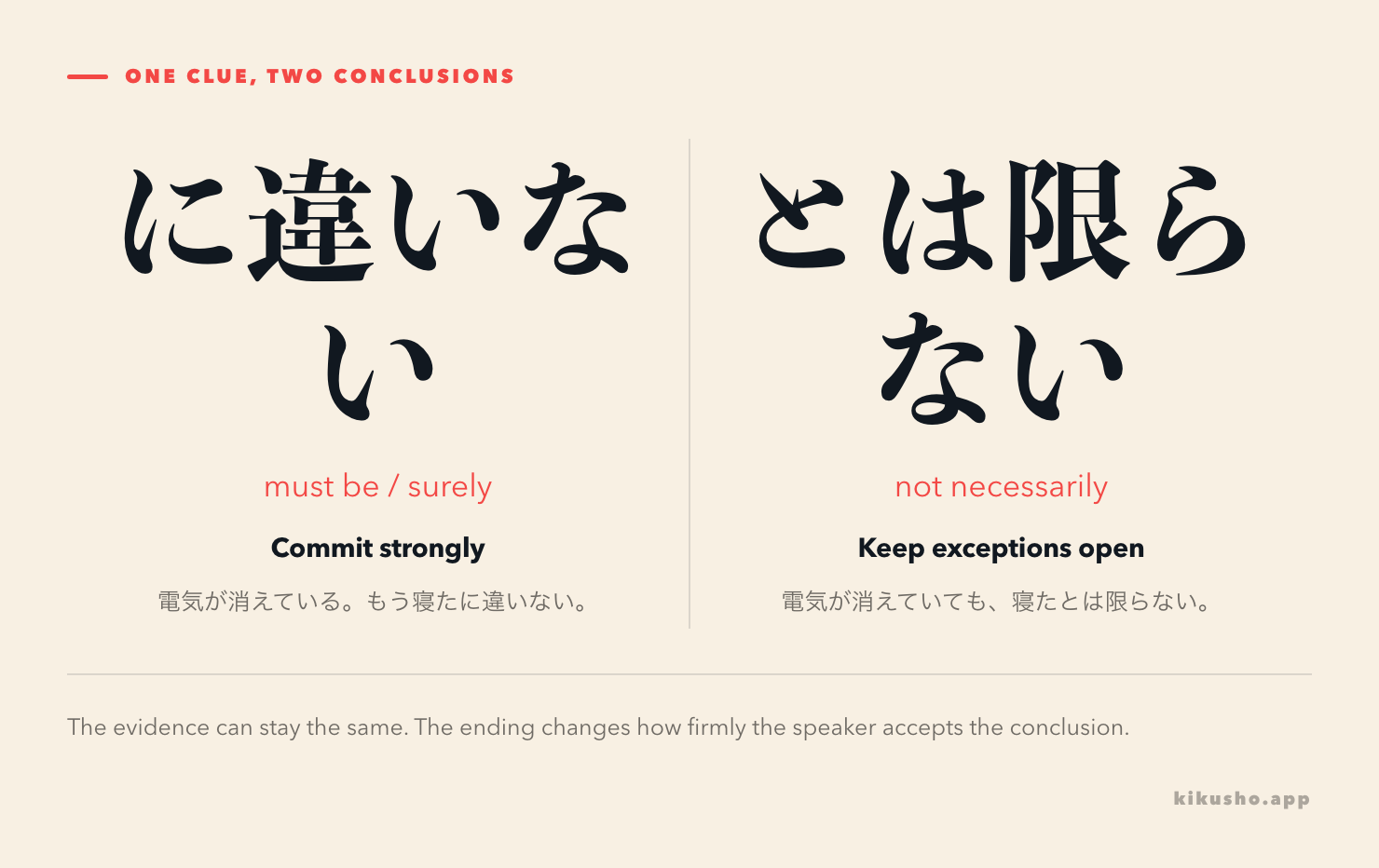
These endings do not express opposite facts. They show opposite attitudes toward certainty:
| Ending | Speaker's move | Natural English cue |
|---|---|---|
| に違いない | Select one conclusion with strong conviction | must be; surely |
| とは限らない | Refuse to guarantee the proposition | not necessarily; not always |
Decide before you finish the sentence
Ask one question while you are building the sentence:
Am I committing to this conclusion, or pointing out that another outcome remains possible?
Commit to the conclusion, and choose に違いない:
足跡がある。誰かがここに来たに違いない。
“There are footprints. Someone must have come here.”
Keep another outcome possible, and choose とは限らない:
足跡があっても、今日誰かが来たとは限らない。
“Even if there are footprints, that does not necessarily mean someone came today.”
The footprint is evidence in both sentences. The first speaker treats it as enough for a firm inference. The second notices a gap: perhaps the footprint is older.
に違いない marks a strong inference
に違いない(にちがいない) follows the content that the speaker judges to be true. It often appears after a reason, observation or surrounding situation:
窓が開いている。誰かが部屋にいるに違いない。
“The window is open. Someone must be in the room.”
This is usually a judgement, not a directly verified report. If you can see the person in the room, 誰かが部屋にいる states the observed fact without adding an inference. The Japan Foundation's Marugoto teaching guide describes に違いない as confident conjecture and notes its use for strongly presenting a writer's view.
English “must” can also express obligation, but に違いない does not tell anyone what they must do. Compare:
- 田中さんは帰ったに違いない。 “Tanaka must have gone home.” The speaker infers what happened.
- 田中さんは帰らなければならない。 “Tanaka must go home.” The sentence expresses necessity.
The polite form changes the ending to に違いありません. That makes the delivery polite; it does not weaken the conviction:
これは何かの間違いに違いありません。
“This must be some kind of mistake.”
とは限らない removes a guarantee
とは限らない(とはかぎらない) takes a proposition and says that it is not the only possible truth or outcome. It is especially useful for generalisations, expectations and cause-and-effect assumptions:
有名な店がいつもおいしいとは限らない。
“A famous restaurant is not always delicious.”
The sentence does not claim that famous restaurants are bad. It says fame does not guarantee the judgement おいしい. Coto Academy's teacher resource describes this pattern as admitting exceptions to a common image or general expectation.
You will often see two helpers around it:
- 必ずしも〜とは限らない makes “not necessarily” explicit: 高いものが必ずしも長持ちするとは限らない。 “Expensive things do not necessarily last.”
- 〜からといって、〜とは限らない challenges a conclusion drawn from a reason: 資格があるからといって、経験があるとは限らない。 “Having a qualification does not necessarily mean having experience.”
The pattern also handles one uncertain future rather than a broad rule:
来年も同じ仕事があるとは限らない。
“There is no guarantee that the same work will exist next year.”
The polite form is とは限りません. Both forms remove certainty; neither asserts the opposite.
For a closer look at the adverb that frequently accompanies this ending, continue with 必ずしも and three other N3 adverbs.
The attachment changes after nouns and な-adjectives
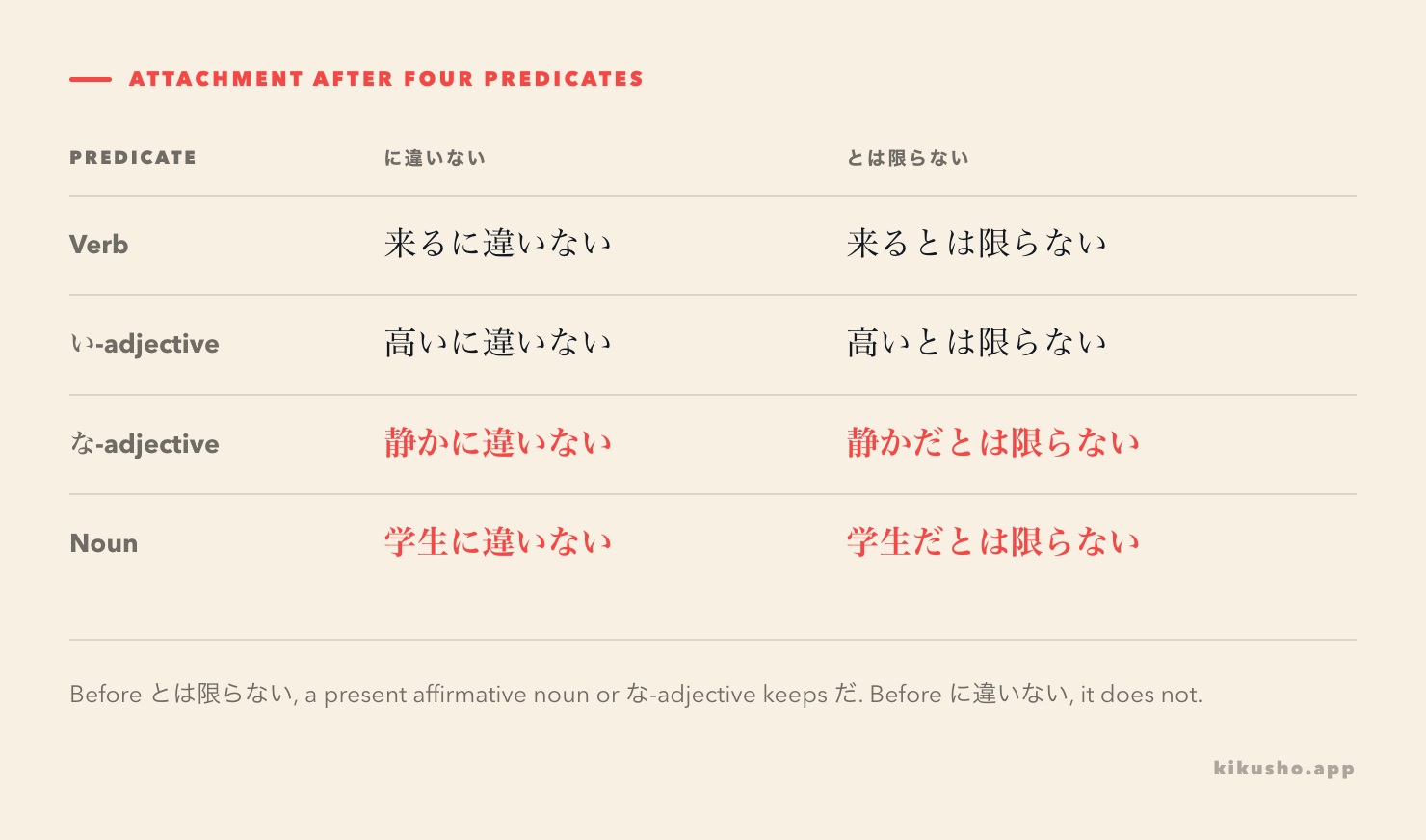
Verbs and い-adjectives use their plain forms before both patterns. Nouns and な-adjectives create the important contrast: omit plain だ before に違いない, but retain だ before とは限らない.
| Predicate | With に違いない | With とは限らない |
|---|---|---|
| Verb | 来るに違いない | 来るとは限らない |
| い-adjective | 高いに違いない | 高いとは限らない |
| な-adjective | 静かに違いない | 静かだとは限らない |
| Noun | 学生に違いない | 学生だとは限らない |
The noun pair exposes both grammar and stance:
あの制服なら、学生に違いない。
“With that uniform, the person must be a student.”
制服を着ていても、学生だとは限らない。
“Even if someone is wearing a uniform, that person is not necessarily a student.”
The second sentence needs だ inside the proposition quoted by と: 学生だ + と + は + 限らない. The first joins 学生 directly to に違いない.
A negative proposition makes the contrast sharper
Both patterns can follow a negative plain form. Read the entire ending before deciding what the sentence means:
田中さんは来ないに違いない。
“Tanaka surely will not come.”
田中さんは来ないとは限らない。
“It is not certain that Tanaka will not come.”
The second sentence leaves open the possibility that Tanaka will come. It does not predict his arrival. This is why translating one word at a time can reverse the intended stance: the negative 来ない sits inside the proposition whose certainty is then removed.
What changes when you swap the ending
Consider a popular film:
評判がいいから、面白いに違いない。
“The reviews are good, so it must be interesting.”
評判がよくても、面白いとは限らない。
“Even if the reviews are good, it is not necessarily interesting.”
The first speaker trusts the reviews enough to commit. The second speaker treats good reviews as insufficient proof. Swapping the endings changes the argument, so the surrounding connector also changes naturally from a supporting から to a concessive ても.
Do not reduce the choice to optimistic versus pessimistic. 雨に違いない can be an unwelcome firm inference, and 失敗するとは限らない can preserve hope. The deciding issue is how strongly the speaker commits to the proposition.
If you need a weaker positive possibility instead, かもしれない and でしょう place the speaker at different points on the uncertainty scale. If the conclusion follows from a schedule, rule or established expectation, はずだ differs from an obligation with べきだ.
Register and N3 placement
Both forms work in careful speech and writing. に違いない sounds more forceful than a plain と思う, so using it for every guess can overstate your confidence. とは限らない is common in explanations and arguments because it qualifies a broad claim without replacing it with another absolute.
This page covers two rows that Kikusho's September 2026 inventory assigns to N3. Bunpro and JLPT Sensei make the same editorial placement for each construction. The Japan Foundation's intermediate Marugoto material independently confirms the attachment and confident-inference function of に違いない. Treat those level labels as study guidance rather than the boundary of an official, complete JLPT grammar syllabus.
When saving either pattern in Kikusho, keep the evidence or generalisation in the same example as the ending. A card containing only に違いない = must be loses the inference, while とは限らない = not necessarily loses the claim being qualified. A complete sentence preserves the reasoning you need to recall.
Practice
Try all seven original questions before consulting the single solution block beneath them.
Question 1
You see wet umbrellas by the entrance and strongly infer that it is raining. Choose the best ending.
外は雨( )。
A. だとは限らない
B. に違いない
C. とは限りません
D. だけではない
Question 2
Choose the sentence that means “A cheap product is not necessarily bad.”
A. 安い商品は悪いに違いない。
B. 安い商品は悪くないに違いない。
C. 安い商品が悪いとは限らない。
D. 安い商品だけが悪いとは限らない。
Question 3
Supply the full ending made from 静か and とは限らない.
田舎だからといって、いつも( )。
Question 4
What does 佐藤さんは参加しないとは限らない mean?
A. Sato certainly will not participate.
B. Sato is forbidden to participate.
C. It is not certain that Sato will not participate.
D. Sato has already participated.
Question 5
Combine the clue and conclusion with に違いない.
机の上に鍵がある。山田さんはまだ会社にいる。
Question 6
Choose the form that correctly follows the noun 専門家.
詳しく説明できる人が、専門家( )。
A. だに違いない
B. に違いない
C. なに違いない
D. でとは限らない
Question 7
Read the exchange and choose the reply that challenges the inference without claiming the opposite.
甲:この店はいつも混んでいるから、料理がおいしいに違いない。
乙:( )
A. そうですね。絶対においしいです。
B. 混んでいても、おいしいとは限りませんよ。
C. おいしくないに違いありません。
D. 料理がおいしいから混んでいます。
Record all seven responses now; the explanations begin below.
Answers and explanations
Answer 1. B. 雨に違いない presents rain as the speaker's firm inference from the umbrellas. A and C remove a guarantee instead. D means “is not only,” which does not express the intended conclusion.
Answer 2. C. 悪いとは限らない says that being bad is not guaranteed, leaving both good and bad cheap products possible. A strongly concludes that the product is bad. B strongly concludes that it is not bad. D adds だけ, changing the claim to whether only cheap products are bad.
Answer 3. 静かだとは限らない. A な-adjective retains だ before とは限らない: 静かだ + と + は + 限らない. The whole sentence means that the countryside is not always quiet just because it is rural.
Answer 4. C. The negative proposition is 佐藤さんは参加しない, “Sato will not participate.” とは限らない removes certainty from that proposition, so participation remains possible. It does not predict participation or express permission.
Answer 5. One natural answer is 机の上に鍵がある。山田さんはまだ会社にいるに違いない。 The key is the clue, and に違いない marks the speaker's strong conclusion that Yamada is still at the office.
Answer 6. B. A noun attaches directly to に違いない, so the correct form is 専門家に違いない. Do not insert plain だ or adjectival な. The sentence strongly identifies the person as an expert.
Answer 7. B. The reply accepts that the restaurant is crowded but says crowding does not guarantee good food. A agrees with the original inference, C commits just as strongly to the opposite conclusion, and D states a causal explanation rather than challenging certainty.
Common questions
What is the difference between に違いない and とは限らない?
に違いない presents a proposition as the speaker's strongly held conclusion: "it must be so." とは限らない says that a proposition is not guaranteed and leaves room for exceptions: "it is not necessarily so."
Do nouns and な-adjectives attach the same way to both patterns?
No. Before に違いない, the plain だ is normally omitted: 学生に違いない and 静かに違いない. Before とは限らない, retain だ: 学生だとは限らない and 静かだとは限らない.
Does とは限らない mean the proposition is false?
No. It removes certainty without asserting the opposite. 安いものが悪いとは限らない means cheap things are not necessarily bad, not that every cheap thing is good.