On this page
Use といったらない to evaluate a quality as beyond description. Use のなんのって when casually retelling an experience with an animated “it was so X, you would not believe it” reaction, often followed by evidence of how extreme it was.
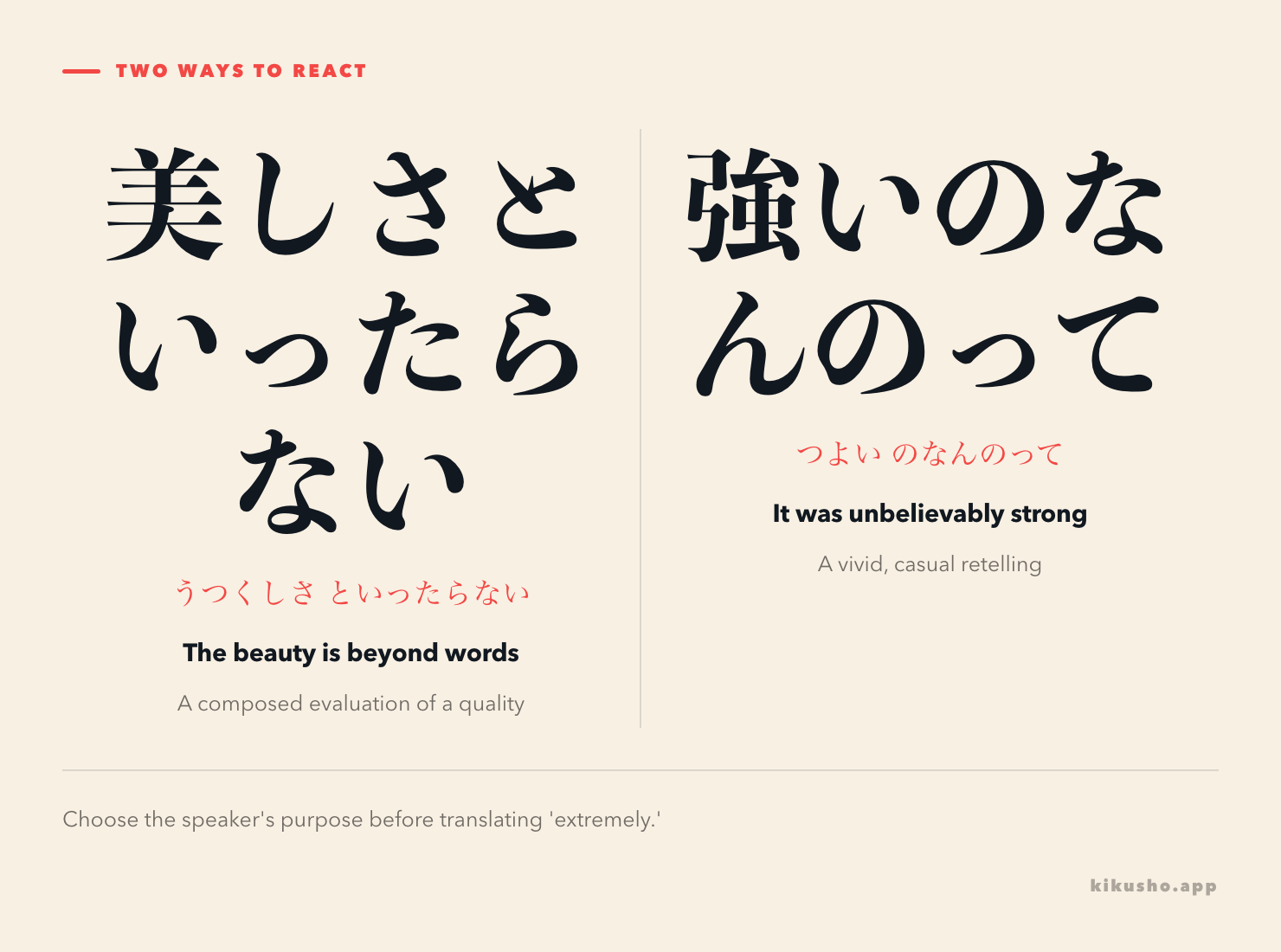
山頂から見た朝日の美しさといったらない。
さんちょうから みた あさひの うつくしさといったらない。
The beauty of the sunrise seen from the summit was beyond description.
山頂は風が強いのなんのって、まっすぐ立っていられなかったよ。
さんちょうは かぜが つよいのなんのって、まっすぐ たっていられなかったよ。
The wind at the summit was unbelievably strong—I could not even stand upright.
The first speaker delivers an evaluation of 美しさ, “beauty.” The second speaker relives the scene for a listener and proves 強い with a result. Both communicate extreme degree, but their grammar and social setting are different.
This lesson reviews inventory items g-195741c00659, といったらない, and g-881dd6783c2f, のなんのって. JLPT Sensei places both at N1, and Bunpro also records のなんのって at N1. The Kikusho inventory records no level disagreement. The official JLPT FAQ explains that vocabulary, kanji and grammar specifications are not published as fixed lists, so the N1 label comes from independent teaching references rather than an official item-by-item syllabus.
Choose evaluation or animated retelling
| What the speaker is doing | Better frame | Typical setting | Helpful English cue |
|---|---|---|---|
| judging a quality as indescribably extreme | X + といったらない | careful speech, essays, reviews, narration | “X is beyond description” |
| reliving an intense experience for a listener | X + のなんのって、result | casual conversation | “so X you wouldn't believe it” |
This distinction is more reliable than memorizing two translations for “extremely.” Ask whether the sentence presents a measured evaluation or performs a lively reaction.
といったらない puts a quality beyond words
The expression contains 言う, “to say,” but it does not literally report somebody's words. It marks a degree so great that ordinary description feels inadequate. Tanosuke's N1 explanation summarizes the force as とても~だ, while Benri Japan presents it as an emphatic degree expression. The stronger English choice depends on context: “indescribably,” “incredibly,” “utterly,” or “beyond words.”
You will often see a quality named directly or turned into a noun with ~さ or こと.
| Attachment | Example | What is evaluated |
|---|---|---|
| i-adjective + といったらない | この部屋は寒いといったらない | how cold the room is |
| na-adjective stem + といったらない | 夜の工場は静かといったらない | how quiet the factory is |
| noun / nominalized quality + といったらない | 説明の分かりにくさといったらない | the degree of difficulty understanding |
| past といったらなかった | 合格を知ったときの感激といったらなかった | an extreme reaction in a past scene |
彼の説明の分かりにくさといったらない。専門家でも要点をつかめなかった。
かれの せつめいの わかりにくさといったらない。せんもんかでも ようてんを つかめなかった。
His explanation was indescribably hard to follow. Even the experts could not grasp the point.
初舞台を終えたときの感激といったらなかった。
はつぶたいを おえた ときの かんげきといったらなかった。
The emotion I felt after finishing my first performance was beyond words.
The construction can praise or criticize. 美しさといったらない is positive; 不便さといったらない is negative. The final ない does not make the quality negative. Treat the whole expression as one emphatic pattern. You may also encounter といったらありはしない and the conversational contraction ったらない. The rougher ありゃしない variant carries a more colloquial voice.
のなんのって reenacts the reaction
のなんのって belongs most naturally to speech. It repeats a predicate, rejects the idea that a normal description is enough, and invites the listener into the speaker's reaction. Bunpro's grammar entry marks the pattern as casual and gives the three core attachment types. J-nihongo's N1 lesson also illustrates the common rhythm: extreme quality first, visible consequence second.
| Word before the pattern | Form | Example |
|---|---|---|
| verb | plain verb + のなんのって | 驚いたのなんのって |
| i-adjective | i-adjective + のなんのって | 寒いのなんのって |
| na-adjective | na-adjective + な + のなんのって | 元気なのなんのって |
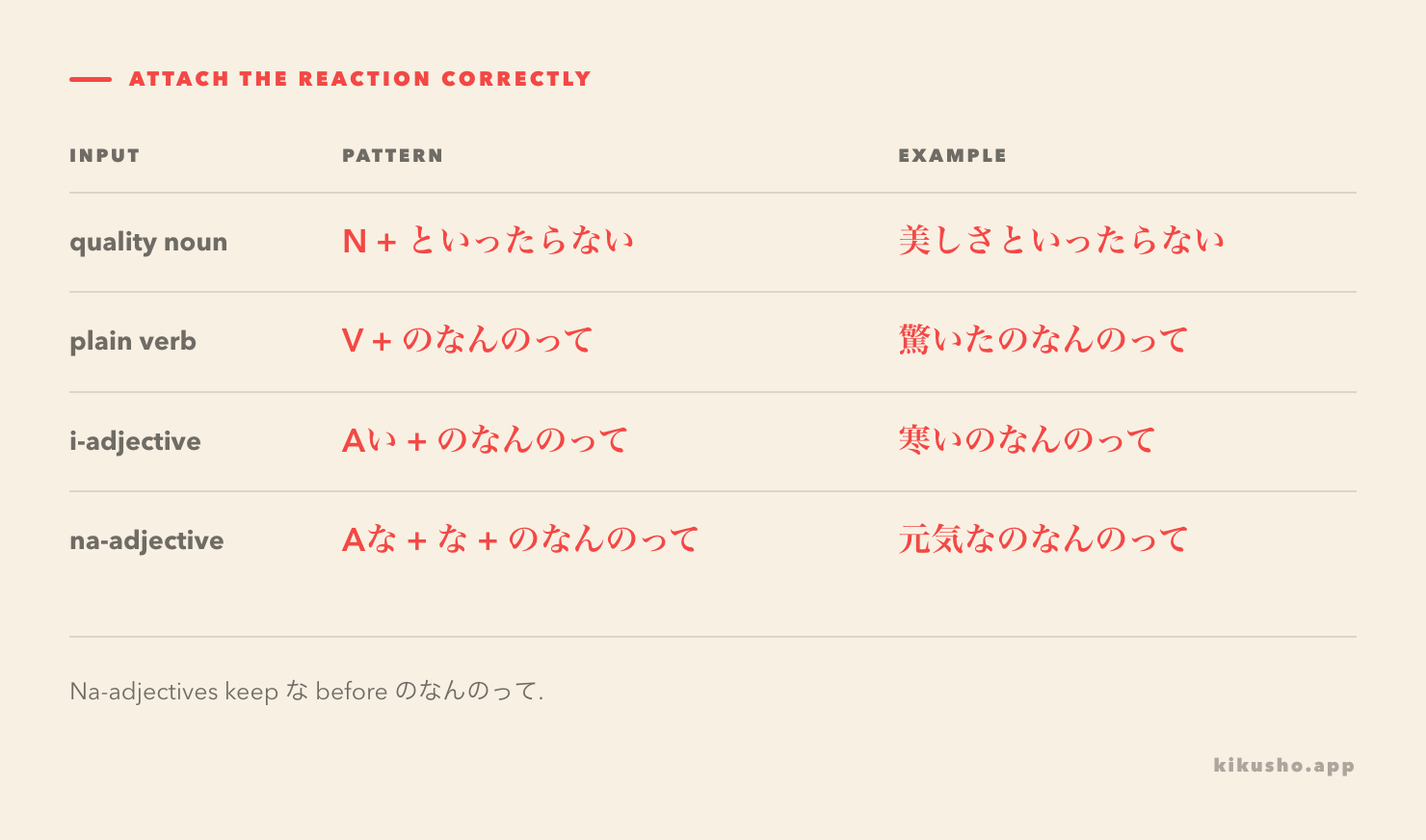
会場は暑いのなんのって、途中で外に出たよ。
かいじょうは あついのなんのって、とちゅうで そとに でたよ。
The venue was so hot you wouldn't believe it—I went outside halfway through.
合格の知らせを見た瞬間は驚いたのなんのって、何度も画面を確認した。
ごうかくの しらせを みた しゅんかんは おどろいたのなんのって、なんども がめんを かくにんした。
When I saw that I had passed, I was so shocked—I checked the screen again and again.
退院した祖父は元気なのなんのって、駅まで歩いて迎えに来たんだ。
たいいんした そふは げんきなのなんのって、えきまで あるいて むかえに きたんだ。
Grandpa was unbelievably energetic after leaving the hospital—he walked all the way to the station to meet me.
The clause after the comma is not grammatically compulsory, but it is pragmatically useful. It supplies evidence: leaving the room proves the heat, repeated checking proves the shock, and walking to the station proves the energy. This consequence makes the emotional claim vivid rather than vague.
The same event can support either viewpoint
Compare two reports after a difficult hike:
あの登山道の険しさといったらない。
あの とざんどうの けわしさといったらない。
The steepness of that mountain trail is beyond description.
あの登山道は険しいのなんのって、三回も引き返そうと思ったよ。
あの とざんどうは けわしいのなんのって、さんかいも ひきかえそうと おもったよ。
That trail was so steep you wouldn't believe it—I thought about turning back three times.
The facts need not change. 険しさといったらない packages steepness as the object of evaluation. 険しいのなんのって sounds like a speaker recreating the ordeal in conversation. The second line becomes especially natural with よ, んだ, a personal result or another sign of interaction.
That is why substitution can damage tone even when the basic degree remains understandable. A formal report is unlikely to address its readers with 大変なのなんのって. A lively conversation may sound stiff if every reaction becomes an abstract noun followed by といったらない.
The nearby lesson on 極まる and この上ない covers more formal ways to place a quality at an extreme. For emotional sentence endings such as ことか, see ことか and ことに. These families overlap in intensity, but they do not share the same attachment or conversational effect.
Avoid three tempting misreadings
First, do not split といったらない into an ordinary conditional plus a negative command. Its fixed meaning concerns indescribable degree. Reading each piece literally will send the sentence in the wrong direction.
Second, do not drop な after a na-adjective before のなんのって. 元気なのなんのって is the target form. In that string, 元気な modifies the nominalizer の; the second の is part of なんのって.
Third, do not confuse this lesson's といったらない with topic-like Xといったら or the emotional Xったら used to bring up a person or thing. The complete fixed ending といったらない and the surrounding degree context identify the construction here.
Store a complete reaction, not an isolated label
For といったらない, save the quality that receives the evaluation: 準備の大変さといったらない. For のなんのって, keep the consequence too: 忙しいのなんのって、昼ご飯を食べる時間もなかった. The consequence becomes a retrieval cue for register and discourse shape.
In Kikusho, import the entire reaction by typing it, speaking it or scanning it, then edit the resulting card and verify its reading. A prompt such as “Which form fits a casual anecdote followed by evidence?” tests the distinction better than a card that maps both patterns to “very.”
Practice: decide what the speaker is doing
Question 1 — grammar choice. A reviewer gives a composed evaluation: このホテルから見える夜景の美しさ__。
① といったらない
② のなんのって
③ なんといっても
④ といったことはない
Question 2 — grammar choice. A friend tells you about a crowded train: 今朝の電車は混んでいる__、二本も見送ったよ。
① といったらない
② のなんのって
③ といったらある
④ ことこの上なく
Question 3 — attachment repair. Correct the na-adjective form in 退院した彼は元気のなんのって、もう仕事に戻った.
Question 4 — text grammar. In 新人とは思えない落ち着きといったらない, does ない negate 落ち着き? Explain the speaker's evaluation.
Question 5 — register. Which pattern better completes a casual story followed by 声が出なかったよ, and why: 驚きといったらない or 驚いたのなんのって?
Question 6 — consequence. Complete this sentence with an original result that demonstrates the degree: 旅行先は寒いのなんのって、__。
Question 7 — production. Write two reactions to a concert: one composed evaluation using といったらない, and one animated retelling using のなんのって plus evidence.
Answers and explanations
Walkthrough 1
The best choice is ① といったらない: このホテルから見える夜景の美しさといったらない. The noun 美しさ is the quality being evaluated as beyond description. The sentence does not stage a casual anecdote or give a conversational consequence.
Walkthrough 2
Choose ② のなんのって: 今朝の電車は混んでいるのなんのって、二本も見送ったよ. The plain progressive verb attaches directly to the pattern. 二本も見送った supplies vivid evidence and よ addresses a listener.
Walkthrough 3
Use 元気なのなんのって. 元気 is a na-adjective, so it takes な before the first の: 退院した彼は元気なのなんのって、もう仕事に戻った.
Walkthrough 4
No. The fixed expression intensifies 落ち着き: the newcomer shows an indescribable or extraordinary degree of composure. Positive or negative judgment comes from the evaluated quality and context, not from the visible ない.
Walkthrough 5
驚いたのなんのって、声が出なかったよ fits the casual retelling. The past verb names the reaction, and the loss of speech proves its degree. 驚きといったらない can evaluate intense surprise, but it gives the line a more composed, literary shape.
Walkthrough 6
One answer is 旅行先は寒いのなんのって、持っていた服を全部重ね着した: “It was so cold at my destination that I wore every piece of clothing I had in layers.” Any natural consequence that demonstrates extreme cold can work.
Walkthrough 7
A possible pair is アンコールの迫力といったらなかった and 観客が盛り上がるのなんのって、床まで揺れていたよ. The first evaluates the encore's impact after the event. The second recreates the crowd's excitement and supports it with a physical consequence.
The final language pass checked attachment, the role of ない, both emotional polarities, conversational register, consequence clauses, level evidence and the reasoning behind every exercise. The review was performed with AI assistance rather than by a human language editor.
Common questions
What is the difference between といったらない and のなんのって?
といったらない evaluates a quality as beyond description and can suit careful speech or writing. のなんのって is a casual, emotionally vivid way to retell how extreme an experience was, often followed by a concrete consequence.
Can といったらない express a positive reaction?
Yes. It can intensify positive reactions such as joy or beauty as well as negative ones such as difficulty or unpleasantness. The evaluated word and context supply the polarity.
What comes before のなんのって?
Use a plain verb, an i-adjective, or a na-adjective followed by な: 驚いたのなんのって, 寒いのなんのって and 元気なのなんのって.
Is the ない in といったらない an ordinary negative?
Do not translate it as a simple negation. The fixed expression means that the degree is beyond saying or description. Variants such as といったらありはしない make the idea of no comparable degree more visible.