On this page
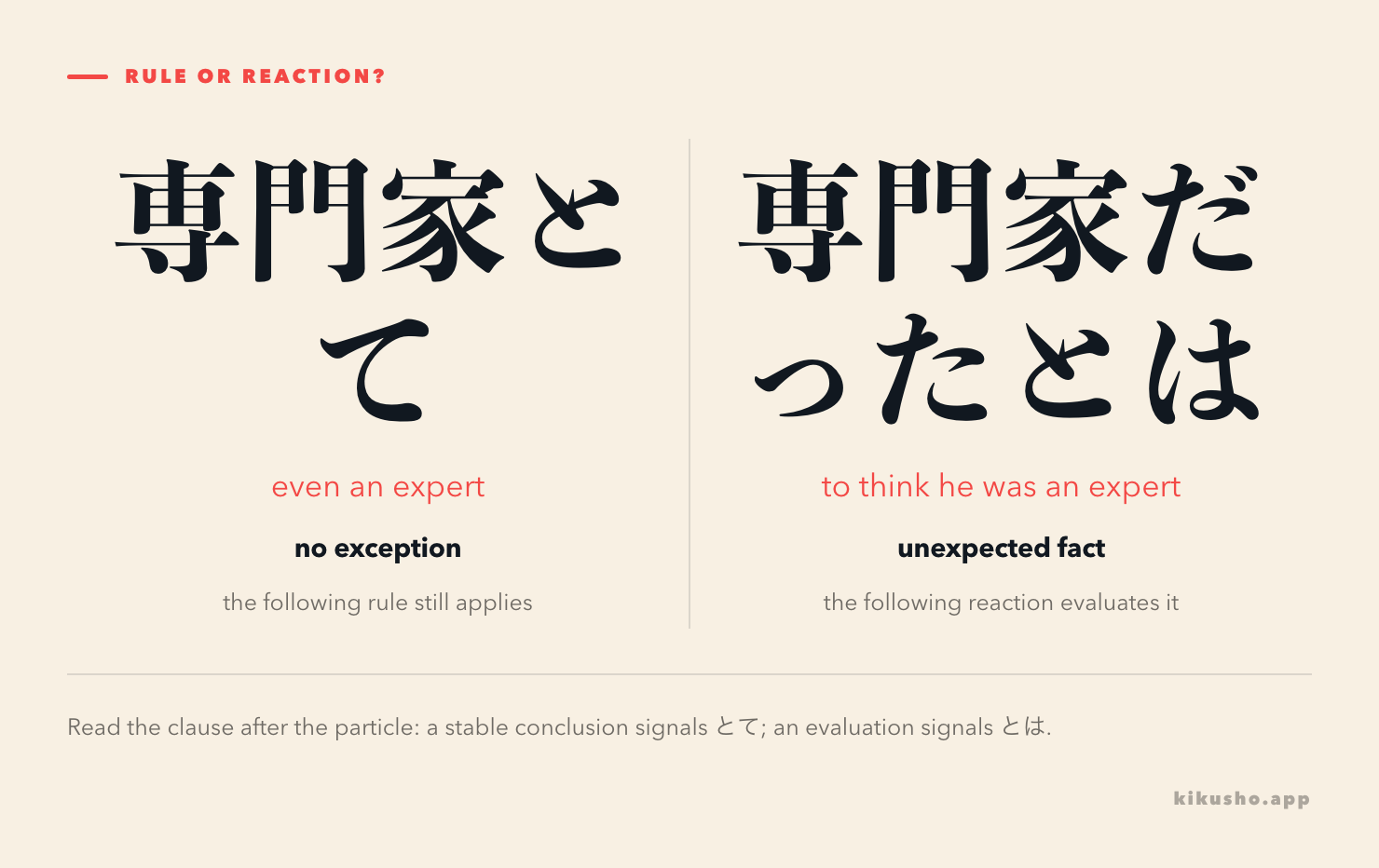
Use とて to concede a case and say that the conclusion still holds even there. Use exclamatory とは to present a fact as surprising, admirable, regrettable or hard to believe. The two forms differ by one kana, but they give the preceding material entirely different jobs.
専門家とて、判断を誤ることはある。
せんもんかとて、はんだんを あやまることは ある。
Even experts sometimes make errors of judgment.
彼がその分野の専門家だったとは驚いた。
かれが その ぶんやの せんもんかだったとは おどろいた。
I was surprised to learn that he was an expert in that field.
The first sentence removes experts from an imagined list of exceptions: expertise does not eliminate mistakes. The second turns the whole fact 彼が専門家だった into the object of surprise.
This lesson verifies inventory items g-1bd88a5b0147, とて, and g-a08f4ba6fafe, とは. JLPT Sensei and 毎日のんびり日本語教師 place concessive とて at N1 and describe the named case as no exception. JLPT Sensei's とは reference and MLC Japanese Language School teach the N1 exclamatory use as a reaction to an unexpected fact.
Nとて means that even N is no exception
After a noun, とて means “even N,” “N too,” or “even someone in N's position.” The main clause states a limitation, rule or experience that still applies.
親とて、子どもの気持ちをすべて理解できるわけではない。
おやとて、こどもの きもちを すべて りかいできる わけでは ない。
Even parents cannot understand everything their children feel.
大企業とて、急な市場の変化に対応できないことがある。
だいきぎょうとて、きゅうな しじょうの へんかに たいおうできないことが ある。
Even large companies sometimes cannot respond to sudden market changes.
私とて、何も不安がないわけではありません。
わたしとて、なにも ふあんが ない わけでは ありません。
I too am not entirely free of anxiety.
The contrast often depends on an expectation that N might be exceptional: parents should understand their children, large companies have resources, and the speaker may appear confident. とて grants the special position but denies that it removes the ordinary limit.
Predicate plus とて means even if the premise is granted
Literary とて can also follow a predicate. It concedes the proposition before it, then states that the consequence remains unchanged.
いくら謝ったとて、失った信頼はすぐには戻らない。
いくら あやまったとて、うしなった しんらいは すぐには もどらない。
Even if one apologizes repeatedly, lost trust will not return at once.
どれほど急ぐとて、必要な確認を省いてはならない。
どれほど いそぐとて、ひつような かくにんを はぶいては ならない。
However much you hurry, you must not omit the necessary checks.
条件が厳しいとて、説明なしに拒否してよい理由にはならない。
じょうけんが きびしいとて、せつめいなしに きょひして よい りゆうには ならない。
Even if the conditions are strict, that does not justify refusing without an explanation.
The predicate remains in a plain form. Nouns attach directly, while a complete nominal or na-adjective proposition may use であるとて. This extended predicate use is distinctly formal and literary.
In ordinary conversation, ても, でも, だって or たところで will often sound more natural. The point of learning とて is recognition in essays, formal arguments, narration and stylized dialogue, plus controlled use when that elevated register is deliberate.
からとて rejects a conclusion drawn from one reason
The frequent frame Pからとて、Qとは限らない/Qわけではない means “just because P, Q does not necessarily follow.”
値段が高いからとて、品質が優れているとは限らない。
ねだんが たかいからとて、ひんしつが すぐれているとは かぎらない。
Just because the price is high does not mean the quality is superior.
経験が長いからとて、常に正しい判断ができるわけではない。
けいけんが ながいからとて、つねに ただしい はんだんが できる わけでは ない。
Long experience does not guarantee consistently correct judgment.
Here から supplies the reason someone might rely on, and とて concedes it without accepting the proposed conclusion. In neutral modern speech, からといって is the common equivalent. Do not mistake からとて for a stronger degree of plain とて; it is a recognizable reason-rejection frame.
Exclamatory とは packages the unexpected fact
The N1 reaction use follows a full proposition. と quotes or packages that fact, and は foregrounds it for evaluation.
この小さな町から三人も代表選手が選ばれるとはすごい。
この ちいさな まちから さんにんも だいひょうせんしゅが えらばれるとは すごい。
It is amazing that three national representatives were selected from this small town.
まさか今日で店が閉まるとは知らなかった。
まさか きょうで みせが しまるとは しらなかった。
I had no idea the shop was closing today.
あれほど準備したのに、最初の問題で失敗するとは残念だ。
あれほど じゅんびしたのに、さいしょの もんだいで しっぱいするとは ざんねんだ。
It is disappointing to fail on the first question after preparing so much.
The reaction can be positive, negative or mixed. Typical endings include 驚いた, すごい, 信じられない, 知らなかった, 残念だ, 情けない and 予想しなかった. The grammar marks emotional or epistemic distance from what the speaker expected; it does not itself decide whether the feeling is admiration or dismay.
The reaction may be left unsaid
Japanese often lets the sentence trail off after とは:
あの二人が兄弟だったとは……。
あの ふたりが きょうだいだったとは……。
To think that those two were brothers.
こんなところで先生に会うとは!
こんな ところで せんせいに あうとは!
To think I would meet my teacher in a place like this!
The missing predicate is recovered as a reaction such as “I never imagined it,” “what a surprise,” or “unbelievable.” Punctuation and context do not create a separate grammar rule; they make the emotional suspension visible.
The same device appeared in the preceding としたことが lesson: 慎重な彼としたことが、間違えるとは first invokes the person's reputation, then とは frames the mistake as the surprising fact.
Attachment reveals which job the phrase performs
| Form | What precedes it | What follows | Sentence job |
|---|---|---|---|
| N + とて | exceptional-seeming noun | general limit or rule | even N is no exception |
| plain predicate + とて | conceded proposition | unchanged result | even if P, still Q |
| から + とて | proposed reason | denied inference | P does not guarantee Q |
| proposition + とは | unexpected fact | reaction or omission | surprise, admiration or dismay |
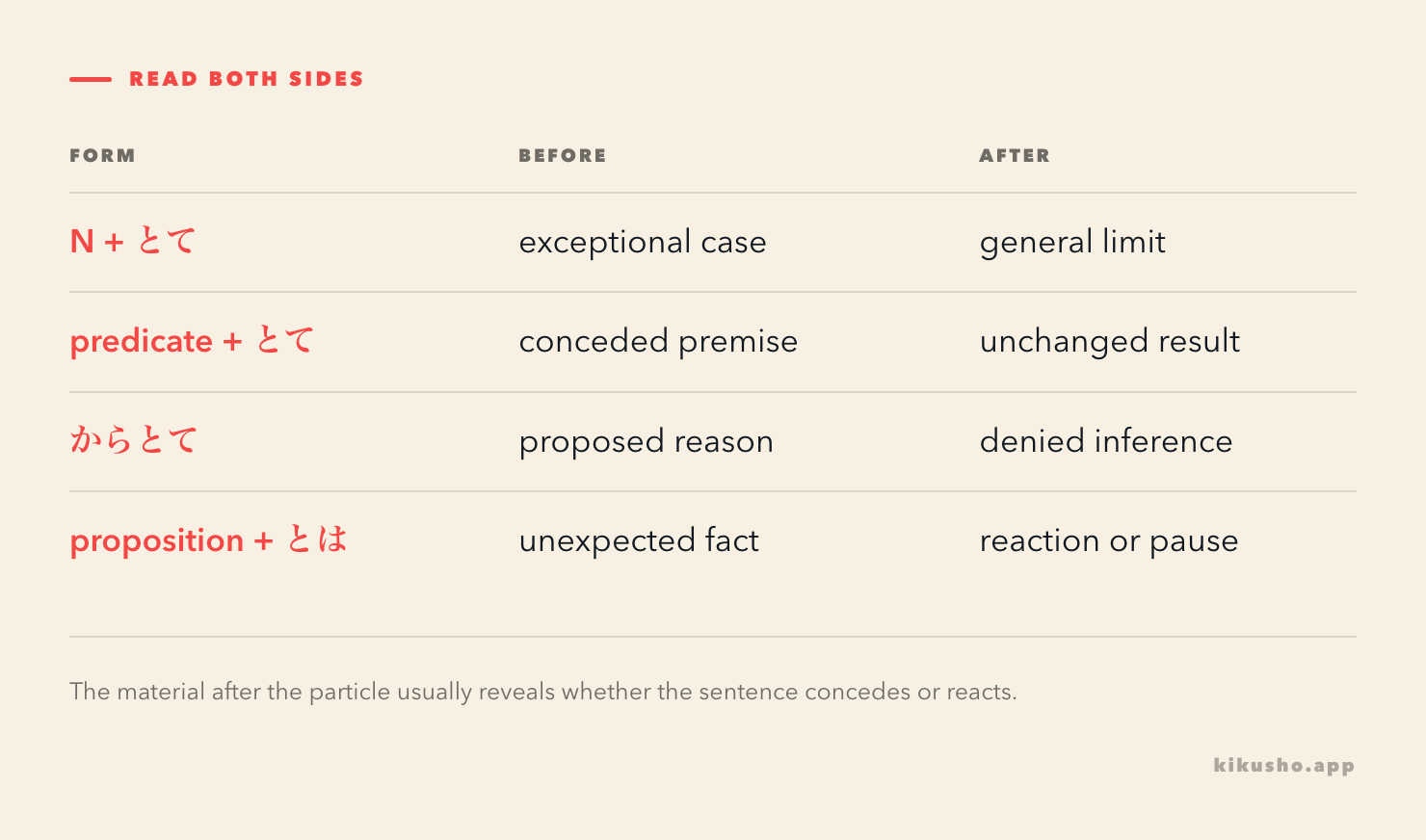
The safest reading order is to inspect what comes after the form. A conclusion such as 例外ではない, 許されない or 変わらない supports concessive とて. A reaction such as 驚いた, すごい or 知らなかった supports exclamatory とは.
Separate reaction とは from definitions and とはいえ
Not every とは expresses surprise. A noun followed by a definition uses a basic topic frame:
幸福とは何か。
こうふくとは なにか。
What is happiness?
敬語とは、相手や場面への配慮を言葉の形に表す仕組みだ。
けいごとは、あいてや ばめんへの はいりょを ことばの かたちに あらわす しくみだ。
Keigo is a system that expresses consideration for the listener and situation through linguistic form.
These sentences ask for or supply a definition. They contain no unexpected event and no emotional reaction.
とはいえ is also a separate concessive connector meaning “although” or “that said”:
春とはいえ、朝はまだ寒い。
Although it is spring, the mornings are still cold.
Do not split it into the exclamatory とは plus an independent いえ. Learn the complete connector. For other literary concessions, the といえども and であろうと lesson compares an acknowledged fact with a hypothetical case, while the formal とも lesson covers another compact “even if” form.
Practice: preserve the rule or react to the fact
Complete the seven prompts before opening the answer panel.
Question 1 — no exception. Complete: どんな専門家__、未来を正確に予測することはできない。
① とは
② とて
③ としたことが
④ とはいえ
Question 2 — surprise. Complete: 彼が一人でこの作品を完成させた__驚いた。
① とて
② からとて
③ とは
④ とも
Question 3 — rejected inference. Complete: 有名だから__、内容が正確だとは限らない。
① とは
② とて
③ からとて
④ としたことが
Question 4 — omitted reaction. What is communicated by まさか彼女が辞任するとは……, even though no reaction predicate is spoken?
Question 5 — definition or exclamation. Explain the two different jobs of とは in 自由とは何か and 彼が突然会社を辞めるとは驚いた.
Question 6 — paired reading. Select the best forms: 親__子どもの全ては分からない。あの父親が相談を一度も受けていなかった__意外だ。
① とは / とて
② とて / とは
③ からとて / とはいえ
④ としたことが / とも
Question 7 — sentence creation. Write one formal sentence with Nとて to deny an exception, then one exclamatory sentence with とは reacting to an unexpected achievement.
Answers and explanations
Reading 1
Use ② とて. どんな専門家とて places every expert under the same human limitation: none can predict the future precisely. The following conclusion remains valid even for the apparently exceptional category.
Reading 2
Use ③ とは. The whole fact 彼が一人でこの作品を完成させた is foregrounded as the object of 驚いた. The sentence reacts to an achievement rather than conceding a condition.
Reading 3
Use ③ からとて. Fame is acknowledged as a possible reason for trusting the content, but the ending とは限らない rejects the inference that fame guarantees accuracy.
Reading 4
The speaker presents her resignation as unexpected and leaves the emotional response implicit. Depending on context, the omitted reaction might be disbelief, shock, regret or a request for an explanation. The trailing とは is expressive rather than incomplete in ordinary dialogue.
Reading 5
In 自由とは何か, the noun 自由 is the topic of a definition: “What is freedom?” In 彼が突然会社を辞めるとは驚いた, a complete event is packaged as an unexpected fact and evaluated by 驚いた. Syntax and discourse purpose separate the two uses.
Reading 6
Use ② とて / とは. 親とて says parents are no exception to the limit on understanding another person. 相談を一度も受けていなかったとは意外だ reacts to the unexpected fact that this particular father had never been consulted.
Reading 7
One model is 受賞歴のある作家とて、毎回傑作を書けるわけではない。新人が初作品で国際賞を取るとはすばらしい. The first preserves a limitation even for an acclaimed author; the second reacts with admiration to the newcomer's unexpected achievement.
Read forward from the particle
With とて, ask which apparently exceptional case has been conceded and which rule still applies. With exclamatory とは, ask what complete fact has been pulled forward for evaluation and whether the reaction is stated or merely felt. Reading the following clause keeps both forms distinct from definitions, quotations and longer connectors that happen to contain the same kana.
An AI agent reviewed both assigned inventory records, supported N1 placement, attachment, concessive logic, reaction use, register, examples and exercise reasoning with the linked references. A human Japanese editor has not reviewed this lesson.
Common questions
What does とて mean in Japanese grammar?
とて is a literary or formal concessive meaning “even N” or “even if P.” It grants the preceding case, then says that the following limitation, rule or result still applies.
What does the N1 exclamatory とは mean?
It presents the preceding fact as surprising, impressive, regrettable or otherwise emotionally striking. The reaction may follow explicitly or be omitted when the sentence trails off.
What is the difference between とて and とは?
とて makes the preceding expression a concessive case that does not change the conclusion. Exclamatory とは makes the preceding expression the fact to which the speaker reacts.
Is every Nとは an expression of surprise?
No. Nとは can introduce a definition, as in 幸福とは何か. The exclamatory use normally follows a full unexpected fact and is supported by context or a reaction such as 驚いた, すごい or 残念だ.