On this page
Use concessive とも when an imagined obstacle will not change the result: 雨が降ろうとも、試合は行う means “Even if it rains, the match will go ahead.” The pattern is more formal and emphatic than ordinary ても, and it most often follows a verb in the volitional form.
That combination gives the sentence a firm logic: grant the strongest plausible condition, then maintain the decision, rule or conclusion. It is especially useful in declarations, promises, written arguments and dramatic statements.
とも concedes A and keeps B fixed
Read the two clauses as a pressure test. Clause A introduces something that could normally overturn clause B. とも tells the reader that it will not.
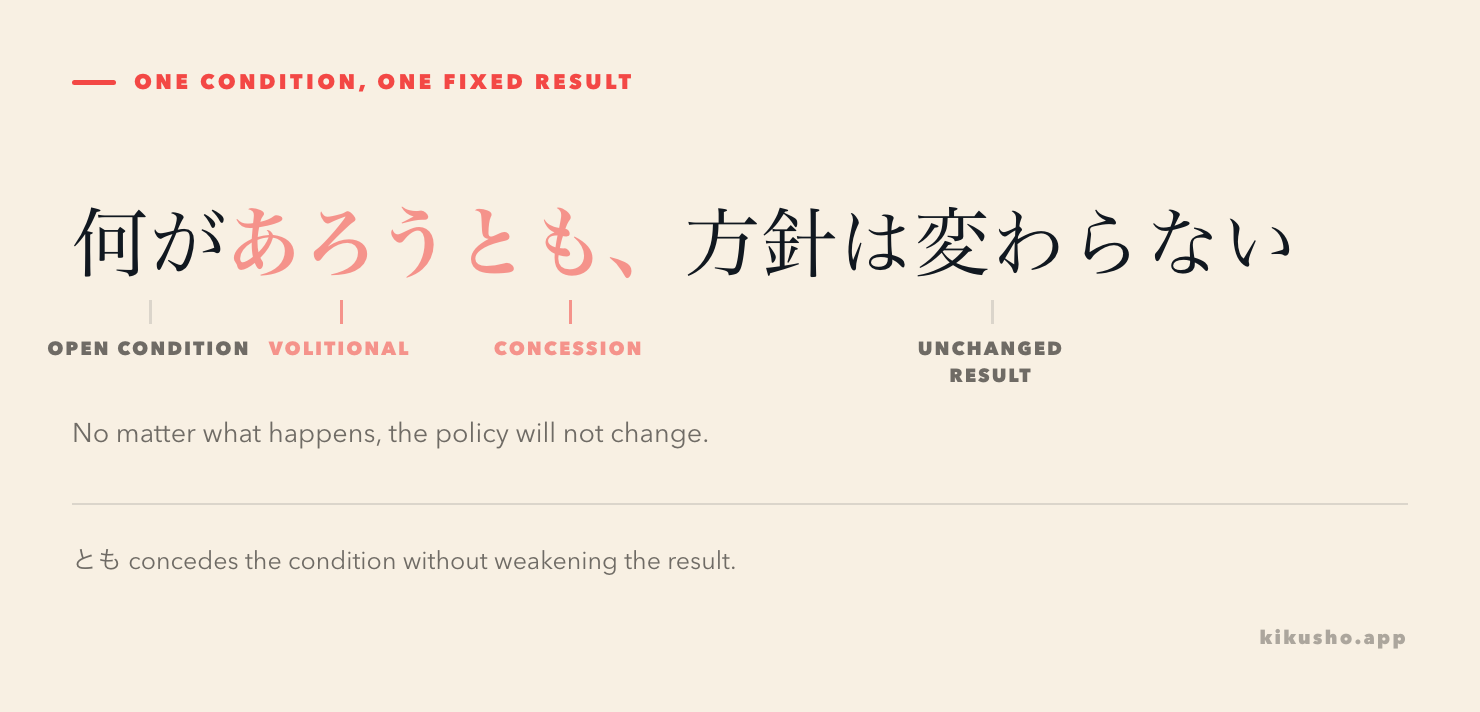
何があろうとも、方針は変わらない。
なにが あろうとも、ほうしんは かわらない。
No matter what happens, the policy will not change.
The open question word 何 makes the condition as broad as possible. あろう is the volitional form of ある, and the following とも concedes every event that could fill that slot. The second clause then announces the invariant result.
Bunpro's とも reference describes this as a formal, emphatic concession and highlights set-like combinations such as 何があろうとも. JLPT Sensei's とも lesson independently gives the “even if” and “no matter” readings and the principal attachment patterns.
The condition need not be likely. A speaker can deliberately choose an extreme case to display resolve:
誰に反対されようとも、この調査を続ける。
だれに はんたいされようとも、この ちょうさを つづける。
No matter who opposes me, I will continue this investigation.
たとえ失敗しようとも、試したことには意味がある。
たとえ しっぱいしようとも、ためした ことには いみが ある。
Even if we fail, trying will have meaning.
たとえ can reinforce the hypothetical reading, but it is optional. The volitional form plus とも already builds the concession.
Build the condition before adding とも
The most productive pattern is verb volitional + とも. Godan verbs take the -ō volitional, ichidan verbs take -yō, and する/来る become しよう/来よう.
| Base form | Form before とも | Complete phrase |
|---|---|---|
| 降る | 降ろう | 雨が降ろうとも |
| 諦める | 諦めよう | 諦めようとも |
| 反対する | 反対しよう | 反対しようとも |
| 来る | 来よう | 誰が来ようとも |
Negative verbs use the ない stem plus なくとも. This looks different on the surface but keeps the same concessive logic.
必要な資料がそろわなくとも、確認できる範囲から始めます。
ひつような しりょうが そろわなくとも、かくにんできる はんいから はじめます。
Even if all the necessary material is not available, we will start with what we can check.
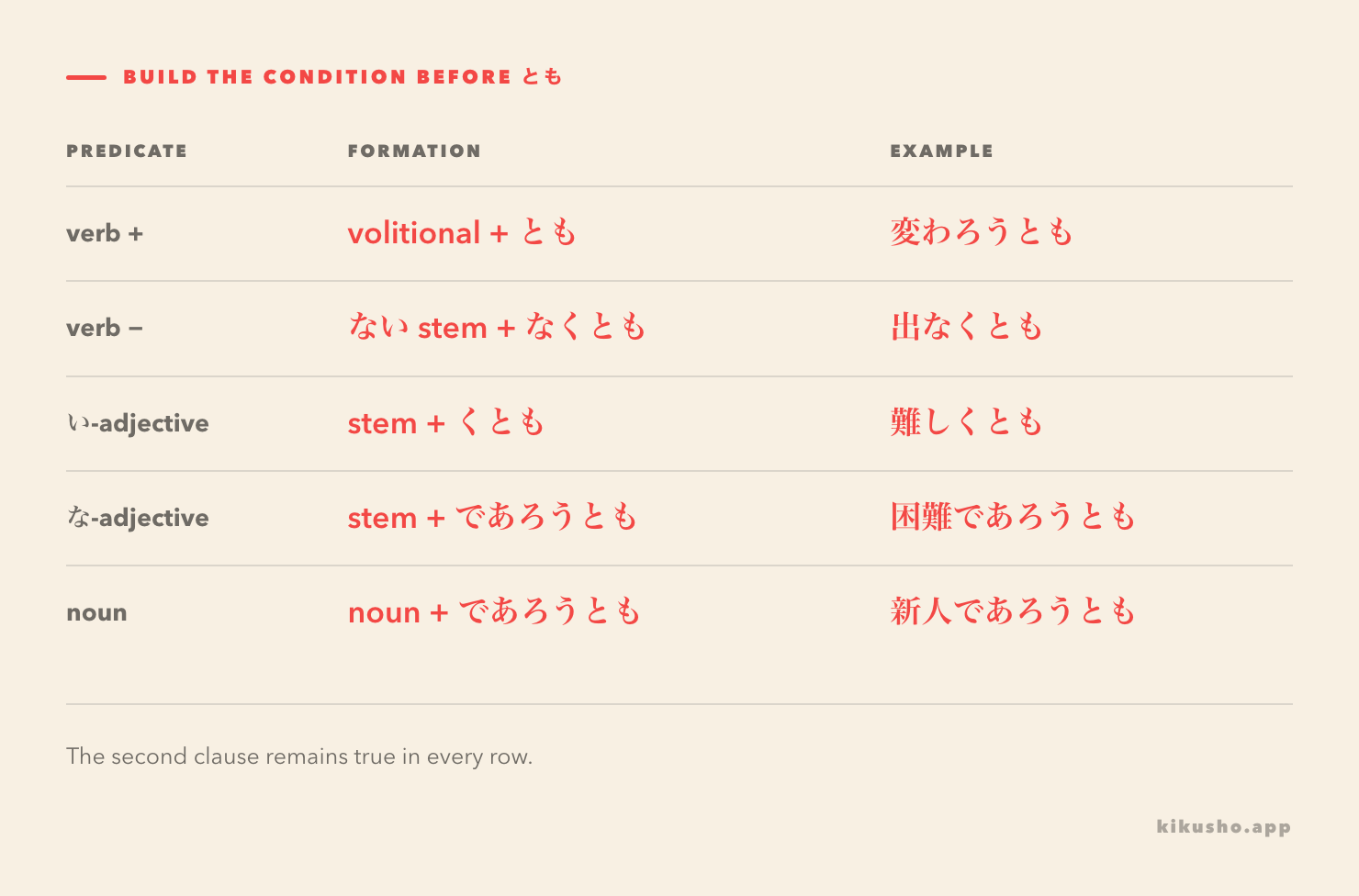
For an い-adjective, remove final い and add くとも. For a noun or な-adjective, であろうとも supplies the formal hypothetical predicate.
| Predicate type | Formation | Example |
|---|---|---|
| verb, affirmative | volitional + とも | 結果が変わろうとも |
| verb, negative | ない stem + なくとも | 結果が出なくとも |
| い-adjective | stem + くとも | どんなに難しくとも |
| な-adjective | stem + であろうとも | 困難であろうとも |
| noun | noun + であろうとも | 新人であろうとも |
どんなに難しくとも、期限までに結論を出さなければならない。
どんなに むずかしくとも、きげんまでに けつろんを ださなければ ならない。
No matter how difficult it is, we must reach a conclusion by the deadline.
相手が新人であろうとも、必要な情報は共有すべきだ。
あいてが しんじんであろうとも、ひつような じょうほうは きょうゆうすべきだ。
Even if the other person is new, the necessary information should be shared.
The forms are not equally frequent in every setting. Vようとも and question-word combinations are central. であろうとも sounds deliberately formal, and ordinary conversation will often choose でも or だとしても instead.
Choose とも when the register supports its force
Compare the same promise in two registers:
雨が降っても、必ず行きます。
Even if it rains, I will definitely go.
雨が降ろうとも、必ず参ります。
Even if it should rain, I will certainly go.
Both sentences preserve the decision despite rain. The first sounds natural in ordinary conversation. The second combines formal とも with humble 参ります, producing a more solemn commitment. Using とも does not automatically make an informal sentence wrong, but it adds weight that may be conspicuous in casual talk.
Hane's N2 overview likewise treats the construction as a formal concession and gives volitional examples with question words. The independently maintained Tomoshi entry labels it written in style and shows the same determination reading. These references support a practical choice: use ても as the neutral default and reserve とも for emphatic or written contexts.
The たとえ~ても lesson teaches the ordinary hypothetical construction and the degree cues どんなに and いくら. This N2 pattern raises the register and often changes the verb from 降っても to volitional 降ろうとも.
Keep とも separate from nearby concessions
Several forms can translate as “even if,” but they frame the hypothetical in different ways.
| Form | Main work | Example cue |
|---|---|---|
| Vても | neutral concession | 雨が降っても |
| たとえ~ても | explicitly supposes one case | たとえ雨が降っても |
| Vようとも | formal, emphatic concession | 雨が降ろうとも |
| plain + としても | sets an assumption for discussion | 雨が降るとしても |
| VようがVまいが | spans affirmative and negative alternatives | 行こうが行くまいが |
としても is useful when reasoning from an assumption: 計画が遅れるとしても、一週間以内だ, “Even assuming the plan is delayed, it will be within a week.” The としても lesson develops that premise-setting role. とも more readily presents resistance: the following commitment survives the obstacle.
Paired forms such as 行こうが行くまいが explicitly cover two alternatives. A single 行こうとも instead concedes one imagined action and maintains the result. If the sentence names two cases and applies one rule to both, the にせよ and にしろ lesson gives a more direct paired structure.
The same spelling has several unrelated jobs
Do not identify this grammar from the final two kana alone. Test whether there is a hypothetical condition and an unchanged result.
A: 手伝ってくれる?
B: もちろんですとも。
A: Will you help me?
B: Of course I will.
Sentence-final とも emphatically agrees with the other speaker. It does not mark a concession. A corpus study from Kobe Gakuin University, 「とも」, analyses this response particle as signalling that the speaker regards the answer as natural or certain.
Three other common lookalikes also require separate parsing:
- 少なくとも三日 means “at least three days”; it fixes a lower bound.
- 遅くとも金曜日までに means “by Friday at the latest”; it fixes an upper time limit.
- 二人とも参加した means “both people participated”; とも includes every member of the named set.
The せめて and 少なくとも lesson develops the lower-bound adverb. とともに, “together with” or “as,” is also a different construction; do not cut it into concessive とも plus に.
A useful diagnostic has two questions:
- Does the material before とも form a possible condition, such as 誰が来よう or 資料がなく?
- Does the following clause remain true despite that condition?
If both answers are yes, the concessive reading is likely. If the sentence is a reply, a quantity limit, an inclusive set or とともに, choose the local meaning instead.
N2 is a supported study placement
JLPT Sensei, Bunpro, Hane and Tomoshi all present the target concession as N2. Their labels agree on the practical placement, while their example sets also reveal why search results can be noisy: the written form とも belongs to several distinct constructions.
The JLPT authority explains in its official FAQ that it does not publish a complete list of vocabulary, kanji and grammar items. Kikusho therefore treats N2 as a source-supported study placement rather than a promise that this exact form will appear on a particular exam.
Practice
All six questions come before the answer block so you can complete the set without seeing a solution.
Question 1
Complete the formal promise: 誰に反対され( )、この計画は続けます。
- A. てもいい
- B. ようとも
- C. るとも
- D. たとも
Question 2
Choose the correct negative form: “Even if we cannot participate, we will send the materials.”
- A. 参加できないとも、資料を送ります。
- B. 参加できなくとも、資料を送ります。
- C. 参加できようとも、資料を送りません。
- D. 参加できなくてとも、資料を送ります。
Question 3
What stays unchanged in 何があろうとも、方針は変えない?
- A. What will happen
- B. The identity of the speaker
- C. The decision not to change the policy
- D. Whether 何 is a question word
Question 4
Rewrite 雨が降っても、式は行います with the more formal concessive とも.
Question 5
Which sentence does not contain the concessive N2 pattern?
- A. どんなに忙しくとも、連絡してください。
- B. 結果が出なくとも、記録は残ります。
- C. 少なくとも三日は必要です。
- D. 誰が来ようとも、歓迎します。
Question 6
Diagnose and correct the attachment error: 相手が新人だろうとも、同じ基準で評価します。 Use the careful written form taught in this lesson.
Answers and explanations
Each note checks the attachment and the result that survives the condition.
Answer 1
B. ようとも. 反対される becomes the volitional 反対されよう, then takes とも. The plan remains in force regardless of opposition.
Answer 2
B. 参加できなくとも、資料を送ります. Remove final い from 参加できない and add くとも. A uses a nonstandard attachment for this target, D incorrectly keeps て, and C changes both the form and result.
Answer 3
C. The decision not to change the policy. 何があろうとも leaves the possible event open, while 方針は変えない states the fixed result.
Answer 4
One natural answer is 雨が降ろうとも、式は行います。 降る changes to volitional 降ろう, and とも marks rain as an obstacle that will not cancel the ceremony.
Answer 5
C. 少なくとも三日は必要です. 少なくとも is the fixed adverb “at least” and sets a lower bound. A, B and D each concede a condition before an unchanged result.
Answer 6
A careful correction is 相手が新人であろうとも、同じ基準で評価します。 A noun uses であろうとも in this formal pattern. The evaluation standard applies even under the hypothetical case that the other person is new.
Read the entire sentence, not the final marker
The reliable unit is condition + とも, unchanged result. That full structure separates formal concession from emphatic agreement, minimum expressions and inclusive とも. When you save an example for review, keep both clauses: 誰が反対しようとも shows the formation, but the following promise or conclusion shows why the speaker chose it.
Common questions
What does とも mean in JLPT N2 grammar?
After a volitional verb, negative verb stem, or adjective form, とも marks a concession: even if the condition occurs, the following result or decision will not change. It often sounds formal, literary or emphatic.
What form comes before concessive とも?
Use a verb in the volitional form, a negative verb stem plus なく, an い-adjective stem plus く, or a noun or な-adjective followed by であろう. Common examples include 行こうとも, 行かなくとも, 忙しくとも and 困難であろうとも.
How does とも differ from ても?
Both can mean “even if,” but ても is the ordinary all-purpose choice. Concessive とも is more formal and emphatic, and its typical verb pattern uses the volitional form, as in 雨が降ろうとも.
Are 少なくとも and 二人とも examples of this grammar?
No. 少なくとも is the fixed adverb “at least,” while 二人とも means “both people.” They contain the same sounds but do not express a hypothetical condition whose result remains unchanged.