On this page
つ~つ joins two opposing or reciprocal verb actions and shows them alternating in one scene. Build each half from the verb's ます-stem plus つ, as in 行きつ戻りつ, but choose from established pairs rather than inventing any two actions.
男は駅の前を行きつ戻りつしていた。
おとこは えきの まえを いきつ もどりつ していた。
The man was pacing back and forth in front of the station.
The repeated つ is compact: it does not state a first action and then a second one. It makes both movements part of one fluctuating scene. That is why the pattern is especially common in descriptions of movement, competition and mutual dependence.
This lesson verifies inventory item g-11539b45cb97, つ~つ. JLPT Sensei and 日本語NET teach the target construction as N1 grammar built from two verb stems. PassJapanese adds an important usage limit: the form survives mainly in literary or idiomatic pairs and is not freely productive in everyday conversation.
Each verb uses its ます-stem plus つ
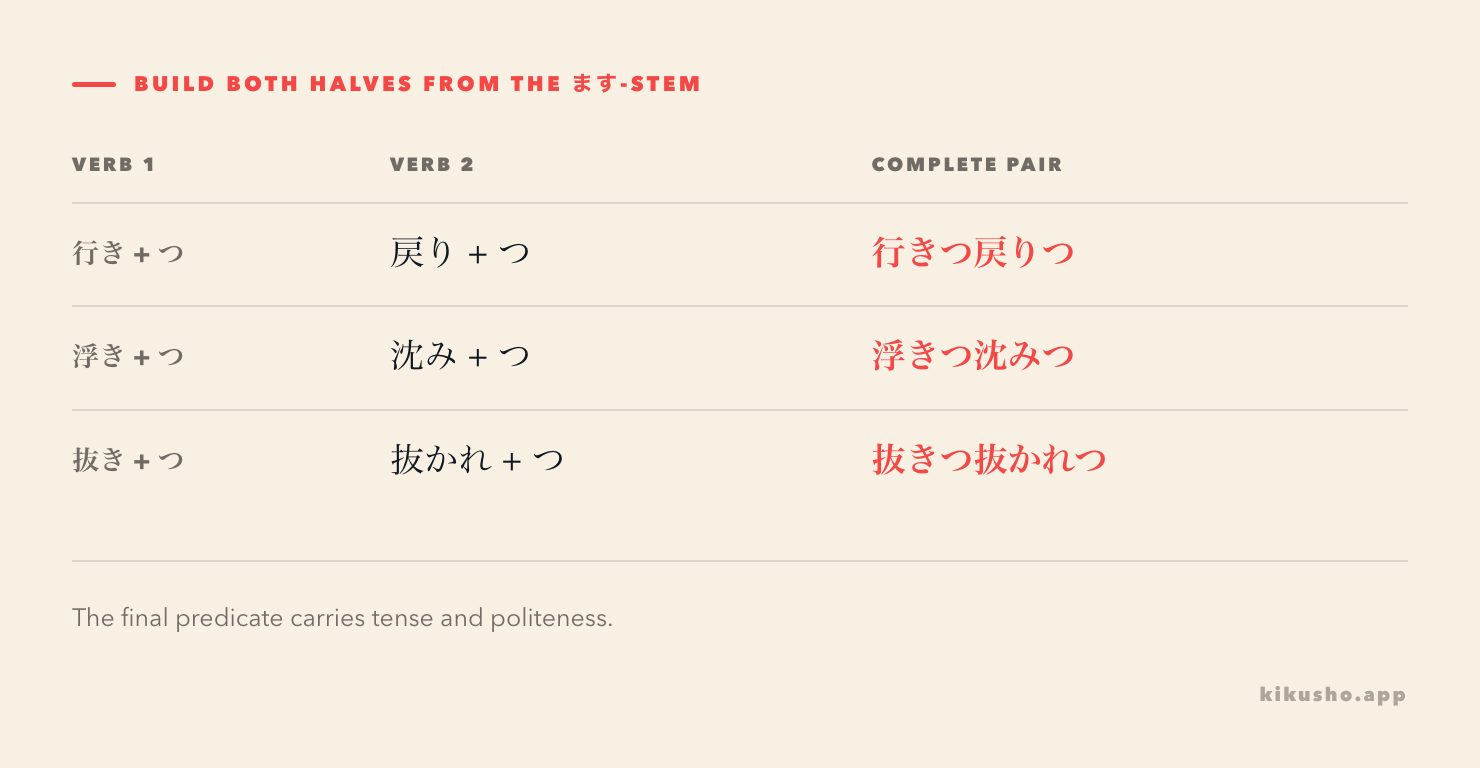
Remove ます from each verb's polite form, then add つ to both stems.
| Dictionary form | ます-form | Stem + つ |
|---|---|---|
| 行く(いく), go | 行きます | 行きつ |
| 戻る(もどる), return | 戻ります | 戻りつ |
| 浮く(うく), float | 浮きます | 浮きつ |
| 沈む(しずむ), sink | 沈みます | 沈みつ |
| 抜く(ぬく), overtake | 抜きます | 抜きつ |
| 抜かれる(ぬかれる), be overtaken | 抜かれます | 抜かれつ |
The complete pair normally acts adverbially and is followed by the predicate that carries tense and politeness:
小舟は波の間を浮きつ沈みつ進んでいった。
こぶねは なみの あいだを うきつ しずみつ すすんでいった。
The small boat moved on, rising and sinking among the waves.
二人は抜きつ抜かれつの接戦を続けた。
ふたりは ぬきつ ぬかれつの せっせんを つづけた。
The two continued a close race, repeatedly overtaking each other.
In the first sentence, 進んでいった places the whole scene in the past. In the second, 抜きつ抜かれつの modifies 接戦 as one descriptive unit. Do not conjugate each つ for tense or politeness.
Three pair shapes cover the examples you are most likely to meet
The relationship between the verbs matters more than their English translations. Natural examples fall into three useful shapes.
Two movements reverse direction
行きつ戻りつ describes repeated movement forward and back. 浮きつ沈みつ presents upward and downward movement in alternation.
彼女は廊下を行きつ戻りつ、知らせを待った。
かのじょは ろうかを いきつ もどりつ、しらせを まった。
She paced up and down the corridor while waiting for news.
The comma can connect the paired description to the main action. Adding する is also possible: 店の前を行きつ戻りつした.
Active and passive forms show reciprocal competition
抜きつ抜かれつ alternates “overtaking” and “being overtaken.” 追いつ追われつ alternates “chasing” and “being chased.” The active-passive opposition lets one compact pair change viewpoint as control passes between participants.
首位の二人は、抜きつ抜かれつゴールへ向かった。
しゅいの ふたりは、ぬきつ ぬかれつ ゴールへ むかった。
The two leaders headed for the finish, trading the lead repeatedly.
Do not infer that any active verb and its passive automatically form an accepted expression. 抜きつ抜かれつ and 追いつ追われつ are conventional; productivity remains limited.
The same root can express mutual exchange
持ちつ持たれつ literally pairs holding with being held, but its established meaning is mutual support or interdependence.
地域の店とは持ちつ持たれつの関係だ。
ちいきの みせとは もちつ もたれつの かんけいだ。
We have a mutually supportive relationship with the local shops.
This is not a visible sequence of first supporting and then receiving support. The pair presents the relationship as reciprocal over time. Learn it as a whole expression rather than calculating its meaning from each half during reading.
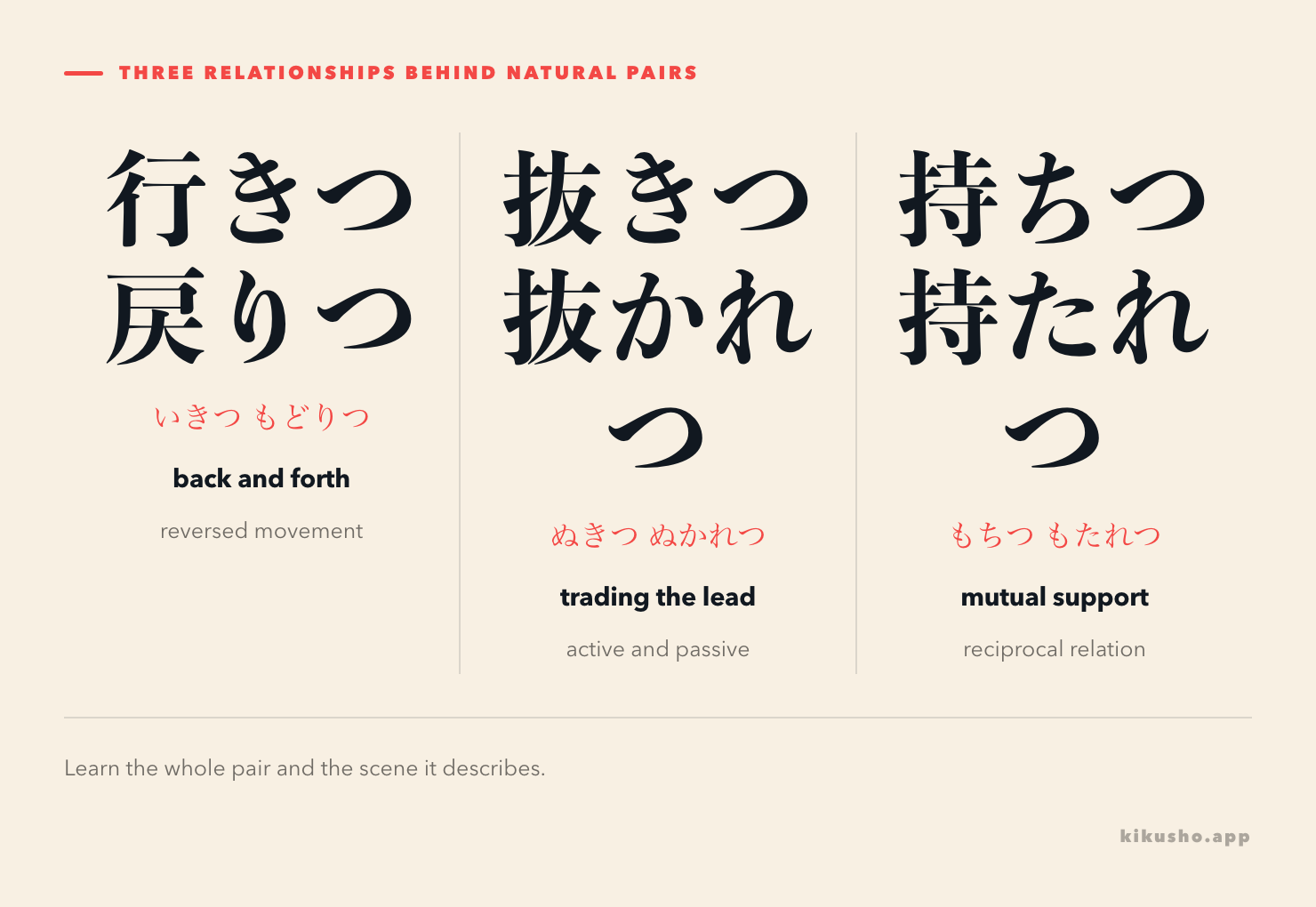
The construction is vivid but only weakly productive
The pattern has a literary, descriptive or idiomatic flavor. It can compress an unstable scene into four rhythmic beats: stem, つ, stem, つ. In a novel, report or sports description, that rhythm can be useful. In ordinary conversation, speakers are more likely to choose a familiar alternative unless the pair itself is well established.
That restriction rules out combinations whose actions merely happen near each other:
✕ 朝はコーヒーを飲みつ新聞を読みつした。
Intended: In the morning I drank coffee and read the newspaper.
Drinking and reading are neither opposing nor a conventional reciprocal pair. For a representative list, say コーヒーを飲んだり、新聞を読んだりした. For simultaneous action, コーヒーを飲みながら新聞を読んだ is natural.
Even semantic opposition does not guarantee that a newly coined pair will sound established. When you meet つ~つ in reading, save the whole pair. A captured line in Kikusho is more useful here as 抜きつ抜かれつ with its sentence than as two isolated instances of つ; the reusable unit is the relationship between the verbs.
つつ is one suffix, while つ~つ is a paired frame
The spelling makes these constructions easy to confuse:
| Form | Attachment | Main job | Example |
|---|---|---|---|
| V-stem + つ + V-stem + つ | two opposing or reciprocal verbs | alternating scene | 行きつ戻りつ歩く |
| V-stem + つつ | one verb, then another predicate | simultaneous action | 音楽を聞きつつ歩く |
| V-stem + つつある | one changing verb | change in progress | 状況が変わりつつある |
| V-stem + つつも | one conceded action or state | “although / while knowing” | 危険と知りつつも進む |
音楽を聞きつつ歩いた。
おんがくを ききつつ あるいた。
I walked while listening to music.
Here 聞きつつ has one suffix, and 歩いた is the main predicate. There is no opposing pair. The つつ and つつある lesson covers simultaneous action, concession and change in progress in full.
The curriculum record contains N2 observations for つつ and つつも because their surface spelling overlaps with this item. The exact paired construction つ~つ is listed at N1 by the sources checked here, including JLPT Sensei, 日本語NET and PassJapanese. Treat those labels as study guidance: the exam authority describes the abilities tested at each level without releasing a form-by-form grammar syllabus.
たり~たり is the flexible choice for representative actions
たり~たり accepts actions that are not opposites and presents them as examples from a larger set:
休日は本を読んだり、料理をしたりする。
きゅうじつは ほんを よんだり、りょうりを したりする。
On days off, I do things like read and cook.
The pair 読書する/料理する has no reciprocal relationship. That is fine with たり~たり. By contrast, つ~つ makes the opposition or reciprocity the center of the picture.
Both forms can describe alternating motion:
猫は部屋に入ったり出たりしている。
ねこは へやに はいったり でたり している。
The cat keeps going in and out of the room.
猫は入口を行きつ戻りつしている。
ねこは いりぐちを いきつ もどりつ している。
The cat is pacing back and forth by the entrance.
The first is neutral and productive. The second uses a conventional rhythmic pair and paints the pacing as one compact scene. The full たり~たり lesson explains its た-form attachment and wider range.
The wrong form reveals the wrong mental model
Three errors identify three different misunderstandings:
- 行くつ戻るつ keeps the dictionary forms. The pattern needs 行きつ戻りつ.
- 行きつ読みつ obeys the attachment rule but ignores the semantic and conventional pairing constraint.
- 行きつ戻りつしましたつ adds つ to the final predicate. The correct sentence is 行きつ戻りつしました; the last predicate carries tense and politeness normally.
A reliable reading test is to ask whether the first verb naturally hands the scene to the second and then back again. If the sentence merely lists activities, use たり~たり. If one action accompanies another, consider ながら or つつ. If an established pair presents a back-and-forth, reciprocal contest or mutual relationship, つ~つ fits.
Practice: identify the pair before choosing the form
Complete all seven prompts before opening the answer panel.
Question 1 — attachment. Complete: 駅の前を行き__戻り__して、友達を待った。
① たり / たり
② つ / つ
③ つつ / つつ
④ て / て
Question 2 — reciprocal competition. Which sentence best describes two runners repeatedly overtaking each other?
① 二人は抜きつ抜かれつ走った。
② 二人は抜くつ抜かれるつ走った。
③ 二人は抜きつつ抜かれつつ走った。
④ 二人は抜いて抜かれてから走った。
Question 3 — representative activities. Choose the natural form: 休日は映画を見__、パンを焼い__する。
① つ / つ
② たり / たり
③ つつ / つつ
④ ながら / ながら
Question 4 — one suffix or a pair. Explain why 音楽を聞きつつ歩く is not an example of つ~つ.
Question 5 — pair meaning. In 地域の会社とは持ちつ持たれつだ, does the phrase describe a literal repeated holding action? State the relationship it expresses.
Question 6 — correction. Correct both problems in 彼は廊下を行くつ読むつしましたつ so that it means “He paced back and forth along the corridor.”
Question 7 — sentence creation. Write one sentence with 浮きつ沈みつ or 行きつ戻りつ. Keep the pair unchanged and put tense on the final predicate.
Answers and explanations
Pair 1
Use ② つ / つ: 駅の前を行きつ戻りつして、友達を待った. Both verbs use their ます-stems, 行き and 戻り, followed by つ. The pair depicts repeated movement in opposite directions.
Pair 2
Use ① 二人は抜きつ抜かれつ走った. 抜き is the stem of the active verb, and 抜かれ is the stem of its passive partner. Together they show the lead changing repeatedly. Option ② keeps dictionary forms, while ③ changes the target pattern to repeated つつ suffixes.
Pair 3
Use ② たり / たり: 休日は映画を見たり、パンを焼いたりする. Watching a film and baking bread are representative activities, not opposing or reciprocal actions. Their たり forms come from 見た and 焼いた.
Pair 4
聞きつつ contains one suffix after one verb stem and means that listening accompanies the main action 歩く. The target つ~つ has two matched verbs, each followed by つ, and presents their opposition or reciprocity as one scene.
Pair 5
It expresses mutual support or interdependence: the local companies and the speaker's side help each other. 持ちつ持たれつ is a conventional whole expression here, not a literal account of alternating physical holds.
Pair 6
A natural correction is 彼は廊下を行きつ戻りつした. Change the dictionary forms to the stems 行き and 戻り, choose the established opposing pair, and remove the extra つ after the final predicate.
Pair 7
One model answer is 小舟は波に揺られながら、浮きつ沈みつ岸へ進んだ: “Rocked by the waves, the small boat moved toward shore, rising and sinking.” The paired form stays fixed, while 進んだ places the complete scene in the past.
Fixed pairs become useful when the surrounding scene is remembered
The pattern's small inventory is an advantage for recognition. Each established pair carries a scene with it: 行きつ戻りつ suggests restless movement, 抜きつ抜かれつ a contest whose lead changes, and 持ちつ持たれつ a relationship sustained by exchange. Learn that scene along with the form, and the four-beat rhythm will signal the relationship before you translate either verb.
This lesson was reviewed for verb-stem attachment, final-predicate tense, movement pairs, active-passive reciprocity, idiomatic mutual support, register and the boundaries with つつ, つつある, つつも and たり~たり. AI-assisted language and exercise review was used; no human Japanese review is claimed.
Common questions
What does つ~つ mean in Japanese grammar?
It joins two contrasting, opposite or reciprocal actions and presents them as alternating within one scene, as in 行きつ戻りつ, “going back and forth.”
How does つ~つ attach to verbs?
Put each verb in its ます-stem, remove ます, and add つ: 行きつ戻りつ. Passive partners are possible in established reciprocal pairs, such as 抜きつ抜かれつ.
Can つ~つ be used with any two verbs?
No. Modern Japanese favors a limited set of conventional pairs whose meanings oppose or answer each other. A freely invented pair will often sound unnatural.
What is the difference between つ~つ, つつ and たり~たり?
つ~つ depicts a compact back-and-forth scene with a conventional pair. つつ links simultaneous actions or marks a developing change, while たり~たり lists representative actions or states more freely.