On this page
Nとしたことが means “for N, of all people, to do that.” It expresses surprise, disappointment or self-reproach when a particular person, group or responsible organization behaves below the standard the speaker normally expects from them.
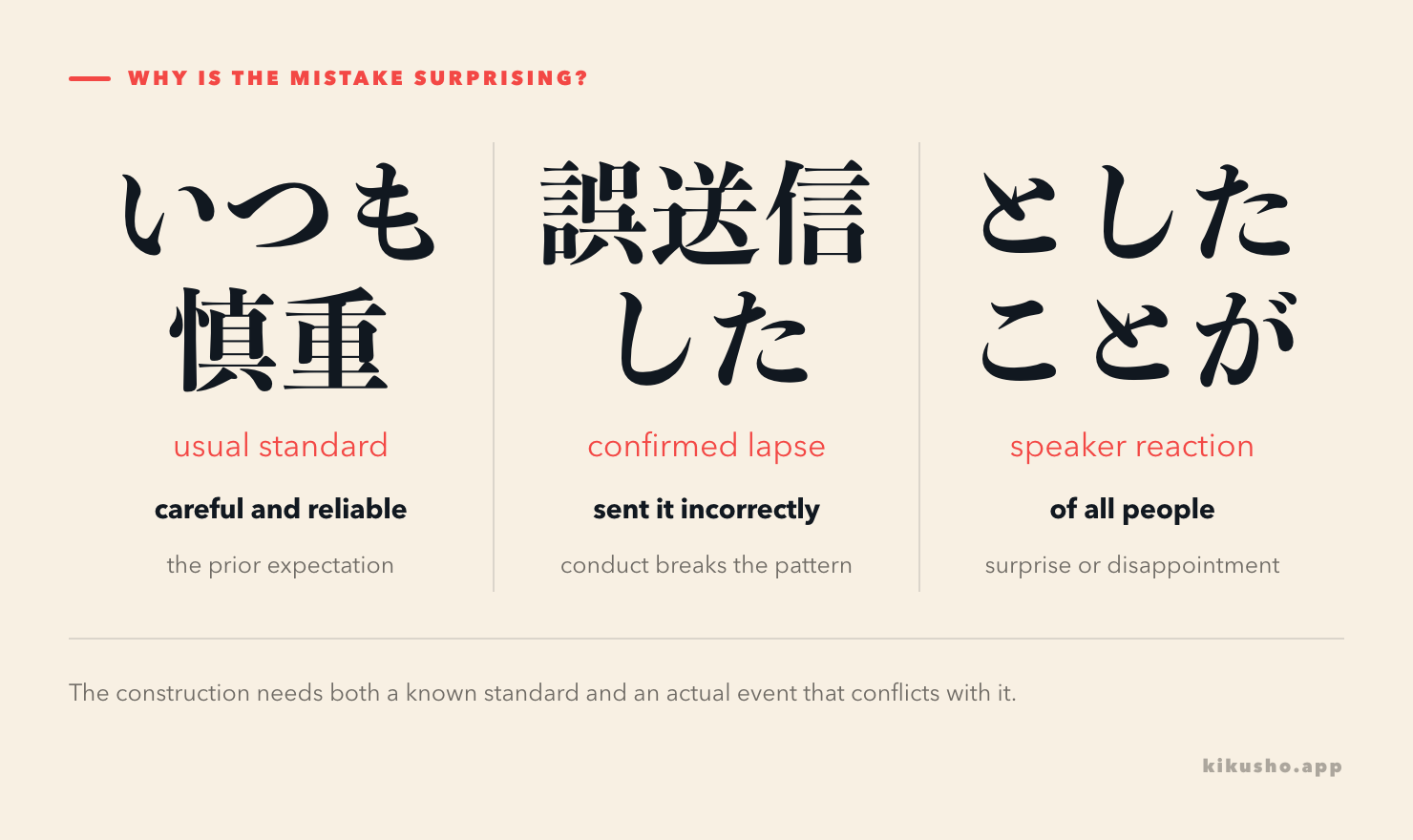
いつも慎重な田中さんとしたことが、添付ファイルを間違えるなんて。
いつも しんちょうな たなかさんと したことが、てんぷファイルを まちがえるなんて。
For the usually careful Ms Tanaka, of all people, to attach the wrong file.
The sentence works because three pieces line up: Tanaka is known for being careful, the mistake has happened, and the speaker reacts to the gap between her usual reliability and this lapse. Without that expectation gap, としたことが sounds theatrical or unfair.
This lesson verifies inventory item g-a4868f1aba89. JLPT Sensei and 毎日のんびり日本語教師 place the construction at N1 and describe surprise at bad behavior or a mistake that is uncharacteristic of the named person. Hane independently emphasizes the person's reputation and the speaker's disappointed or incredulous reaction.
The noun carries a prior positive expectation
The core shape is simple:
person, role or responsible entity + としたことが + unexpected lapse
The noun may be a named or described individual:
ベテランの佐藤さんとしたことが、会議の場所を確認し忘れるとは珍しい。
ベテランの さとうさんと したことが、かいぎの ばしょを かくにんしわすれるとは めずらしい。
It is unusual for an experienced person like Mr Sato to forget to check the meeting location.
It may be a role whose competence the context makes relevant:
会計の専門家としたことが、合計を一桁間違えるなんて信じられない。
かいけいの せんもんかと したことが、ごうけいを ひとけた まちがえるなんて しんじられない。
I cannot believe that an accounting expert, of all people, got the total wrong by one digit.
It may also be an organization treated as a responsible actor:
長年の実績がある出版社としたことが、著者名を誤記するとは。
ながねんの じっせきが ある しゅっぱんしゃと したことが、ちょしゃめいを ごきするとは。
For a publisher with such a long record to print the author's name incorrectly.
The grammar does not simply mean “N made a mistake.” It presupposes that this mistake is unexpected for this N. A novice making an ordinary novice error may not support the construction unless the sentence has established a special reason to expect better.
とは and なんて expose the speaker's reaction
The unexpected action frequently ends in とは or なんて. An explicit reaction may follow, or the sentence may trail off because the surprise is obvious.
あの冷静な彼としたことが、人前で声を荒らげるとは驚いた。
あの れいせいな かれと したことが、ひとまえで こえを あらげるとは おどろいた。
I was surprised that he, normally so calm, raised his voice in public.
彼女としたことが、締め切りの日を忘れるなんて。
かのじょと したことが、しめきりの ひを わすれるなんて。
For her, of all people, to forget the deadline.
The second sentence is grammatically complete as an expressive fragment. The omitted reaction might be 信じられない, 珍しい, どうしたのだろう or simple dismay. This is common in speech and in written dialogue.
An ordinary finite statement can follow the pattern, but とは/なんて makes the emotional evaluation easier to hear. Compare the neutral 彼女が締め切りを忘れた with 彼女としたことが、締め切りを忘れるなんて. The first reports the event; the second evaluates it against the person's character.
The lapse is treated as real, not merely possible
The construction normally reacts to something that has happened or is being presented as an established fact.
いつも準備の早い部長としたことが、資料をまだ送っていないとは。
いつも じゅんびの はやい ぶちょうと したことが、しりょうを まだ おくっていないとは。
For the manager, who always prepares early, not to have sent the materials yet.
The negative event まだ送っていない is a current realized state: the materials remain unsent. The grammar does not require a past-tense verb, but it does require the speaker to treat the expectation breach as real.
That is why this version clashes:
× 部長としたことが、資料を忘れるかもしれない。
The manager, of all people, might forget the materials.
The speaker cannot fully perform a reaction to a known lapse while leaving the lapse merely speculative. For a future warning, use an ordinary possibility or concern: 部長でも資料を忘れるかもしれないから、確認しよう, “Even the manager might forget the materials, so let's check.”
私としたことが turns the criticism inward
私としたことが is a common fixed use. The speaker presents the mistake as beneath their own normal standard.
私としたことが、予約の日付を一週間も間違えていた。
わたしと したことが、よやくの ひづけを いっしゅうかんも まちがえていた。
I cannot believe I had the reservation date wrong by an entire week.
私としたことが、確認もせずに返事を送るなんて。
わたしと したことが、かくにんも せずに へんじを おくるなんて。
For me, of all people, to send a reply without even checking it.
The usual tone is self-reproach, embarrassment or rueful humor. It can also sound self-important because the speaker implicitly claims that such mistakes are normally beneath them. Tone and relationship decide whether it comes across as charming, ironic or arrogant.
Use a plainer apology when the listener needs accountability more than performance: 確認不足でした。申し訳ありません, “I failed to check. I am sorry.” 私としたことが voices the speaker's surprise; it does not itself repair the harm.
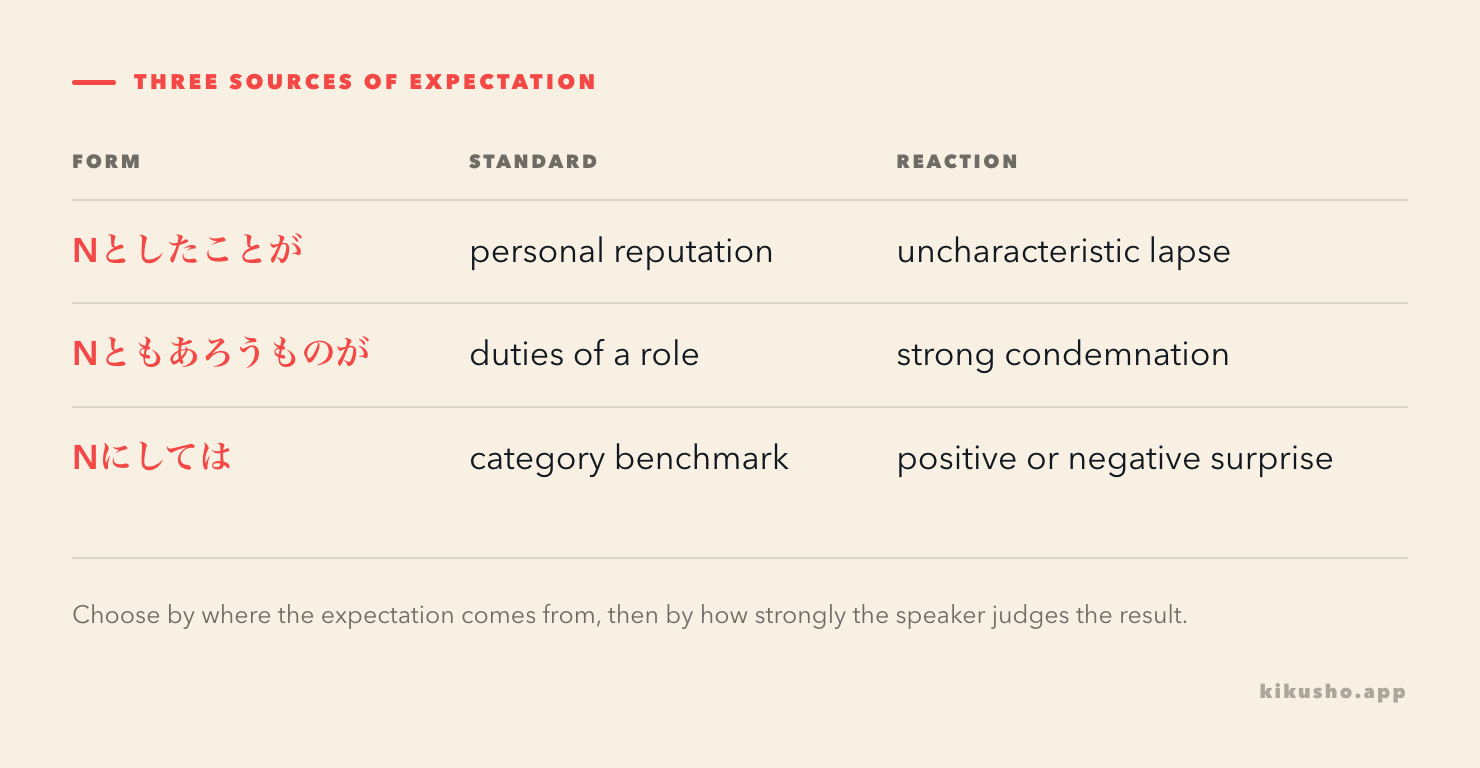
としたことが and ともあろうものが differ in force
Both constructions invoke expectations, but they aim the criticism differently.
| Form | Source of the standard | Typical problem | Main reaction |
|---|---|---|---|
| Nとしたことが | this person's usual character or reputation | an uncharacteristic lapse | surprise, disappointment, self-reproach |
| Nともあろうものが | duties attached to a respected role or status | conduct unworthy of the role | stronger blame or condemnation |
| Nにしては | a category or condition used as a benchmark | any surprising result, positive or negative | comparison rather than personal disbelief |
慎重な彼としたことが、鍵をかけ忘れるとは珍しい。
It is unusual for him, normally so careful, to forget to lock the door.
警備責任者ともあろうものが、避難口を施錠するとは許されない。
It is unacceptable for a security manager to lock an emergency exit.
The first is a surprising slip by a known careful person. The second violates a professional duty and invites moral criticism. The ではあるまいし and ともあろうものが lesson develops that stronger role-based construction.
にしては can describe a positive surprise
にしては compares a result with what a category or condition would normally suggest:
初めて作ったにしては、きれいにできた。
はじめて つくったにしては、きれいに できた。
The result is remarkably polished for a first attempt.
This is a positive mismatch and does not criticize anyone. としたことが would be unsuitable because there is no lapse to react to.
Even with a negative result, にしては is more descriptive:
プロにしては、基本的なミスが多い。
There are many basic mistakes for a professional.
This compares the person's performance with the professional benchmark. あの人としたことが、基本的なミスをするなんて instead reacts personally to this person's out-of-character mistake. The に反して and にしては comparison explains the benchmark structure in full.
Do not direct it casually at other people
The grammar reveals the speaker's view of someone's normal standard. Said about a close colleague after a harmless oversight, it can express warm surprise. Said directly to a subordinate, stranger or superior, it may sound condescending, sarcastic or accusatory.
先生としたことが、こんな漢字も読めないんですか。
For a teacher, of all people, can you not even read this kanji?
The Japanese is structurally possible, but the social act is harsh. In a neutral workplace correction, describe the issue without judging the person's identity: この漢字の読みをもう一度確認してください.
The pattern also resists inanimate subjects with no reputation or agency. 天気としたことが雨になるなんて is not a natural way to express surprise at rain. A company, school or government body can work when it is treated as a responsible institution; random objects and weather cannot.
Practice: locate the violated expectation
Work through every prompt before revealing the explanation panel.
Question 1 — core meaning. Complete the reaction: いつも時間に正確な山田さん__、一時間も遅刻するなんて。
① にしては
② としたことが
③ であるまいし
④ に反して
Question 2 — natural context. Which situation best supports 部長としたことが?
① The manager completes the report on time as usual.
② The manager may possibly forget a report next month.
③ The normally meticulous manager has sent the confidential report to the wrong address.
④ A cheap printer produces an unexpectedly clear page.
Question 3 — expressive ending. Complete: あの冷静な彼としたことが、あんなに慌てる__。
① とは
② ために
③ ほどなら
④ ばかりで
Question 4 — self-reference. What attitude can 私としたことが、鍵を忘れるなんて express, and why might it sometimes sound arrogant?
Question 5 — realized event. Explain why 彼としたことが、明日遅刻するかもしれない is a poor fit for the construction.
Question 6 — boundary. Choose between としたことが, ともあろうものが and にしては for each purpose: an admired colleague's rare oversight; condemnation of a judge violating the law; praise for a beginner's strong performance.
Question 7 — response writing. Create one sentence reacting to a usually careful person's confirmed mistake with としたことが. Add とは or なんて and an appropriate reaction.
Answers and explanations
Expectation 1
Use ② としたことが. Yamada's established punctuality creates the positive expectation, while the one-hour delay is an already-realized, uncharacteristic lapse.
Expectation 2
Choose ③. The manager is normally meticulous, the confidential report was actually sent to the wrong address, and the error conflicts with that reputation. The other options lack either an actual lapse, a responsible person or an expectation gap.
Expectation 3
Use ① とは: あの冷静な彼としたことが、あんなに慌てるとは. The particle frames the agitated behavior as the surprising fact. An explicit reaction such as 驚いた may follow, or the sentence may trail off expressively.
Expectation 4
It commonly expresses embarrassment, rueful humor or self-reproach: the speaker cannot believe they fell below their own normal standard. It may sound arrogant because the phrasing also implies “someone as competent or careful as me does not usually make such mistakes.”
Expectation 5
かもしれない leaves tomorrow's lateness speculative, while としたことが normally reacts to a breach treated as real. A neutral warning such as 彼でも遅刻するかもしれない fits a future possibility better.
Expectation 6
Use としたことが for the admired colleague's rare oversight, ともあろうものが for strong condemnation of a judge violating duties attached to the role, and にしては for the beginner's unexpectedly strong performance. The three choices locate the standard in personal reputation, role-based duty and a neutral category benchmark respectively.
Expectation 7
One model is いつも慎重な木村さんとしたことが、確認前の資料を顧客に送るとは驚いた. Kimura's usual care establishes the expectation, the sending is presented as fact, and とは驚いた voices the speaker's reaction.
Let the person's normal standard do the work
Before choosing としたことが, identify the person or responsible entity, the positive expectation already attached to them, and the confirmed conduct that breaks it. Then decide whether your relationship permits the expressive judgment. When the surprise is only a neutral benchmark mismatch, choose にしては; when a public role has been seriously betrayed, ともあろうものが may carry the stronger criticism.
This lesson received an AI-only check of its assigned inventory record, N1 placement, noun attachment, actuality constraint, social tone, Japanese sentences and exercise reasoning using the references above. It has not received human Japanese editorial review.
Common questions
What does としたことが mean in Japanese?
Nとしたことが expresses surprise, disappointment or self-reproach because a respected or normally reliable person has done something out of character, especially a careless mistake.
What comes before としたことが?
A noun referring to a particular person, role, group or responsible organization comes directly before it: 彼としたことが, 先生としたことが, or あの会社としたことが.
Can としたことが describe a future possibility?
It ordinarily reacts to conduct presented as already realized. It sounds unnatural when paired with a merely speculative かもしれない event because the speaker is reacting to a known breach of expectation.
What is the difference between としたことが and にしては?
としたことが is an expressive reaction to an uncharacteristic lapse by a particular person or responsible entity. にしては more neutrally compares a result with a category or condition and can mark a positive surprise.