On this page
Use ~尽くす when one action reaches its limit: everything is used, said, searched or otherwise dealt with. Use NにNを重ねて when the same effort, examination, failure or experience is repeated and accumulated over time.
調査員は町中を探し尽くした。
ちょうさいんは まちじゅうを さがしつくした。
The investigators searched every part of the town.
調査に調査を重ねて、原因を特定した。
ちょうさに ちょうさを かさねて、げんいんを とくていした。
After investigation upon investigation, they identified the cause.
The first sentence views searching as complete. The second makes the repeated rounds of investigation visible. English may translate both with “thoroughly,” so the Japanese image is the safer test.
This lesson verifies g-89ca8c175848, 尽くす(つくす), and g-b3fd7b6e50be, に~を重ねて(に~をかさねて). 日本語NET and 毎日のんびり日本語教師 support verb-stem attachment and the total-completion meaning of ~尽くす. For the repeated-noun frame, 日本語NET and 毎日のんびり日本語教師 independently describe the same noun placed before に and を重ねて, with repetition leading to a result.
Ask whether the sentence reaches a limit or builds layers
The quickest decision comes from the shape of the process.
| Question | ~尽くす | NにNを重ねて |
|---|---|---|
| What is highlighted? | the action reaches totality | instances accumulate |
| What attaches? | verb ます-stem + 尽くす | same action noun + に + same noun + を重ねて |
| Does repetition matter? | not necessarily | yes |
| Does a final limit matter? | yes | not necessarily |
| Typical image | nothing is left undone or unused | one layer added to another |
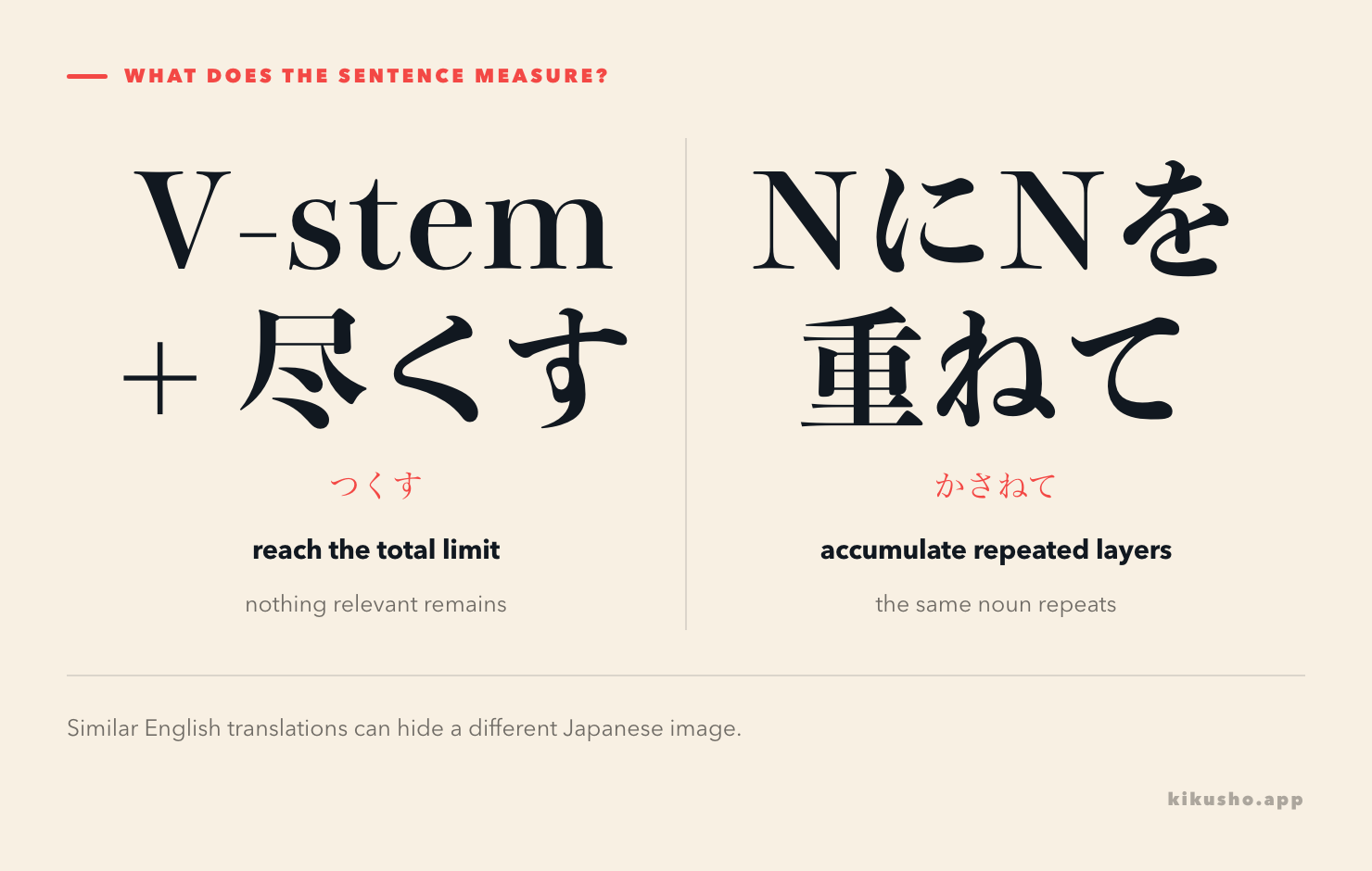
The result may follow either construction, but it does not define either one. 食べ尽くした is complete even without a later achievement. 議論に議論を重ねた emphasizes repetition even if the final decision is still pending.
~尽くす attaches to the verb stem
Remove ます and add 尽くす:
| Dictionary form | ます-form | With 尽くす | Meaning |
|---|---|---|---|
| 食べる | 食べます | 食べ尽くす | eat everything |
| 使う | 使います | 使い尽くす | use up completely |
| 探す | 探します | 探し尽くす | search everywhere / exhaust the search |
| 知る | 知ります | 知り尽くす | know thoroughly |
| 言う | 言います | 言い尽くす | say fully / exhaust in words |
The compound behaves as a verb. Conjugate 尽くす, not the first stem:
一週間で保存食を使い尽くしてしまった。
いっしゅうかんで ほぞんしょくを つかいつくして しまった。
We ended up using all the preserved food in one week.
彼女はこの地域の歴史を知り尽くしている。
かのじょは この ちいきの れきしを しりつくしている。
She knows the history of this region inside out.
この景色の美しさは言葉では言い尽くせない。
この けしきの うつくしさは ことばでは いいつくせない。
Words cannot fully express the beauty of this view.
言い尽くせない uses the potential negative of the complete compound: even using every possible word would not exhaust the description.
Totality can apply to a resource, an area or a subject
The object determines what “all” means.
With a consumable object, ~尽くす means depletion:
貯金を使い尽くした。
ちょきんを つかいつくした。
I used up all my savings.
With a bounded area, it means exhaustive coverage:
周辺の道を歩き尽くした。
しゅうへんの みちを あるきつくした。
I walked every road in the surrounding area.
With knowledge or expression, it means mastery or full expression:
専門家でも、その現象を知り尽くしているとは言えない。
せんもんかでも、その げんしょうを しりつくしているとは いえない。
Even an expert cannot be said to know that phenomenon completely.
Passive forms are also possible when the affected object fills the scene:
会場は観客で埋め尽くされた。
かいじょうは かんきゃくで うめつくされた。
The venue was completely filled with spectators.
The form is strong. 本を読んだ only reports reading; 本を読み尽くした says the relevant supply or body of books was exhausted.
NにNを重ねて repeats one action noun
The emphatic frame is:
N + に + the same N + を重ねて
検討に検討を重ねて、計画を修正した。
けんとうに けんとうを かさねて、けいかくを しゅうせいした。
After repeated deliberation, we revised the plan.
改良に改良を重ねて、ようやく製品が完成した。
かいりょうに かいりょうを かさねて、ようやく せいひんが かんせいした。
Improvement after improvement finally produced the finished product.
失敗に失敗を重ねて、安定した方法を見つけた。
しっぱいに しっぱいを かさねて、あんていした ほうほうを みつけた。
Through repeated failures, we found a reliable method.
The repeated noun is often a verbal noun: 検討, 改良, 努力, 研究, 失敗, 我慢. The frame treats each occurrence as another layer added to the preceding ones. It can introduce a successful result, a costly outcome or a process still underway.
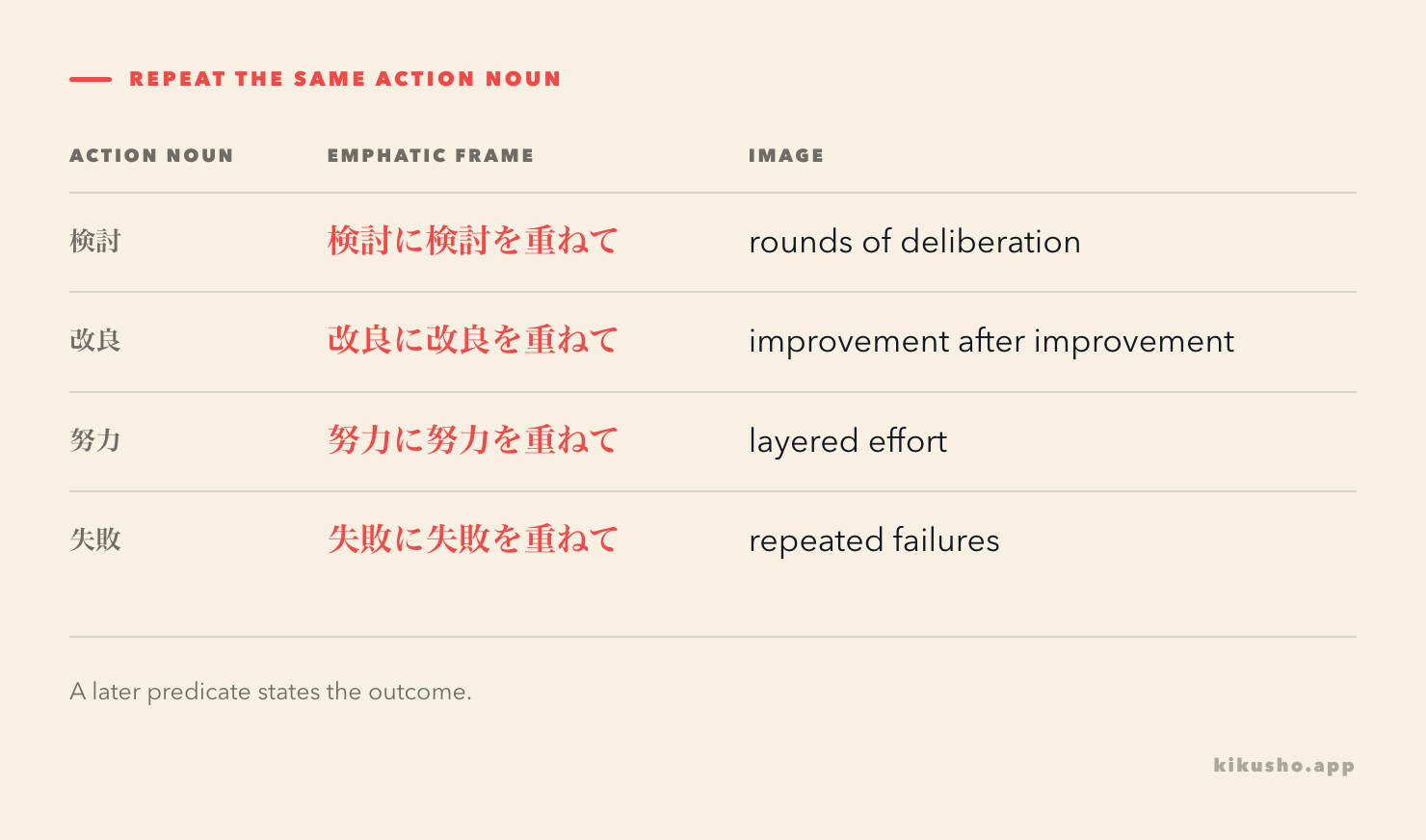
The doubled noun is emphatic, while Nを重ねる is broader
Japanese also uses the ordinary frame Nを重ねる:
チームは何度も議論を重ねた。
チームは なんども ぎろんを かさねた。
The team held repeated discussions.
経験を重ねるうちに、判断が速くなった。
けいけんを かさねる うちに、はんだんが はやくなった。
As I accumulated experience, my decisions became faster.
The target 議論に議論を重ねて intensifies the layering by repeating the noun. It is well suited to formal accounts of a demanding process. 議論を重ねて is less emphatic and easier to place in neutral prose.
Do not fill the two noun slots with unrelated words:
✕ 努力に研究を重ねて
That may be interpretable as the ordinary idea of adding research to effort, but it is not the fixed emphatic pattern taught here. For NにNを重ねて, repeat the same noun: 努力に努力を重ねて or 研究に研究を重ねて.
Completion can occur once; accumulation needs multiple instances
Consider two product-development reports:
技術者たちは材料を使い尽くした。
ぎじゅつしゃたちは ざいりょうを つかいつくした。
The engineers used up all the materials.
技術者たちは改良に改良を重ねた。
ぎじゅつしゃたちは かいりょうに かいりょうを かさねた。
The engineers made improvement after improvement.
The first could describe one continuous attempt that consumes the full supply. The second requires repeated improvements. Conversely, repeating an action does not guarantee completion: a team may conduct 検討に検討を重ねて and still postpone its decision.
This also separates ~尽くす from ~切る. Both can indicate completion, but ~尽くす strongly evokes total scope or nothing remaining, while ~切る often focuses on carrying an action through. The present lesson keeps that neighboring contrast narrow so that the two assigned patterns remain distinct.
A result phrase does not decide the construction
Words such as ようやく, 結果 and 末 often follow accumulated effort, but choose the grammar from the process before them:
試行に試行を重ねた末、問題を解決した。
しこうに しこうを かさねた すえ、もんだいを かいけつした。
After attempt upon attempt, we solved the problem.
The あげく and 末に lesson explains how the final outcome is framed. NにNを重ねて supplies the repeated process; 末に marks the endpoint after it. Similarly, に至る can report the stage or conclusion eventually reached after repeated deliberation.
Practice: total limit or accumulated layers
Keep the explanation panel closed until you have worked through the seven prompts.
Question 1 — total depletion. Fill the gap: 非常食を全部使い__しまった。
① 重ねて
② 尽くして
③ に努力を
④ つつ
Question 2 — repeated deliberation. Complete: 検討__検討__重ねて、方針を決めた。
① を / に
② に / を
③ に / に
④ を / を
Question 3 — stem attachment. Which form means “searched everywhere”?
① 探す尽くした
② 探して尽くした
③ 探し尽くした
④ 探した重ねた
Question 4 — same noun. Correct 努力に研究を重ねて、目標を達成した so that it uses the emphatic target frame about repeated effort.
Question 5 — meaning test. Why can 議論に議論を重ねた be true even if no decision was reached?
Question 6 — choose by scene. Select the better form for each blank: 町中を歩き__。調査__調査__重ねた。
① 尽くした / に / を
② 重ねた / を / に
③ 尽くした / を / を
④ つつある / に / に
Question 7 — sentence creation. Write one sentence with ~尽くす that makes the total scope clear, and one with NにNを重ねて that names a result after repetition.
Answers and explanations
Limit 1
Use ② 尽くして: 非常食を全部使い尽くしてしまった. 使い is the stem of 使う, and the compound says the emergency food was completely exhausted.
Limit 2
Use ② に / を: 検討に検討を重ねて、方針を決めた. The same noun appears twice, first with に and then with を重ねて, to show repeated rounds of deliberation.
Limit 3
Use ③ 探し尽くした. Attach 尽くす to the ます-stem 探し, then conjugate the compound to past 探し尽くした.
Limit 4
Write 努力に努力を重ねて、目標を達成した. The emphatic frame repeats the same noun. 努力に研究を重ねて describes adding one different thing to another and does not instantiate this target pattern.
Limit 5
The construction asserts repeated accumulation, not successful completion. Many discussions can be layered without exhausting the subject or producing agreement. A separate predicate states the result.
Limit 6
Use ① 尽くした / に / を: 町中を歩き尽くした。調査に調査を重ねた. The first action covers the whole town; the second consists of repeated investigations.
Limit 7
Model answers: 図書館にある資料を読み尽くした, “I read all the materials in the library,” and 改良に改良を重ねて、軽い製品を完成させた, “After improvement upon improvement, we completed a lightweight product.” The first defines a total set; the second repeats one action noun and states the resulting achievement.
Negation exposes what each pattern promises
使い尽くさなかった denies total depletion: some supply may remain. 努力に努力を重ねなかった denies the repeated buildup: the speaker did not keep adding effort after effort. One negative looks for a remainder; the other looks for missing repetitions. That difference remains useful even when both positive sentences receive the loose translation “worked thoroughly.”
Review covered verb-stem attachment, compound conjugation, total resource and scope readings, passive 埋め尽くされる, the repeated-noun frame, neutral Nを重ねる, and the distinction between completion and accumulation. Codex performed the language and exercise checks; a human Japanese reviewer was not involved.
Common questions
What does ~尽くす mean in Japanese grammar?
Attached to a verb stem, ~尽くす means doing that action completely, to exhaustion or until nothing relevant remains.
What does NにNを重ねて mean?
It repeats the same action noun around に and を重ねて to emphasize many accumulated instances, as in 検討に検討を重ねて.
What is the difference between ~尽くす and NにNを重ねて?
~尽くす looks toward total completion or depletion; NにNを重ねて looks backward over repeated layers of the same effort, event or experience.
Can two different nouns be used in NにNを重ねて?
The emphatic target pattern repeats the same noun. Ordinary Nを重ねる can appear without that repetition, but it is a less emphatic related frame.