On this page
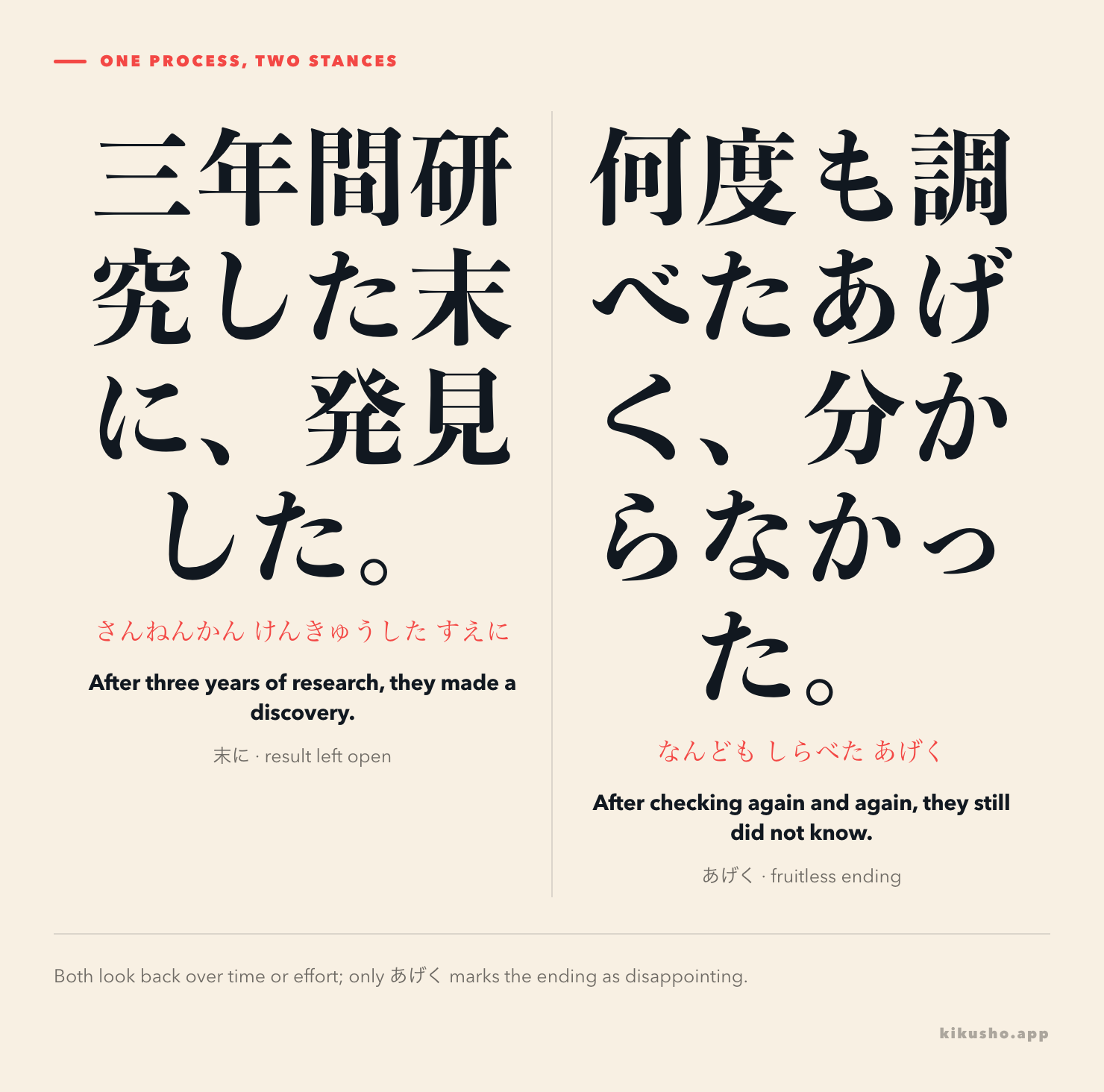
Use 末に for the result reached after a long process when you want to leave that result open to any evaluation. Use あげく when the same process ends with disappointment, trouble or the sense that all that effort led nowhere.
The result decides between them
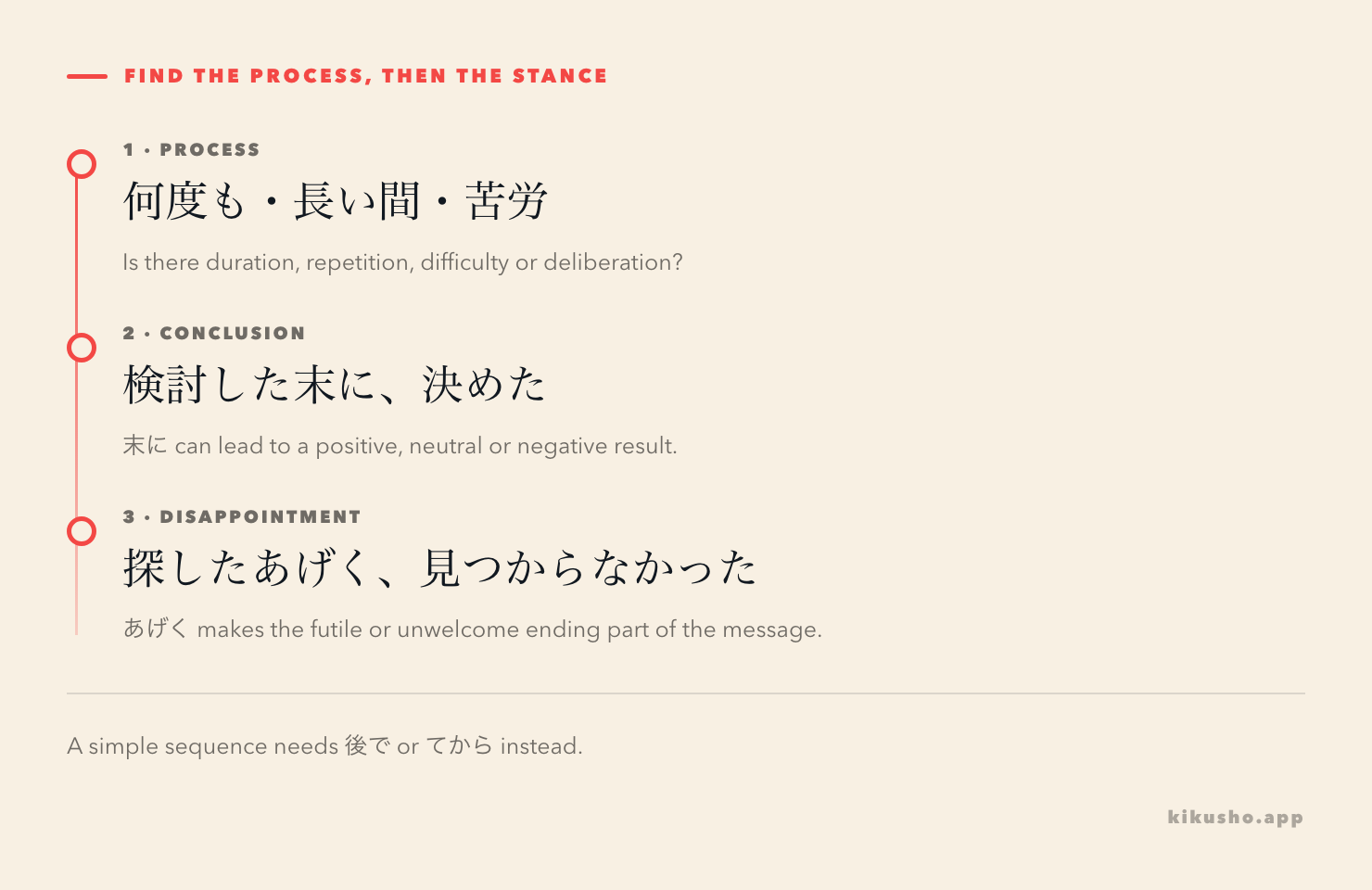
Both constructions look back over more than one quick action. The first clause contains time, repeated effort, hesitation or difficulty; the second gives the end point. The difference lies in how the speaker evaluates that end point.
| Question to ask | Choose | What it contributes |
|---|---|---|
| Was the final result welcome, neutral or simply being reported? | 末に | a conclusion after a substantial process |
| Does the speaker treat the result as bad, futile or exasperating? | あげく | a disappointing conclusion after a substantial process |
| Was there no substantial process at all? | neither | use 後で, てから or a direct result expression |
Compare the same positive result:
何度も練習した末に、代表に選ばれた。
なんども れんしゅうした すえに、だいひょうに えらばれた。
After practising many times, I was finally selected as a representative.
The long effort leads to a welcome achievement, so 末に fits cleanly. あげく would make the listener search for a problem: perhaps selection brought regret, or the speaker thinks the effort was excessive. The positive words do not become ungrammatical, but the speaker's stance changes.
An academic analysis in Mie Tsunoda's chapter on Japanese clause linkage groups あげく and 末に as result constructions after a lengthy or difficult process. It singles out あげく as marking the result unsatisfactory and the preceding effort ineffective. A Japanese teacher's side-by-side comparison reaches the same practical test: replacing あげく with 末に can remove the disappointment, while replacing 末に with あげく may add disappointment that the original never expressed.
Both attach to a completed process
The attachment is almost identical:
| Before the construction | あげく | 末に |
|---|---|---|
| Verb | Vた + あげく(に) | Vた + 末(に) |
| Noun | N + の + あげく(に) | N + の + 末(に) |
| Before another noun | あげくの + N | 末の + N |
さんざん迷ったあげく、何も買わずに帰った。
さんざん まよった あげく、なにも かわずに かえった。
After all that hesitation, I went home without buying anything.
長い話し合いの末に、計画を変更することにした。
ながい はなしあいの すえに、けいかくを へんこうする ことに した。
After a long discussion, we decided to change the plan.
The verb appears in the た-form because the process is viewed as complete before its result. Nouns take の, and the most natural nouns already contain a process: 議論 (discussion), 交渉 (negotiation), 苦労 (hardship), 検討 (consideration) and 試行錯誤 (trial and error). A bare object or place does not acquire duration just because のあげく or の末 follows it.
に is optional in these sentence-linking uses. 考えた末、決めた and 考えた末に、決めた both work; so do 迷ったあげく、諦めた and 迷ったあげくに、諦めた. Keep の when a following noun is modified: 議論の末の合意 is “the agreement reached after the discussion,” while 苦労のあげくの失敗 frames failure as the bitter end of the hardship.
あげく makes the disappointment part of the grammar
The clearest home for あげく is a long, difficult path whose result feels wasteful or worse than expected.
二時間も並んだあげく、店は目の前で閉まってしまった。
にじかんも ならんだ あげく、みせは めのまえで しまって しまった。
After waiting in line for two hours, the shop closed right in front of us.
The queue is not mere background. The length makes the closure more exasperating. も, さんざん, 何度も and 長い間 often appear with あげく because they make the cost of the process visible.
何度も説明したあげく、最初からやり直すことになった。
なんども せつめいした あげく、さいしょから やりなおす ことに なった。
After explaining it over and over, we ended up having to start again from the beginning.
The source pages place this pattern at N2. Bunpro's あげく entry verifies the た-form and noun + の attachments, including あげくの + noun, and notes that an undesirable process can also motivate the choice even when the final decision is not inherently bad. JLPT Sensei's あげく page independently records the same attachment and N2 placement. Treat N2 here as a study placement from these references, not a guaranteed description of exam content.
あげくの果てに raises the emotional pressure
The expanded form あげくの果てに intensifies the sense of an extreme, regrettable end:
借金を重ねたあげくの果てに、店まで失った。
しゃっきんを かさねた あげくの はてに、みせまで うしなった。
After sinking further and further into debt, he ended up losing even the shop.
The ordinary あげく already carries a negative evaluation. あげくの果てに makes the culmination sound especially severe. It is useful for a dramatic escalation, not a decorative longer version for every example.
末に reports the conclusion without fixing its value
末に still needs a substantial lead-up, but it does not instruct the listener to judge the outcome as disappointing.
数か月の交渉の末に、両社は合意に達した。
すうかげつの こうしょうの すえに、りょうしゃは ごういに たっした。
After months of negotiations, the two companies reached an agreement.
慎重に検討した末、今回は採用を見送ることにした。
しんちょうに けんとうした すえ、こんかいは さいようを みおくる ことに した。
After careful consideration, we decided not to proceed with the appointment this time.
The first result is positive. The second may disappoint the applicant, but the sentence itself presents a formal conclusion rather than the writer's frustration. 末に can therefore appear in reports, announcements and accounts of decisions where あげく would inject too much attitude.
JLPT Sensei's 末に entry places it at N2 and records both Vた + 末に and Nの + 末に. Its examples include successful agreements, personal decisions and an unwelcome death, which shows why “positive versus negative” is too simple. 末に permits either; it does not promise a happy ending.
A bad result can take either form
When the outcome is negative, both constructions may be possible. The choice changes the voice, not the facts.
長い議論の末に、計画は中止になった。
After a long discussion, the plan was cancelled.
長い議論のあげく、計画は中止になった。
After all that discussion, the plan ended up being cancelled.
The first sentence records the cancellation as the final conclusion of the discussion. The second invites the reaction “all that discussion, and this is where we ended up.” English often needs after all that or ended up to expose the added stance.
This distinction resembles the evaluation carried by ~ばかりに and ~あまり, but the relationship is different. Those forms connect a cause or excessive degree to a bad consequence. あげく looks across a process toward its disappointing final point; 末に looks across the same process without building disappointment into the connector.
Neither form means a simple “after”
The process requirement stops several tempting substitutions.
朝ご飯を食べた後で、家を出た。
あさごはんを たべた あとで、いえを でた。
After breakfast, I left home.
Breakfast is one completed event in a sequence. 食べた末に would suggest that eating involved prolonged difficulty or deliberation; 食べたあげく would additionally prepare an unwelcome result. Neither belongs in this ordinary schedule.
Likewise, 結果 names a result without requiring the speaker to look back over a long path. 調べた結果、原因が分かった can mean simply “As a result of checking, we found the cause.” 何日も調べた末に、原因が分かった makes the duration and eventual conclusion central. 何日も調べたあげく、原因が分からなかった adds the sting of fruitless work.
If you save one of these expressions from an article or notice, keep the lead-up and the result together. A card containing only 末に = after erases the long process; one containing only あげく = finally erases the speaker's disappointment. Kikusho can make an editable card from pasted text or a selected line, so preserve enough of the sentence for the contrast to return during review.
Practice: read the process and the stance
Question 1 — grammar choice. A welcome result follows years of effort. Complete the sentence: 三年間研究を続けた( )、新しい治療法を発見した。
- ① あげく
- ② 末に
- ③ ものだから
- ④ 最中に
Question 2 — grammar choice. The speaker stresses that repeated calls achieved nothing: 何度も電話した( )、誰も出なかった。
- ① 末にだけ
- ② あげく
- ③ 次第で
- ④ 上に
Question 3 — attachment. Which form correctly completes 長時間の話し合い( )、ようやく結論が出た?
- ① を末に
- ② があげく
- ③ の末に
- ④ にあげく
Question 4 — sentence composition. Arrange the pieces into “After much deliberation, I decided to decline the offer”: 断ることにした / 申し出を / さんざん考えた末に.
Question 5 — connected text. Choose the pair that best preserves the different stances.
住民と一年間交渉した( first )、新しい公園を造ることで合意した。しかし、工事会社を何度も探した( second )、一社も見つからなかった。
- ① first あげく / second 末に
- ② first 末に / second あげく
- ③ first 最中に / second 末に
- ④ first ものだから / second あげく
Question 6 — meaning change. In いろいろな仕事をした末に、日本語教師になった, what extra stance would 末に → あげく tend to add?
- ① The career was decided before the other jobs.
- ② Becoming a teacher was impossible.
- ③ The speaker sees the path or result as regrettable or unsatisfactory.
- ④ The speaker became a teacher by accident at that exact moment.
Question 7 — correction. Why is 昼ご飯を食べた末に、コーヒーを飲んだ unnatural for an ordinary lunch sequence, and how could you correct it?
Answers and explanations
Answer 1. ② 末に. Three years of research is a sustained process and the discovery is welcome. 末に presents the eventual result without adding disappointment. あげく would make the achievement sound problematic or not worth the effort. 最中に would place the discovery during the research, not at its culmination.
Answer 2. ② あげく. Repeated calls form the process, and 誰も出なかった is the fruitless outcome. あげく carries that exasperation. Plain 末に could report the same facts more neutrally, but 末にだけ is not the intended construction.
Answer 3. ③ の末に. A noun takes の before either construction: 話し合いの末に. The particle を, が or に cannot replace that linking の here. The result is positive or neutral, so 末に is also the natural semantic choice.
Answer 4. さんざん考えた末に、申し出を断ることにした。 The た-form 考えた closes the deliberation before its result. 末に keeps the decision neutral; 申し出を is the object of 断る.
Answer 5. ② first 末に / second あげく. Reaching an agreement about a park is a successful conclusion after a year of negotiation, so 末に fits the first blank. Repeatedly searching and finding no company is fruitless, so あげく fits the second. Reversing them would cast the agreement as regrettable while flattening the frustration of the failed search.
Answer 6. ③. あげく adds the speaker's negative evaluation. It can suggest that the many jobs were burdensome, that becoming a teacher was an unwelcome end point, or that the path felt futile. The chronology remains the same; the attitude changes.
Answer 7. An ordinary lunch followed by coffee contains no long or difficult process, so 末に overstates the lead-up. Say 昼ご飯を食べた後で、コーヒーを飲んだ or 昼ご飯を食べてから、コーヒーを飲んだ. If the meal truly involved a prolonged ordeal, the context would have to make that unusual reading explicit.
When both choices seem possible, do not ask only whether the final event is bad. First find the stretch of time or effort. Then decide whether the sentence merely reaches its conclusion or asks the listener to feel how badly that effort ended.
Common questions
What is the difference between あげく and 末に?
Both present a final outcome after a long or difficult process. あげく adds the speaker's disappointment or sense that the process was fruitless, while 末に can introduce a positive, neutral or negative result.
What form comes before あげく and 末に?
Use a verb in the た-form or a noun followed by の: 迷ったあげく, 話し合いのあげく, 考えた末に and 交渉の末に. The particle に is often omitted from both constructions.
Can あげく describe a positive result?
It can be grammatically possible when the path itself was troublesome, but あげく makes the whole outcome sound unwelcome, disappointing or not worth the effort. Use 末に for an unambiguously welcome achievement.
Are あげく and 末に ordinary ways to say after?
No. They require a process with duration, repeated effort, difficulty or deliberation. For a simple sequence such as eating and leaving, use 後で, てから or another ordinary time expression.