On this page
Use sentence-final ってば when the listener has not accepted or acted on what you already said: “I’m telling you.” Use Nってば or Nったら when you bring up a person with visible feeling, often annoyance, surprise or affectionate exasperation.
A: 本当に一人で大丈夫?
ほんとうに ひとりで だいじょうぶ?
Are you really okay on your own?
B: 大丈夫だってば。
だいじょうぶだってば。
I told you, I’m fine.
B is not simply reporting 大丈夫だ. The added ってば pushes the already available message back toward A: listen to it, accept it and stop asking.
This lesson verifies inventory item g-043ea0d7f12e, ってば/ったら. JLPT Sensei places the pair at N1 and records both the “I told you” and emotionally marked topic readings. Kotobank’s dictionary entry for てば independently distinguishes a topic use from a sentence-final appeal colored by frustration. An NINJAL reference extract likewise records topic marking with blame or challenge and a separate sentence-final use.
The conversation before ってば supplies its force
Sentence-final ってば normally reacts to conversational pressure. The listener has ignored, doubted, forgotten or failed to act on a message, so the speaker says it again with more force.
A: 早く準備して。
はやく じゅんびして。
Get ready quickly.
B: 今やってるってば。
いま やってるってば。
I’m doing it now, I told you.
もう帰るってば!
もう かえるってば!
I’m telling you, I’m going home!
触らないでってば。
さわらないでってば。
I said not to touch it.
The material before ってば can be an assertion, intention, negative instruction or other complete informal message. The particle operates on the whole utterance.
| Message being reinforced | With ってば | Conversational effect |
|---|---|---|
| 大丈夫だ | 大丈夫だってば | believe that I am fine |
| 今やってる | 今やってるってば | recognize that I am already doing it |
| 行かない | 行かないってば | accept that I will not go |
| 触らないで | 触らないでってば | heed the repeated instruction |
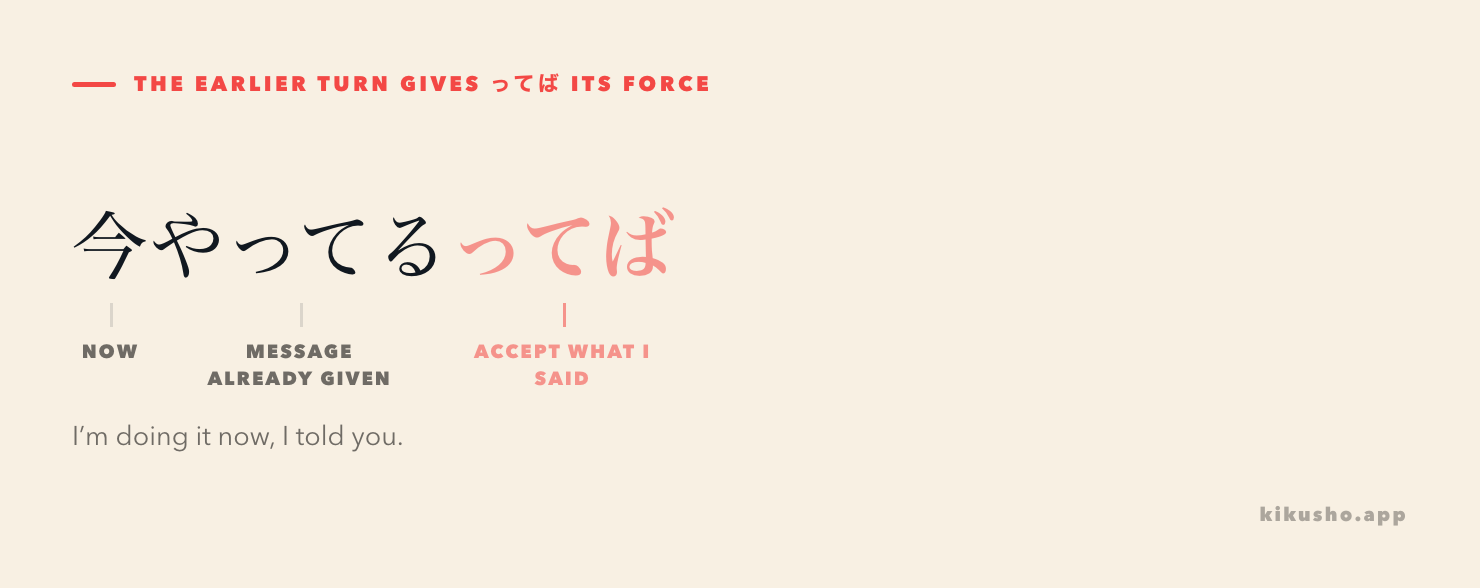
The form is often related historically and functionally to と言えば, but translating it mechanically as “if one says” misses the interaction. In this use, the missing context is not a conditional result. It is the earlier turn that made repetition necessary.
Nってば and Nったら make someone an emotional topic
Placed after a person or another noun phrase, both forms can mean “speaking of X,” with the speaker’s attitude already audible.
田中さんってば、また傘を忘れたんだよ。
たなかさんってば、また かさを わすれたんだよ。
Would you believe it, Tanaka forgot his umbrella again.
お父さんったら、私の話を最後まで聞かないんだから。
おとうさんったら、わたしの はなしを さいごまで きかないんだから。
Dad never listens to the end of what I say, honestly.
うちの猫ったら、また私の枕で寝てる。
うちの ねこったら、また わたしの まくらで ねてる。
That cat of mine is sleeping on my pillow again.
The cat sentence can be affectionate rather than angry. The construction marks emotional involvement; context and intonation choose among irritation, disbelief, teasing and fond exasperation.
This topic use differs from neutral は. 田中さんは傘を忘れた supplies information about Tanaka. 田中さんってば… presents Tanaka as the person whose behavior has prompted the speaker’s reaction.
ってば readily insists on a full message; ったら favors the emotional topic
The two forms overlap after names and noun phrases:
健太ってば、返事もしない。
けんたってば、へんじも しない。
That Kenta won’t even answer.
健太ったら、返事もしない。
けんたったら、へんじも しない。
Kenta, of all people, won’t even answer.
The exact difference here depends heavily on voice, speaker and local conversational style. A useful production rule is narrower:
- use full message + ってば to insist that the listener accept what was said;
- recognize both Nってば and Nったら as emotionally marked topic forms;
- do not force a universal “ってば is always X, ったら is always Y” distinction where native usage overlaps.
Learner resources sometimes label the pair feminine. Such descriptions may help identify a character voice in older dialogue or stylized media, but they are not grammatical attachment rules. Age, relationship, region, persona and intonation all affect the impression. The dependable register fact is that these uses are intimate, conversational and emotionally marked.
Expressive ったら is not the ordinary たら conditional
Conditional たら attaches to a past-form base and introduces a consequence, plan or discovery:
雨が降ったら、試合は中止です。
あめが ふったら、しあいは ちゅうしです。
If it rains, the match will be canceled.
家に帰ったら、連絡してください。
いえに かえったら、れんらくして ください。
Please contact me when you get home.
Each sentence has a condition and a result. The apparent ったら in 降ったら or 帰ったら comes from the verb’s past form plus ら. It does not mark annoyance.
Expressive ったら commonly follows a noun topic and leads into an evaluation:
弟ったら、宿題を忘れて遊びに行った。
おとうとったら、しゅくだいを わすれて あそびに いった。
My brother went out to play after forgetting his homework, of all things.
There is no “if my brother” clause here. 弟 is the emotional topic, and the rest explains why the speaker brought him up.
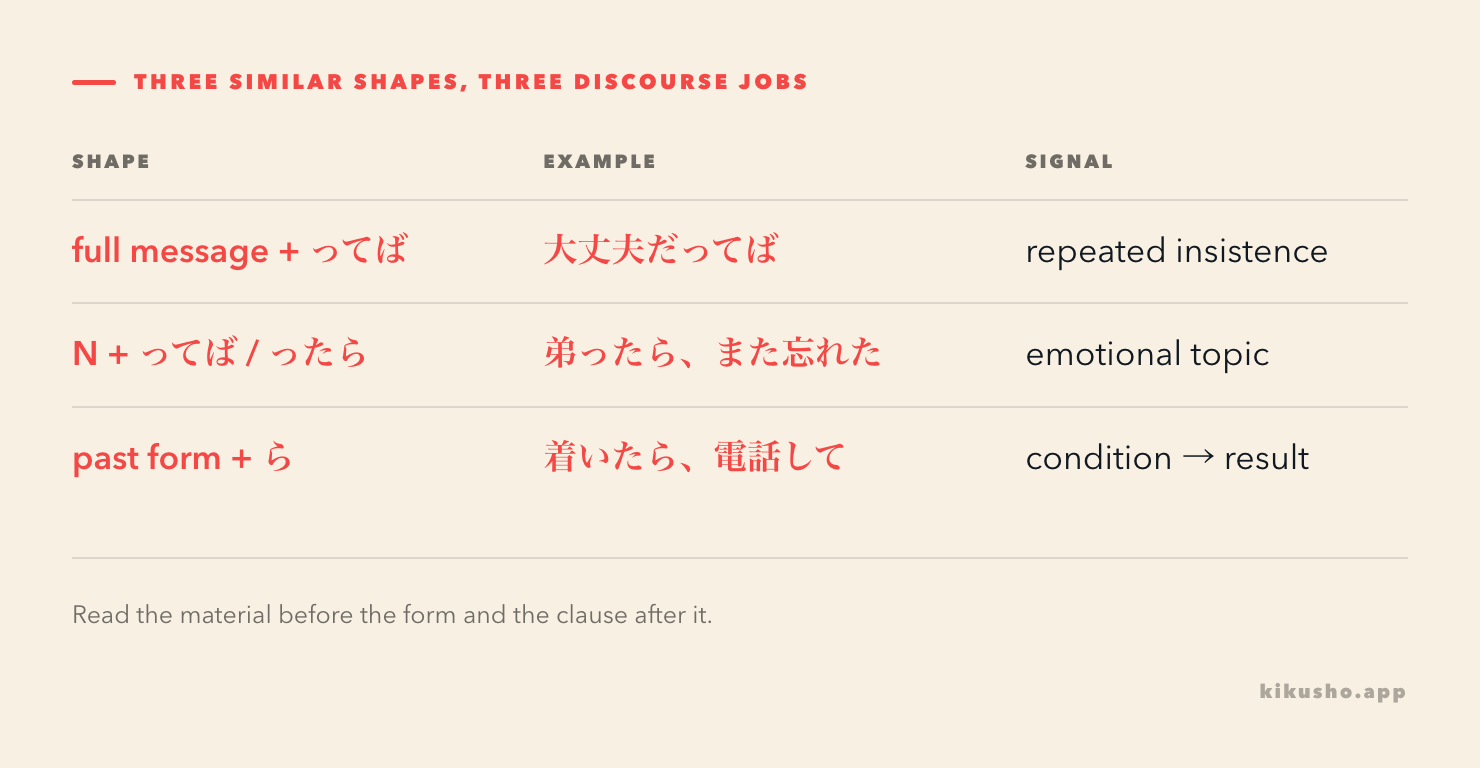
The もしも and たら lesson covers conditional formation. If the phrase before たら is a conjugated predicate and a result follows, test the conditional reading first. If a person is followed directly by ったら and then evaluated, the emotional-topic reading is much more likely.
Neutral topic markers do not carry the same social pressure
Three similar-looking topic frames do different work:
| Form | Core job | Typical tone |
|---|---|---|
| Nは | establish a topic | neutral |
| Nって | quote or conversationally introduce a topic | informal, not necessarily annoyed |
| Nってば / Nったら | foreground a topic with reaction | intimate and emotionally marked |
山田さんって、どんな人?
やまださんって、どんな ひと?
What kind of person is Yamada?
This って is a casual topic marker. The speaker may be simply asking. Compare:
山田さんってば、電話に全然出ないんだ。
やまださんってば、でんわに ぜんぜん でないんだ。
Yamada just won’t answer the phone.
The extra ば makes the speaker’s frustrated appeal more available. The という and casual って lesson maps neutral conversational naming, quotation and topic uses without importing this insistence into all of them.
Politeness cannot be added by changing only the final verb
These particles presume conversational closeness and expose the speaker’s attitude. Adding です/ます elsewhere does not automatically make the exchange suitable for a customer, supervisor or stranger.
部長ったら、また忘れましたね。
The predicate is polite, but 部長ったら still treats the manager as an emotionally charged topic and may sound disrespectful. In a formal setting, state the issue directly: 部長はまたお忘れのようです or another context-appropriate sentence.
Likewise, 大丈夫ですってば is structurally understandable, but the insistent ってば can clash with deference. If you need to repeat a polite assurance, 大丈夫です。ご心配なく or 先ほど申し上げたとおり、大丈夫です manages the relationship more carefully.
The mistake is often conversational, not morphological
Three diagnostics catch most errors:
- No earlier resistance: Saying 大丈夫だってば without doubt, repetition or pressure can sound abruptly defensive.
- Neutral report intended: Replacing plain は with ったら adds reaction that the speaker may not want.
- Conditional clause misread: In 終わったら教えて, the following request completes an ordinary “when finished” condition.
When reading dialogue, inspect the previous turn. A repeated question, ignored request or rejected assurance licenses sentence-final ってば. When a noun comes first, inspect the comment after it: blame, surprise or affectionate teasing supports the emotional-topic reading.
Practice: recover the missing conversational turn
First reconstruct the missing relationship or prior turn in all seven prompts. Open the explanations only afterwards.
Question 1 — repeated assurance. A keeps asking whether B needs help. Complete B’s reply: 一人でできる__。
① ったら雨だ
② ってば
③ たら
④ として
Question 2 — emotional topic. Which sentence most naturally means “That mom of mine forgot her key again”?
① 母が忘れたら、また鍵だ。
② 母ったら、また鍵を忘れた。
③ 母って、鍵なら忘れた。
④ 母なら、また鍵ったら忘れた。
Question 3 — ordinary conditional. Which sentence contains conditional たら rather than the expressive particle?
① 妹ったら、また笑ってる。
② もう知ってるってば。
③ 駅に着いたら、電話して。
④ 先生ってば、意外と冗談が好きだ。
Question 4 — context requirement. Why can 今やってるってば sound oddly defensive as the first line of a calm conversation?
Question 5 — tone. Does うちの犬ったら、靴の上で寝てる have to express anger? Explain what decides the attitude.
Question 6 — repair for formality. Replace 部長ったら、また会議を忘れましたね with a neutral workplace report that does not make the manager an emotional topic.
Question 7 — two-turn writing. Write a short exchange in which one speaker repeats a question or instruction and the other responds naturally with sentence-final ってば.
Answers and explanations
Turn 1
Use ② ってば: 一人でできるってば. The earlier repeated offers of help supply the ignored or doubted message, so B insists that A accept “I can do it alone.”
Turn 2
Use ② 母ったら、また鍵を忘れた. 母 is foregrounded with exasperation, and the following clause explains the reaction. The other choices mix topic and conditional pieces without a coherent attachment.
Turn 3
Use ③ 駅に着いたら、電話して. 着いたら introduces the time-condition “when you arrive,” and 電話して states the requested result. The other sentences use an emotional topic or sentence-final insistence.
Turn 4
Sentence-final ってば normally answers resistance, doubt or failure to listen. Without an earlier request or question, the listener cannot easily recover why the speaker is insisting, so the line can sound as if an argument began offstage.
Turn 5
No. It can show affectionate exasperation or amusement. The relationship, situation, wording, facial expression and intonation determine whether the reaction is warm, irritated or both.
Turn 6
One neutral repair is 部長はまた会議をお忘れのようです: “It seems the manager has forgotten the meeting again.” It reports the observation without using an intimate emotional-topic particle.
Turn 7
One model exchange is: A: 早く宿題を始めて。B: 今始めるってば。 A repeats or presses the instruction; B answers, “I’m starting now, I told you.” The preceding turn makes the insistence interpretable.
Omission can make the pressure stronger
A speaker may call only お母さんってば! or ねえ、聞いてってば!. The missing continuation is recoverable from the scene: respond, listen, stop, remember what I said. This is why isolated dictionary glosses feel inadequate. The form does not merely name annoyance; it uses shared conversational history to make the listener supply the unsaid demand.
Review covered sentence-final insistence, emotional topic marking, overlap between Nってば and Nったら, affectionate as well as critical readings, ordinary conditional たら, neutral って, and register limits. Codex checked the examples and exercises; no human Japanese review is claimed.
Common questions
What does ってば mean in Japanese?
It can insist that the listener accept a message already stated, like “I told you,” or mark a person as an emotionally charged topic.
What does conversational ったら mean?
After a person or topic, ったら foregrounds that person with annoyance, surprise, criticism or affectionate exasperation: “as for X” or “that X again.”
Is expressive ったら the same as the たら conditional?
No. Conditional たら links a condition to a result, while expressive ったら marks a topic or carries the speaker’s reaction in informal conversation.
Are ってば and ったら always angry or feminine?
No. They are intimate and emotionally marked, and can sound impatient, teasing or affectionate depending on context, voice and relationship. Gender descriptions in learner materials are tendencies, not attachment rules.