On this page
わ〜わで piles up two or more circumstances and presents their combined result, usually with frustration, strain or a sense of chaos. Its dependable frame is Aわ、Bわで、C: “what with A and B, C.”
朝から電話は鳴るわ、急な来客はあるわで、仕事が全く進まなかった。
あさから でんわは なるわ、きゅうな らいきゃくは あるわで、しごとが まったく すすまなかった。
What with the phone ringing and unexpected visitors arriving all morning, I got no work done at all.
The two わ markers make the interruptions feel cumulative. Final で then carries that pile into 仕事が全く進まなかった, the result.
Build the pattern from complete predicates
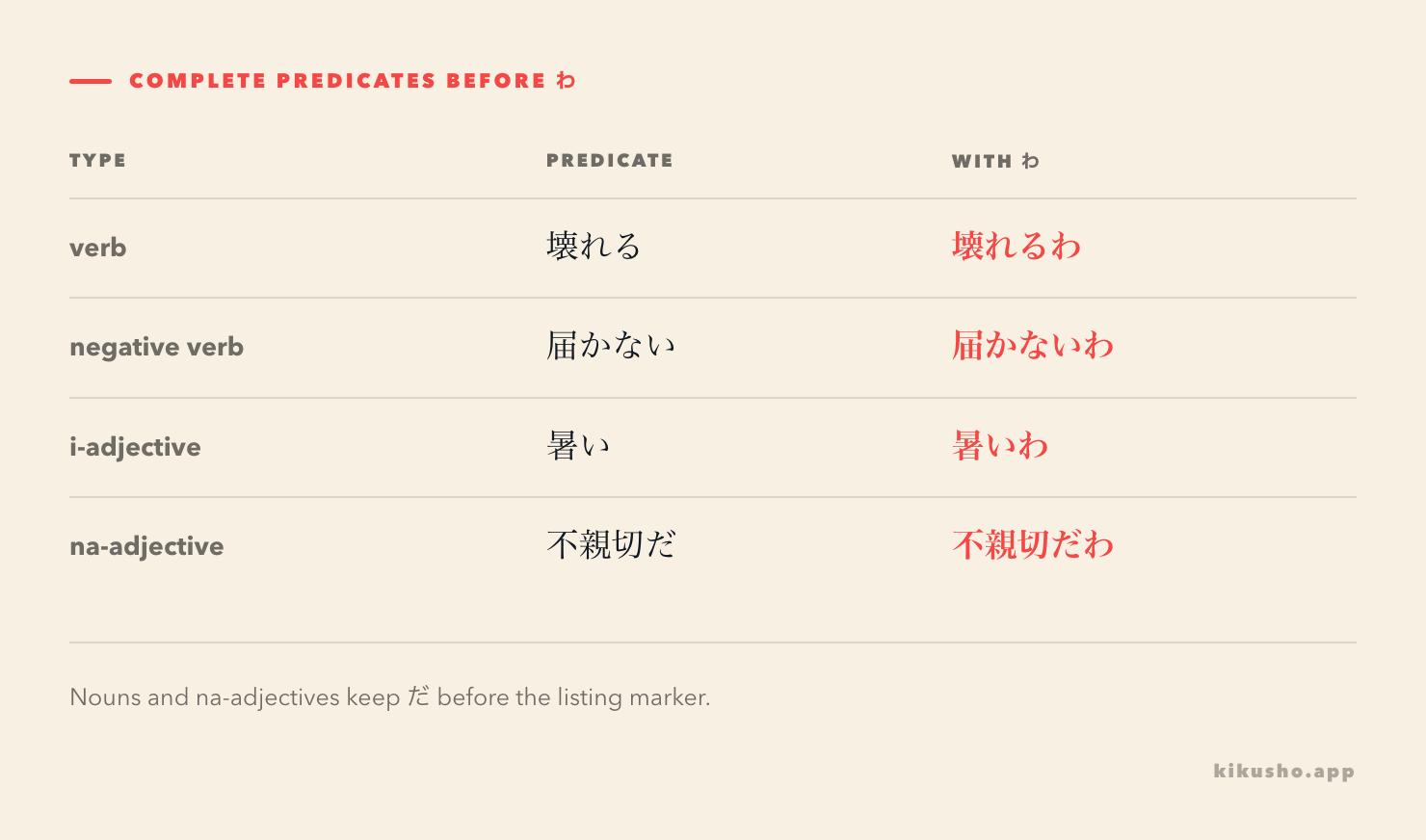
Each item before わ is a predicate, not simply a noun in a list. Verbs and i-adjectives attach directly. Na-adjectives and noun predicates retain だ.
| Predicate type | Formation | Example before わ |
|---|---|---|
| affirmative verb | V nonpast + わ | 壊れるわ |
| negative verb | Vない + わ | 届かないわ |
| i-adjective | Aい + わ | 暑いわ |
| na-adjective | Aだ + わ | 不親切だわ |
| noun predicate | Nだ + わ | 雨だわ |
This gives the full frame:
A(plain nonpast)わ、B(plain nonpast)わで、C。
店員は不親切だわ、説明は曖昧だわで、結局何も買わなかった。
てんいんは ふしんせつだわ、せつめいは あいまいだわで、けっきょく なにも かわなかった。
The staff were unhelpful and the explanations were vague, so in the end I bought nothing.
Bunpro's N1 reference gives the same attachments for verbs, i-adjectives, na-adjectives and nouns, including だ after the latter two. NIHONGO NET's lesson independently describes the construction as multiple adverse circumstances creating a hectic or overwhelming situation. Their N1 labels are editorial study placements; there is no official checklist assigning every grammar form to a JLPT level.
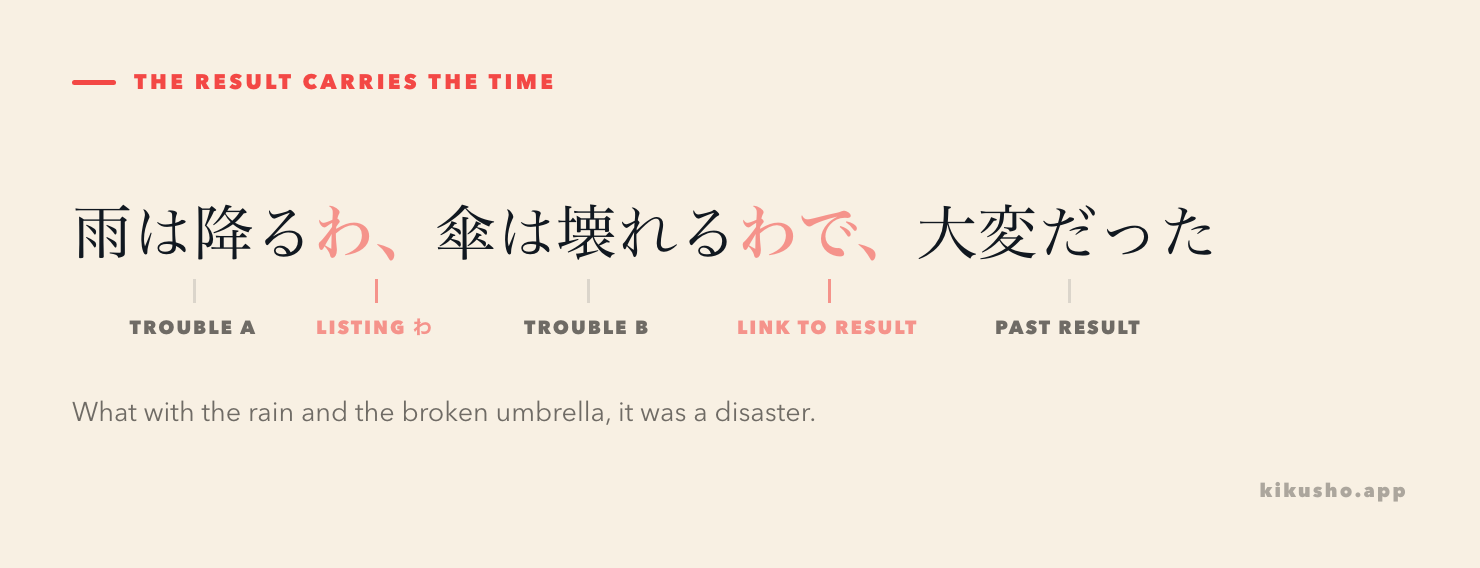
The final clause carries the time of the whole scene
Past events commonly appear in the nonpast form inside the list:
旅行先では雨は降るわ、財布はなくすわで、散々だった。
りょこうさきでは あめは ふるわ、さいふは なくすわで、さんざんだった。
On the trip, it rained and I lost my wallet; it was awful.
降る and なくす do not mean that the story has suddenly moved into the present. They stage each event as it enters the pile. 散々だった locates the evaluation in the past. A Japanese-teacher explanation of repeated わ makes this timing rule explicit: when recounting the past, the sentence ending bears the past tense while the listed predicates remain nonpast.
The same division works with a current result:
パソコンは動かないわ、資料は見つからないわで、発表の準備どころではない。
パソコンは うごかないわ、しりょうは みつからないわで、はっぴょうの じゅんびどころでは ない。
The computer will not work and I cannot find the materials, so I am in no position to prepare the presentation.
The listed predicates and the result are all current here. Read the tense from the final clause and the wider context, not from わ itself.
This わ is a listing marker, even when は appears nearby
The sound wa can represent different pieces of grammar. In 電話は鳴るわ, both appear:
| Written form | Position | Job |
|---|---|---|
| 電話は | after the noun | marks 電話 as the topic or contrast |
| 鳴るわ | after the predicate | adds one item to the accumulating list |
Writing 電話わ鳴るは reverses both spellings and is wrong. The final listing わ is also distinct from a sentence-ending わ that can soften or colour a standalone utterance. Repetition and the larger shape disambiguate it: Aわ、Bわで、C contains two parallel predicates and a resulting clause.
会場は駅から遠いわ、案内は分かりにくいわで、着く前に疲れてしまった。
かいじょうは えきから とおいわ、あんないは わかりにくいわで、つくまえに つかれてしまった。
The venue was far from the station and the directions were hard to follow, so I was tired before I even arrived.
Here 会場は and 案内は organize the two complaints. 遠いわ and 分かりにくいわで put them into the accumulating frame.
Use it for a loaded pile, not an ordinary list
The pattern does more than join two reasons. It performs the speaker's reaction to their accumulation. 絵でわかる日本語 teaches わ〜わで for bad circumstances happening together and contrasts it with an unnatural positive example. Bunpro describes negative use as overwhelmingly common while allowing that rare positive contexts occur. For reliable production, use the form when the pile is troublesome, hectic or emotionally charged.
Compare three ways to describe similar material:
雨が降って、風も強かったので、試合は中止になった。
It rained and the wind was strong, so the match was cancelled.
雨は降るわ、風は強いわで、試合どころではなかった。
What with the rain and the strong wind, there was no question of playing the match.
The first sentence reports causes. The second makes the weather feel like a pile the speaker had to face. For a neutral sample of actions, たり〜たり is safer: 本を読んだり、音楽を聞いたりする merely names representative activities.
This is also why the pattern often suggests more than the two items named. The speaker is giving enough evidence for you to feel the whole mess, not promising an exhaustive inventory.
Final で links the pile to its consequence
The で after the last わ makes the causal or circumstantial connection easy to see:
この部屋は狭いわ、日当たりは悪いわで、長く住む気にはなれない。
この へやは せまいわ、ひあたりは わるいわで、ながく すむ きには なれない。
The room is small and gets poor sunlight, so I cannot imagine living here long.
In conversation, で can be omitted, leaving Aわ、Bわ、C. The fully marked Aわ、Bわで、C is the clearest productive form because it exposes the boundary between the accumulated circumstances and their result.
A bare repeated Aわ、Bわ has a wider emotional range. It can dramatize pleasant abundance in the right context, while teacher references tend to reserve the わ〜わで construction for an adverse or troublesome conclusion. Keep the final result visible when you are learning the N1 pattern; it prevents a vivid list from becoming a vague exclamation.
だの lists complaints from a different angle
Both わ〜わで and だの〜だの can sound negative, but they package the material differently:
客は部屋が狭いだの、駅から遠いだのと不満を並べた。
The guest complained that the room was small, that the station was far away, and so on.
部屋は狭いわ、駅からは遠いわで、客はすぐに出ていった。
The room was small and far from the station, so the guest left at once.
だの often echoes claims, excuses or complaints and gathers them with と before a speech verb. わ〜わで stages circumstances as they accumulate and leads into what that pile caused. The だの〜だの and やれ〜やれ comparison explains the reporting angle in detail.
For structured addition without the sense of commotion, 上に joins facts that support the same evaluation. わ〜わで is more performative: its repeated beat lets the listener feel each new burden arrive.
If you save an example in Kikusho, keep the result clause on the same card as the repeated markers. 雨は降るわ、傘は壊れるわ shows the rhythm, but 大変だった reveals why the speaker chose it and anchors the past-time reading.
Practice: keep the answers below every question
Question 1 — choose the natural accumulation. Which sentence best says that repeated trouble made the morning chaotic?
- 朝は電話をしたり、客が来たりで、静かだった。
- 朝から電話は鳴るわ、客は来るわで、大変だった。
- 朝は電話が鳴ったわで、客が来たわで、大変だった。
- 朝は電話や客を大変だった。
Question 2 — keep the narrative time straight. Complete a past account: 旅行中は雨が__わ、電車は__わで、散々だった。
- 降った / 遅れた
- 降る / 遅れる
- 降り / 遅れ
- 降って / 遅れて
Question 3 — attach a na-adjective. Complete: 店員は不親切__、説明は曖昧__、何も買わなかった。
- わ / わで
- でわ / でわで
- だわ / だわで
- なわ / なわで
Question 4 — separate は from わ. Supply the correct hiragana in both positions: 電話_鳴る_、客_来る_で、仕事が進まない。
Question 5 — choose the neutral list. You only want to name two examples of weekend activities, without frustration. Which is best?
- 本を読むわ、音楽を聞くわで、週末を過ごす。
- 本を読んだり、音楽を聞いたりして、週末を過ごす。
- 本だわ、音楽だわで、週末を過ごす。
- 本を読むだの、音楽を聞くだの、週末を過ごす。
Question 6 — compose the result. Use パソコンが動かない, 資料が見つからない and 準備ができなかった to make one past-tense sentence with わ〜わで.
Question 7 — interpret the text. Read: 引っ越しの日は、雨は降るわ、手伝いの人は遅れるわで、予定どおりには進まなかった。 Why are 降る and 遅れる nonpast even though the move happened in the past, and what does the repeated わ add?
Answers and explanations
Answer 1: 2. 電話は鳴るわ、客は来るわで gives two parallel predicates and presents their accumulation as the reason the morning was difficult. Choice 1 clashes with the quiet result, choice 3 repeats で after each item and uses the wrong narrative shape, and choice 4 has no valid predicates.
Answer 2: 2, 降る / 遅れる. The listed events normally use plain nonpast forms even inside this past account. Final 散々だった fixes the scene in the past.
Answer 3: 3, だわ / だわで. Na-adjective predicates retain copular だ before the listing marker: 不親切だわ、曖昧だわで.
Answer 4. 電話は鳴るわ、客は来るわで、仕事が進まない。 Topic は follows each noun; listing わ follows each predicate. The second listing marker takes で because it leads into the result.
Answer 5: 2. たり〜たり neutrally names representative activities. The other choices impose an evaluative list or fail to form a suitable sentence for the intended calm description.
Answer 6. One natural answer is パソコンは動かないわ、資料は見つからないわで、準備ができなかった。 The two nonpast trouble clauses accumulate before the past result できなかった.
Answer 7. The inner nonpast forms stage each difficulty vividly as part of the accumulating scene; 進まなかった carries the overall past time. Repeated わ adds the speaker's sense that one problem followed another, rather than neutrally reporting two causes.
The smallest reliable cue is also the most visual: two complete predicates, two わ beats, then a result. Once you can see that contour, the form stops looking like four unrelated particles and starts sounding like a pile taking shape.
This page received an AI language check by OpenAI Codex. The pass covered attachment after every predicate type, nonpast forms in past narration, the distinction between は and わ, all original examples, readings, translations, distractors and question-to-answer mappings. No human review is claimed.
Common questions
What does わ〜わで mean in Japanese?
わ〜わで lists two or more circumstances whose accumulation produces a difficult, chaotic or otherwise striking result. In English it often becomes “what with A and B” or “A happened, B happened, so…”.
How do you form わ〜わで?
Put わ after each plain nonpast predicate and normally add で after the final わ: Aわ、Bわで、result. Verbs and i-adjectives attach directly; nouns and na-adjectives retain だ, as in 不親切だわ.
Why does わ〜わで use present forms for past events?
The listed predicates commonly stay in the nonpast form to stage the events vividly as an accumulating scene. The final clause carries the overall time, as in 雨は降るわ、傘は壊れるわで、大変だった.
Is the わ in わ〜わで the topic particle は?
No. The listing marker is written わ. A clause can contain both: 電話は鳴るわ has topic は after 電話 and listing わ after 鳴る.