On this page
Use とっさに when someone reacts in the tiny window before deliberate thought is possible. It does more than say “quickly”: an event demands an answer, movement or judgment on the spot.
子どもが車道に出そうになり、母親はとっさに子どもの腕をつかんだ。
こどもがしゃどうにでそうになり、ははおやはとっさにこどものうでをつかんだ。
The child was about to step into the road, and the mother grabbed their arm in a split second.
The grab is quick, but speed is only part of the picture. The danger arrives without enough time to plan, and the mother produces an immediate response. This page teaches the N1 inventory item とっさに (g-3dab6cd4be5c).
とっさ is a moment; に turns it into the timing of a reaction
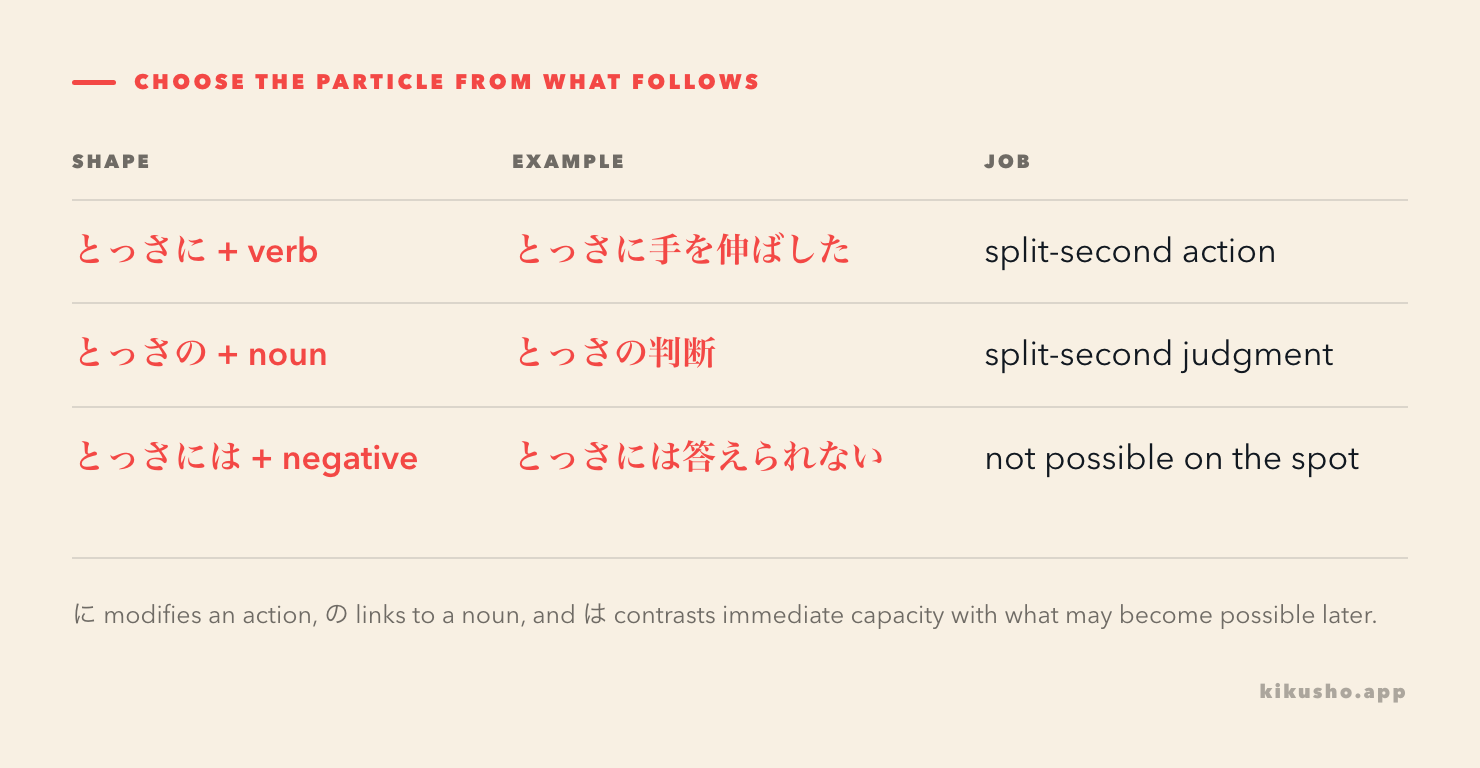
とっさ(咄嗟) is a noun for an extremely short moment. Adding に makes an adverbial expression placed before a verb:
| Shape | Function | Example |
|---|---|---|
| とっさに + verb | action in the split-second window | とっさに手を伸ばした |
| とっさの + noun | a judgment, action or reply made in that window | とっさの判断 |
| とっさには + negative/potential | what could not be done on the spot | とっさには答えられなかった |
コップが机から落ちそうになり、とっさに手を伸ばした。
コップがつくえからおちそうになり、とっさにてをのばした。
The glass was about to fall from the desk, and I reached out in a split second.
運転手のとっさの判断が、大きな事故を防いだ。
うんてんしゅのとっさのはんだんが、おおきなじこをふせいだ。
The driver's split-second judgment prevented a serious accident.
The adverb normally modifies an action, perception, answer or decision. The noun pattern often accompanies 判断(はんだん), 行動(こうどう), 返事(へんじ) or 機転(きてん). These are partnerships, not a closed list.
Both とっさ and 咄嗟 appear in Japanese. The kanji are uncommon enough that hiragana is an ordinary, readable choice. Recognition of 咄嗟 helps with adult prose; producing the kanji is not what makes the expression correct.
The trigger and the response occupy different halves of the sentence
The cleanest model has two parts:
- something sudden creates a narrow response window;
- the person acts とっさに inside that window.
犬がいきなり道路に飛び出し、運転手はとっさにブレーキを踏んだ。
いぬがいきなりどうろにとびだし、うんてんしゅはとっさにブレーキをふんだ。
A dog suddenly ran into the road, and the driver hit the brakes in a split second.
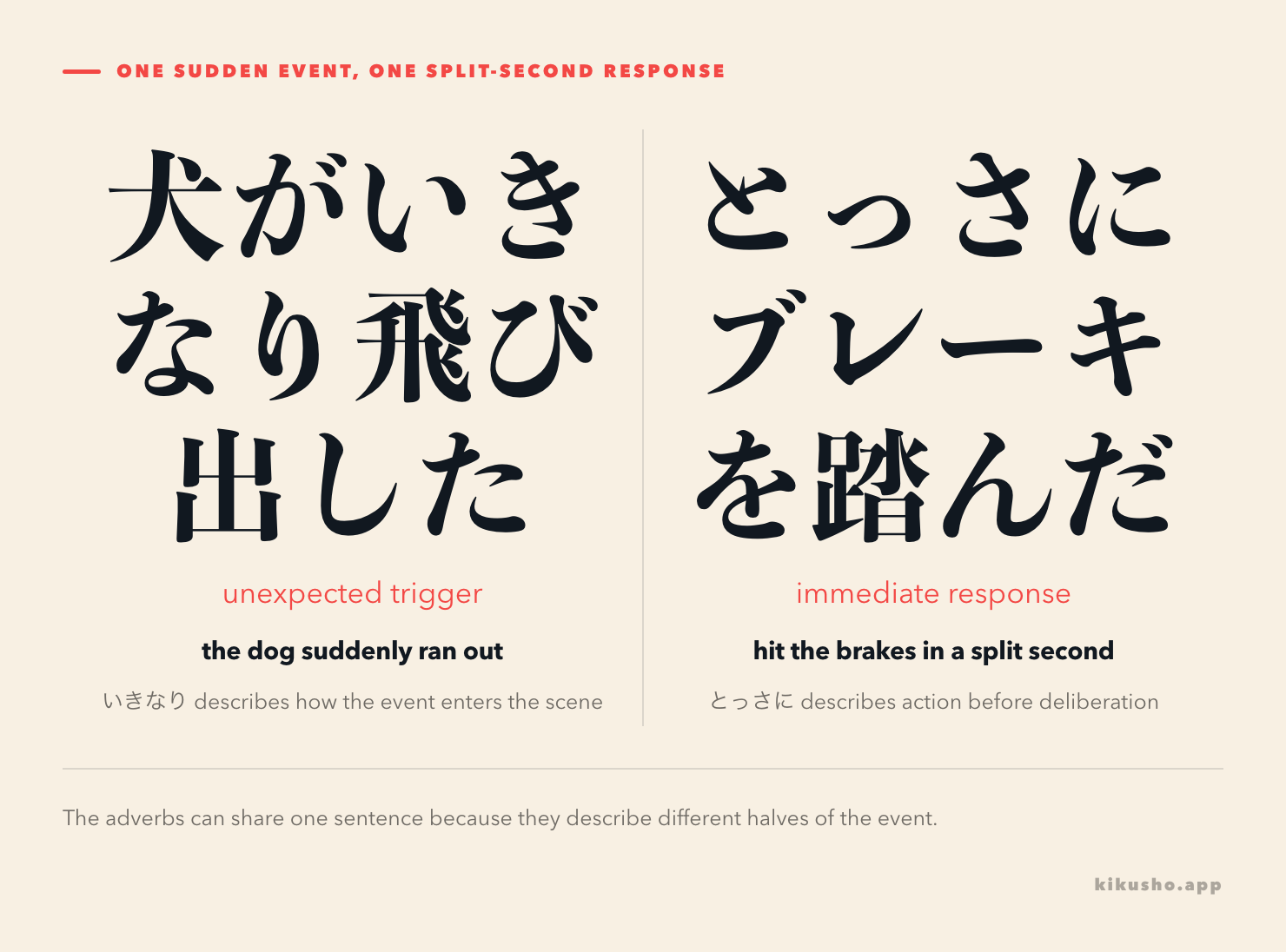
This division explains why いきなり and とっさに can appear together. いきなり looks at the dog's abrupt entry. とっさに looks at the driver's response. The いきなり, 一気に and 直ちに comparison develops abrupt entry, uninterrupted momentum and action without delay.
The trigger need not be physical danger. An unexpected question can force an instant answer, and new information can force a quick judgment:
急に意見を求められたが、とっさに例を一つ挙げることができた。
きゅうにいけんをもとめられたが、とっさにれいをひとつあげることができた。
I was suddenly asked for my opinion, but I managed to give an example on the spot.
The answer is purposeful. とっさに therefore does not mean that the person lost all control; it says that the decision had to be made with almost no preparation.
とっさには often exposes a limit under pressure
Adding は can contrast what is possible in that tiny window with what might be possible after reflection. It appears naturally with negative or potential predicates:
名前は知っていたのに、とっさには思い出せなかった。
なまえはしっていたのに、とっさにはおもいだせなかった。
I knew the name, but I could not recall it on the spot.
複雑な質問だったので、とっさには答えられなかった。
ふくざつなしつもんだったので、とっさにはこたえられなかった。
It was a complicated question, so I could not answer immediately.
The sentences do not say that recall or an answer is impossible forever. は draws a boundary around immediate performance: not in that first pressured moment. This is useful in interviews, emergencies and conversations where later reflection changes what a person can do.
Do not treat とっさには as a mandatory fixed form. A positive statement normally uses simple とっさに. The extra は matters when the writer sets the immediate moment against a wider possibility.
すぐに measures delay; とっさに measures the response window
すぐに is broad. It says that one event follows another after little time, even when the action is planned and calm.
家に着いたら、すぐに連絡します。
いえについたら、すぐにれんらくします。
I will contact you as soon as I get home.
Nothing here demands a reflex or emergency judgment. The speaker has already formed a plan. Replacing すぐに with とっさに would create an unsupported crisis-like response window.
Now compare:
ボールが顔に向かって飛んできたので、とっさによけた。
ボールがかおにむかってとんできたので、とっさによけた。
A ball flew toward my face, so I dodged instinctively.
The second sentence contains both speed and pressure from an unexpected trigger. すぐによけた can still be grammatical, but it reports short delay more neutrally and loses the split-second decision viewpoint.
思わず removes intention; とっさに leaves room for judgment
思わず foregrounds an action that happened without intending it. Laughter, tears, a cry or an emotional remark often fits:
予想外の答えを聞いて、思わず笑ってしまった。
よそうがいのこたえをきいて、おもわずわらってしまった。
I heard the unexpected answer and laughed without meaning to.
The speaker did not decide that laughter was the best immediate response; it escaped. とっさに, by contrast, can describe an effective quick choice:
自転車が近づいてきたので、とっさに子どもを歩道側へ寄せた。
じてんしゃがちかづいてきたので、とっさにこどもをほどうがわへよせた。
A bicycle came toward us, so I quickly moved the child toward the sidewalk.
The two can overlap when a reaction is both unplanned and immediate. Choose the detail you want to foreground: 思わず for lack of intention, とっさに for the tiny window in which a response occurs. The ふと and つい lesson maps two other kinds of unplanned action: a thought that simply arises and an impulse or lapse that overcomes restraint.
反射的に is narrower when the automatic reflex itself matters. 即座に is more compatible with a deliberate, sometimes formal decision made without delay. とっさに sits between them: the time pressure is central, while the response may be reflexive or may involve quick judgment.
The expression needs a plausible reason for the urgency
A sentence with とっさに becomes convincing when the scene explains why reflection was unavailable. That reason can be stated before it or supplied by the surrounding text.
Natural contexts include:
- something falls, moves or appears unexpectedly;
- danger requires protective movement;
- a question demands an immediate reply;
- a secret or mistake is nearly exposed;
- a speaker must improvise an explanation or decision.
A routine scheduled action normally needs another adverb. 毎朝七時にとっさに家を出る is odd because a daily departure is not presented as a split-second response. 毎朝、朝食を終えるとすぐに家を出る can describe prompt routine action, while 警報を聞いてとっさに家を出た supplies the trigger that the N1 expression expects.
When saving an example in Kikusho, retain both the trigger and the reaction. A card showing only とっさに答えた hides why this is different from すぐに答えた. 急に質問され、とっさに答えた preserves the pressure that gives the adverb its meaning.
Practice: separate sudden events from split-second reactions
Try every question before revealing the review notes.
Question 1 — grammar choice. A plate slips from a shelf and you catch it before it hits the floor.
皿が棚から落ちてきたので、( )受け止めた。
- ア. とっさに
- イ. ついに
- ウ. わざと
- エ. ゆっくり
Question 2 — noun modification. Choose the natural phrase for “a split-second judgment.”
- ア. とっさに判断
- イ. とっさの判断
- ウ. とっさな判断
- エ. とっさで判断
Question 3 — immediate capacity. The speaker found an answer later, but could not answer under the first pressure. Which sentence fits?
- ア. とっさには答えられなかった。
- イ. とっさの答えられなかった。
- ウ. とっさで答えられなかった。
- エ. とっさを答えられなかった。
Question 4 — trigger and response. Choose the pair for an abrupt event followed by a split-second reaction.
猫が( )窓から飛び出したので、私は( )手を伸ばした。
- ア. とっさに/いきなり
- イ. いきなり/とっさに
- ウ. すぐに/ついに
- エ. 思わず/ゆっくり
Question 5 — viewpoint. Which word best completes each sentence?
- 友達の冗談がおかしくて、( )笑った。\
- 自転車が倒れそうになり、( )支えた。
- ア. とっさに/思わず
- イ. 思わず/とっさに
- ウ. すぐに/ついに
- エ. いきなり/わざと
Question 6 — sentence composition. Arrange all four chunks to say “Asked unexpectedly, I could not think of a good example on the spot.”
- いい例を思いつかなかった
- 急に質問され
- とっさには
- 私は
Question 7 — connected text. Read the scene and choose the accurate account.
店員の持っていた大きな箱がいきなり落ちた。近くにいた客は、とっさに子どもを後ろへ下がらせたが、何が起きたのかと聞かれても、とっさには説明できなかった。
- ア. The clerk acted according to plan, and the customer slowly moved the child.
- イ. The box fell abruptly; the customer reacted immediately but could not explain the event on the spot.
- ウ. The customer unintentionally laughed and later refused to explain.
- エ. The clerk reacted to the customer, who had deliberately dropped the box.
Answers and explanations
Answer 1. ア, とっさに. The falling plate creates a very short response window, and catching it is the immediate reaction. ついに means finally, わざと marks intention, and ゆっくり contradicts the urgent scene.
Answer 2. イ, とっさの判断. とっさ is a noun, so の links it to 判断. Before a verb, the adverbial form is とっさに. な, で and bare とっさに do not produce the requested noun phrase.
Answer 3. ア, とっさには答えられなかった. に gives the immediate-response timing, and は contrasts that pressured moment with the possibility of answering later. The other particles do not create this adverbial limit.
Answer 4. イ, いきなり/とっさに. いきなり describes the cat's abrupt movement into the scene. とっさに describes the speaker's split-second response. Reversing the pair assigns the viewpoints to the wrong halves.
Answer 5. イ, 思わず/とっさに. The laugh escapes without intention, so 思わず is the sharper choice. The falling bicycle creates a narrow window for protective action, so とっさに foregrounds the quick response. Either adverb can overlap in some scenes, but these prompts supply one decisive cue for each.
Answer 6. 急に質問され、私はとっさにはいい例を思いつかなかった. The unexpected question supplies the pressure. とっさには marks what was unavailable in that first moment, and いい例を思いつかなかった completes the negative capacity claim.
Answer 7. イ. いきなり marks the box's abrupt fall. The first とっさに presents the customer's protective action; とっさには説明できなかった limits the later failure to the immediate moment. The passage does not say the drop was planned, the movement was slow or the customer refused permanently.
N1 is a study placement for this lexical adverb
JLPT Sensei and several N1 study lists place とっさに at N1. Digital Daijisen defines the adverb as action in that very instant, while Kotobank's noun entry verifies とっさ as an extremely short moment and records noun phrases such as とっさの判断 and とっさの行動. These dictionary sources verify the language, not an exam level.
The item behaves more like advanced vocabulary than a conjugating grammar suffix. Kikusho retains the source inventory's N1 placement because learners must recognize its adverbial and noun shapes in adult Japanese. The exam authority does not publish a definitive form-by-form syllabus, so the label remains editorial study guidance.
For this lexical-adverb lesson, OpenAI Codex performed the AI language review. The check covered the noun and adverbial forms, kanji reading, trigger-response logic, positive and negative examples, and distinctions from すぐに, いきなり, 思わず, 反射的に and 即座に. It also verified each of the seven solution notes against its prompt. This was an AI-only check; no human reviewer participated.
Common questions
What does とっさに mean in Japanese?
とっさに marks an action or decision made in the tiny window immediately after something happens, before there is time for deliberate thought. It often translates as instinctively, on the spot or in a split second.
What is the difference between とっさに and すぐに?
すぐに simply says that little time passes before an action. とっさに presents a response made under sudden time pressure, often because an unexpected event leaves no time to think.
How is とっさに different from 思わず?
とっさに foregrounds the short response window and can include a quick, purposeful judgment. 思わず says that an action or reaction happened without intending it, as when someone laughs despite trying not to.
Can とっさ modify a noun?
Yes. Use とっさの before nouns such as 判断, 行動, 返事 and 機転: とっさの判断 means a split-second judgment. Use とっさに before a verb.