On this page
Use た上で when A is completed and considered before B, dictionary-form 上で when B matters in the course of A, and 上に when B is one more fact about the same situation. The shared 上 does not make these three patterns interchangeable: the verb form and the following particle tell you which relationship the sentence builds.
This is an N2 consolidation lesson rather than a claim that every reference assigns the forms to N2. JLPT Sensei lists both 上で and 上に at N3. Bunpro also places prerequisite 上で at N3, but places additive 上に at N2. These are editorial estimates because the JLPT publishes no exhaustive official grammar syllabus.
One kanji, three sentence designs
Start by locating the form immediately before 上 and the particle immediately after it.
| Pattern | Relationship | Quick test |
|---|---|---|
| Vた + 上で、B | finish and consider A, then do B | Is A a deliberate prerequisite for B? |
| V辞書形 / Nの + 上で、B | B matters in activity A or from standpoint A | Is A the domain where B applies? |
| plain predicate + 上に、B | A is true, and B adds another fact | Do A and B accumulate? |
資料を読んだ上で、参加するか決めます。
しりょうをよんだうえで、さんかするかきめます。
I will decide whether to participate after reading and considering the materials.
参加する上で、事前の登録が必要です。
さんかするうえで、じぜんのとうろくがひつようです。
Advance registration is necessary in order to participate.
この講座は実用的な上に、説明も分かりやすいです。
このこうざはじつようてきなうえに、せつめいもわかりやすいです。
This course is practical, and its explanations are easy to understand too.
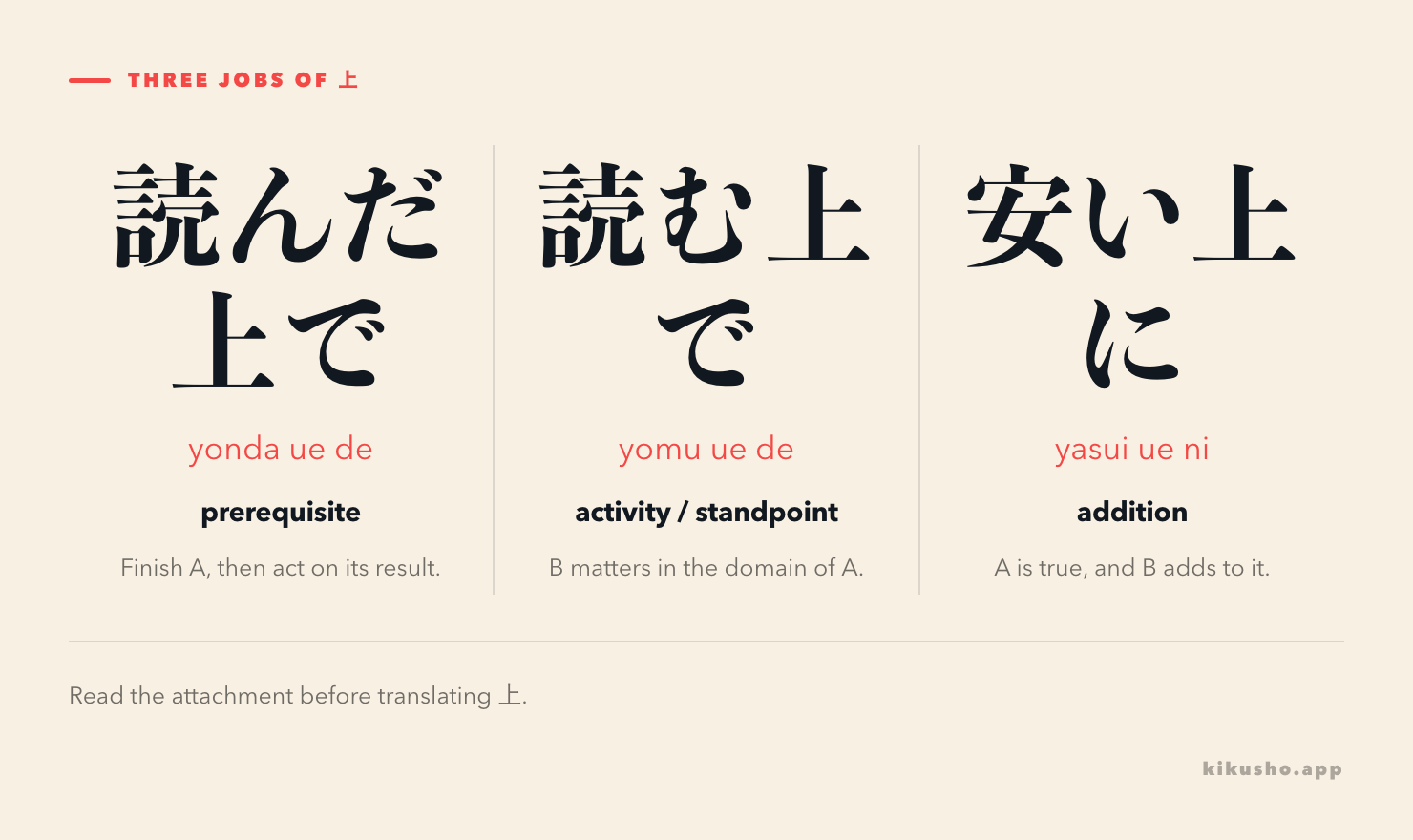
The first two examples both concern participation, yet they disagree about whether participation has happened. 読んだ is completed before the decision. 参加する remains the activity being discussed. The third sentence has no before-and-after chain at all; it adds a second favourable property.
Vた+上で turns A into a considered prerequisite
This pattern is more specific than ordinary “after.” A is completed first, and its result or information supports the controlled action in B. Decisions, confirmations, applications and replies therefore occur naturally after it.
現物を確認した上で、注文しました。
げんぶつをかくにんしたうえで、ちゅうもんしました。
I placed the order after inspecting the actual item.
The inspection is not merely earlier on a timeline. It informs the order. That is why Bunpro contrasts 上で with plain てから: てから can report simple sequence, whereas た上で highlights a prerequisite and sounds more formal. For everyday action order without that considered basis, review 前に and 後で.
Nouns that name an action can fill the same slot with Nの上で:
十分な話し合いの上で、計画を変更しました。
じゅうぶんなはなしあいのうえで、けいかくをへんこうしました。
We changed the plan after thorough discussion.
This noun pattern is common in careful or formal wording. It does not license any noun whatsoever; 話し合い works because it supplies the preparatory process on which the change is based.
V辞書形+上で and Nの上で frame an activity or standpoint
Replace the た-form with the dictionary form and the time relationship changes. The first clause no longer says “complete A first.” It names the activity, field or situation within which B is useful, important or necessary.
海外で働く上で、現地の制度を知ることは大切です。
かいがいではたらくうえで、げんちのせいどをしることはたいせつです。
Knowing the local system is important when working abroad.
The person does not first finish working abroad and then learn the system. 働く is the frame in which the knowledge matters. English translations such as “for,” “when” and “in order to” can all appear, so the attachment is more reliable than one memorised gloss.
A noun can instead name the standpoint from which a statement is true. The Japan Foundation's teaching note on 上で and 上では records restricted nouns such as 理論, 法律 and 健康 in this use.
理論の上では可能でも、実行するのは難しいです。
りろんのうえではかのうでも、じっこうするのはむずかしいです。
It may be possible in theory, but carrying it out is difficult.
Here 理論の上では means “from a theoretical standpoint.” It does not put theory first in a sequence. Context distinguishes this restricted viewpoint use from an action noun such as 話し合い in 話し合いの上で, where discussion supplies the completed basis for a later decision.
Compare the minimal pair:
| Sentence | What it says |
|---|---|
| 申込書を確認した上で、送信した。 | I checked the form, then sent it on that basis. |
| 申し込む上で、住所が必要だ。 | An address is necessary in the process of applying. |
The first sentence places 確認 before 送信. The second does not place 申し込む before 必要だ; it makes applying the domain for the requirement.
~上に stacks another fact
Additive 上に follows a plain predicate and means “in addition,” “on top of that,” or “not only A but also B.” It commonly piles up two advantages or two problems so that both point toward the same conclusion.
この道は狭い上に、夜は暗いです。
このみちはせまいうえに、よるはくらいです。
This road is narrow, and on top of that it is dark at night.
Both facts support a negative assessment of the road. The pattern can just as easily stack praise:
新しい図書館は静かな上に、駅からも近いです。
あたらしいとしょかんはしずかなうえに、えきからもちかいです。
The new library is quiet and, in addition, close to the station.
This additive relationship overlaps with だけでなく and ばかりでなく, but 上に has a stronger sense of piling one supporting fact onto another. When the second fact reverses the first rather than reinforces it, choose a contrastive connector instead of forcing an additive stack.
Attachment exposes the difference before translation does
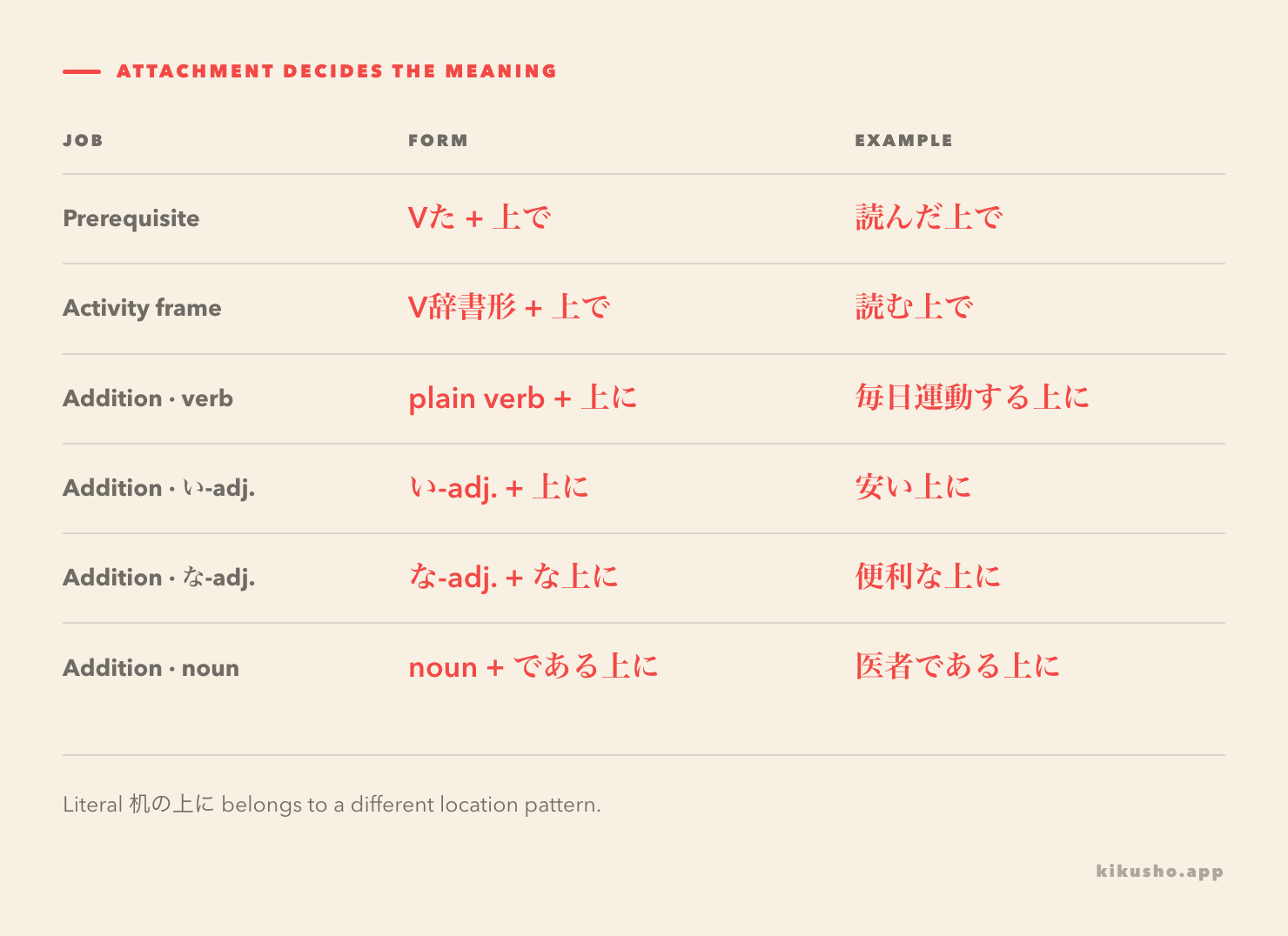
| Intended meaning | Attachment | Example |
|---|---|---|
| prerequisite | Vた + 上で | 読んだ上で |
| activity or standpoint | V辞書形 + 上で | 読む上で |
| addition after a verb | plain verb + 上に | 毎日運動する上に |
| addition after an い-adjective | い-adjective + 上に | 安い上に |
| addition after a な-adjective | な-adjective + な + 上に | 便利な上に |
| addition after a noun | noun + である + 上に | 医者である上に |
The noun row for 上に is grammatical, but context must prevent a literal spatial reading. 机の上に本がある means “there is a book on the desk,” where 上 is the noun “top” and に marks location. It is not additive grammar. The wider に versus で location lesson explains that literal particle choice. In an additive sentence, the material after 上に supplies another proposition rather than the location of an object.
What changes when you pick the wrong form
Suppose the intended message is “After checking the schedule, I booked a ticket.”
日程を確認した上で、切符を予約しました。
にっていをかくにんしたうえで、きっぷをよやくしました。
Changing 確認した to 確認する produces 日程を確認する上で, “in the course of checking the schedule.” That can introduce something needed for checking, but it no longer says the check was completed before booking. Changing で to に produces an additive frame, so it would need a second parallel fact rather than the planned booking based on the check.
The particles are therefore not decorative variants. で closes either a prerequisite frame or a standpoint frame. に opens an additional fact. The verb form then distinguishes the two jobs of 上で.
Practice
Try all seven questions before opening the shared answer section.
Question 1
Choose the form that makes reading the terms a prerequisite for applying.
利用条件をよく読んだ__、申し込んでください。
A. 上に
B. 上で
C. 上は
D. 上を
Question 2
Choose the form meaning “when managing this project.”
この企画を進める__、予算の確認が欠かせません。
A. 上で
B. 上に
C. 上まで
D. 上から
Question 3
Choose the natural attachment for additive 上に.
この宿は静か__、温泉もあります。
A. の上に
B. だ上に
C. な上に
D. で上に
Question 4
Build one sentence from the four numbered pieces.
__ __ __ __。
- 契約するか\
- 説明を聞いた\
- 決めます\
- 上で、
Question 5
Which sentence means that experience is useful in the activity of teaching, rather than something completed before it?
A. 教えた上で、経験が役立ちます。
B. 教える上で、経験が役立ちます。
C. 教える上に、経験が役立ちます。
D. 教えた上に、経験が役立ちます。
Question 6
Read the description and choose the supported conclusion.
この研修は内容が実践的な上に、講師の説明も明確です。ただし、受講を決める前に日程を確認してください。
A. The training has two stated advantages.
B. The schedule was confirmed after the training finished.
C. The instructor's explanation contradicts the practical content.
D. 上に makes the schedule a prerequisite.
Question 7
Choose the sentence that naturally means “After comparing three plans, we selected the cheapest one.”
- 三つの案を比べる上で、最も安い案を選びました。\
- 三つの案を比べた上に、最も安い案を選びました。\
- 三つの案を比べた上で、最も安い案を選びました。\
- 三つの案を比べる上に、最も安い案を選びました。
Answers and explanations
Answer 1
B. 読んだ is the た-form, and applying is the controlled action taken after the conditions have been read and considered. 上に would require an added parallel fact.
Answer 2
A. 進める is the dictionary form, so 進める上で frames project management as the activity in which checking the budget is essential.
Answer 3
C. 静か is a な-adjective. Add な before additive 上に: 静かな上に. The second fact, having a hot spring, adds another favourable property.
Answer 4
2 → 4 → 1 → 3. 説明を聞いた上で、契約するか決めます means “After hearing and considering the explanation, I will decide whether to sign.” The completed explanation is the basis for the decision.
Answer 5
B. Dictionary-form 教える上で means “in teaching” or “when teaching.” A places a completed act of teaching before the usefulness claim; C and D switch to addition without supplying two parallel facts.
Answer 6
A. 実践的 and 説明も明確 are two favourable facts stacked by 上に. The final sentence gives separate advice about the schedule and does not change the connector's job.
Answer 7
3. Comparing all three plans is completed before, and supplies the basis for, the selection. Choice 1 frames comparison as an activity but does not mark it as completed first. Choices 2 and 4 use additive 上に where a prerequisite relationship is needed.
When a saved sentence contains 上, keep the attachment and the following clause with it. Kikusho can turn that complete sentence into an editable study card, preserving whether you met 読んだ上で, 読む上で or 上に instead of flattening all three into the same English gloss.
Common questions
What is the difference between た上で and 上に?
Verb た-form + 上で makes the completed first action a considered prerequisite for the second: 説明を読んだ上で決める. 上に adds another fact: 説明が長い上に、分かりにくい. The particle and the attachment both change.
Why can a dictionary-form verb come before 上で?
Dictionary-form + 上で means while doing, for doing, or in the course of an activity. 申し込む上で必要な情報 concerns what is necessary when applying. It does not mean that the application was completed first.
Must the two facts joined by 上に have the same evaluation?
上に typically stacks facts pointing in the same direction, such as two advantages or two problems. If the second fact reverses the first, a contrastive connector is usually clearer.
Are 上で and 上に N2 or N3 grammar?
Reference lists disagree. JLPT Sensei places both at N3, while Bunpro places the prerequisite 上で at N3 and additive 上に at N2. This N2 review consolidates forms that some references introduce earlier; the JLPT does not publish an exhaustive official grammar list.