On this page
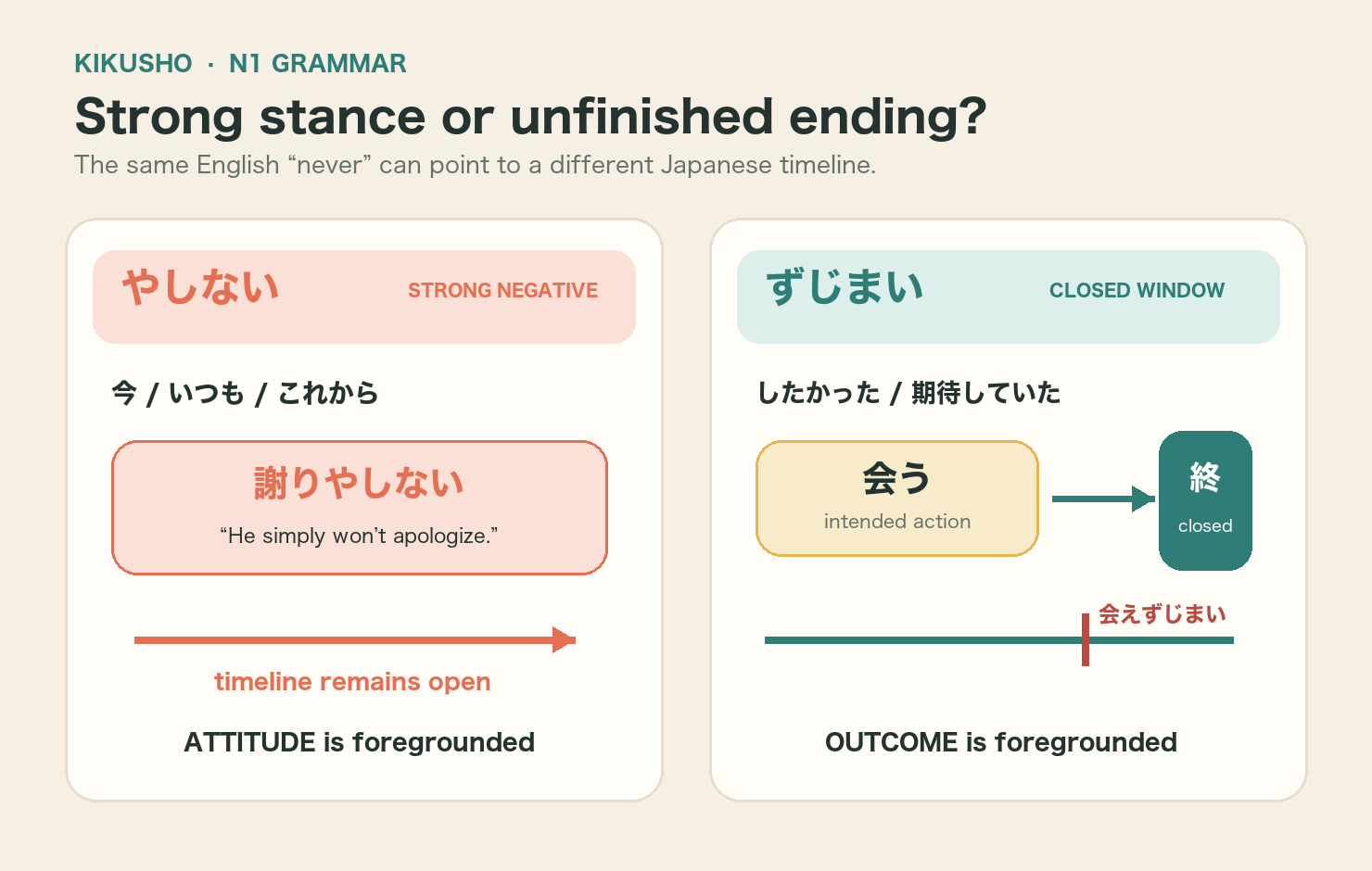
やしない is a forceful “doesn’t,” “won’t” or “could never,” colored by the speaker’s attitude. ずじまい means that a relevant period ended without an intended or expected action being achieved. The first pushes a negative judgment into the present conversation; the second closes a timeline and reports what never happened.
彼は何度頼んでも謝りやしない。
かれは なんど たのんでも あやまりやしない。
No matter how many times you ask, he never apologizes.
転職する前に彼と話したかったが、結局会えずじまいだった。
てんしょくする まえに かれと はなしたかったが、けっきょく あえずじまいだった。
I wanted to speak with him before changing jobs, but in the end I never got to see him.
The first speaker sounds frustrated and predicts or describes continued non-action. The second looks back after the opportunity has passed. Translating both with “never” hides the contrast.
This lesson verifies inventory items g-42507f7e5c07, やしない, and g-8ad94942646f, ずじまい. JLPT Sensei and 絵でわかる日本語 support the strong-negative meaning and ます-stem attachment of やしない. 便利ジャパン describes ずじまい as an intended action ending unrealized and gives せずじまい. There is a placement disagreement: those references teach the targets with N1 material, while 日本語教師のN1et classifies ずじまい as N2. These labels are study guidance rather than an official exhaustive syllabus.
Attitude and endpoint decide the form
| Diagnostic | やしない | ずじまい |
|---|---|---|
| Central meaning | strong negative stance | unrealized outcome |
| Endpoint required | no | yes, stated or understood |
| Typical time view | present, habitual or future | retrospective or still unresolved now |
| Common feeling | frustration, disbelief, defiance | regret, disappointment, unfinished business |
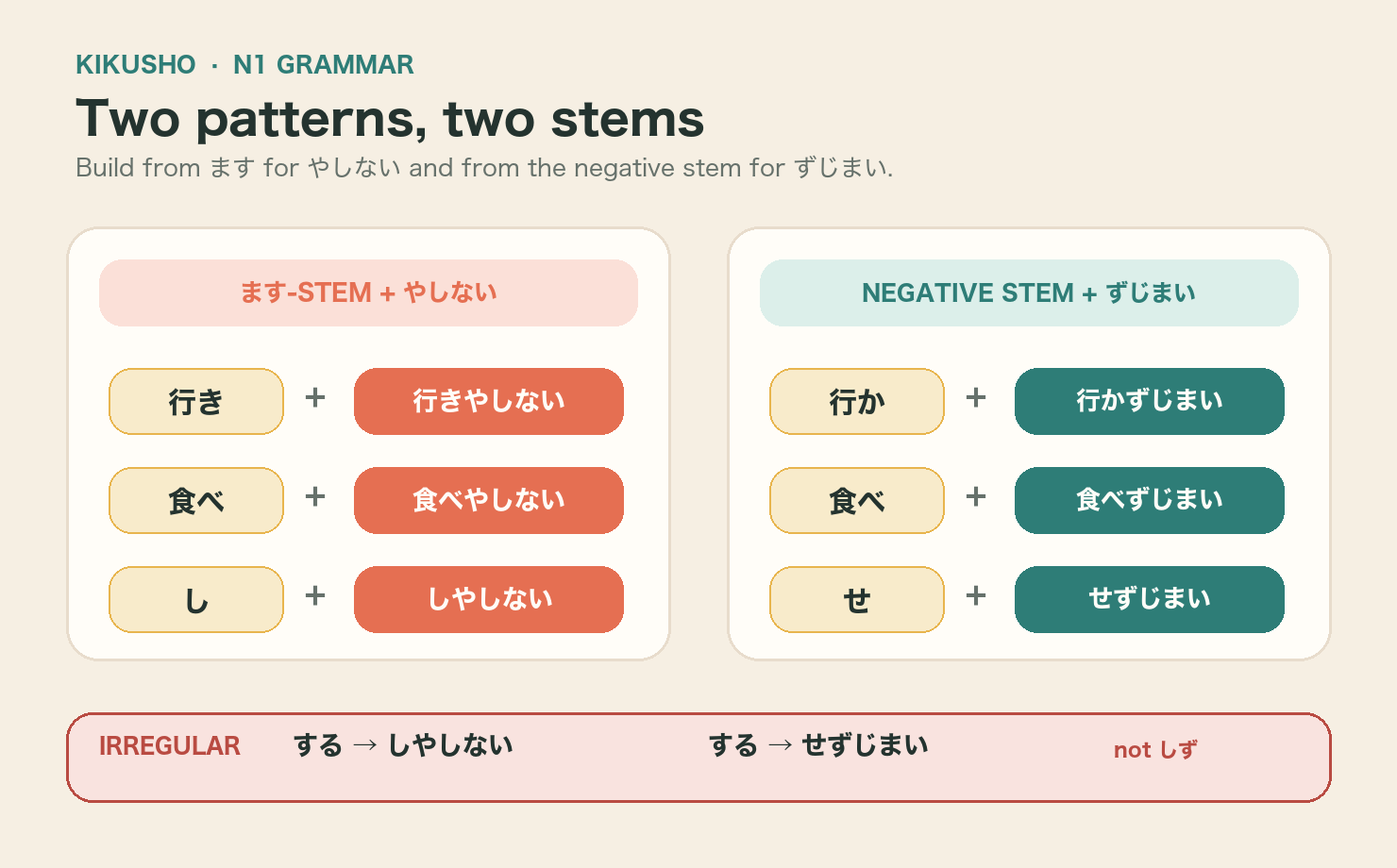
| Attachment | verb ます-stem | negative stem + ず |
With やしない, the speaker rejects an action emphatically:
そんな説明では、誰も納得しやしない。
そんな せつめいでは、だれも なっとくしやしない。
Nobody is ever going to accept an explanation like that.
The discussion has not necessarily ended. The claim can concern a habit, a prediction or what the speaker considers impossible.
With ずじまい, a window closes:
展覧会に行くつもりだったが、忙しくて行かずじまいだった。
てんらんかいに いく つもりだったが、いそがしくて いかずじまいだった。
I meant to visit the exhibition, but I ended up never going.
The exhibition ended, the trip ended, or the speaker gave up. That boundary turns a negative into an unrealized outcome.
やしない uses the ます-stem
| Dictionary form | ます-form | Target form |
|---|---|---|
| 行く | 行きます | 行きやしない |
| 読む | 読みます | 読みやしない |
| 食べる | 食べます | 食べやしない |
| する | します | しやしない |
| 来る | 来ます | 来やしない(きやしない) |
Do not start from the ない-form: 行かやしない and 食べなやしない are wrong for this pattern. Use 行きやしない and 食べやしない.
あの人は人の話を聞きやしない。
あの ひとは ひとの はなしを ききやしない。
That person never listens to anyone.
今さら謝っても、彼女は許しやしないだろう。
いまさら あやまっても、かのじょは ゆるしやしないだろう。
Even if you apologize now, she probably will not forgive you.
A potential verb can be negated too:
こんな重い箱、一人では運べやしない。
こんな おもい はこ、ひとりでは はこべやしない。
There is no way I can carry such a heavy box alone.
Here 運べる → 運べます → 運べやしない negates ability emphatically. やしない itself is not a potential ending.
Strong negation exposes the speaker
Plain ない can report a fact. やしない makes the speaker’s stance audible.
彼は手伝わない。
He does not help.
彼は手伝いやしない。
He never helps at all.
The second can sound irritated or accusatory. It suits dialogue and inner monologue better than a neutral report. It can also express defiance:
こんなことで諦めやしない。
こんな ことで あきらめやしない。
I will never give up over something like this.
The っこない lesson covers a nearby impossibility. できっこない declares success impossible; できやしない forcefully rejects the possibility and may reveal more frustration. They overlap, so voice and context matter.
ずじまい uses the negative stem plus ず
Remove ない from the plain negative and add ずじまい:
| Dictionary form | ない-form | Target form |
|---|---|---|
| 行く | 行かない | 行かずじまい |
| 読む | 読まない | 読まずじまい |
| 食べる | 食べない | 食べずじまい |
| する | しない | せずじまい |
| 来る | 来ない(こない) | 来ずじまい(こずじまい) |
する is irregular: use せずじまい, not しずじまい.
資料を集めたのに、発表はせずじまいだった。
しりょうを あつめたのに、はっぴょうは せずじまいだった。
Although I gathered the materials, I ended up never giving the presentation.
The expression commonly takes だ, だった, になる or で終わる:
その本は買ったまま、読まずじまいになっている。
その ほんは かった まま、よまずじまいに なっている。
I bought that book, but it still remains unread.
名前を聞く機会がなく、誰なのか分からずじまいで終わった。
なまえを きく きかいが なく、だれなのか わからずじまいで おわった。
I never had a chance to ask the name, so it ended without me finding out who it was.
The last example shows that deliberate intention by the grammatical subject is not required. An expected or desired resolution can also fail to arrive.
ずじまい is more than a past negative
昨日は先生に質問しなかった。
きのうは せんせいに しつもんしなかった。
I did not ask the teacher yesterday.
質問しないまま授業が終わった。
しつもんしない まま じゅぎょうが おわった。
The class ended while I still had not asked the question.
聞きたいことがあったのに、質問せずじまいだった。
ききたい ことが あったのに、しつもんせずじまいだった。
Although I had something I wanted to ask, I ended up never asking.
The past negative states a fact. ないまま tracks a continuing state into another event. ずじまい packages the episode as an unrealized ending and often suggests disappointment. The ずに lesson covers the plain written connector; adding じまい supplies the sense of closure.
Regret is common but not compulsory. 結局、その機械は一度も使わずじまいだった may express regret, criticism or a neutral history. The fixed elements are the endpoint and missing realization.
The そびれる and 損なう lesson separates a missed chance from a failed attempt. 言いそびれた focuses on one missed moment; 言わずじまいだった views the whole period as ending without the statement.
Keep the same verb and change the timeline
彼は本当の理由を話しやしない。
かれは ほんとうの りゆうを はなしやしない。
He simply will not tell us the real reason.
The speaker complains about his current refusal. The chance to speak may remain.
彼は本当の理由を話さずじまいで会社を辞めた。
かれは ほんとうの りゆうを はなさずじまいで かいしゃを やめた。
He left the company without ever telling us the real reason.
Leaving closes the relevant window. Use the “still possible?” test for やしない and the “window closed?” test for ずじまい.
Practice: track stance, stem and endpoint
Question 1 — irritated habit. A manager complains that one employee never reads the instructions. Which ending carries that frustration?
彼は説明書を読み( )。
A. ずじまいだった
B. やしない
C. ないまま
D. そびれた
Question 2 — closed opportunity. The exhibition has ended, and the speaker intended to visit.
忙しくて、結局展覧会には行か( )。
A. やしない
B. ずじまいだった
C. っこないだ
D. ずにはいられなかった
Question 3 — two stems. Which pair is correctly formed?
A. 読まやしない/読みずじまい
B. 読みやしない/読まずじまい
C. 読むやしない/読まないずじまい
D. 読めやしない/読みずじまい
Question 4 — irregular する. Fill both blanks.
彼は準備を____。私は準備したのに、発表は____だった。
Question 5 — guaranteed meaning. What must be true in 名前を聞けずじまいだった?
A. The speaker disliked the name.
B. The speaker will never ask anyone’s name again.
C. The relevant opportunity ended without the name being asked.
D. The speaker deliberately refused to ask.
Question 6 — open timeline. You are still waiting and angrily predict that Ken will not come. Which sentence fits?
A. 健は来やしないよ。
B. 健は来ずじまいだった。
C. 健は来ないまま終わった。
D. 健は来そびれたよ。
Keep the scene at the station in mind: the waiting window has not closed yet.
Question 7 — sentence pair. Use one verb twice: first with やしない for a forceful present, habitual or future negative, then with ずじまい after a clear endpoint.
Answers and explanations
Question 1
B. やしない. 読み + やしない expresses an emphatic complaint about a habit. A would need a completed episode, while C needs a following event.
Question 2
B. ずじまいだった. The exhibition’s end closes the opportunity, and 結局 supports the unrealized outcome. The connection is 行か + ずじまい.
Question 3
B. 読みやしない/読まずじまい. やしない uses 読み, the ます-stem. ずじまい uses the negative stem 読ま plus ず.
Question 4
彼は準備をしやしない。私は準備したのに、発表はせずじまいだった。
かれは じゅんびを しやしない。わたしは じゅんびしたのに、はっぴょうは せずじまいだった。
He never prepares. Although I prepared, I ended up never giving the presentation.
する gives しやしない with the ます-stem, but せずじまい with ず.
Question 5
C. The relevant period ended without the speaker managing to ask. Regret is likely, but dislike, permanent refusal and deliberate choice are not guaranteed.
Question 6
A. 健は来やしないよ。 The waiting period remains open, and the speaker forcefully predicts non-arrival. B and C look back after an endpoint.
Question 7
彼は何度頼んでも返事を書きやしない。
かれは なんど たのんでも へんじを かきやしない。
No matter how often I ask, he never writes a reply.
連絡先を失くしてしまい、結局返事を書かずじまいだった。
れんらくさきを なくしてしまい、けっきょく へんじを かかずじまいだった。
I lost the contact details and in the end never got to write a reply.
書き is the ます-stem and carries the forceful stance; 書か + ずじまい closes the failed episode.
Keep the timeline visible
Choose やしない when the speaker forcefully rejects an action or possibility and no closed episode is required. Choose ずじまい when an expected action or resolution remains absent at the end of its relevant window. The English word “never” is only the surface; attitude versus endpoint is the real decision.
Common questions
What is the difference between やしない and ずじまい?
やしない forcefully says that an action does not or will not happen, often with frustration. ずじまい looks back on an opportunity or expectation that ended without the action being achieved.
How do you form やしない?
Add やしない to the verb’s ます-stem: 行きやしない, 食べやしない, しやしない and 来やしない, read きやしない.
How do you form ずじまい?
Remove ない from the negative form and add ずじまい: 行かずじまい and 読まずじまい. The irregular forms are せずじまい and 来ずじまい, read こずじまい.
Does ずじまい always express regret?
It often suggests regret or unfinished business, but its essential meaning is that the relevant period ended without the expected action occurring.