On this page
はどうであれ means that a conclusion stays the same whatever a variable turns out to be. はさておき means that a topic is being put aside for now so the speaker can move to a different priority. Both can become “regardless of” in English, but they organize the argument differently.
結果はどうであれ、この経験は無駄にならない。
けっかは どうであれ、この けいけんは むだに ならない。
Whatever the result, this experience will not be wasted.
結果はさておき、準備の過程を振り返ろう。
けっかは さておき、じゅんびの かていを ふりかえろう。
Let’s put the result aside and review the preparation process.
The first sentence covers every possible result and says none changes the value of the experience. The second does not say the result is irrelevant forever. It changes the agenda: the result can wait while the process receives attention.
This lesson verifies inventory items g-af74ddca3564, はどうであれ, and g-8b6b9554cde6, はさておき. JLPT Sensei’s はどうであれ reference supports the noun frame, variants such as 何であれ and its N1 study placement. Bunpro’s はさておき explanation independently describes the move from one topic to a more important one and gives both noun and かどうか attachments. A level disagreement matters here: JLPT Sensei presents はさておき as N1, while 日本語NET teaches it as N2. These labels are study guidance; the present JLPT does not publish an exhaustive grammar-item syllabus.
One removes influence; the other redirects attention
The easiest test is to ask what happens to A.
| Pattern | What happens to A? | Relationship to B |
|---|---|---|
| Aはどうであれ、B | A may take any value | B stays true for every value |
| Aはさておき、B | A is suspended in this discussion | B becomes the current focus |
With はどうであれ, imagine a dial that can move through several settings. The statement after the comma does not change:
天候はどうであれ、式は予定どおり行います。
てんこうは どうであれ、しきは よていどおり おこないます。
Whatever the weather, we will hold the ceremony as scheduled.
Sunny, rainy or windy: the same decision applies. The weather is an irrelevant variable for this decision.
With はさておき, imagine moving a file from the center of a desk to a tray marked “later”:
天候の問題はさておき、まず会場を決めましょう。
てんこうの もんだいは さておき、まず かいじょうを きめましょう。
Let’s set the weather issue aside and decide on the venue first.
The weather may still affect the event. The speaker only decides that it is not the next item to discuss.
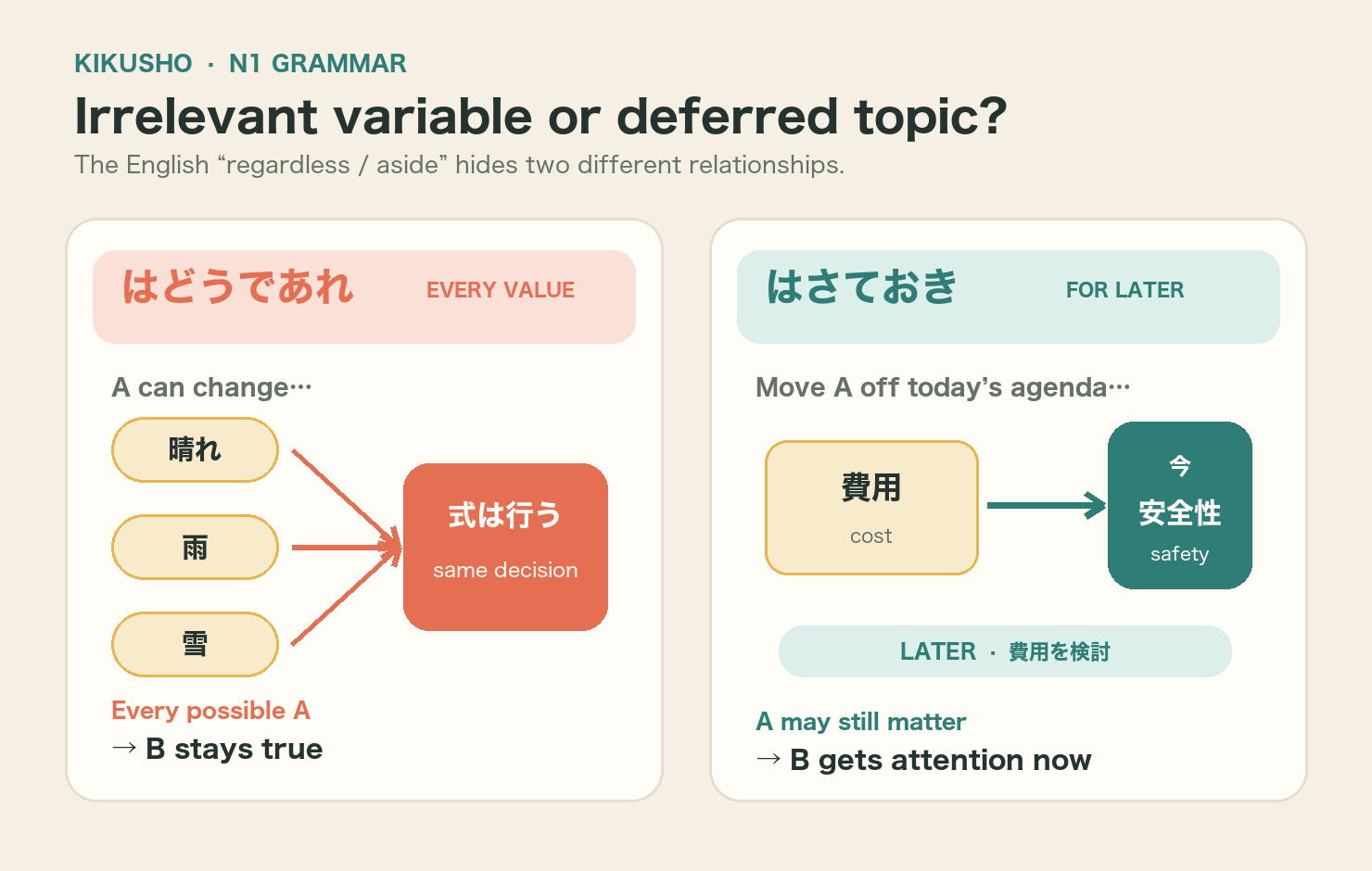
はどうであれ keeps the conclusion invariant
The core frame is:
noun + は/が + どう(で)あれ、unchanged conclusion
Common nouns name results, reasons, circumstances, positions or evaluations:
理由はどうであれ、無断で資料を持ち出してはいけない。
りゆうは どうであれ、むだんで しりょうを もちだしては いけない。
Whatever the reason, you must not remove the documents without permission.
評価がどうであれ、この方針は変えない。
ひょうかが どうであれ、この ほうしんは かえない。
Whatever the evaluation, we will not change this policy.
The particle は presents the variable contrastively; が can present its condition more neutrally. The target relationship comes from どうであれ: B survives all possible states of A.
The で may be omitted in the set form どうあれ:
結果はどうあれ、報告は必要だ。
けっかは どうあれ、ほうこくは ひつようだ。
Whatever the result, a report is necessary.
For learning and controlled production, どうであれ makes the connection to である easier to see. It is formal and assertive. In ordinary conversation, どうであっても, どんな結果でも or a specific ても sentence may sound less ceremonial.
Related question-word frames remove another kind of distinction:
誰であれ、規則を守らなければならない。
だれであれ、きそくを まもらなければ ならない。
Whoever it is, they must follow the rules.
理由が何であれ、事前に連絡してください。
りゆうが なんであれ、じぜんに れんらくして ください。
Whatever the reason, please contact us in advance.
These share the formal であれ family. The であれ and たりとも lesson develops concession with nouns and extreme minimum cases; here the important signal is どう, which ranges over possible states.
はさておき changes the agenda
The basic frame is:
noun + はさておき/はさておいて、new focus
費用はさておき、この案が実現可能かを確認しよう。
ひようは さておき、この あんが じつげん かのうかを かくにんしよう。
Leaving the cost aside, let’s check whether this proposal is feasible.
細かい表現はさておいて、まず論理の流れを直してください。
こまかい ひょうげんは さておいて、まず ろんりの ながれを なおして ください。
Put the small wording issues aside and fix the logical flow first.
さておき is the conjunctive form of さておく; さておいて makes the linking form more explicit. Both introduce what comes next. The first matter is not proved unimportant, false or permanently irrelevant. The speaker puts it outside the current scope.
The construction can manage a conversation politely:
私の感想はさておき、利用者の反応を見てみましょう。
わたしの かんそうは さておき、りようしゃの はんのうを みてみましょう。
My impressions aside, let’s look at the users’ reactions.
It can also sound dismissive if the first matter matters to the listener:
あなたの事情はさておき、期限は守ってください。
あなたの じじょうは さておき、きげんは まもって ください。
Your circumstances aside, please meet the deadline.
The grammar is correct, but the speaker openly deprioritizes the listener’s circumstances. In sensitive contexts, acknowledge the concern before redirecting: 事情は理解しています。そのうえで、期限について相談させてください。
A whether-clause can take either pattern
Both expressions can follow a question embedded with かどうか, so attachment alone cannot decide between them:
成功するかどうかはどうであれ、挑戦する価値はある。
せいこうするか どうかは どうであれ、ちょうせんする かちは ある。
Whether it succeeds or not, it is worth attempting.
成功するかどうかはさておき、まず試作品を作ろう。
せいこうするか どうかは さておき、まず しさくひんを つくろう。
Leaving aside whether it will succeed, let’s build a prototype first.
In the first, both answers—success and failure—leave 挑戦する価値はある intact. In the second, the success question is premature; building the prototype is the present task.
Use the full embedded-question boundary:
[成功するかどうか] + はどうであれ/はさておき
Do not attach either pattern directly to a finite verb:
✕ 成功するはどうであれ
✕ 成功するはさておき
Turn the proposition into a question with かどうか, or choose a noun such as 成功の可能性.
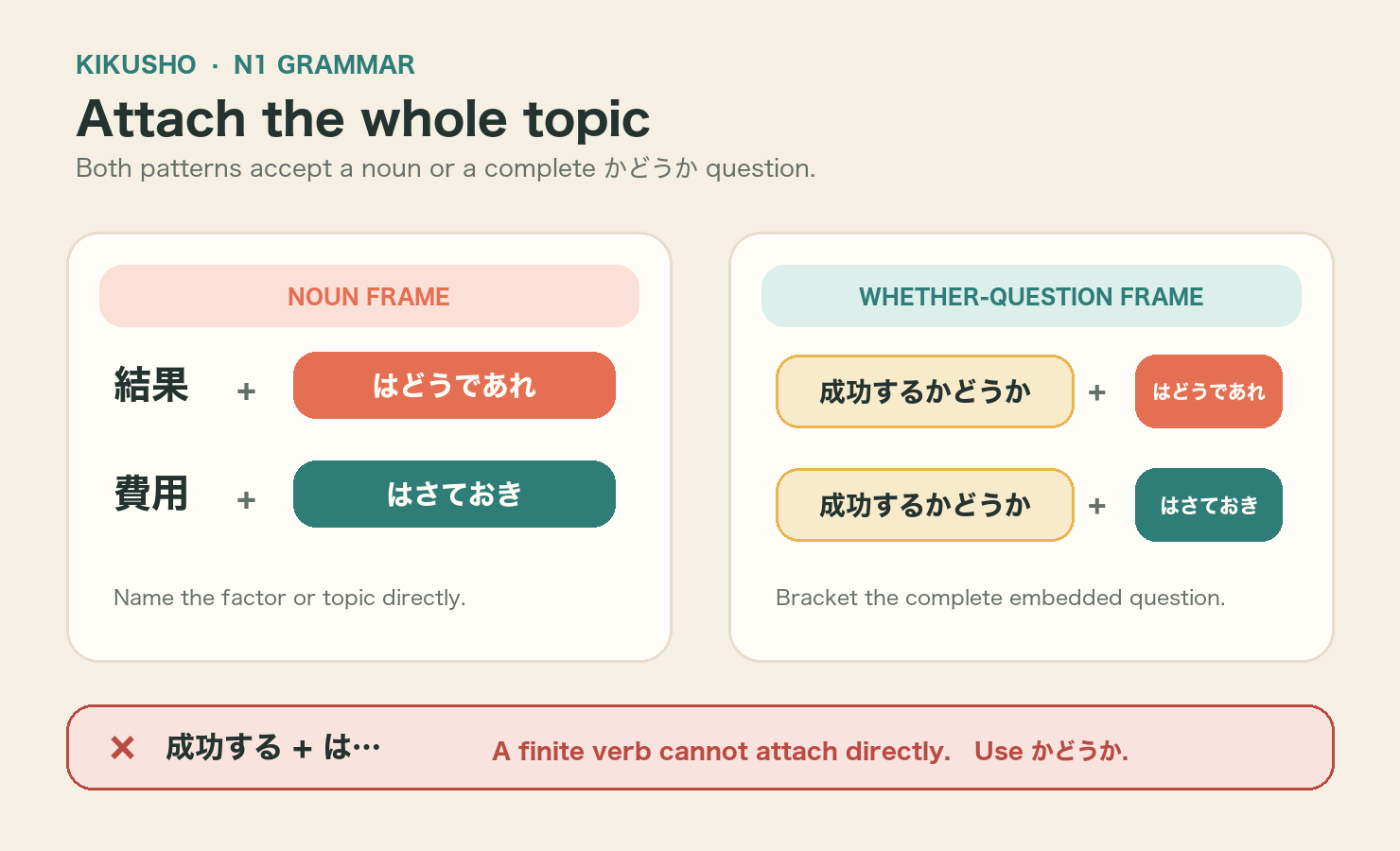
The same noun can reveal the contrast
Keeping the noun constant makes the logical difference visible:
値段はどうであれ、必要な部品なら購入します。
ねだんは どうであれ、ひつような ぶひんなら こうにゅうします。
Whatever the price, we will buy it if it is a necessary part.
This is a strong claim: price does not change the purchase decision. A realistic speaker should use it only if every price is truly meant, or if rhetorical force is deliberate.
値段はさておき、この部品が安全基準を満たすか確認しましょう。
ねだんは さておき、この ぶひんが あんぜん きじゅんを みたすか かくにんしましょう。
Put the price aside for now and check whether this part meets the safety standard.
Price can return after the safety check. The sentence establishes an order of attention, not indifference to cost.
Try the “later” test. If Aについては後で考える preserves the intention, はさておき is likely. Try the “every value” test. If Aがどんな状態でもB preserves the intention, はどうであれ is likely.
| Intended thought | Better choice |
|---|---|
| Every possible result leaves my decision unchanged | 結果はどうであれ |
| We will discuss the result after the process | 結果はさておき |
| Every reason leads to the same prohibition | 理由はどうであれ |
| The reason can wait while we help the injured person | 理由はさておき |
Nearby expressions do not erase the distinction
にかかわらず can also make a condition irrelevant:
天候にかかわらず、試合を行います。
てんこうに かかわらず、しあいを おこないます。
The match will be held regardless of the weather.
This overlaps with 天候はどうであれ. にかかわらず is common in rules and policies; はどうであれ can sound more like a speaker’s emphatic principle. The にかかわらず and を問わず comparison covers condition-neutral rules and category-neutral eligibility.
はともかく is close to はさておき because both bracket A:
味はともかく、見た目はきれいだ。
あじは ともかく、みためは きれいだ。
Whatever one may say about the taste, it looks attractive.
はともかく often withholds evaluation of A while commenting on B. はさておき more vividly manages the agenda: “put A aside and move to B.” The はもとより and はともかく lesson contrasts bracketing with inclusive emphasis.
Do not choose by English translation alone. “Regardless of the result” can describe invariance, while “result aside” can describe a topic switch. Identify the relationship the Japanese sentence needs.
Practice: keep every answer until the panel
Question 1 — invariant conclusion. Which option makes the prohibition survive every possible reason?
理由( )、他人のデータを無断で使ってはいけない。
A. はさておき
B. はどうであれ
C. に入らない
D. に先立って
Question 2 — agenda management. The team will discuss cost later and must check safety now. Which expression matches that order of attention?
費用( )、まず安全性を確認しましょう。
A. はどうであれ
B. はさておき
C. であれ~であれ
D. にもかかわらず
Question 3 — whether-clause attachment. Which sentence is grammatical and matches “Whether it is adopted or not, the research remains valuable”?
A. 採用するはどうであれ、この研究には価値がある。
B. 採用されるかどうかはどうであれ、この研究には価値がある。
C. 採用されるどうかはさておき、この研究には価値がある。
D. 採用されるかはさておくで、この研究には価値がある。
Question 4 — what remains possible? After hearing 納期はさておき、品質を確認しよう, what can still happen later?
A. The deadline can still be discussed.
B. The deadline can never affect any decision.
C. Quality has already been rejected.
D. Every possible deadline has been approved.
Question 5 — strengthen the logic. Rewrite the first clause so that the sentence means “No matter what the evaluation is, I will publish the data.”
評価____、私はデータを公開する。
Question 6 — social meaning. A colleague has explained a family emergency. Which reply redirects the discussion without bluntly discarding that concern?
A. 家庭の事情はさておき、期限を守ってください。
B. 理由はどうであれ、言い訳です。
C. 事情は理解しました。そのうえで、期限をどう調整するか相談しましょう。
D. 家庭の事情はどうあれ、関係ありません。
Question 7 — sentence creation. Write two sentences about one project. In the first, use はどうであれ to state a conclusion that survives every possible result. In the second, use はさておき to postpone one question and name the present priority.
Answers and explanations
Question 1
B. はどうであれ. The prohibition remains valid for every possible reason. はさておき would only postpone discussion of the reason and would not by itself express the same universal rule.
Question 2
B. はさておき. Cost remains a real issue, but the team moves it out of the current discussion to focus on safety. はどうであれ would claim that cost never changes the relevant conclusion, which is stronger than the context allows.
Question 3
B. 採用されるかどうかはどうであれ、この研究には価値がある。 The complete embedded question is 採用されるかどうか; はどうであれ then says that either answer leaves the research’s value intact. A attaches directly to a finite verb, C lacks か, and D uses an invalid ending.
Question 4
A. The deadline can still be discussed. はさておき places it aside within the current agenda. It does not establish that deadlines are irrelevant in every possible state.
Question 5
One complete answer is:
評価がどうであれ、私はデータを公開する。
ひょうかが どうであれ、わたしは データを こうかいする。
Whatever the evaluation, I will publish the data.
評価はどうであれ is also possible with a contrastive topic. In both versions, publication remains constant across possible evaluations.
Question 6
C. It acknowledges the circumstances, then introduces the practical issue to negotiate. A, B and D are grammatically possible in suitable settings, but each dismisses the colleague’s explanation and would sound needlessly harsh here.
Question 7
One possible pair is:
審査の結果はどうであれ、報告書は公開します。
しんさの けっかは どうであれ、ほうこくしょは こうかいします。
Whatever the review result, we will publish the report.
審査の結果はさておき、今はデータの誤りを直しましょう。
しんさの けっかは さておき、いまは データの あやまりを なおしましょう。
Put the review result aside for now; let’s correct the data errors.
Check the logic, not only the form. The first conclusion must hold for every result. The second sentence must leave one question available for later while naming a current focus.
Keep one decision rule
Use はどうであれ when B remains true across every possible value of A. Use はさておき when A may still matter, but B deserves attention first. If “whatever A is” preserves the claim, choose the invariant form. If “we can return to A later” preserves the plan, choose the agenda-setting form.
Common questions
What is the difference between はどうであれ and はさておき?
はどうであれ says the conclusion remains true whatever value the first factor takes. はさておき temporarily leaves the first topic for later so the speaker can focus on a different priority now.
What does はどうであれ mean?
It means “whatever” or “regardless of how.” In 結果はどうであれ、努力は無駄ではない, every possible result leaves the conclusion unchanged.
What does はさておき mean?
It means “leaving aside” or “setting aside for now.” The speaker brackets one topic and moves the discussion to something more relevant or urgent.
Can both patterns follow かどうか?
Yes. A whether-clause can be followed by either expression, but the logic still differs: はどうであれ makes either answer irrelevant to the result, while はさておき postpones that question in the present discussion.