On this page
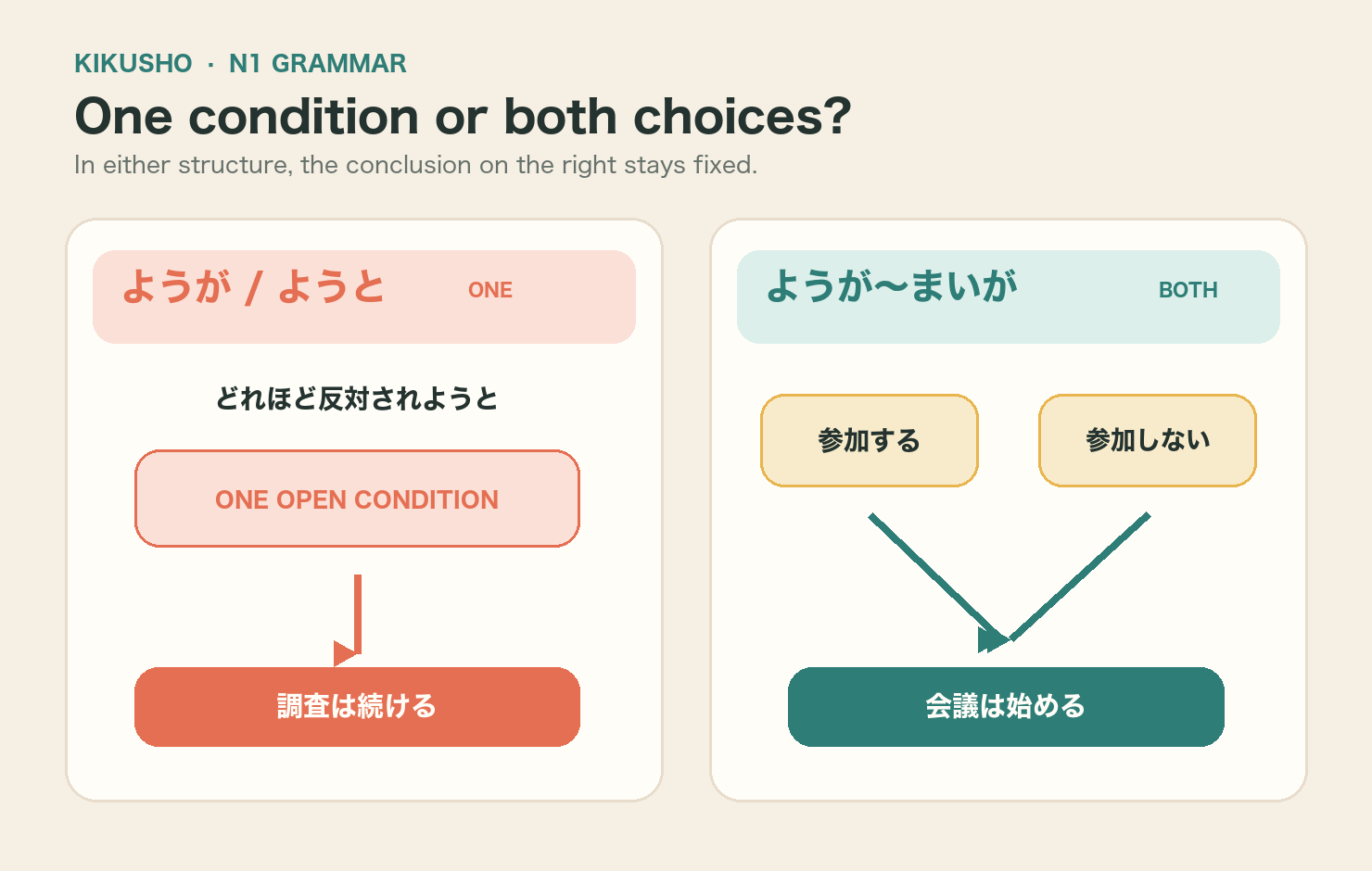
V-volitional + ようが/ようと presents one condition and says the following conclusion survives it. V-volitional + ようが~V-dictionary + まいが, or the matching と pair, explicitly covers both doing and not doing the action. Both express indifference to a condition, but the paired form closes the yes-or-no set.
何を言われようが、方針は変えない。
なにを いわれようが、ほうしんは かえない。
No matter what I am told, I will not change the policy.
彼が参加しようが参加するまいが、会議は予定どおり開く。
かれが さんかしようが さんかするまいが、かいぎは よていどおり ひらく。
Whether he participates or not, the meeting will take place as scheduled.
The first sentence selects an extreme or unrestricted condition: whatever people say. The second names the two exhaustive alternatives, participation and non-participation. In both, the clause after the comma remains fixed.
This lesson verifies inventory items g-9241b404c085, ようが/ようと, and g-601bdac5210e, ようと~まいと/ようが~まいが. JLPT Sensei’s single-condition lesson and 日本語NET support the concessive meaning and volitional attachment. Bunpro and 絵でわかる日本語 independently explain the affirmative-versus-negative pair. These teaching references consistently place the target uses with N1 material; the level remains study guidance because the present JLPT publishes no exhaustive item syllabus.
One condition or both sides of a choice
| Shape | What A contributes | What happens to B |
|---|---|---|
| Aようが/Aようと(も)、B | one extreme, unknown or unrestricted condition | B still holds |
| AようがAまいが、B | A happens or does not happen | B holds in both cases |
| AようとAまいと、B | the same two-case set with と | B holds in both cases |
どれほど時間がかかろうと、最後まで調べる。
どれほど じかんが かかろうと、さいごまで しらべる。
No matter how long it takes, I will investigate to the end.
The duration may take any value. The sentence does not need to say “take time or not take time”; a single concessive condition is enough.
時間がかかろうがかかるまいが、確認の手順は省けない。
じかんが かかろうが かかるまいが、かくにんの てじゅんは はぶけない。
Whether it takes time or not, the checking procedure cannot be omitted.
This version deliberately contrasts the positive and negative alternatives. It fits a binary issue: time-consuming or not.
Build the single concessive from the volitional form
For verbs, use the ordinary volitional form, then が, と or とも:
| Verb | Volitional | Concessive form |
|---|---|---|
| 行く | 行こう | 行こうが/行こうと |
| 読む | 読もう | 読もうが/読もうと |
| 食べる | 食べよう | 食べようが/食べようと |
| する | しよう | しようが/しようと |
| 来る | 来よう(こよう) | 来ようが/来ようと |
誰が反対しようとも、必要な情報は公開する。
だれが はんたいしようとも、ひつような じょうほうは こうかいする。
No matter who objects, we will publish the necessary information.
The optional も reinforces the concessive reading after と. Do not confuse this よう with the noun よう(様) in resemblance or purpose expressions. Here it is the verb’s volitional ending.
Adjectives and nouns use formal conjectural forms in the broader single-condition family:
どんなに高かろうが、不要な物は買わない。
どんなに たかかろうが、ふような ものは かわない。
No matter how expensive it may be, I will not buy something unnecessary.
相手が専門家だろうと、根拠の確認は必要だ。
あいてが せんもんかだろうと、こんきょの かくにんは ひつようだ。
Even if the other person is an expert, the evidence still needs checking.
高かろう and 専門家だろう are formal in this use. In ordinary conversation, どんなに高くても and 専門家でも are often more natural. The N1 forms suit written argument, forceful declarations and formal narration.
The paired form repeats the same verb
The clearest templates are:
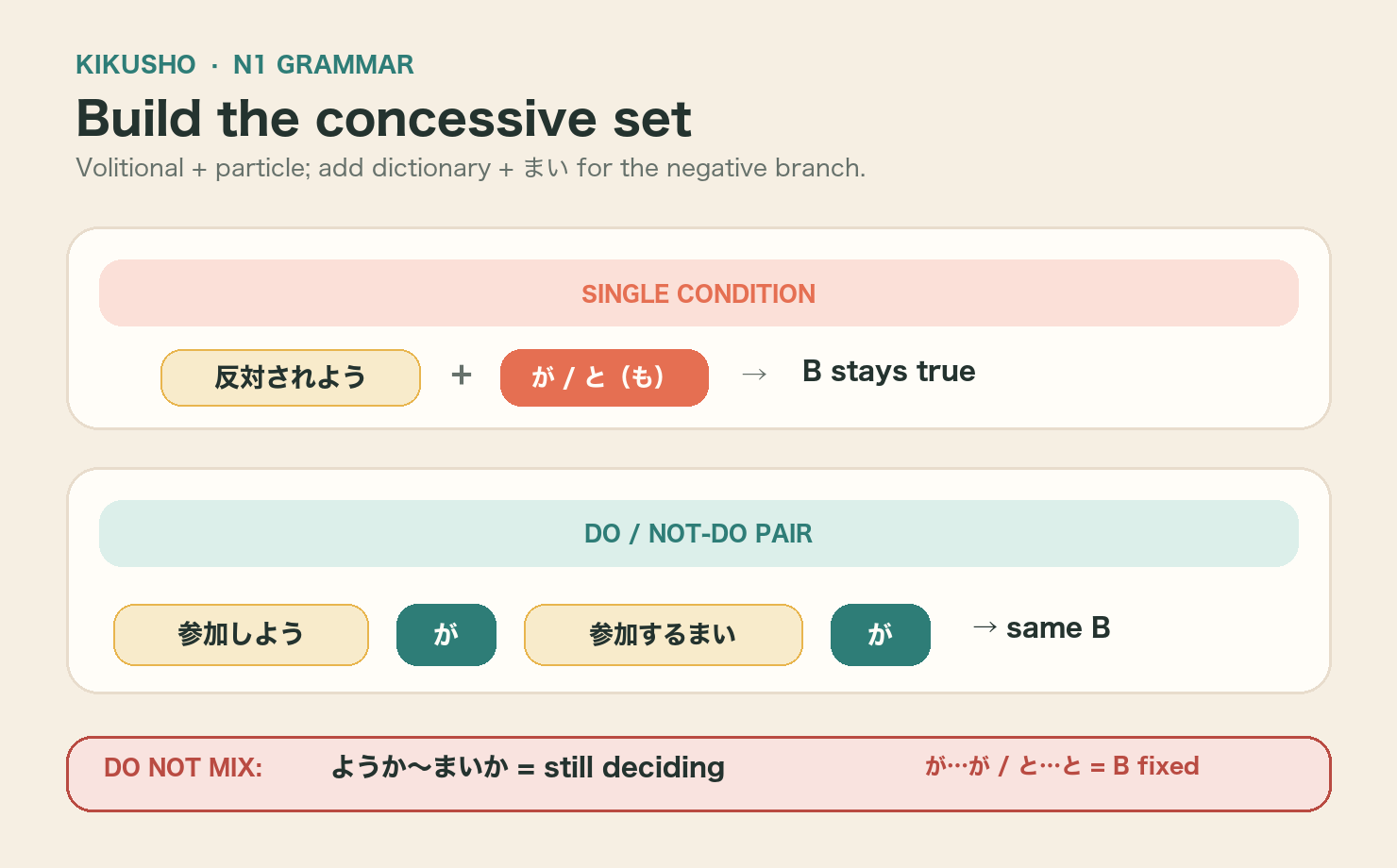
V-volitional + が + V-dictionary + まいが、B
V-volitional + と + V-dictionary + まいと、B
食べようが食べまいが、料金は同じだ。
たべようが たべまいが、りょうきんは おなじだ。
Whether you eat or not, the price is the same.
本人が認めようと認めまいと、記録は残っている。
ほんにんが みとめようと みとめまいと、きろくは のこっている。
Whether the person admits it or not, the record remains.
Repeat the lexical verb. The first half is affirmative volitional; the second uses the dictionary form plus まい. Keeping the particle matched makes the pair transparent: が…が or と…と.
Common irregular and easily confused forms include:
| Verb | Affirmative side | Negative side |
|---|---|---|
| する | しようが | するまいが/しまいが |
| 来る | 来ようが(こようが) | 来まいが(こまいが) |
| 見る | 見ようと | 見まいと |
For controlled production, するまい is the easiest transparent form. しまい also occurs, but do not confuse it with 仕舞い or the result pattern ずじまい.
まい does not make B negative
In the pair, まい negates only the second A alternative. The following clause can be positive or negative:
雨が降ろうが降るまいが、祭りは行う。
あめが ふろうが ふるまいが、まつりは おこなう。
Whether it rains or not, the festival will be held.
雨が降ろうが降るまいが、予定は変えない。
あめが ふろうが ふるまいが、よていは かえない。
Whether it rains or not, we will not change the schedule.
The construction asserts invariance, not negativity. まい supplies “not A” so that the pair covers both possibilities.
The later clause often contains a decision, rule, evaluation or inevitable result. If B changes depending on A, this construction is logically wrong:
✕ 雨が降ろうが降るまいが、降ったら中止する。
The final clause now says rain does matter. A natural version is 雨が降ったら中止する, without an indifference frame.
Do not confuse が with か
Changing one particle changes the job of the sentence:
留学しようかするまいか、まだ迷っている。
りゅうがくしようか するまいか、まだ まよっている。
I am still wondering whether to study abroad or not.
留学しようがするまいが、申請期限は確認しておくべきだ。
りゅうがくしようが するまいが、しんせい きげんは かくにんしておくべきだ。
Whether you study abroad or not, you should check the application deadline.
ようか~まいか leaves the choice undecided and commonly leads to 迷う, 考える or 決める. ようが~まいが says B is already independent of that choice. The まい and ようか~まいか lesson develops negative intention and deliberation separately.
The paired form also differs from two positive alternatives:
賛成しようが反対しようが、結果は公表する。
Whether they agree or oppose, we will publish the result.
This gives A versus B. 賛成しようが賛成するまいが gives A versus not-A. The とも~とも and ようが~ようが lesson compares positive alternatives with unresolved labels.
Match the force to the setting
These forms can sound resolute:
周囲に笑われようが、私は研究を続ける。
しゅういに わらわれようが、わたしは けんきゅうを つづける。
Even if people around me laugh, I will continue my research.
They can also sound cold when a person’s wishes are declared irrelevant:
本人が望もうが望むまいが、計画は進める。
Grammatically, the decision survives either preference. Socially, the sentence announces that the person has no influence. In collaborative settings, state the constraint and acknowledge the concern instead of using a sweeping indifference form unless that force is intended.
Practice: identify the condition set
Question 1 — one extreme condition. Which ending means “No matter what anyone says, I will go”?
誰に何を言われ( )、私は行く。
A. ようが
B. まいか
C. ずじまいで
D. たところでない
Question 2 — exhaustive yes or no. Complete the sentence with the transparent pair.
彼が来____、会議は始める。
A. ようか来まいか
B. ようが来まいが
C. ても来なくてもか
D. るが来ないが
Question 3 — matched particles. Which form follows the standard paired template?
A. 読もうが読むまいと
B. 読もうと読むまいと
C. 読むと読もうまいと
D. 読もうか読むまいが
Question 4 — する. Write the が…が pair meaning “whether they participate or not,” using 参加する.
Question 5 — logic check. Which sentence contradicts its own indifference frame?
A. 高かろうが、必要なら買う。
B. 参加しようと参加しまいと、資料は全員に送る。
C. 雨が降ろうが降るまいが、雨なら中止する。
D. 誰が反対しようとも、記録は公開する。
Question 6 — deliberation or invariance. You have not decided whether to accept a job. Select the form that keeps the choice open.
A. 引き受けようが引き受けまいが、迷っている。
B. 引き受けようか引き受けまいか、迷っている。
C. 引き受けようと引き受けまいと、迷っている。
D. 引き受けずじまいか、迷っている。
Pause on the difference between an open decision and a conclusion already fixed.
Question 7 — sentence pair. Write one sentence with a single ようが/ようと(も) condition, then another with ようが~まいが or ようと~まいと for both doing and not doing the same action.
Answers and explanations
Question 1
A. ようが. 言われる → 言われよう is the passive volitional form. The following decision, 私は行く, survives whatever is said.
Question 2
B. ようが来まいが. The complete sentence is 彼が来ようが来まいが、会議は始める. Read the two forms as こようが/こまいが.
Question 3
B. 読もうと読むまいと. It keeps と on both sides and repeats the verb as affirmative volitional plus dictionary form + まい.
Question 4
参加しようが参加するまいが
さんかしようが さんかするまいが
whether they participate or not
参加しまいが is also attested, but 参加するまいが displays the dictionary-form connection most clearly.
Question 5
C. The opening claims that rain and no rain lead to the same result, but the final clause makes cancellation depend on rain. Remove the concessive pair or make B genuinely invariant.
Question 6
B. 引き受けようか引き受けまいか、迷っている. か…か presents the undecided alternatives. The が and と pairs instead announce that a later conclusion does not depend on the choice.
Question 7
One possible pair is:
どれほど反対されようと、調査は続ける。
どれほど はんたいされようと、ちょうさは つづける。
No matter how strongly people object, I will continue the investigation.
委員が賛成しようが賛成するまいが、調査結果は公表する。
いいんが さんせいしようが さんせいするまいが、ちょうさ けっかは こうひょうする。
Whether the committee members agree or not, we will publish the findings.
The first selects one unrestricted condition. The second explicitly covers agreement and non-agreement.
Count the alternatives before choosing
Use ようが/ようと(も) when one extreme or unrestricted condition cannot alter B. Use ようが~まいが/ようと~まいと when you want to say that both doing and not doing A leave B unchanged. If the speaker is still deciding, change the connector to か and use ようか~まいか instead. EOF
Remove accidental patch-style leading plus signs if present.
sed -i '' 's/^+//' content/blog/you-ga-you-to-mai-to-regardless.md
Common questions
What does ようが or ようと mean in Japanese?
After a volitional form, ようが or ようと means “even if” or “no matter.” It presents a condition that does not change the following decision or result.
What does ようが~まいが mean?
It explicitly covers both doing and not doing an action: V-volitional + が + V-dictionary + まいが. The conclusion stays true under either choice.
Are ようが~まいが and ようと~まいと different?
Their core meaning is the same. Keep が with が or と with と. と may also appear as とも in the single-condition form.
How is ようか~まいか different?
ようか~まいか presents a decision still under consideration: whether to do something or not. ようが~まいが says the later conclusion is unaffected by either alternative.