On this page
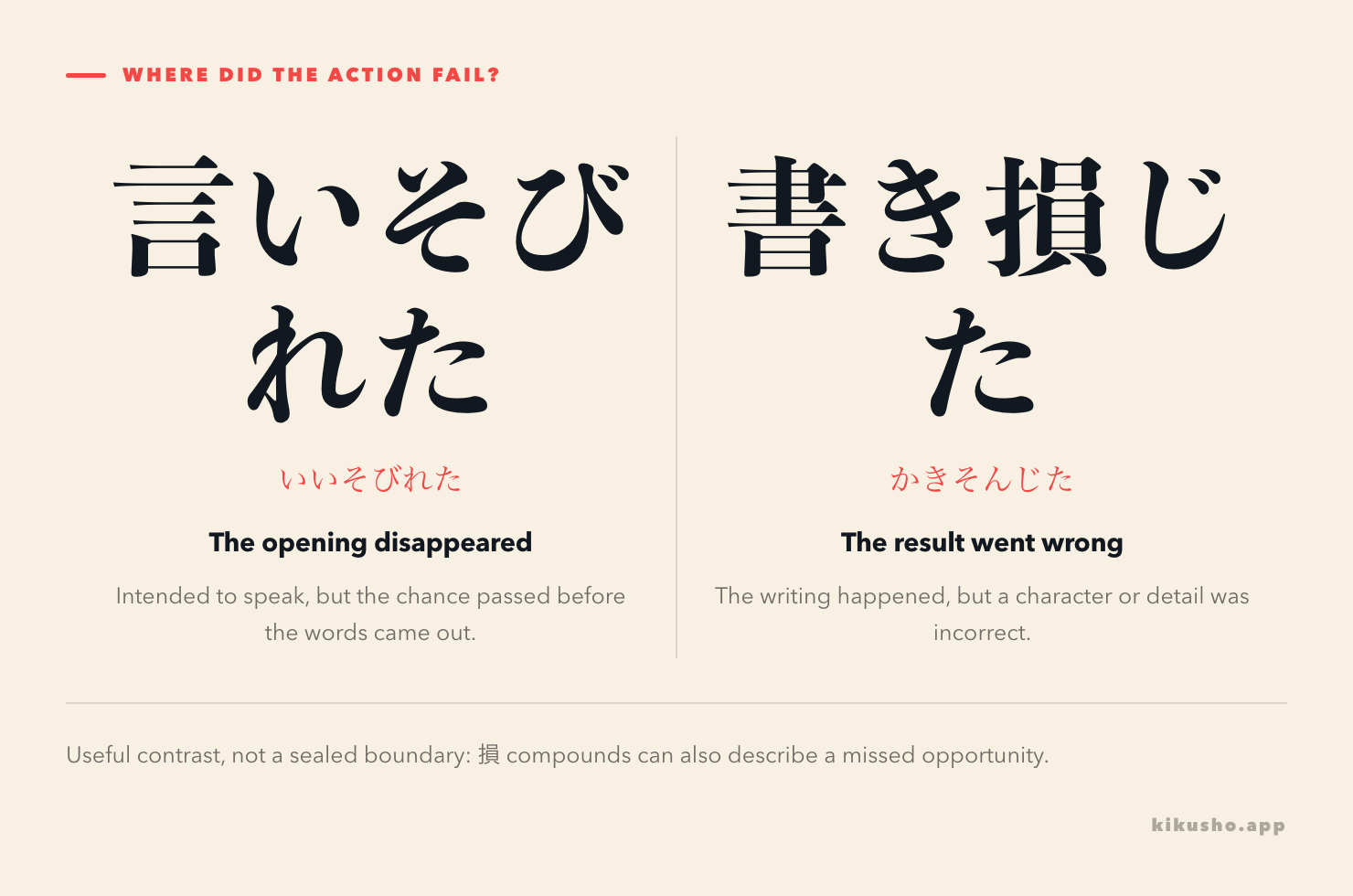
言いそびれた means that the chance to say something slipped away. 書き損じた means that the writing went wrong. Both constructions attach to a verb stem and report a failure, but they locate that failure at different points in the action.
お礼を言おうと思っていたが、帰り際に言いそびれた。
おれいをいおうとおもっていたが、かえりぎわにいいそびれた。
I meant to thank them, but I missed the chance as we were leaving.
申込書に電話番号を書き損じた。
もうしこみしょにでんわばんごうをかきそんじた。
I wrote the phone number incorrectly on the application form.
The first action never found its moment. The second action took place but did not produce the intended result. That contrast is the safest starting point, although 損なう/損ねる can also cover a missed opportunity.
Build all four forms from the ます-stem
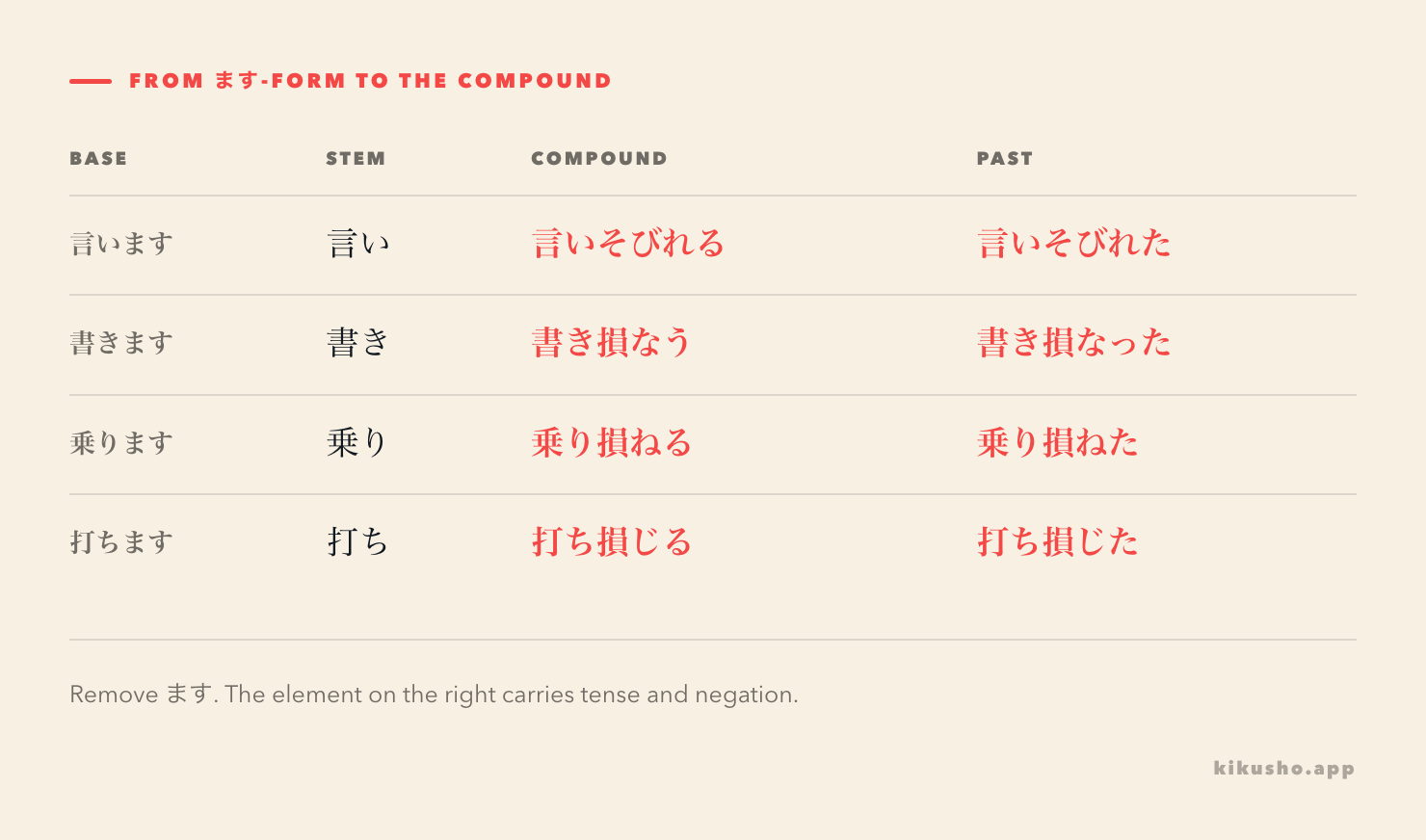
Remove ます from the polite form, then attach the final element directly. The result behaves as one compound verb, so the element on the right conjugates.
| Base verb | Stem | Compound | Past form |
|---|---|---|---|
| 言います | 言い | 言いそびれる | 言いそびれた |
| 書きます | 書き | 書き損なう | 書き損なった |
| 乗ります | 乗り | 乗り損ねる | 乗り損ねた |
| 打ちます | 打ち | 打ち損じる | 打ち損じた |
そびれる, 損ねる and 損じる conjugate as ichidan verbs. 損なう is godan, so its past is 損なった, not 損ないた. The basic compound-verb lesson explains the same left-stem, right-conjugation structure with earlier vocabulary.
This formation rule helps you recognize a compound. It does not mean that every verb combines naturally with every ending. Learn the whole form you encounter: 言いそびれる, 乗り損ねる, 書き損じる.
そびれる puts the failure before the action
Use V-stem + そびれる when someone intended, expected or had reason to do V, but the opportunity disappeared. Timing, circumstances or hesitation prevent the action from getting its proper moment.
会議の後で部長に質問したかったが、話しかけそびれた。
かいぎのあとでぶちょうにしつもんしたかったが、はなしかけそびれた。
I wanted to ask the manager a question after the meeting, but I missed my chance to approach her.
忙しくて昼ご飯を食べそびれた。
いそがしくてひるごはんをたべそびれた。
I was so busy that I missed the chance to eat lunch.
Daijisen's そびれる entry defines it as losing the opportunity to perform an action and notes that it usually follows a verb's connecting form. A Japanese-teacher reference likewise distinguishes 返しそびれた from simply forgetting to return something: the speaker still had the return in mind, but the occasion vanished.
That difference is a tendency in what the speaker chooses to present. 返し忘れた directly attributes the failure to forgetting. 返しそびれた presents a missed opening, perhaps because the friend left suddenly. It should not be used to prove what the speaker privately remembered at every instant.
The 損なう family reaches unsuccessful execution too
V-stem + 損なう/損ねる/損じる can report that an intended action was missed or that it failed to reach the expected result. Some compounds describe a lost opportunity:
駅まで走ったが、終電に乗り損ねた。
えきまではしったが、しゅうでんにのりそこねた。
I ran to the station, but missed the last train.
Others describe defective execution:
宛名を一文字書き損じたので、新しい封筒を使った。
あてなをひともじかきそんじたので、あたらしいふうとうをつかった。
I wrote one character of the address incorrectly, so I used a new envelope.
ボールを打ち損なって、弱いゴロになった。
ボールをうちそこなって、よわいゴロになった。
I mishit the ball, and it became a weak grounder.
The action boundary distinguishes these last examples from そびれる. A person who 書きそびれた never found the chance to write. A person who 書き損じた did write, but the written result was wrong or inadequate.
There is overlap, so use the contrast as a guide
The neat timeline is useful, but it is not an absolute division. 乗り損なう and 乗り損ねる can mean missing a train or bus before boarding. 言い損なう can mean saying something incorrectly or failing to say it when the moment came. The verb and the scene decide whether the failure concerns opportunity, execution or result.
| Form in context | What failed? | Natural interpretation |
|---|---|---|
| お礼を言いそびれた | the chance to speak | missed the chance to thank someone |
| 電車に乗り損ねた | successful boarding | missed the train |
| 名前を書き損じた | the written result | wrote the name incorrectly |
| ボールを打ち損なった | the quality of contact | mishit the ball |
A Nagoya University study of these three 損 compounds found both missed-opportunity and unsuccessful-result uses. Its usage analysis also shows that the variants do not have identical distributions: 損なう and 損ねる cover more of the mapped meanings, while 損じる is unavailable in some combinations. That evidence is a reason to check complete words, rather than to invent a free substitution rule.
For a test item, look beyond the English phrase “failed to.” If the prompt emphasizes 機会, timing, hesitation or a person leaving, そびれる is a strong candidate. If it shows an attempt, a mistaken mark, poor contact or an inadequate result, a 損 compound is more likely. If both describe a missed departure, conventional pairing and the choices may decide.
Keep suffixal and standalone 損なう separate
In 健康を損なう, 損なう is the main verb “harm” or “impair.” There is no preceding verb stem.
睡眠不足は判断力を損なう。
すいみんぶそくははんだんりょくをそこなう。
Lack of sleep impairs judgment.
Compare 判断し損なう, where 判断し is the stem of 判断する and the compound means failing to judge correctly. The earlier verb-collocation lesson covers standalone 健康を損なう beside suffixal 乗り損なう.
見損なう needs special care because it has an established evaluation sense:
君を見損なった。
きみをみそこなった。
I misjudged you / I am disappointed in you.
The sentence need not mean that the speaker literally failed to see the person. Whole-word meaning overrides mechanical assembly.
Level and register
The assigned Kikusho inventory and JLPT Sensei place そびれる and the three 損 variants at N1. A Japanese-teacher reference independently labels 損なう/損ねる/損じる as N1. No conflicting level placement appeared in the reviewed sources. These N1 labels express agreement among preparation publishers; the exam administrator does not issue a point-by-point grammar checklist.
These forms appear in both speech and writing, but individual compounds differ in familiarity and setting. 言いそびれる, 食べそびれる and 乗り損ねる work in ordinary conversation; 書き損じる is especially at home when a written or performed result goes wrong. Treat that as usage evidence for particular compounds, not a rule that one ending owns an entire register.
When saving one in Kikusho, keep the clause that reveals the stage of failure. A bare card reading “fail to” merges all four endings. 言おうと思ったが、言いそびれた preserves the lost chance; 一文字書き損じた preserves the defective result. Those details give the next review a decision to retrieve.
Practice: locate the failure
Mark seven choices in sequence. The explanations remain folded beneath the complete set.
Question 1: lost speaking opportunity. Choose the best completion: 先生に聞きたいことがあったが、授業の後すぐ帰られて、__。
- ア. 聞きそびれた
- イ. 聞き始めた
- ウ. 聞き切った
- エ. 聞き直した
Question 2: defective written result. Which sentence clearly says that the writer put down a character incorrectly?
- ア. 漢字を書きそびれた。
- イ. 漢字を書き損じた。
- ウ. 漢字を書き始めた。
- エ. 漢字を書き忘れた。
Question 3: build the compound. Which form correctly means “missed the last train”?
- ア. 終電に乗る損ねた
- イ. 終電に乗って損ねた
- ウ. 終電に乗り損ねた
- エ. 終電に乗ります損ねた
Question 4: conjugate 損なう. Complete the sentence in the past: ボールを打ち__、試合に負けた。
- ア. 損ないて
- イ. 損なって
- ウ. 損ねって
- エ. 損じって
Question 5: standalone meaning. What does 損なう mean in 長時間の運転は健康を損なう?
- ア. miss the chance to drive
- イ. forget to check health
- ウ. harm or impair health
- エ. write health incorrectly
Question 6: compare the pair. Which interpretation best preserves the contrast?
- 手紙を書きそびれた。\
- 手紙を書き損じた。
- ア. Sentence 1 presents a lost chance to write; Sentence 2 presents writing that went wrong.
- イ. Sentence 1 means the letter was perfect; Sentence 2 means it was never planned.
- ウ. Both necessarily mean that the writer forgot the letter existed.
- エ. Both describe physical damage to the letter.
Question 7: avoid a false rule. Which statement is accurate?
- ア. そびれる always means the action was attempted badly.
- イ. 損なう, 損ねる and 損じる can replace one another in every compound.
- ウ. Every word ending in 損なう means physical damage.
- エ. 損 compounds can cover missed opportunities as well as unsuccessful results, and established pairings matter.
Answers and explanations
1. ア: 聞きそびれた. The teacher left immediately, so the speaker lost the opportunity to ask. The scene foregrounds timing before the intended action could happen.
2. イ: 漢字を書き損じた. 書き損じる can describe writing something incorrectly. 書きそびれる presents a missed opportunity; 書き始める only begins the action; 書き忘れる attributes the omission to forgetting.
3. ウ: 終電に乗り損ねた. Remove ます from 乗ります to obtain 乗り, then attach 損ねた. The other answers retain an incompatible form between the two parts.
4. イ: 損なって. 損なう is godan: its て-form is 損なって. The complete compound is 打ち損なって, reporting an unsuccessful hit.
5. ウ: harm or impair health. Here 健康 is the object of standalone 損なう. No first verb stem precedes it, so this is not the suffixal failure construction.
6. ア: Sentence 1 presents a lost chance to write; Sentence 2 presents writing that went wrong. This is the clearest contrast between the two families. Some 損 compounds also express a missed opportunity, so the distinction is a contextual guide rather than a ban on overlap.
7. エ: 損 compounds can cover missed opportunities as well as unsuccessful results, and established pairings matter. The other statements turn useful tendencies into false absolutes or confuse suffixal 損なう with the standalone verb “harm.”
Common questions
What is the difference between そびれる and 損なう?
V-stem + そびれる focuses on losing the chance or timing to do an intended action. V-stem + 損なう can also describe a missed chance, but it additionally covers an action attempted or performed with an unsuccessful result. The surrounding verb and context therefore matter more than a rigid translation.
How do そびれる, 損なう, 損ねる and 損じる attach to a verb?
Remove ます and attach the ending directly: 言います becomes 言いそびれる, 書きます becomes 書き損なう or 書き損じる, and 乗ります becomes 乗り損ねる. The final element conjugates, as in 言いそびれた and 乗り損ねなかった.
Are 損なう, 損ねる and 損じる always interchangeable?
No. Their failure and missed-opportunity senses overlap, but established combinations and preferred meanings differ. Research based on actual usage finds 損なう and 損ねる in the widest range, while 損じる is more restricted. Check the complete compound instead of substituting the endings mechanically.
Is standalone 損なう the same grammar pattern?
No. In 健康を損なう, 損なう is the main verb meaning harm or impair. In 書き損なう, it follows the stem 書き and marks a failed or defective action. 見損なう also has a lexicalized sense meaning to misjudge or think less of someone, so the whole word must be read in context.