On this page
Use AずにB when action A remains undone while action B happens. 朝ご飯を食べずに出かけた means “I went out without eating breakfast”: eating did not happen, but going out did.
The pattern is built from the verb's plain negative base. It often carries a more compact, careful or written tone than ~ないで, and it must not be confused with ~なくて, which commonly links a negative fact to a reason or result.
This lesson covers inventory item g-4974eb9ffe78, ずに. JLPT Sensei and Bunpro place it at N3. Those labels are study estimates because the JLPT does not publish an exhaustive grammar syllabus.
One action stays undone while the next proceeds
The basic relationship is A did not happen; B happened in that state.
何も言わずに帰りました。
なにも いわずに かえりました。
I went home without saying anything.
辞書を使わずに新聞を読みました。
じしょを つかわずに しんぶんを よみました。
I read the newspaper without using a dictionary.
バスに乗らずに駅まで歩きました。
バスに のらずに えきまで あるきました。
I walked to the station instead of taking the bus.
In every example, the verb after ずに supplies the main event. The omitted action may be deliberate, accidental or simply absent; the form itself does not decide. 鍵をかけずに出かけてしまった frames the omission as a mistake, while 車を使わずに歩いた can present a deliberate alternative.
The same person usually controls both actions because the sentence describes what someone did while leaving something else undone. That is a useful production default, not a mechanical rule for every sentence. In 母に気づかれずに家を出た, the passive verb presents “without being noticed by my mother,” so the participants are divided by the passive construction.
Build ~ずに from the ない-stem
Make the plain ない-form, remove ない, then add ずに.
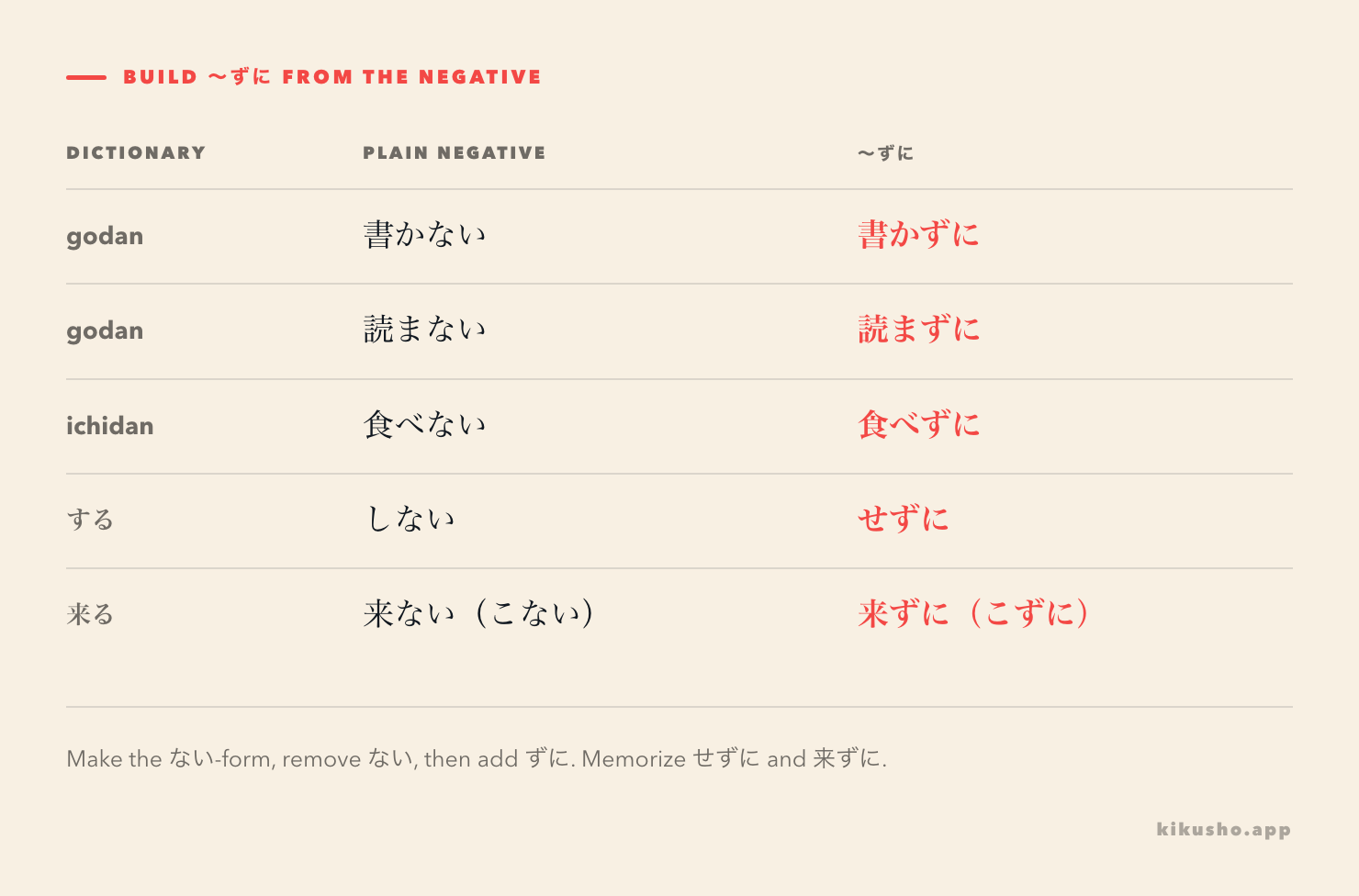
| Dictionary form | Plain negative | ~ずに form |
|---|---|---|
| 書く(かく) | 書かない | 書かずに |
| 読む(よむ) | 読まない | 読まずに |
| 食べる(たべる) | 食べない | 食べずに |
| する | しない | せずに |
| 来る(くる) | 来ない(こない) | 来ずに(こずに) |
The essential exception is する → せずに, never ×しずに. Noun + する verbs follow it too: 勉強せずに, 連絡せずに, 確認せずに. 来る becomes 来ずに, read こずに. These shapes preserve older negative grammar behind ず, which Bunpro explains as a classical negative auxiliary.
The に can sometimes disappear, especially in compact written connections and familiar expressions:
朝ご飯を食べず、学校へ行った。
I went to school without eating breakfast.
迷わず進んでください。
Please proceed without hesitation.
For reliable production, learn ~ずに + main action first. A bare ~ず before a comma or verb can feel more literary or compressed, whereas ~ずに exposes the connection clearly.
The final predicate carries time and politeness
~ずに does not independently mark past tense or politeness. The predicate that closes the sentence does that work.
| Sentence | Time and style |
|---|---|
| 朝ご飯を食べずに出かける | non-past plain |
| 朝ご飯を食べずに出かけた | past plain |
| 朝ご飯を食べずに出かけました | past polite |
This is why 食べずに stays unchanged in all three. Read to the end before deciding when the event happened. The same principle helps with a longer sentence such as 昨日は何も買わずに帰ってきました: 帰ってきました supplies the completed past event.
~ずに and ~ないで share a core meaning
For “do B without doing A,” ~ずに and ~ないで often describe the same event.
朝ご飯を食べずに出かけた。
朝ご飯を食べないで出かけた。
I went out without eating breakfast.
The first often suits writing, careful narration and concise expressions. The second is very natural in ordinary conversation. ~ずに is still heard in speech, so “written” is a tendency rather than a ban. Nihongo to Japan gives both forms and makes the same register comparison.
There is one practical boundary: ~ないで can end a turn as a negative request, and ~ないでください makes that request polite. ~ずに does not fill that request slot.
このボタンを触らないでください。
Please do not touch this button.
Do not replace it with ×触らずにください. A clause such as ボタンに触らずに待ってください is grammatical, but its structure is different: “Please wait without touching the button.” The main requested action is 待ってください.
The dedicated ~ないで and ~ないでください lesson covers both the conversational “without doing” form and negative requests.
~なくて usually connects a reason or negative state
English can use “not” in all these sentences, but Japanese marks different relationships.
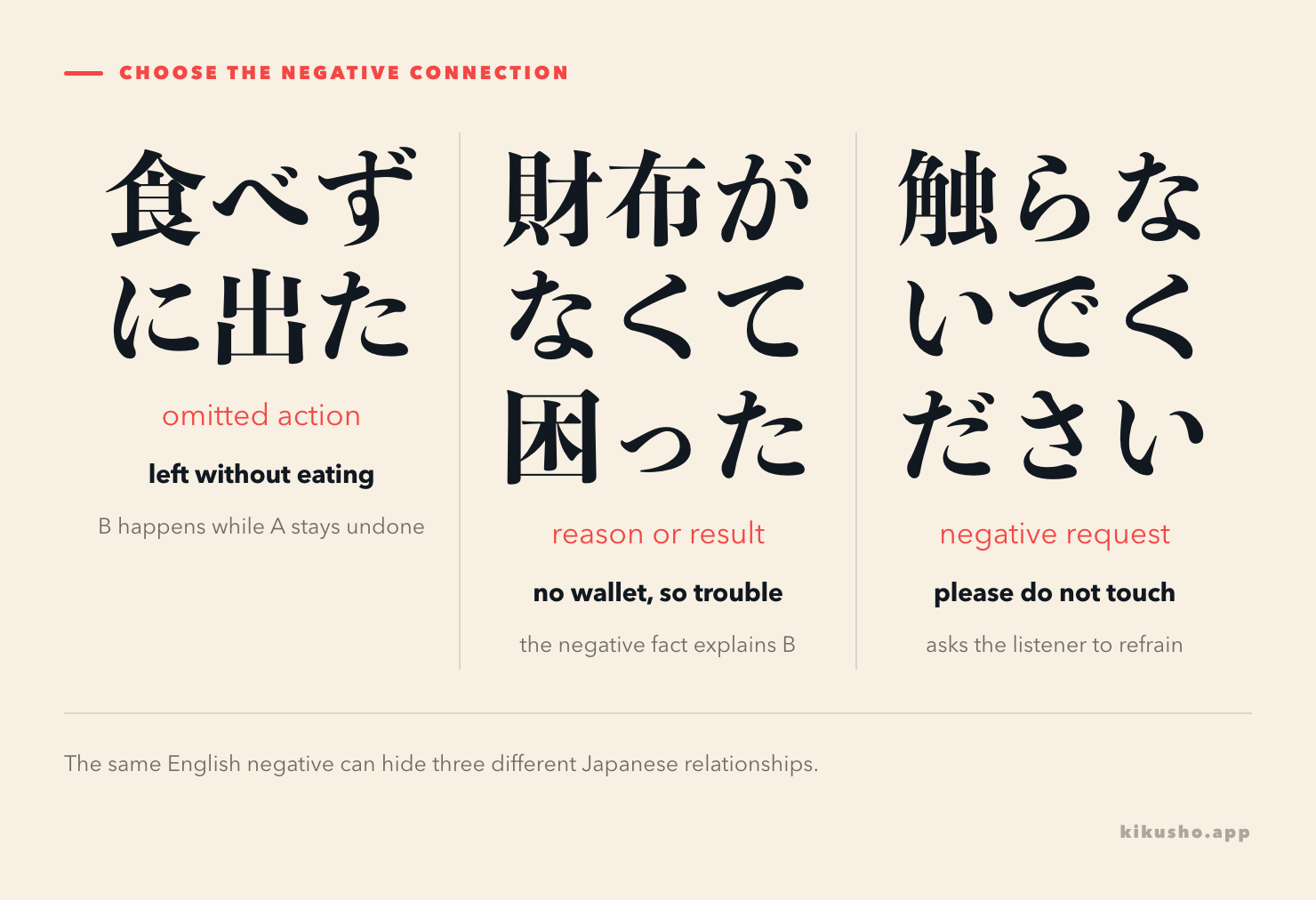
| Form | Main relationship | Example |
|---|---|---|
| ~ずに | B happens with A omitted | 朝ご飯を食べずに出た |
| ~なくて | a negative fact leads to or joins B | 財布がなくて困った |
| ~ないでください | ask the listener not to do A | ここに触らないでください |
財布を持たずに家を出ました。
I left home without taking my wallet.
財布がなくて払えませんでした。
I could not pay because I did not have my wallet.
The first reports an action performed while another action was omitted. The second makes the absence of the wallet the reason payment failed. The Japan Foundation's teaching discussion of ~なくて shows that negative clause connections depend on the semantic relationship, not on a single English translation.
Real usage has overlap and context can support more than one analysis. For study and production, use this dependable test: if a person does B while leaving action A undone, choose ~ずに/~ないで; if the negative fact explains a problem, feeling or result, start by considering ~なくて.
Longer ~ず expressions reverse or extend the result
Do not assume every form containing ず says that an action simply stays undone.
| Pattern | Outcome |
|---|---|
| ~ずに | A stays undone while B happens |
| ~ずにはいられない | the subject cannot refrain, so A occurs |
| ~ずに済む | the situation is resolved without A |
| ~ざるを得ない | circumstances leave no choice, so A occurs |
Compare 笑わずに話を聞いた, “I listened without laughing,” with 笑わずにはいられなかった, “I could not help laughing.” The longer expression produces the opposite real-world outcome: laughter occurs. The strong impulses lesson explains that structure.
新しい物を買わずに済んだ says the speaker managed without buying something new. The ~て済む/~で済む lesson includes this wider “the matter is settled” logic. 予定を変更せざるを得ない says external conditions force a change; see the ~ざるを得ない lesson.
Save both sides of the relationship in Kikusho
A card containing only 食べずに preserves the ending but loses the event that makes it meaningful. Save 朝ご飯を食べずに出かけた so review can reconstruct both the omitted action and the main action. For 知らずに, keep the object too: その事実を知らずに答えた, “I answered without knowing that fact.”
Add a short register note when it helps: “more compact or formal than ないで; still used in speech.” That is more accurate than labeling ずに as writing-only. A contrast card can pair 触らないでください with 触らずに待ってください to preserve the difference between a negative request and an omitted action inside a positive request.
Practice: keep A undone while B moves forward
Answer all six questions before opening the explanation block.
Question 1 — formation. Complete 手紙を書か__送りました, “I sent it without writing a letter.”
- なくて
- ずに
- ないでください
- せずに
Question 2 — the する exception. Complete 今日は何も__休みました, “Today I rested without doing anything.”
- しずに
- しなくて
- しないでください
- せずに
Question 3 — relationship. You could not pay because you did not have money. Complete お金が__、払えませんでした.
- なくて
- ないで
- なくずに
- ずに
Question 4 — sentence assembly. Arrange every chunk once to say “I read the newspaper without using a dictionary.”
新聞を読みました / 辞書を / 使わずに
Question 5 — negative request. A museum employee asks a visitor not to touch an exhibit. Which form fits?
- 触らずにください
- 触らなくてください
- 触らないでください
- 触らずください
Question 6 — connected text. Choose the line that best continues the passage.
今朝は寝坊しました。時間がなかったので、__。
- 朝ご飯がなくて寝ました
- 朝ご飯を食べずに家を出ました
- 朝ご飯を食べないでください
- 朝ご飯を食べずにはいられませんでした
Answers and explanations
Answer 1. Choice 2, ずに. 書く → 書かない → 書かずに. Writing stays undone while sending happens. せずに belongs to する verbs.
Answer 2. Choice 4, せずに. The fixed する exception is する → せずに, not ×しずに. 何もせずに休みました means the speaker rested without doing anything.
Answer 3. Choice 1, なくて. The lack of money explains the failed payment, so お金がなくて、払えませんでした presents a negative cause and result. It is not an action deliberately omitted while paying.
Answer 4. 辞書を使わずに新聞を読みました. 使う → 使わない → 使わずに marks dictionary use as omitted. 読みました supplies the main past polite action.
Answer 5. Choice 3, 触らないでください. A direct polite request not to act uses the complete ない-form plus でください. ~ずに cannot replace that request ending.
Answer 6. Choice 2, 朝ご飯を食べずに家を出ました. Oversleeping leaves no time for breakfast, so the speaker leaves while breakfast remains uneaten. Choice 4 would mean the speaker could not help eating breakfast, which reverses the intended outcome.
Where the N3 label becomes uncertain
JLPT Sensei, Bunpro and Nihongo to Japan place ~ずに at N3, matching this curriculum inventory. Some Japanese-teacher materials introduce it earlier, including an Iku lesson that groups it with N4 material. The disagreement concerns study order; the sources agree on the negative-base formation, せずに, and the central “without doing” relationship.
OpenAI Codex performed the language review, checking each attachment rule, Japanese reading, English gloss and exercise answer against the independent references cited above. This was an AI review; no human review is claimed.
Common questions
What does ~ずに mean in Japanese?
~ずに means “without doing.” In AずにB, action A remains undone while action B happens: 朝ご飯を食べずに出かけた means “I went out without eating breakfast.”
How do you form ~ずに?
Make the plain ない-form, remove ない, and add ずに: 読まない becomes 読まずに and 食べない becomes 食べずに. The main exceptions are する → せずに and 来る → 来ずに, read こずに.
What is the difference between ~ずに and ~ないで?
Both can mean that B happens without A. ~ずに often feels more compact or formal and is common in writing, while ~ないで is more conversational. Only ~ないで also makes a direct negative request, as in 触らないでください.
What is the difference between ~ずに and ~なくて?
~ずに presents an omitted action alongside a main action. ~なくて often presents a negative fact as a reason or result connection: 財布がなくて払えなかった means “I could not pay because I did not have my wallet.”