On this page
~ところを (tokoro o) acknowledges someone's circumstances before a request, apology or thanks: “while you're busy,” “during your break,” or “when you're in a hurry.” The clause names the situation you are asking someone to make room for; the words after it state what you need, regret, or appreciate.
This N1 grammar reference teaches ところを, inventory unit g-7791293a1152, including courteous prefaces, an action interrupted at a particular moment, and a result contrary to the normal or expected course. Those uses share a situation-setting frame, but they do not all express politeness.
JLPT Sensei and Bunpro classify the construction at N1. The inventory's Tanos comparison is a surface match retained from its snapshot, not a newly checked explanation. These labels help organise study; the exam organisers explain why no exhaustive current syllabus is published. This page does not teach every construction containing ところ or replace separate reading and listening work.
The word before ところ keeps its noun attachment
ところ names a situation here. Build the phrase modifying it before choosing the sentence's final level of politeness. The attachment chart is shared across the frame; the timing must fit the use.
| Before ところを | Attachment | Phrase and reading | Situation named |
|---|---|---|---|
| i-adjective | adjective directly | お忙しいところを — おいそがしいところを | while you are busy |
| na-adjective | adjective + な | 大変なところを — たいへんなところを | while things are difficult |
| noun | noun + の | お休みのところを — おやすみのところを | during your break or day off |
| verb clause | plain form | 休んでいるところを — やすんでいるところを | while resting |
| past ongoing clause | plain past ongoing | 休んでいたところを — やすんでいたところを | while resting then, in a narrative |
Bunpro's attachment table distinguishes the word classes. For a current courteous interruption, the Japan Foundation's explanation specifies non-past adjective or verb clauses and noun + の. The past ongoing row belongs to a narrated event; it is not a reason to put yesterday's tense into a preface about someone who is busy now.
Thus お忙しいですところを wrongly inserts a sentence ending into the modifier. お休みなところを uses the na-adjective attachment where this noun phrase needs の. The sentence can still finish politely: お休みのところを、何度も連絡してしまい申し訳ありません。
おやすみのところを、なんどもれんらくしてしまいもうしわけありません。
“I'm sorry for contacting you repeatedly during your time off.”
The regret concerns the repeated contact. The first clause identifies whose time it intruded on.
Requests, apologies and thanks supply different endings
For a request, acknowledge the inconvenience and then ask for the action:
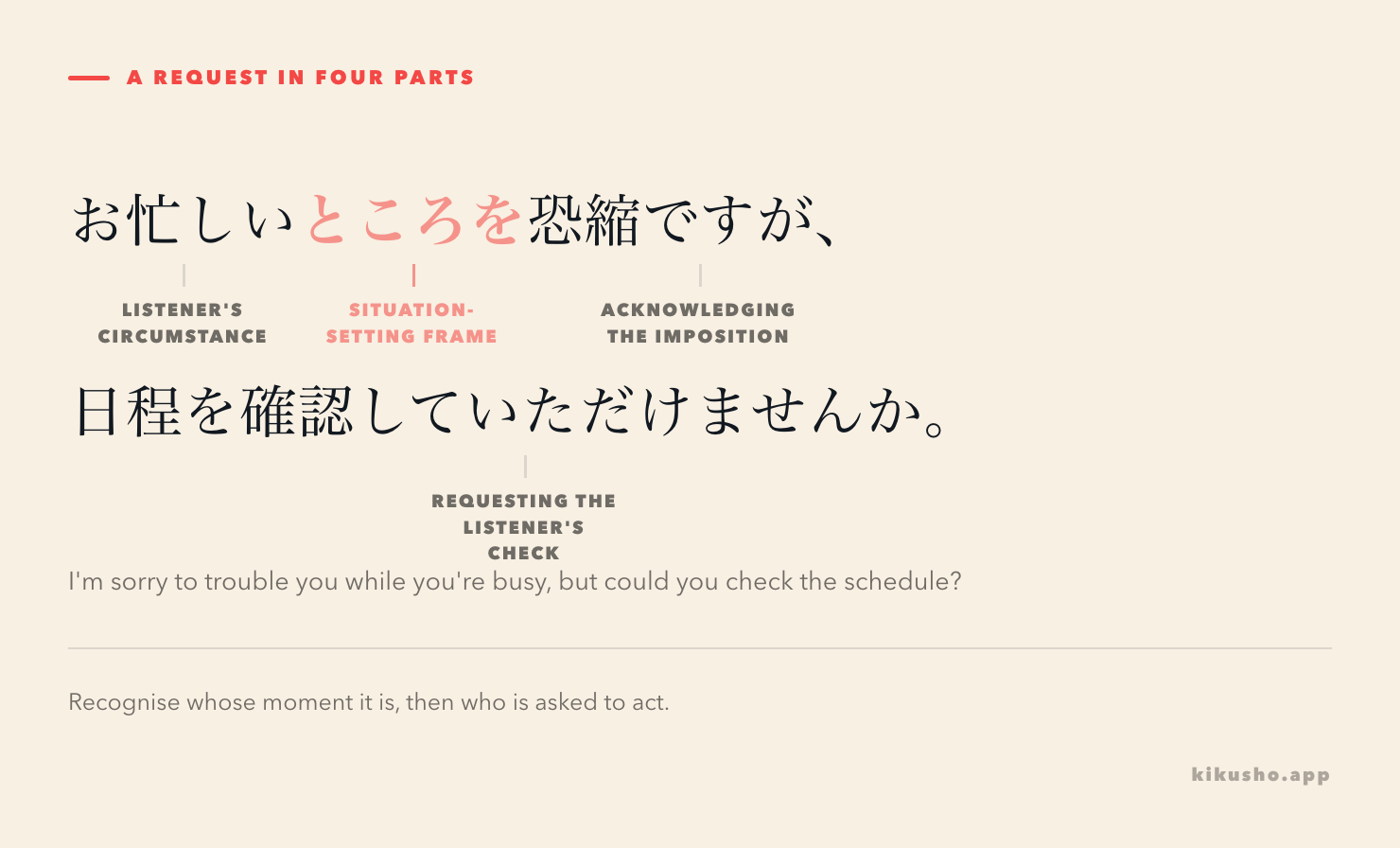
お忙しいところを恐縮ですが、この日程を確認していただけませんか。
おいそがしいところをきょうしゅくですが、このにっていをかくにんしていただけませんか。
“I'm sorry to trouble you while you're busy, but could you check this schedule?”
恐縮 is read きょうしゅく. In this preface it conveys the speaker's sense of imposing. The N4 keigo and request lesson explains ~ていただけませんか; here that ending asks the listener to check. Adding ところを does not switch the checker to the speaker.
For an apology, state the intrusion rather than a favour you want. The repeated-contact example above does that. For thanks, name the help already received:
お急ぎのところを、道を教えてくださってありがとうございました。
おいそぎのところを、みちをおしえてくださってありがとうございました。
“Thank you for explaining the way even though you were in a hurry.”
お急ぎ names the person's hurry; 教えてくださって identifies the help. The gratitude does not mean the listener was free, and the same preface would not by itself be an instruction to stop.
Common openings are compact enough to learn with their circumstances:
| Preface | Reading | Circumstance to recognise |
|---|---|---|
| お忙しいところを | おいそがしいところを | the listener is busy |
| お休みのところを | おやすみのところを | a break or day off |
| お急ぎのところを | おいそぎのところを | the listener is in a hurry |
| ご多忙のところを | ごたぼうのところを | a more formal busy-time preface |
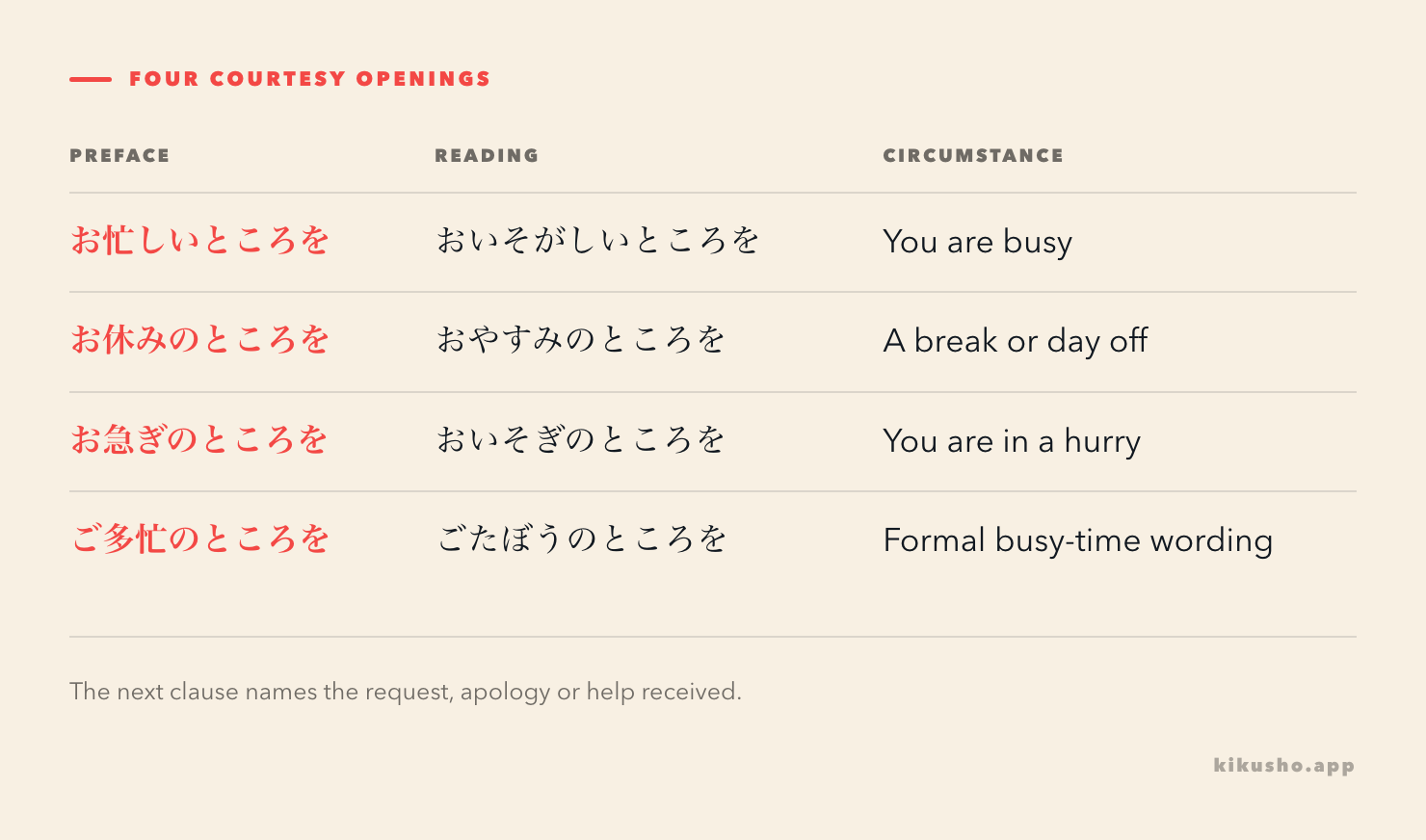
MLC's teaching page records these openings. ご多忙の uses 多忙 as a noun phrase here; it is not a rule that every na-adjective changes to の when made formal. A preface about a break also needs a real break: it is not the right stock line merely because your message is long.
The courtesy frame also belongs to spoken Japanese
A telephone opening, a meeting's thanks and a service announcement can all make someone's timing explicit. The Japan Foundation's lesson describes this as formal spoken wording, while Mayumi Ito's Mango explanation places it in formal speech and polite conversations. Email is one setting, not a demonstrated majority of its use.
In a courteous preface, を can disappear: お忙しいところ、恐れ入りますが… still makes room for the listener's circumstances. MLC marks that omission separately from the contrasting-normal-course use below. Keeping the full ところを while learning makes the frame easier to see.
There is no special polite conjugation of ところを itself. A friendly conversation may use simpler surrounding words, whereas 恐縮ですが or 申し訳ありません maintains distance. That does not make every complete sentence with ところを appropriate for every listener. The politeness overview separates the listener's register from whose action is described.
Nor does a careful opening make a needless interruption considerate. If the other person says they cannot stop, their answer carries more information than the formula you prepared.
A narrated interruption does not need an apology
帰ろうとしていたところを、同僚に呼び止められました。
かえろうとしていたところを、どうりょうによびとめられました。
“I was stopped by a colleague when I was about to head home.”
帰ろうとしていた supplies the earlier intention or imminent action; 呼び止められました reports what interrupted it. No thanks or request is implied. The Japan Foundation's first ところ lesson describes this pattern with actions that directly affect the situation, including stopping, helping and passive forms. 同僚に names the person who intervenes.
Keep it separate from sentence-final 帰るところです, which simply locates the action just ahead. The earlier stage lesson owns the before/during/just-finished distinction; this new unit explains what happens to a situation in the following clause.
An expected course can be replaced by what happened
本来なら私が資料を届けるべきところを、先生が持ってきてくださいました。
ほんらいならわたしがしりょうをとどけるべきところを、せんせいがもってきてくださいました。
“I should have delivered the materials, but the teacher brought them instead.”
The first clause states the expected responsibility, not a completed delivery. The second gives the actual event. 本来なら and べき make that contrast visible; this lesson uses that expectation as context without claiming to teach the whole べき system.
The Foundation's second lesson also describes a usual course followed by a contrary result. MLC explicitly retains を for this use. Practise it with を; optional courtesy omission is not permission to erase particles from every ところ phrase.
The surrounding predicate decides whether the speaker thanks someone, regrets the change, or simply reports it. A generic translation “despite” cannot tell you who did the work.
Try eight tasks with the answer block still closed
Do all eight before moving to the shared explanations. The tasks test the attachment, the following action and the context, not whether a longer phrase sounds more impressive.
Question 1
You are addressing someone who is busy now. Which opening uses the i-adjective attachment?
- A. お忙しいのところを
- B. お忙しいなところを
- C. お忙しいところを
- D. お忙しいですところを
Question 2
You know the listener is on a day off. Insert the attachment in お休み__ところを、連絡してしまい申し訳ありません。
- A. の
- B. な
- C. で
- D. を
Question 3
Read 帰ろうとしていたところを、同僚に呼び止められた。 Which interpretation preserves the event?
- A. The colleague is thanked for having gone home.
- B. A colleague stopped me when I was about to head home.
- C. I had just arrived home when the colleague thanked me.
- D. I politely asked the colleague to go home.
Question 4
Arrange all four chunks in ご多忙 __ __ ★ __ ありがとうございます。 State what goes in ★ and then write the whole sentence.
- A. 時間を作って
- B. の
- C. くださって、
- D. ところを
Question 5
Ask someone busy to check this schedule. Build one sentence with お忙しい, ところを, 恐れ入りますが, この日程, 確認する, and ~ていただけませんか. Keep the full preface and use the correct て-form.
Question 6
A shop normally closes at ten, but yesterday it remained open until eleven. Write the contrast with 普段なら, 十時に閉まる, ところを, 昨日は, and 十一時まで開いていた. Preserve the difference between the usual course and yesterday's event.
Question 7
Read the complete message:
お忙しいところを恐れ入りますが、添付した資料を確認していただけませんか。急ぎではありませんので、来週で結構です。
Who is busy, who is being asked to check the attachment, and what does the second sentence say about timing? Explain why the busy-time preface alone would not convey the full request.
Question 8
Read these two connected sentences:
本来なら私が説明するべきところを、先生が説明してくださいました。お忙しい中、ありがとうございました。
Which account matches the expected and actual roles?
- A. The teacher was supposed to explain, but I explained instead.
- B. Neither person explained; both only discussed a future plan.
- C. I was supposed to explain, but the teacher did it, and I thanked the teacher.
- D. I thanked the teacher for interrupting my completed explanation.
Answers and explanations
Answer 1: C. お忙しいところを puts the i-adjective directly before ところ. A inserts の and B inserts な; D uses です where a modifying adjective is needed. Politeness can appear later in the sentence.
Answer 2: A. お休みのところを、連絡してしまい申し訳ありません。 uses noun + の. な is the attachment for a na-adjective, not this noun phrase; で and を cannot replace の in the given modifier.
Answer 3: B. 帰ろうとしていた (かえろうとしていた) places me at the point of intending to leave, and 同僚に呼び止められた (どうりょうによびとめられた) names the colleague who stopped me. A and D invent gratitude or a request, while C reverses the timing and changes the event.
Answer 4: A goes in ★. The order is B → D → A → C: ご多忙のところを時間を作ってくださって、ありがとうございます。 (ごたぼうのところをじかんをつくってくださって、ありがとうございます。) の connects the noun phrase to ところ; 時間を作って gives the listener's action before くださって. The speaker is grateful for that action, not for being busy.
Answer 5: One model is お忙しいところを恐れ入りますが、この日程を確認していただけませんか。
おいそがしいところをおそれいりますが、このにっていをかくにんしていただけませんか。
“I'm sorry to trouble you while you're busy, but could you check this schedule?” 確認する → 確認して supplies the て-form. The listener is asked to check; the speaker receives the favour. A wording that makes the speaker check would change the requested actor.
Answer 6: One model is 普段なら十時に閉まるところを、昨日は十一時まで開いていた。
ふだんならじゅうじにしまるところを、きのうはじゅういちじまであいていた。
“Although it normally closes at ten, yesterday it stayed open until eleven.” 閉まる states the usual course, while 開いていた reports yesterday's continuing open state. This does not say the shop actually closed at ten yesterday. The shop's opening state is read あいていた, not a prediction about future opening. Variations in punctuation do not change that contrast.
Answer 7: The recipient is busy and is asked to check the materials. 添付した資料 (てんぷしたしりょう) means the attached materials, and 確認していただけませんか asks the recipient's help. 急ぎではありませんので、来週で結構です (いそぎではありませんので、らいしゅうでけっこうです) says it is not urgent and next week is fine. The first clause acknowledges circumstances; only the following request names the task. It does not promise that the recipient must accept.
Answer 8: C. 私が説明するべき (わたしがせつめいするべき) supplies my expected responsibility; 先生が説明してくださいました (せんせいがせつめいしてくださいました) names the teacher's actual help. A swaps the roles. B ignores the completed action, and D invents a prior completed explanation and an interruption that the text does not state.
Keep the clause that explains the favour
A saved ところを alone loses whether you interrupted a break, received help during a hurry, or saw someone take over a responsibility. With pasted Japanese text in Kikusho, check the example and register note before saving the card. Keeping 誰が何をしたか, “who did what,” beside the preface preserves the part that changes a translation from an apology into thanks.
Common questions
What does お忙しいところを mean?
It acknowledges that the listener is busy before a request, apology or expression of thanks. The following clause supplies that purpose; the preface alone does not ask for anything. お忙しい is read おいそがしい.
How do nouns and adjectives attach to ところを?
A noun normally takes の, as in お休みのところを; a na-adjective takes な, as in 大変なところを. An i-adjective attaches directly, as in お忙しいところを. A verb uses its plain clause form, with the tense appropriate to the particular use.
Can I leave out を after ところ?
Courtesy prefaces can omit it: お忙しいところすみません still acknowledges a busy moment. Do not extend that omission automatically to every construction. Keep を when practising the normal-or-expected-course contrast, following MLC's distinction between that use and the optional courtesy preface.
Is ところを only used in business email?
No. It also appears in formal conversation, telephone openings, announcements and spoken thanks. The Japan Foundation explicitly describes formal spoken prefaces. N1 is a study-list estimate for this construction, not a claim that a familiar courtesy phrase must wait until advanced study.