On this page
An author can support a proposal, examine its conditions rigorously and still allow adjustments as needed. 支持(しじ), 厳密(げんみつ) and 適宜(てきぎ) express those three different moves: backing a position, attending precisely to details and responding appropriately to circumstances.
These three words separate a position from its implementation
This is a small N1 vocabulary set for reading arguments and procedural explanations. None of the three means “therefore,” and none by itself proves a conclusion. They tell you what someone supports, how carefully something is defined or checked, and how an action can be adapted.
You need ordinary noun modifiers, adverbial に and する verbs before using the set. If the argument's central nouns are still difficult, the academic argument vocabulary lesson covers concepts, definitions, theory and logic separately.
The N1 placement comes from the dated curriculum inventory, whose two vocabulary datasets share Jonathan Waller's Tanos ancestry. Those datasets are one source family. These are editorial estimates: the JLPT supplies no exhaustive official vocabulary syllabus. There is also a concrete boundary disagreement: JapaneseTest4You's current 支持 page labels that word N2, despite its N1 observation in the frozen inventory. Learn its use rather than treating the level label as a restriction on where you may encounter it.
The set has three different grammatical shapes
| Word and reading | Part of speech | Sense taught here | Useful combinations |
|---|---|---|---|
| 厳密・げんみつ | な-adjective | rigorous, precise, strict about details | 厳密な条件; 厳密に区別する; 厳密さ |
| 支持・しじ | Noun; する verb | support, endorsement, backing | 提案を支持する; 支持を得る; 支持を失う |
| 適宜・てきぎ | Noun / な-adjective; also used adverbially | suitability; appropriately, as needed, at one's discretion | 適宜休憩を取る; 適宜変更する; 適宜に行動する |
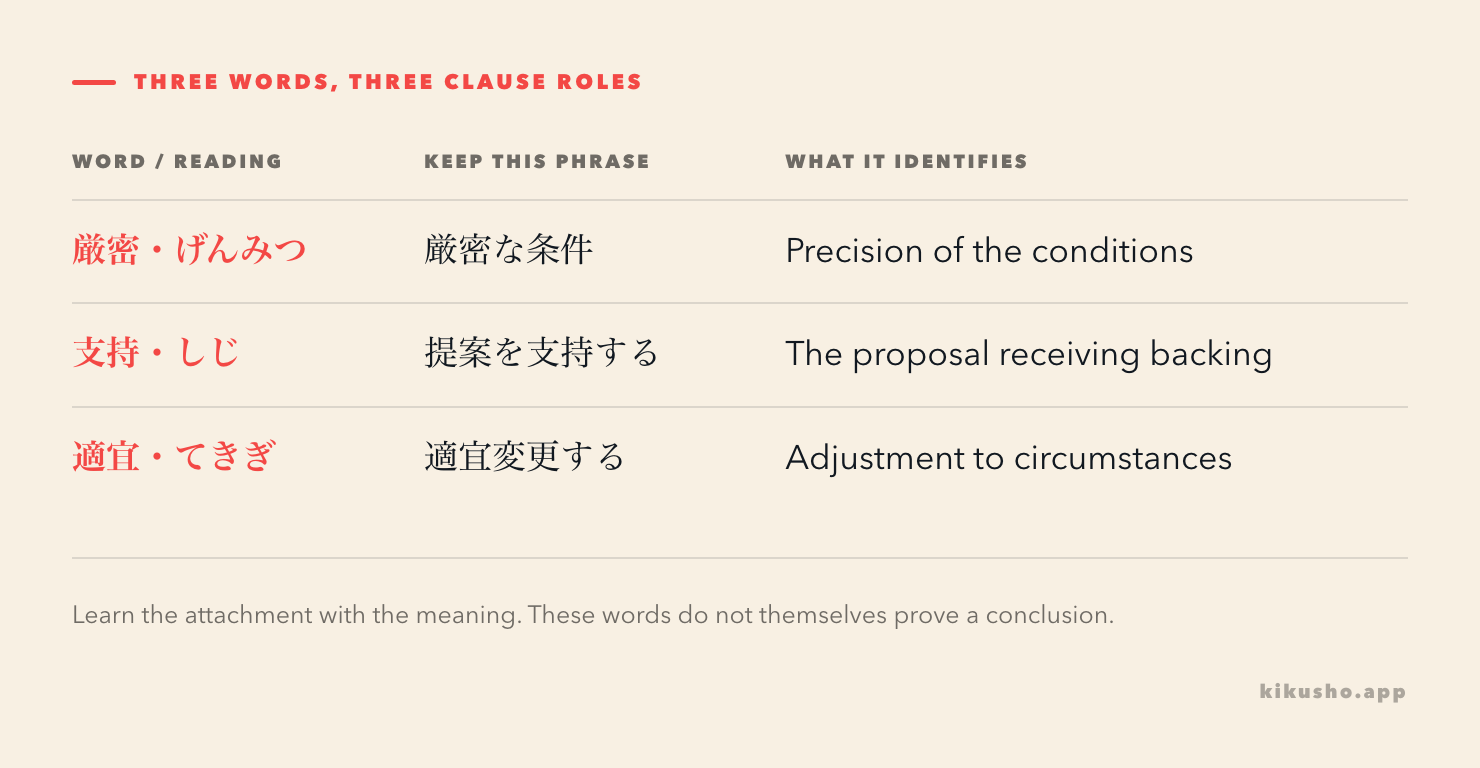
The short English gloss is only a starting point. “Strict” can describe discipline or accuracy; “support” can mean endorsement or physical holding; “as needed” requires a situation that determines the need. The Japanese construction narrows the interpretation.
厳密 concerns the detail that a loose account might miss
Shogakukan's 厳密 entry describes close attention that avoids errors and omissions. The independently published Kanjipedia entry also centres attention to fine details.
Before a noun, use 厳密な. Before a verb, use 厳密に. As a predicate, 厳密だ or 厳密です follows the normal な-adjective pattern. The noun 厳密さ names the degree or quality of rigour.
この実験では、厳密な条件の下で温度を測定した。
In this experiment, we measured the temperature under strictly controlled conditions.
Here 条件(じょうけん)means conditions and 測定(そくてい)means measurement. The conditions leave little room for variation or oversight. Calling them 厳密 does not tell you whether the result was favourable.
報告書では、原因と結果を厳密に区別している。
The report distinguishes rigorously between cause and effect.
The precision belongs to 区別する(くべつする), the act of distinguishing. You are reading a claim about the method, not an assertion that every conclusion in the report is correct.
You may also see 厳密に言えば, “strictly speaking.” It introduces a more exact formulation. Listen for the qualification that follows: the writer may accept an everyday description while limiting its technical accuracy.
支持 identifies what receives the backing
Shogakukan gives both physical support and endorsement of an opinion or claim. Kanjipedia independently describes agreeing with and backing another person's opinion or action.
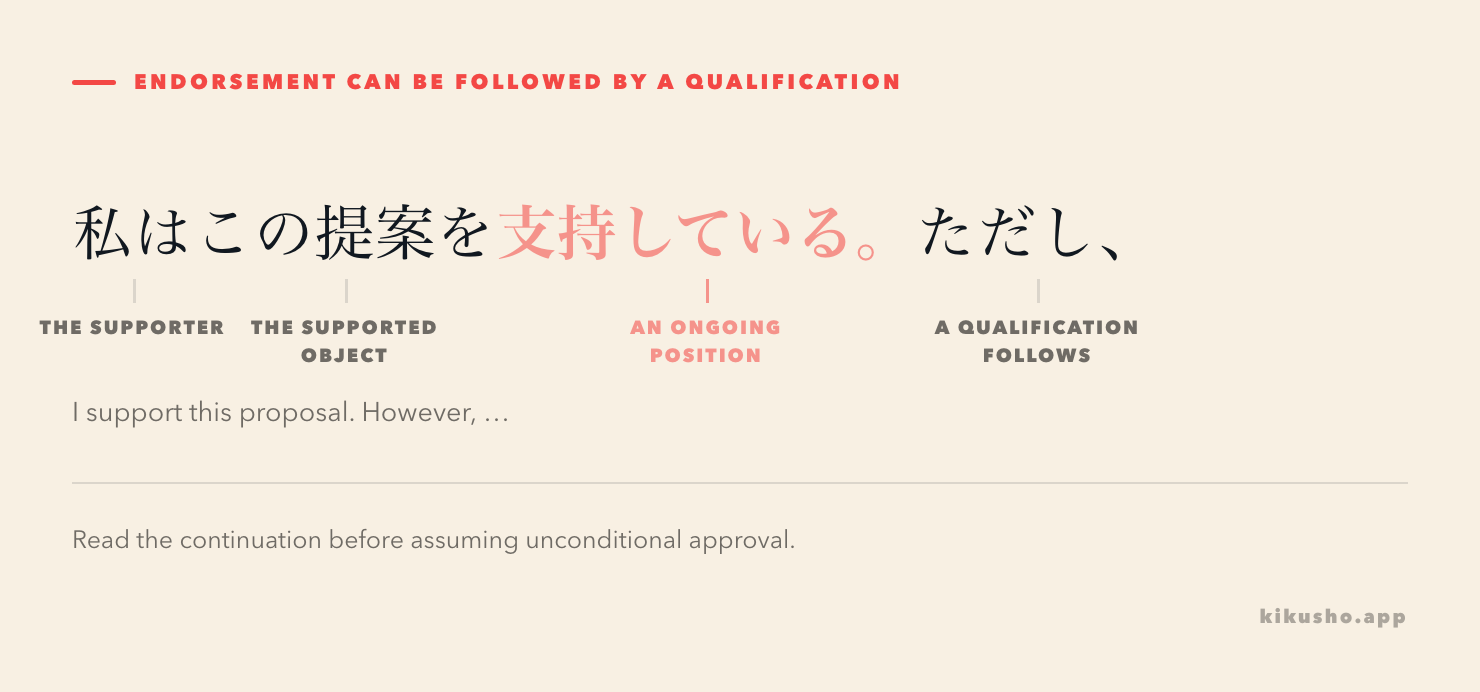
For endorsement, person は proposal を 支持する names the supporter and the supported object. A clause may omit the supporter when the preceding passage already identifies them.
私はこの提案を支持するが、費用については再検討が必要だ。
I support this proposal, but its cost needs reconsideration.
提案(ていあん)is a proposal; 再検討(さいけんとう)is reconsideration. The speaker's backing can coexist with a reservation. 支持する does not automatically mean unconditional approval of every detail.
As a noun, 支持 can be obtained or lost:
新しい計画は住民の支持を得た。
The new plan gained the residents' support.
住民(じゅうみん)are residents; 得た(えた)is the past of 得る, “obtain.” The sentence reports endorsement. It does not say that the residents paid for the plan or carried it out themselves.
The physical sense matters in technical contexts, but it is not the main target of this argument lesson. Do not expand the retained source gloss “maintenance” into a claim that 支持 is the ordinary word for servicing a machine.
適宜 leaves a choice responsive to the circumstances
Shogakukan's 適宜 entry distinguishes suitability from acting by one's judgement as circumstances permit. Shueisha's dictionary on IMIDAS likewise gives suitability and discretion. These are separate publishers.
The noun / な-adjective label is real, but instructions frequently use 適宜 directly before an action. You can also encounter 適宜に. Do not force に into every sentence or conclude that its presence is always wrong.
長時間の作業では、適宜休憩を取ってください。
During long periods of work, please take breaks as needed.
休憩(きゅうけい)is a break. The timing is left to judgement rather than specified as a fixed interval. The instruction still asks for a sensible response to the work and the person's condition.
参加者の人数に応じて、説明の方法を適宜変更する。
Adjust the method of explanation as appropriate for the number of participants.
変更する(へんこうする)means change or modify. The condition before the comma supplies a reason for adjustment. 適宜 does not mean changing things randomly, nor does it guarantee that every possible change is permitted.
The pattern becomes visible across consecutive sentences
私はこの提案を支持している。ただし、実施の条件を厳密に確認する必要がある。現場の状況に応じて、手順を適宜変更したい。
I support this proposal. However, we need to check the conditions for implementation rigorously. I would like to adjust the procedure as appropriate to the situation on site.
実施(じっし)means implementation; 現場(げんば)is the site where the work takes place; 手順(てじゅん)is a procedure. This is an original teaching passage, not a quotation from an exam.
The first sentence states a position. The second imposes a careful check. The third proposes flexibility in procedure. Strict checking and situational adjustment can concern different things, so their appearance together does not create a contradiction.
In a longer passage, mark the noun or action each target belongs to. Does 厳密 describe the definition, the conditions or a distinction? Who supports which proposal? What circumstances govern the action modified by 適宜? That reading work prevents a favourable position from being mistaken for an unqualified conclusion.
Nearby words overlap without becoming interchangeable
厳格(げんかく) is a useful comparison for 厳密. Kanjipedia's 厳格 entry emphasises strictness that tolerates no wrongdoing or negligence. Think of a stern attitude or strict discipline. 厳密 draws attention to precision and gaps in details. The meanings can overlap around rules, so this is a difference in focus rather than a universal ban on either word.
賛成(さんせい) expresses agreement or being in favour. 支持 adds the perspective of backing the person, position or proposal. You can agree with a proposal and support it; the two descriptions need not conflict. They also do not require that 支持 involve money or that 賛成 be merely private.
Their common frames help: 提案に賛成する and 提案を支持する. Preserve the particle with the verb instead of switching only the headword in an otherwise unchanged sentence.
適宜 has its own trap: discretion is not carelessness. An instruction can leave the moment of a break open while keeping a deadline fixed. Find the limits stated elsewhere in the document before treating 適宜 as unrestricted permission.
Collect the surrounding action when you meet these words
For your next month of reading, look for 厳密 near definitions, distinctions and conditions; 支持 near proposals, policy and public opinion; 適宜 near procedural directions and adjustments. These are useful places to notice the words, not a claim about their measured frequency.
Keep a short extract that includes the attachment, following the sentence-context study guide. A note containing only 適宜 and “suitability” hides the action that made the word understandable.
In Kikusho, paste the instruction where you encountered 適宜, then inspect the generated card before saving it. Keep the actual action in the example field and edit a broad gloss if it fails to explain that encounter. On a later review, try explaining what decision the instruction leaves to the reader.
Practice questions
Attempt the six questions in sequence. The numbered solutions follow the complete exercise.
Question 1
Select the correct reading for 厳密 in this sentence: 定義を厳密に確認する。
A. げんびつ
B. げんみつ
C. けんみつ
D. げんめつ
Question 2
Choose the best word for the context.
疲れを感じたら、__休憩を取ってください。休憩の時刻は各自で判断してください。
A. 厳密
B. 支持
C. 適宜
D. 反対
Question 3
Choose the closest paraphrase of 委員会はこの案を支持している。
A. 委員会はこの案を後押ししている。
B. 委員会はこの案を中止している。
C. 委員会はこの案を忘れている。
D. 委員会はこの案を読み間違えている。
Question 4
Which sentence uses 厳密 appropriately?
A. この定義は厳密する。
B. この定義を厳密な確認した。
C. この定義は厳密い。
D. この定義では二つの意味を厳密に区別している。
Question 5
Select the pronunciation of 適宜 as used in 手順を適宜変更する。
A. てきい
B. てきぎ
C. てきき
D. ていぎ
Question 6
Identify the complete sentence meaning that a new plan gained residents' backing.
A. 新しい計画は住民の支持に得た。
B. 新しい計画は住民の支持が得た。
C. 新しい計画は住民の支持を得た。
D. 新しい計画は住民の支持な得た。
Answers and explanations
Answer 1
Pronunciation: げんみつ. The matching option is B. Both syllables matter: 厳 contributes げん here, and 密 contributes みつ. The other choices change a sound in the compound; げんめつ is the reading of a different word, 幻滅, “disillusionment.”
Answer 2
Choice C: 適宜. The following sentence assigns the timing to each person's judgement, matching “as needed.” 厳密 would call for precision; 支持 is support and cannot modify taking a break in this bare form. 反対 means opposition and does not express flexible timing.
Answer 3
Choice A: 後押ししている. 後押し(あとおし)means backing or encouragement. It preserves the committee's endorsement. Cancelling, forgetting and misreading the proposal describe different actions, not paraphrases of 支持.
Answer 4
Choice D. 厳密に modifies 区別している. In A, the adjective is incorrectly treated as a する noun; B puts the noun-modifying な before the verb 確認した; C incorrectly appends い to the adjective stem. The correct adjective predicate would be 厳密だ.
Answer 5
Choice B gives てきぎ. The final element is 宜, read ぎ in this compound. It is not an extra い or an unvoiced き. ていぎ is the reading of 定義, “definition,” which is a separate word.
Answer 6
Choice C matches the intended meaning. 住民の identifies whose backing it is, and 支持を is the object of 得た. A marks that object with に instead of を; B leaves the transitive 得た without the intended を object; D uses the adjective connector な where no adjective attachment is available.
Common questions
What are the readings of 厳密, 支持 and 適宜?
厳密 is げんみつ, 支持 is しじ and 適宜 is てきぎ. 厳密 describes precision or rigorous attention to detail, 支持 means support or backing, and 適宜 expresses suitability or acting as circumstances require.
Does 適宜 mean doing something carelessly?
No. 適宜 asks for an appropriate response or allows discretion according to the circumstances. In 適宜休憩を取る, take breaks as needed; it does not instruct you to disregard the task or its constraints.
Are all three words exclusively N1 vocabulary?
No. This N1 lesson follows an editorial reference inventory. JapaneseTest4You currently labels 支持 N2, although the frozen inventory assigns it N1. Level lists are estimates, and an earlier placement does not make the word unnecessary for advanced reading.