
On this page
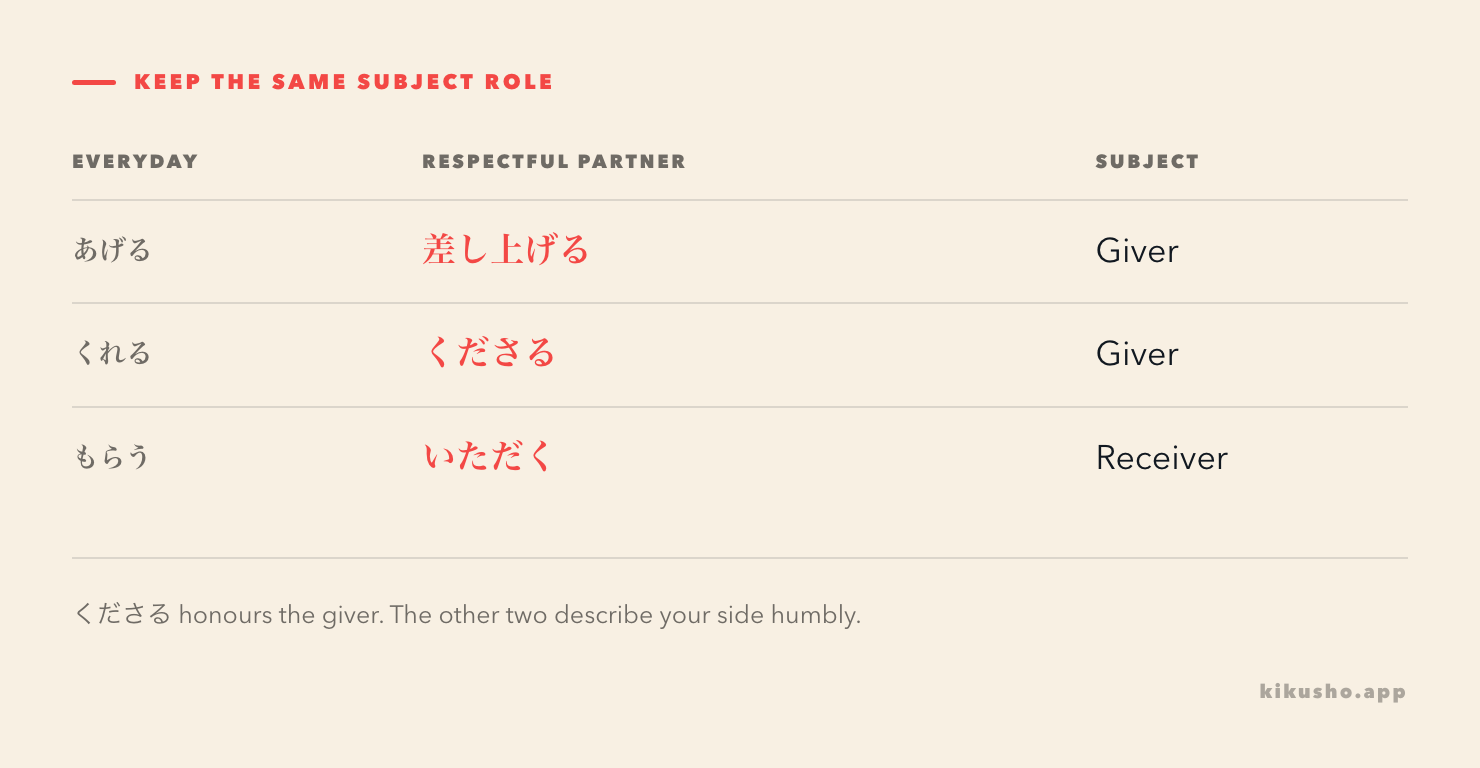
あげる describes giving to someone else, くれる describes someone giving toward you or your side, and もらう describes receiving. Their respectful partners, 差し上げる, くださる and いただく, preserve those roles while changing how you refer to the people involved.
Why learn these six as one set?
A book changes hands once. You can tell that event from the giver's side or the receiver's side, and you can describe a teacher's part in it respectfully. That produces several possible sentences without producing several gifts.
This N4 vocabulary lesson teaches the six verbs with objects: a book, a souvenir, a present. The basic trio may already be familiar from beginner lessons. Coto Academy introduces it in a guide labelled N5, whereas this curriculum's Waller/Tanos-derived vocabulary records place all six at N4. Those are study classifications, with a shared source family behind the inventory, rather than an official exhaustive JLPT word list.
Keep three questions separate: who gives, who receives, and whose action the verb makes the subject. Once those are clear, you can choose the level of respect. The examples state the participants so that you can see the pattern; conversation often leaves known participants unspoken.
The six verbs and their forms
All six are transitive verbs in the uses taught here: the thing transferred is marked with を. “Giving” includes the transfer of an object or ownership, rather than every movement of a hand toward somebody.
| Word and reading | Meaning in this set | Verb group | Polite form | Plain past |
|---|---|---|---|---|
| あげる | Give to someone else | Ichidan | あげます | あげた |
| くれる | Give toward me or my side | Ichidan | くれます | くれた |
| もらう | Receive from someone | Godan | もらいます | もらった |
| 差し上げる(さしあげる) | Humbly give, showing respect to the recipient | Ichidan | 差し上げます | 差し上げた |
| くださる | Respectfully describe someone giving toward my side | Godan, special ます form | くださいます | くださった |
| いただく | Humbly receive, showing respect to the giver | Godan | いただきます | いただいた |
The first three are often written in kana, as they are here. The reading of 差し上げる is さしあげる. If the group names are unfamiliar, the earlier lesson on verb groups and polite endings explains what ichidan and godan do.
Watch くださいます. It is the standard polite form to learn, with くださいました in the past. Do not build it by treating くださる as an ordinary ichidan verb. Shogakukan's entry identifies くださる as an honorific giving verb, and the University of Texas giving-and-receiving chart explicitly pairs it with くださいます.
Follow the gift before changing the verb
あげる: the giver is the subject
私は旅行で買った絵はがきを友達にあげた。
わたしは りょこうでかった えはがきを ともだちに あげた。
I gave a friend a postcard I bought on my trip.
私 gives, 友達に identifies the recipient, and 絵はがきを identifies the postcard. A useful phrase to retain is 友達におみやげをあげる, “give a friend a souvenir.” The direction is away from the speaker in this example.
But “away from me” is a starting example, not the complete meaning of the verb. In a neutral account, 田中さんは同僚に手帳をあげた(たなかさんは どうりょうに てちょうを あげた)means “Tanaka gave a colleague a diary.” You are neither giver nor receiver. Tokyo University of Foreign Studies explicitly includes transfers between third parties under あげる.
くれる: the gift comes toward your side
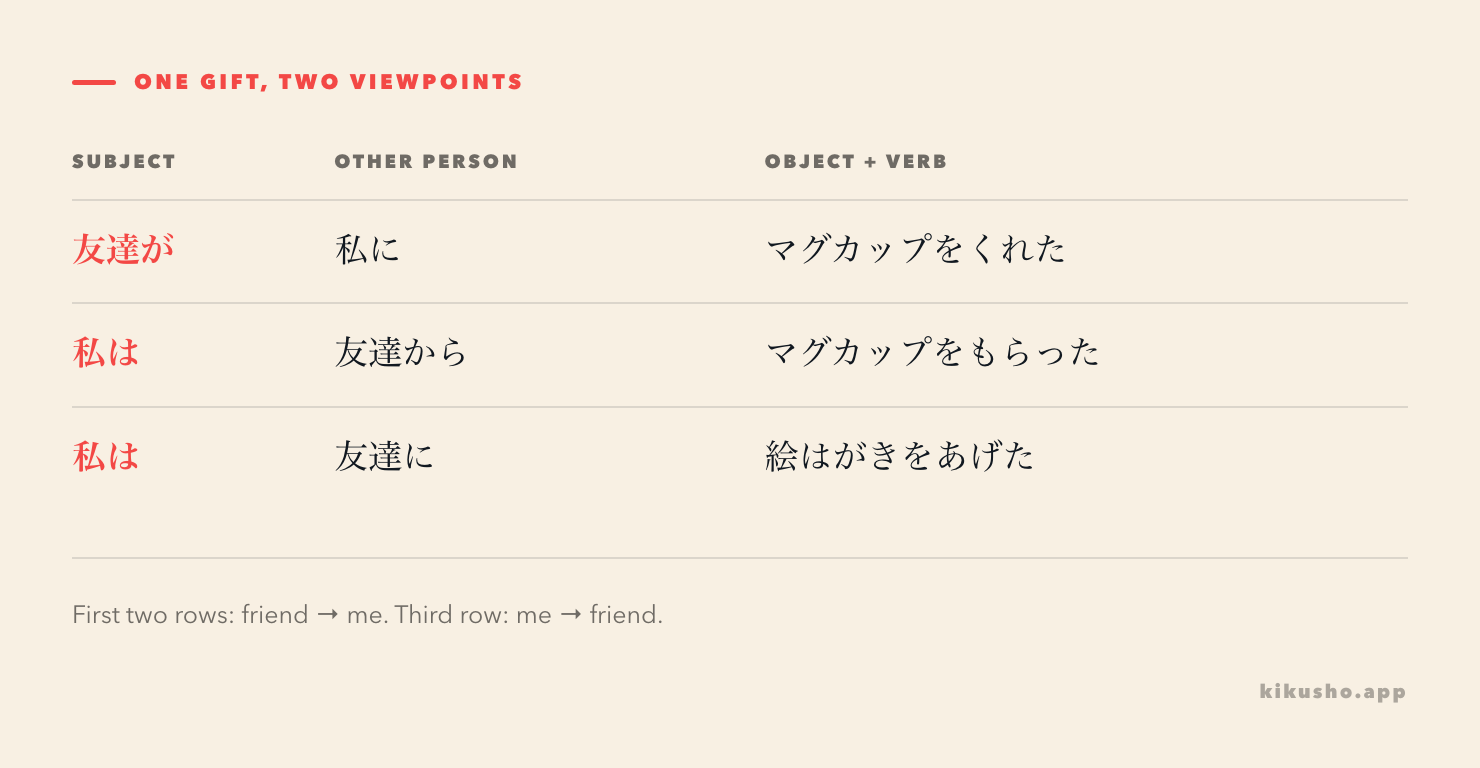
友達が私に青いマグカップをくれた。
ともだちが わたしに あおい マグカップを くれた。
A friend gave me a blue mug.
The friend is still the person doing the giving. くれる does not mean “I receive” grammatically, even though a gift reaches you. That matters when you identify the subject or rewrite the sentence.
The recipient can also be someone you present as close to you. 近所の人が弟に絵本をくれた(きんじょのひとが おとうとに えほんを くれた)means “A neighbour gave my younger brother a picture book.” The speaker's brother receives it; the speaker need not touch it. This is the “my side” relationship, not physical motion toward the place where you are standing.
もらう: make the receiver the subject
私は友達から青いマグカップをもらった。
わたしは ともだちから あおい マグカップを もらった。
I received a blue mug from a friend.
This can describe the very same mug as the くれる example. Now 私 is the subject because receiving is the verb's action. 友達から identifies the giver. For this kind of transfer from a person, 友達に can also mark the source.
Do not memorise に as meaning “recipient” regardless of the verb. In 友達にあげた, the friend receives. In 友達にもらった, the friend gives. The TUFS explanation lays out that change of subject; Coto's object examples also show the alternative から.
もらう is not limited to a first-person subject either. 弟は友達からカードをもらった means “My younger brother received a card from a friend.” Identify the receiver from the sentence instead of silently replacing every subject with 私.
Add respect without reversing the transfer
The three respectful partners do different work. くださる honours the giver's action. 差し上げる and いただく describe your side's giving or receiving humbly, showing respect to the other participant. The Japan Foundation's teaching notes distinguish these roles and give their sentence frames.
差し上げる: your side gives
お礼に、森先生に紅茶のセットを差し上げました。
おれいに、もりせんせいに こうちゃのセットを さしあげました。
I gave Professor Mori a tea set as a thank-you gift.
The giver is the speaker, left unstated here. Professor Mori receives the set. 先生にお礼の品を差し上げる(せんせいに おれいのしなを さしあげる)is a useful combination for describing a gift given respectfully.
A humble verb is not automatically the best announcement while handing someone a present. The Japan Foundation cautions that directly declaring 差し上げます to a superior can sound inappropriate. An offer such as よろしければ、どうぞ, “Please take this, if you would like it,” avoids making the act of giving the centre of attention. Describing the gift afterwards and offering it in person are different situations.
くださる: the respected person gives
卒業の日、森先生が私に写真集をくださいました。
そつぎょうのひ、もりせんせいが わたしに しゃしんしゅうを くださいました。
On graduation day, Professor Mori gave me a photography book.
Professor Mori is the subject, and the speaker receives the book. 先生がくださった本, “the book the teacher gave me,” uses the plain past inside a noun-modifying phrase while retaining the honorific verb. A plain ending does not erase the respect built into くださる.
Compare the forms carefully: くださる → くださった, but くださいます → くださいました. The polite ending and the honorific vocabulary are two separate choices.
いただく: your side receives
卒業の日、森先生から写真集をいただきました。
そつぎょうのひ、もりせんせいから しゃしんしゅうを いただきました。
On graduation day, I received a photography book from Professor Mori.
The book travels in the same direction as before. The receiver has become the subject, and いただく expresses the receiving humbly. 先生から本をいただく and 先生に本をいただく both work for receiving a book from a teacher; the Japan Foundation notes this source-marking alternative.
いただく → いただいた follows the godan pattern. Shogakukan's dictionary lists the humble receiving sense separately from its other meanings. Recognising this verb from a mealtime expression is useful, but here the sentence concerns receipt of a book, not eating it.
Where the simple arrows need a qualification
The people still matter. A giving verb helps you infer a missing participant; it does not make every あげる sentence about you. In the ordinary situations above, くれる points toward the speaker's side. In a quoted conversation, identify who is speaking before interpreting “my side.” Read the surrounding passage before supplying a name.
A gift is different from a temporary loan. If someone lends you a book and expects it back, do not describe the transaction as an ordinary gift with あげる merely because the book changed hands. These examples concern giving and receiving, with no return obligation implied.
ます and respect are different. あげます is polite speech, while 差し上げます also expresses deference within the event. Choose by the relationship and situation, not by replacing every everyday verb with the longest one. The broader guide to Japanese politeness explains that distinction.
This page stops at the six lexical verbs. Putting one after another verb's て-form introduces the giving or receiving of an action or favour; that extension needs its own treatment, especially for requests. Knowing which person receives an object gives you a foundation without pretending the later constructions have all been covered.
What to practise when a gift comes up
Name the giver and receiver first. Then say the event once with the giver as subject and once with the receiver as subject. If you can keep the object moving between the same two people, you have checked more than an English gloss.
For a gift you record in Kikusho, keep the person's role in the editable example: 先生がくださいました and 先生からいただきました recall different sentence structures for one exchange. A register note is useful here because it preserves why the everyday くれました or もらいました was changed.
Work through all six questions below before consulting the shared answers.
Practice questions
Question 1: read the verb
Choose the reading of 差し上げました.
先生にお礼の品を差し上げました。
- A. さしさげました
- B. さしあげました
- C. さちあげました
- D. さしのぼりました
Question 2: complete the gift story
You bought a scarf as a present for a friend. Choose the verb that describes giving it to them.
私は友達の誕生日に、マフラーを( )。
- A. あげた
- B. くれた
- C. もらった
- D. 借りた
Question 3: preserve the event
Which sentence describes the same exchange from the receiver's side?
友達が私にノートをくれました。
- A. 私は友達にノートをあげました。
- B. 友達は私からノートをもらいました。
- C. 私は友達からノートをもらいました。
- D. 私は友達にノートを貸しました。
Question 4: choose the respectful use
You are reporting that your teacher gave you a dictionary. Which sentence fits?
- A. 私が先生に辞書をくださいました。
- B. 先生が私に辞書をいただきました。
- C. 私が先生に辞書を差し上げました。
- D. 先生が私に辞書をくださいました。
Question 5: speak as the receiver
Choose the humble receiving verb. The teacher gave the speaker the book.
この本は、先生から( )。
- A. 差し上げました
- B. いただきました
- C. くださいました
- D. あげました
Question 6: include your side
A neighbour gives a toy to your younger sister. You describe the gift as coming to your family. Which sentence fits that viewpoint?
- A. 妹が近所の人におもちゃをくれました。
- B. 近所の人が妹からおもちゃをもらいました。
- C. 近所の人が妹におもちゃをくれました。
- D. 妹が近所の人におもちゃをあげました。
Answers and explanations
For each correction, trace the gift between the two people before checking the verb's level of respect.
Answer 1
B: さしあげました. The dictionary form is 差し上げる(さしあげる). Its polite past is 差し上げました. The sentence describes giving a thank-you gift to a teacher; 品 is しな here. The other choices do not read this verb.
Answer 2
A: あげた. You give the scarf to the friend. くれた would put you in the wrong giving role for this ordinary first-person statement. もらった would make you receive the scarf, and 借りた would mean you borrowed it. Neither matches a present you bought and gave away.
Answer 3
C. The friend gives, you receive, and the notebook stays the same. A and B reverse the direction. D changes giving into lending. In the correct rewrite, 私 becomes the receiver-subject and 友達から marks the giver.
Answer 4
D. 先生 is the respected giver and 私 is the recipient. くださる honours the teacher's giving. A wrongly assigns that honorific action to the speaker; B uses the humble receiving verb for the teacher; C describes you giving the teacher a dictionary instead.
Answer 5
B: いただきました. The speaker receives the book from the teacher. The other three verbs describe giving and do not supply the required receiving action. から marks the source here; the same object could be described with the teacher as subject using くださいました.
Answer 6
C. The neighbour gives to your sister, who is presented as part of your side. You do not have to be the direct recipient to use くれる. A, B and D all make the toy move from the sister to the neighbour instead. Read 近所 as きんじょ, “the neighbourhood,” and 妹 as いもうと.
Common questions
What is the difference between くれる and もらう?
Both can describe a gift coming to you. With くれる, the giver is the subject: a friend gives you something. With もらう, the receiver is the subject: you receive something from a friend. The event can stay the same while the sentence changes viewpoint.
Does あげる always mean that I am the giver?
No. It can describe you giving to someone else, but also a transfer between other people. The verb identifies a giving viewpoint; it does not replace all information about who the participants are.
Why is the polite form of くださる くださいます?
くださる belongs to a small group of honorific verbs with a special form before ます. Learn くださいます and くださいました as the standard polite forms. The plain past is くださった.