
On this page
If you hear こちらは受付でございます (こちらは うけつけで ございます), the speaker is identifying the reception desk, not announcing that one exists. Japanese keigo basics become easier to read when you separate polite service wording, respect for someone else's action, and a favour you ask someone to do. This N4 reference teaches eight assigned forms, including irregular verbs and requests that a two-pattern introduction leaves out.
The overview of Japanese politeness introduces the listener-versus-actor distinction and the inside/outside group boundary. Here we apply it to particular expressions and their limits. JLPT Sensei's N4 list and Bunpro's N4 lessons place these forms at N4; the JLPT organisers' FAQ explains why level lists are study estimates rather than an official exhaustive grammar syllabus. The Japan Foundation's Irodori teaches several of the same patterns in its pre-intermediate course. Recognition is useful now even if you rarely produce such formal expressions in everyday conversation.
Eight forms, three jobs
Locate the person doing the action, then check whether you are identifying something, asking for help, or describing an action. Each row is an actual construction in this lesson's assigned inventory; the ordinary counterpart is a reading aid, not a license to swap registers in every sentence.
| Form | Job and ordinary counterpart | Read it in context |
|---|---|---|
| ございます (gozaimasu) | Formal existence; あります | 空席がございます (くうせきが ございます): “There are available seats.” |
| でございます (de gozaimasu) | Formal identification after a noun; です | こちらは受付でございます (こちらは うけつけで ございます): “This is reception.” |
| いらっしゃる (irassharu) | Respectful いる/行く/来る, for the other person | 先生は教室にいらっしゃいます (せんせいは きょうしつに いらっしゃいます): “The teacher is in the classroom.” |
| なさる (nasaru) | Respectful する, for the other person | 先生は確認なさいます (せんせいは かくにん なさいます): “The teacher will check it.” |
| お~になる (o–ni naru) | Respectful established verb-stem frame | 先生は資料をお読みになります (せんせいは しりょうを およみに なります): “The teacher will read the materials.” |
| いたします (itashimasu) | Humble/courteous します, for your side | 私が確認いたします (わたしが かくにん いたします): “I will check it.” |
| お~ください (o–kudasai) | Respectful instruction or invitation to the listener | こちらでお待ちください (こちらで おまちください): “Please wait here.” |
| ~ていただけませんか (te itadakemasen ka) | Indirect request to receive the listener's action; ~てもらえませんか | もう少しゆっくり話していただけませんか (もうすこし ゆっくり はなして いただけませんか): “Could you speak a little more slowly?” |
The eight rows are g-382e90cc7487, g-1276411f6dfe, g-7912c38271e9, g-5e397fd5b7bd, g-84709e8ccb4b, g-01a3435a7963, g-9110029ae1db, and g-1e5bd3d76692 in the Kikusho reference inventory. The Agency for Cultural Affairs' Keigo Guidelines distinguish five formal categories. The three jobs in this table are a first reading pass, not a claim that all eight forms belong to one grammatical class.
At the counter: ございます exists, でございます identifies
空席がございます (くうせきが ございます) says “There are available seats.” が marks what exists, as in 空席があります. Stand-alone ございます is very polite existence wording; you also hear it in fixed greetings like ありがとうございます. Bunpro's ございます entry and JLPT Sensei's entry distinguish this use from the copular expression.
こちらは受付でございます (こちらは うけつけで ございます) says “This is reception.” The noun 受付 is followed by でございます, a much more formal です. A clerk may say こちらは予約の確認書でございます (こちらは よやくの かくにんしょで ございます): “This is the reservation confirmation.” The noun being identified is the clue; there is no が marking a thing's existence. Bunpro's でございます entry and JLPT Sensei's entry describe service identification. The higher register belongs to an appropriate setting, not to every です in your own conversation.
Whose action? いらっしゃる, なさる, お~になる
When you respect the actor, いる, 来る, and 行く can all become いらっしゃる (irassharu). The place or destination tells you which meaning is intended. 先生は教室にいらっしゃいます means the teacher is in the classroom; 先生は明日こちらへいらっしゃいます (せんせいは あした こちらへ いらっしゃいます) means the teacher will come here tomorrow. Its polite form is いらっしゃいます, not a mechanically guessed いらっしゃります. The Agency's guidelines list the three ordinary verbs; Bunpro's N4 entry confirms the honorific use. Do not elevate your own action or your company's action when speaking to a client.
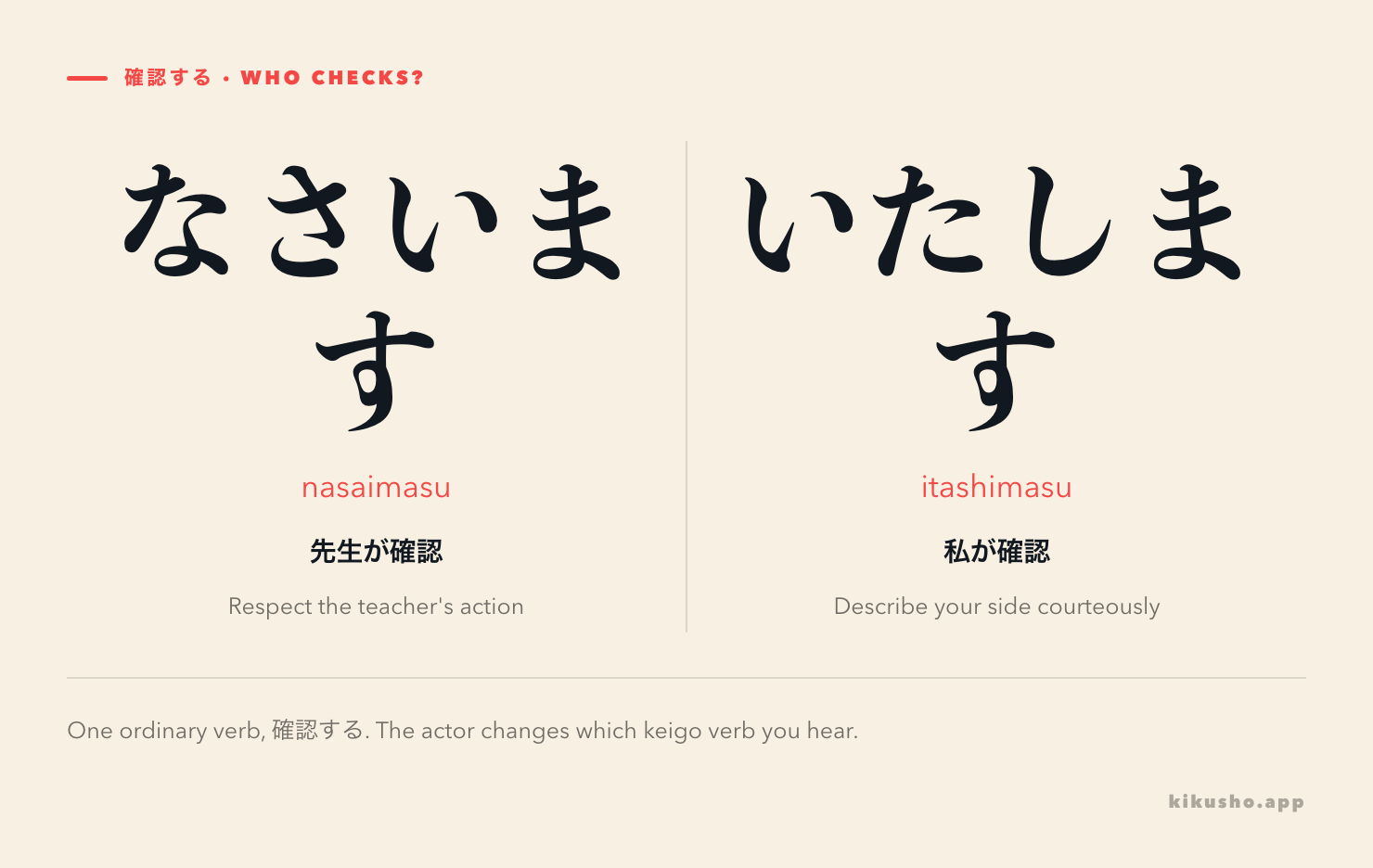
For the respected person's する, learn なさる (nasaru) and its polite なさいます together. 先生は確認なさいます raises the teacher who checks; 私が確認いたします describes my checking courteously. The verb remains “check/do”; what changes is whose action receives respect. JLPT Sensei's なさる page confirms なさいます; the Agency's examples class なさる as respectful speech. In a conversation with an outsider, even your own manager belongs to your side, so check the group boundary before applying an honorific.
For many established regular verbs, お + ます-stem + になる raises the other person's action. 読む → お読みになる → お読みになります (よむ → およみに なる → およみに なります); the に belongs to the frame. 先生は資料をお読みになります means the teacher will read the materials. Sino-Japanese verbal nouns often use ご, but the prefix and pattern do not attach naturally to every verb. The Agency's guidelines explicitly flag unsuitable constructions and the doubled honorific お読みになられる; Bunpro places the working frame at N4. Learn ご覧になる for “look/see” rather than forcing the ordinary stem of 見る into a universal formula.
Your side acts: いたします
する → いたす → いたします (suru → itasu → itashimasu) describes your side's action courteously. 私が確認いたします is “I will check it”; 私がご案内いたします (わたしが ごあんない いたします) is “I will guide you.” ご案内 addresses an action directed towards the guest; いたします is not a respectful replacement for what that guest does. The Agency's guidelines classify いたす among forms that make one's own side's action courteous and describe the combined お/ご~いたす pattern. Bunpro's いたす lesson and JLPT Sensei's いたします lesson check the actor and construction. There are more precise classifications within humble speech; these examples are enough to decide whose action a counter sentence describes.
Two requests that sound polite in different ways
お~ください (o–kudasai) uses お + ます-stem + ください: 待つ → 待ちます → お待ちください (まつ → まちます → おまちください). こちらでお待ちください respectfully asks someone to wait here. この案内をお読みください (この あんないを およみください) invites the listener to read the guide. This service wording does not make every command gentle merely because you added a prefix. The Japan Foundation's Irodori Lesson 4 explicitly restricts this frame: short stems from 見る/着る/寝る/出る, and 来る/する, do not simply form ordinary お~ください. Its examples include お読みください and お待ちください. For “please look,” use ご覧ください, not an invented お見ください. Sino-Japanese action nouns often take ご~ください, with exceptions such as お電話ください. JLPT Sensei's dedicated N4 page confirms the stem frame.
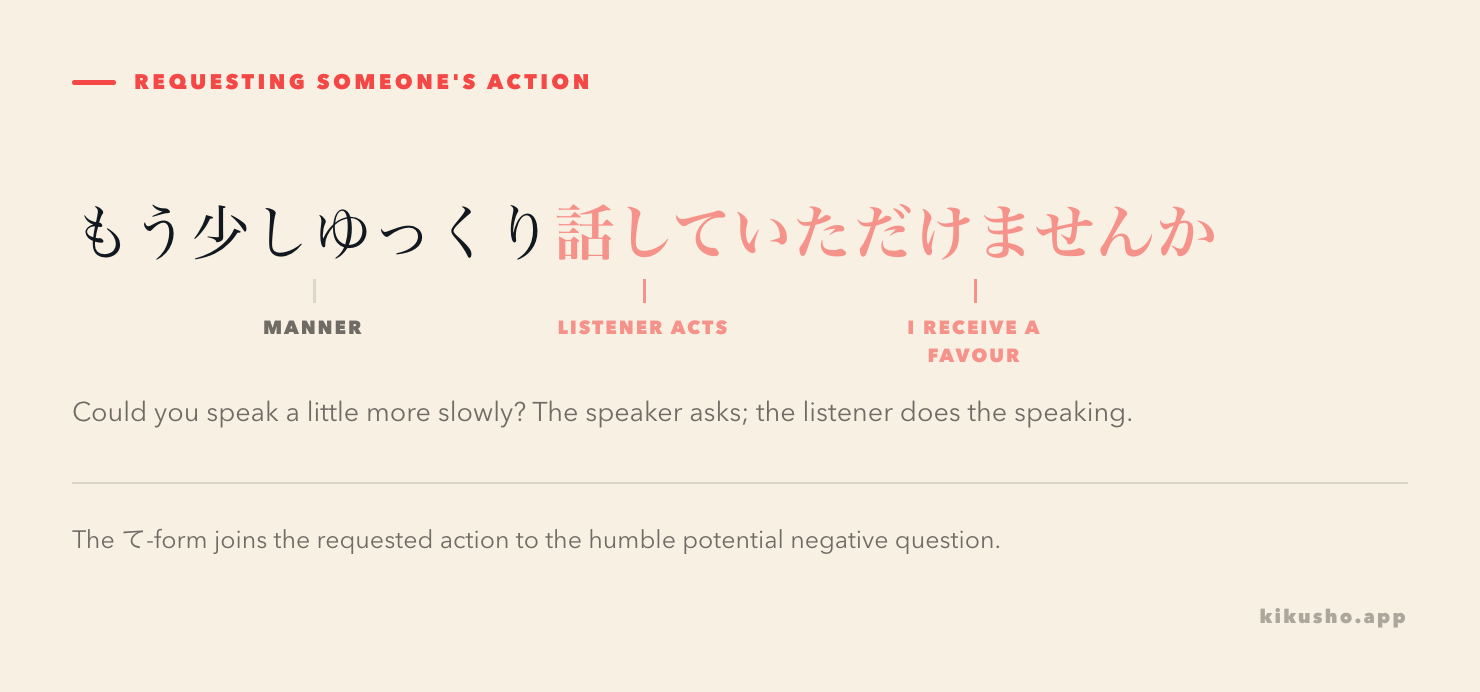
~ていただけませんか (te itadakemasen ka) is a different request: verb て-form + いただけませんか. もう少しゆっくり話していただけませんか asks the listener to speak more slowly as a favour to you. この欄に名前を書いていただけませんか (この らんに なまえを かいて いただけませんか) asks, “Could you write your name in this field?” The いただく family presents you as receiving someone's action; the potential negative question leaves room for an answer. The Japan Foundation's Irodori Lesson 16 analyses this exact negative request as a more deferential ~てもらえませんか, and Bunpro's dedicated N4 page confirms the attachment. The giving-and-receiving vocabulary lesson explains いただく with objects; here what you receive is another person's action.
The interaction decides which request works. お待ちください tells a guest where to wait in a respectful service instruction; 待っていただけませんか asks if someone can wait for you as a favour. Tofugu's guide to ください distinguishes honorific invitations and instructions from ways to ask for a favour. A request's purpose and actor matter as much as its form.
Practice: choose the form by its job
Try all eight situations first. The answer block follows the last request, so you can work through the forms without seeing a solution alongside a prompt.
Question 1 — grammar choice. A clerk means “There are available seats.” Which line expresses existence, rather than identifying an object?
- A. 空席がございます。
- B. 空席がでございます。
- C. 空席をございます。
Question 2 — grammar choice. A clerk identifies a document: “This is the reservation confirmation.” Which sentence uses a formal copula after a noun?
- A. こちらは予約の確認書がございます。
- B. こちらは予約の確認書でございます。
- C. こちらは予約の確認書をございます。
Question 3 — sentence composition. Say “The teacher is in the classroom” politely and respectfully, with 先生, 教室に, and the honorific verb for いる. State its special polite ending.
Question 4 — sentence composition. Say “I will check it” as a courteous speaker-side action, with 私が, 確認 and the humble/courteous form of します. Then state how “The teacher will check it” changes the doer and form.
Question 5 — grammar choice. Describe a teacher reading 資料, respecting the teacher's action. Which is the established お~になる frame?
- A. 先生は資料をお読みになります。
- B. 先生は資料をお読みいたします。
- C. 先生は資料をお読みになられます。
Question 6 — grammar choice. A service sign respectfully asks a reader to read the guide. Which uses お~ください without forcing a one-syllable stem or the wrong て-form?
- A. この案内をお読みください。
- B. この案内をお読んでください。
- C. この案内をお見ください。
Question 7 — text grammar. Read 先生は教室にいらっしゃいます。私がご案内いたします。 Which person is respected as actor in the first sentence, and whose action is described courteously in the second? Explain why the second verb is inappropriate for the teacher's own action in this context.
Question 8 — sentence composition. Ask a teacher, “Could you speak a little more slowly?” Use もう少しゆっくり, 話す, and the negative potential request for receiving the teacher's action. Say what changes if you use ゆっくりお話しください instead.
Answers and explanations
Answer 1. A, 空席がございます (くうせきが ございます). が marks the seats whose existence is asserted; ございます stands where あります would. B incorrectly puts が immediately before the identifying でございます; C gives the existence verb an object を it does not take.
Answer 2. B, こちらは予約の確認書でございます (こちらは よやくの かくにんしょで ございます). The noun 確認書 is identified using a formal counterpart of です. A, with がございます, instead asserts that a confirmation document exists and changes the information given; C wrongly pairs を with ございます.
Answer 3. 先生は教室にいらっしゃいます (せんせいは きょうしつに いらっしゃいます). 教室に locates the teacher, so いらっしゃる replaces いる and respects the teacher. Its special polite form is いらっしゃいます, not いらっしゃります; changing the subject to 私 would make the honorific choice wrong for my own presence.
Answer 4. 私が確認いたします (わたしが かくにん いたします) courteously describes my action, using する → いたす → いたします. To respect the teacher doing it, say 先生は確認なさいます (せんせいは かくにん なさいます), using なさる → なさいます. Switching 私 and 先生 without switching the verb reverses who is being honoured.
Answer 5. A, 先生は資料をお読みになります (せんせいは しりょうを およみに なります). 読む supplies 読み to お + stem + になる, and the teacher is the respected reader. B uses speaker-side いたします about the teacher. C adds another respectful られる to an already respectful お読みになる, the doubled form the Agency's guidelines warn against.
Answer 6. A, この案内をお読みください (この あんないを およみください). 読み is the ます-stem of 読む. B mixes お with the て-form 読んで in this frame. C means “look,” not “read,” and 見る does not normally give お見ください; the established “please look” is ご覧ください.
Answer 7. 先生 is the respected actor in 教室にいらっしゃいます: the teacher is present. 私 acts in ご案内いたします: I will guide someone courteously. いたします is for my side's action, so it would not raise the teacher's action if 先生 were the guide. The passage does not say a clerk is discussing their own boss with a client; that group boundary would change the choice.
Answer 8. もう少しゆっくり話していただけませんか (もうすこし ゆっくり はなして いただけませんか). 話して is the て-form of 話す, and いただけませんか asks whether I could receive the teacher's help. ゆっくりお話しください is a respectful instruction or invitation to speak slowly, formed from 話します → 話し; it does not frame the act as a favour on my behalf.
Common questions
Is ございます the same as でございます?
No. 空席がございます says there are seats, replacing あります. こちらは受付でございます identifies the place as reception, replacing です after a noun. The particle and noun before the ending tell you which job the sentence is doing.
Can I use お~になる and お~ください with any verb?
No. Both attach to a verb's ます-stem, but conventional choices and restrictions matter. お読みになる and お待ちください work; one-syllable stems such as 見る do not make an ordinary お見ください. Learn the established special form ご覧ください instead.
What is the difference between お待ちください and 待っていただけませんか?
お待ちください is a respectful instruction to wait. 待っていただけませんか asks whether the listener could wait as a favour to the speaker. Context decides which sounds suitable.
Does keigo first appear on the JLPT at N4?
There is no official exhaustive JLPT grammar syllabus. Several study lists place these forms at N4, while other courses teach them at different stages. The level is a study estimate.