On this page
性格 describes a characteristic pattern, 性質 an inherent disposition or property, and 特徴 the feature that stands out. The other eight words in this N3 set show how Japanese moves from describing a person to judging what that person does: with care, composure, candour, stubbornness, meanness, selfishness or idleness.
The distinction matters because a dictionary gloss such as “character” does not tell you whether the word belongs with a person, a material, a decision or a specific act. The noun or particle beside the word usually settles the choice.
Eleven words connect description with conduct
| Word and reading | Class | Working sense | Combination to keep |
|---|---|---|---|
| 意地(いじ) | Noun | Stubborn pride, will or disposition | 意地を張る |
| 意地悪(いじわる) | Noun / な-adjective | Meanness; deliberate unkindness | 意地悪な質問 |
| けち | Noun / な-adjective | Stingy; unwilling to part with money or goods | けちな人 |
| 正直(しょうじき) | Noun / な-adjective / adverbial use | Truthful; frank; frankly | 正直に話す |
| 慎重(しんちょう) | Noun / な-adjective | Careful; prudent; not hasty | 慎重に検討する |
| 性格(せいかく) | Noun | Character; personality; characteristic nature | 明るい性格 |
| 性質(せいしつ) | Noun | Inherent disposition or property | 水に溶ける性質 |
| 特徴(とくちょう) | Noun | Distinguishing feature | 特徴のある声 |
| 怠ける(なまける) | Ichidan verb | Be idle; avoid work one should do | 仕事を怠ける |
| 冷静(れいせい) | Noun / な-adjective | Calm; emotionally composed | 冷静な判断 |
| わがまま | Noun / な-adjective | Selfish or wilful behaviour | わがままを言う |
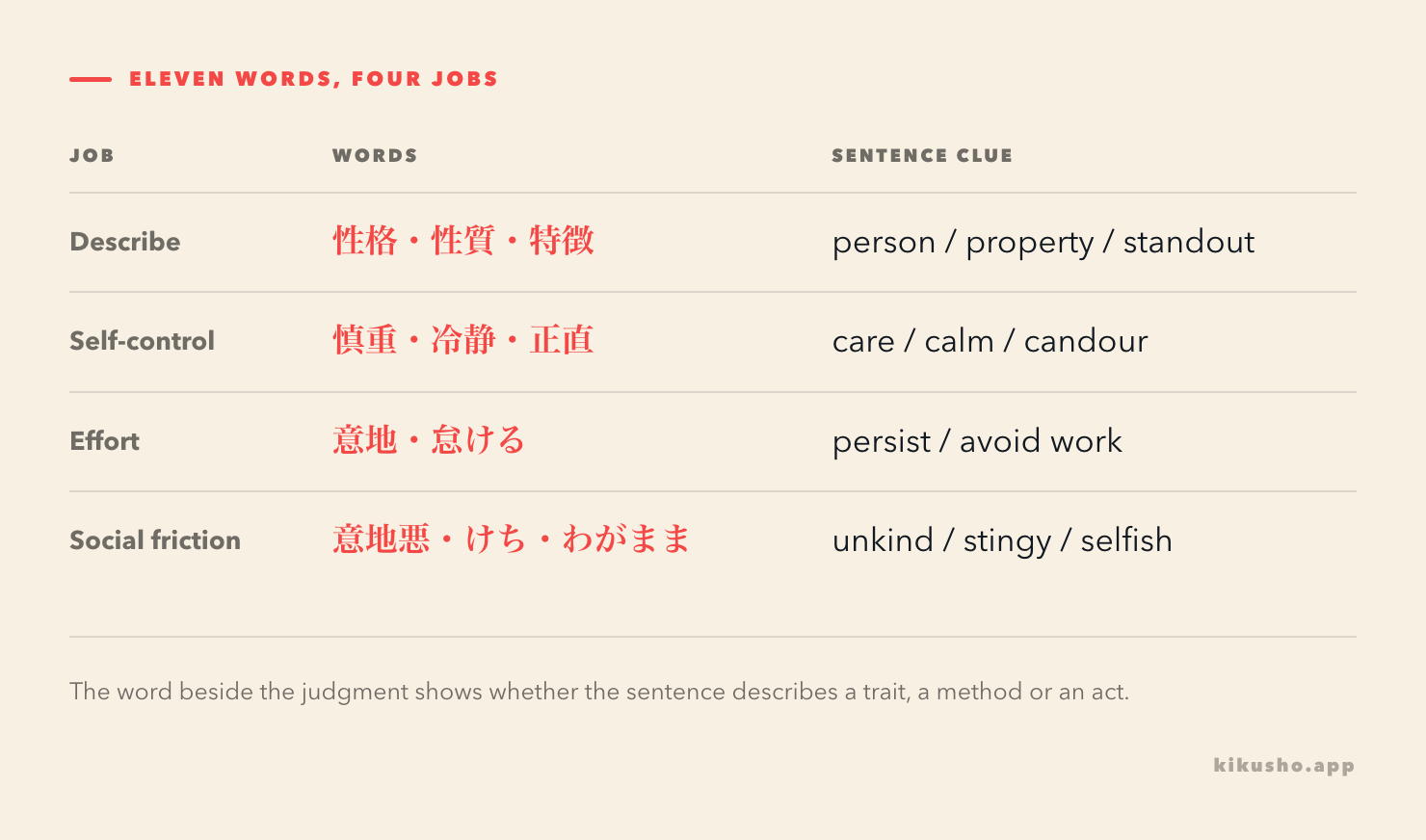
The table separates grammatical jobs as well as meanings. 慎重な計画 modifies a noun; 慎重に計画する modifies an action. 意地を張る needs a noun and particle, while 意地悪な言い方 uses a な-adjective. Learning the whole combination prevents a translation from becoming an unusable card.
性格, 性質 and 特徴 answer three different questions
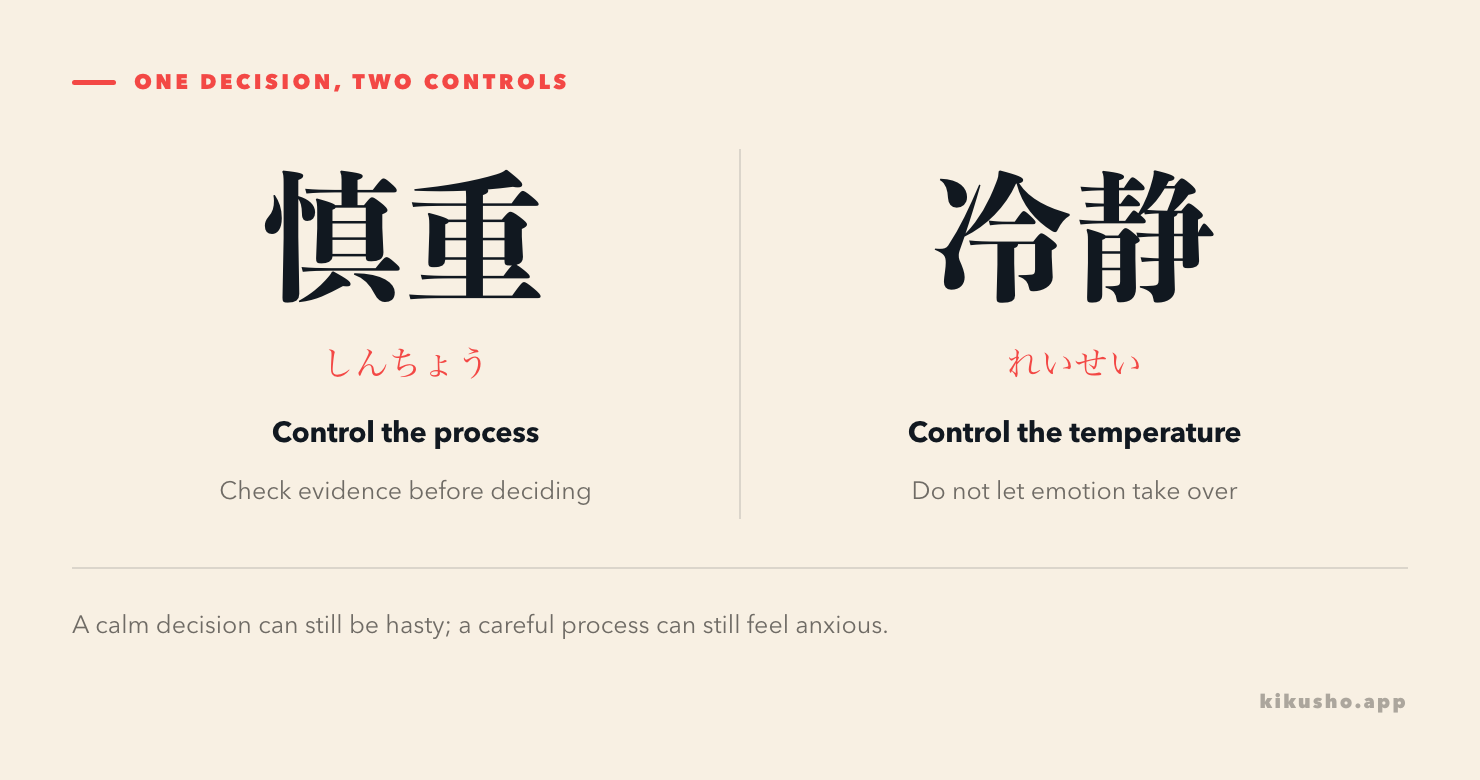
Use 性格(せいかく) when the question is “What kind of person is this?” It describes a characteristic pattern visible in emotion, thought or behaviour.
弟は明るい性格で、初対面の人にもよく話しかける。
おとうとは あかるい せいかくで、しょたいめんの ひとにも よく はなしかける。
My younger brother has a cheerful personality and often talks to people he has just met.
The dictionary entry for 性格 also allows the characteristic nature of a thing or issue, as in 問題の性格. Personality is its central everyday use, not its absolute boundary.
性質(せいしつ) asks what disposition or property belongs to something. It can describe a person, but it also fits materials, substances and phenomena without personifying them.
この紙には、水を吸いやすい性質がある。
この かみには、みずを すいやすい せいしつが ある。
This paper has the property of absorbing water easily.
For a person, 穏やかな性質 presents gentleness as an underlying disposition. For paper, metal or light, 性格 would usually be the wrong first choice because the sentence is about an inherent property. Shogakukan's 性質 entry records both human disposition and the properties of things.
特徴(とくちょう) answers “What makes it recognizable or different?” It selects a noticeable point rather than naming the whole personality or the underlying material property.
この鳥の特徴は、長いくちばしと赤い羽だ。
この とりの とくちょうは、ながい くちばしと あかい はねだ。
This bird's distinguishing features are its long beak and red feathers.
The 特徴 definition centers on a point that stands out compared with others. That comparative idea explains 特徴のある声, “a distinctive voice,” and 最大の特徴, “the most notable feature.”
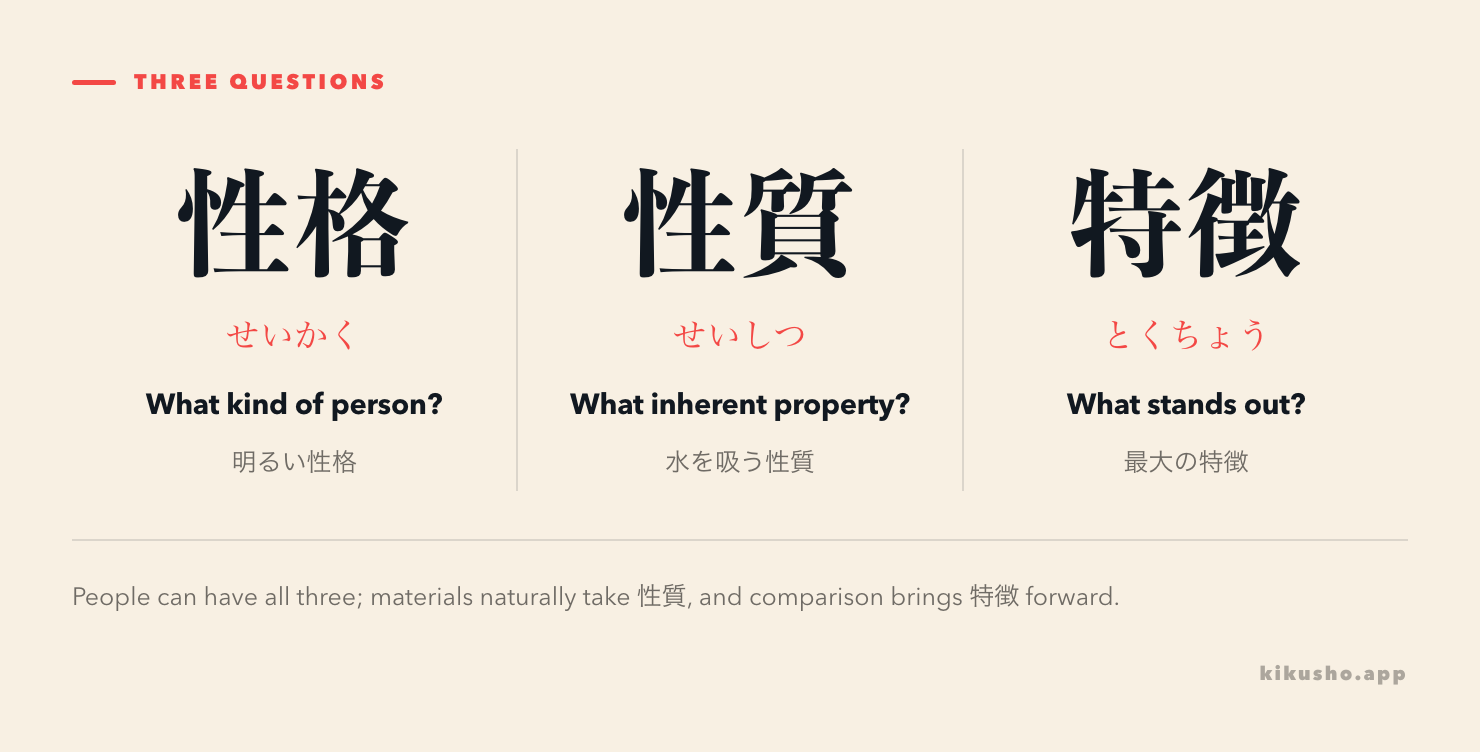
慎重 controls the process; 冷静 controls the emotional temperature
慎重(しんちょう) describes a person or action that does not proceed lightly. It points to checking, considering and avoiding a hasty decision.
契約の条件を慎重に確認してから、署名してください。
けいやくの じょうけんを しんちょうに かくにんしてから、しょめいして ください。
Please check the contract terms carefully before signing.
The dictionary entry gives patterns such as 慎重な人 and 慎重に検討する. Its practical opposite is rashness: acting before the necessary thought or checking is complete.
冷静(れいせい) describes composure. The person is not being carried away by fear, anger or excitement.
問題が起きても、彼女は冷静に状況を説明した。
もんだいが おきても、かのじょは れいせいに じょうきょうを せつめいした。
Even when a problem arose, she calmly explained the situation.
The 冷静 entry pairs the word with 冷静な判断 and 冷静に処理する. The two words often cooperate, but they do not guarantee each other. Someone may remain 冷静 while making a quick decision without enough checks; another person may follow a 慎重 procedure while feeling anxious throughout it.
正直 describes truthfulness and also introduces a frank opinion
正直(しょうじき) can characterize a person or an answer as truthful.
ミスを隠さず、正直に話してくれてありがとう。
ミスを かくさず、しょうじきに はなしてくれて ありがとう。
Thank you for speaking frankly without hiding the mistake.
It also works as a discourse adverb. 正直、分かりません or 正直に言うと、分かりません means “Frankly, I don't know.” Here the speaker frames the coming statement as candid rather than assigning someone a permanent trait. The dictionary entry for 正直 records both truthfulness and adverbial phrases such as 正直なところ.
意地 is stubborn will; 意地悪 is deliberate unkindness
The shared characters make 意地(いじ) and 意地悪(いじわる) look like a simple base word and its negative form. Their common combinations need to be learned separately.
意地 often appears in set phrases about pride or determination:
- 意地を張る: stubbornly refuse to give in
- 意地を通す: insist on carrying one's will through
- 意地になる: become obstinately determined
- 食い意地が張っている: be excessively eager for food
彼は間違いに気づいたのに、意地を張って謝らなかった。
かれは まちがいに きづいたのに、いじを はって あやまらなかった。
Although he noticed his mistake, he stubbornly refused to give in and did not apologize.
The 意地 entry covers disposition, stubborn will and appetite. “Pride” is useful in 意地を張る, but it cannot replace every sense.
意地悪 directly evaluates unkind conduct. It works as a noun, as in 意地悪をする, and as a な-adjective, as in 意地悪な質問.
答えられないと知っていて、そんな意地悪な質問をした。
こたえられないと しっていて、そんな いじわるな しつもんを した。
Knowing that the person could not answer, someone asked such a mean question.
Intent matters in that example. The dictionary definition describes deliberately troubling someone or treating them harshly. A difficult question is not automatically 意地悪.
けち and わがまま criticize different kinds of self-interest
けち most often criticizes unwillingness to spend or share money and goods. It is a noun and な-adjective.
彼はけちだから、必要な道具にもお金を使わない。
かれは けちだから、ひつような どうぐにも おかねを つかわない。
He is stingy, so he will not spend money even on necessary tools.
The けち entry also records broader senses such as shabby, petty or mean. Learn けちをつける separately: it means to find fault or make a disparaging complaint, not simply to avoid spending.
わがまま is broader social self-centeredness. A person follows their own wishes without considering another person's needs or convenience.
自分の予定だけを優先するのは、わがままだと思う。
じぶんの よていだけを ゆうせんするのは、わがままだと おもう。
I think it is selfish to give priority only to your own schedule.
It forms わがままな人, わがままを言う and わがままを通す. The dictionary entry makes the interpersonal limit explicit: the person acts as they please without consideration for others. A reasonable request stated respectfully does not become わがまま merely because it expresses what you want.
怠ける names the work someone avoids
怠ける(なまける) is an ichidan verb: 怠けます, 怠けた, 怠けない. It means failing to do what one should or avoiding work.
試験が終わっても、勉強を怠けてはいけない。
しけんが おわっても、べんきょうを なまけては いけない。
Even after the exam is over, you must not slack off on studying.
Shogakukan's definition gives 仕事を怠ける for not doing the work one should. The existing N2 character and behaviour lesson teaches 怠る(おこたる), which tends to name the duty, check or necessary action left undone: 安全確認を怠る. 怠ける puts more attention on idleness or avoiding effort.
A connected description shifts between fact and judgment
Read the following workplace account once for the situation, then again for the noun and particle beside each target word.
新しい責任者は正直で冷静な性格だ。計画を慎重に検討し、商品の特徴だけでなく、材料の性質もよく調べる。ところが、忙しくなると部下に意地悪な言い方をすることがある。部下の一人は意地を張って助けを求めず、別の一人は仕事を怠ける。予算を全く使いたがらない責任者をけちだと言う人もいれば、自分の予定を優先する態度をわがままだと感じる人もいる。
あたらしい せきにんしゃは しょうじきで れいせいな せいかくだ。けいかくを しんちょうに けんとうし、しょうひんの とくちょうだけでなく、ざいりょうの せいしつも よく しらべる。ところが、いそがしくなると ぶかに いじわるな いいかたを することが ある。ぶかの ひとりは いじを はって たすけを もとめず、べつの ひとりは しごとを なまける。よさんを まったく つかいたがらない せきにんしゃを けちだと いう ひとも いれば、じぶんの よていを ゆうせんする たいどを わがままだと かんじる ひとも いる。
The new manager has a frank and calm personality. They examine plans carefully and investigate both a product's distinguishing features and the properties of its materials. When busy, however, they sometimes speak to subordinates in a mean way. One subordinate is too stubborn to ask for help, while another slacks off at work. Some call the manager stingy for refusing to use any budget; others find the habit of prioritizing the manager's own schedule selfish.
The first sentence presents traits. The middle reports methods and actions. The final judgments are attributed to people with と言う and と感じる, which makes the evaluator visible. That is safer and more precise than presenting every negative label as an objective fact. The N3 relationship vocabulary lesson adds the role words that often shape these evaluations.
N3 is a study label, not an official exhaustive word list
The reference inventory places all eleven records in this N3 lesson. Its inherited sources disagree on 意地, 意地悪 and 性質, placing them at N1 or N2 in some rows, while independent N3 resources also teach several members of the set. Repeated copies of the same source list are one source family, not independent votes.
The JLPT official FAQ points learners away from the old practice of treating the Test Content Specifications as a current public syllabus. Word-by-word level assignments are therefore study estimates. The useful task here is to recognize each word in context, choose its normal grammatical frame and distinguish it from its closest neighbor.
In Kikusho, attach the evidence to the card. Put 性質 beside the material whose property it names, 冷静 beside the moment of pressure, and 意地悪 beside the act that made it unkind. A single English label will not preserve those boundaries. The N1 continuation applies the same method to 人柄/個性, both readings of 気質, and 誠実/忠実.
Practice: choose the word the sentence supports
Attempt all ten questions before revealing the shared answer panel.
1 · Reading. Which reading belongs to 慎重?
- イ しんじゅう
- ロ しんちょう
- ハ じんちょう
- ニ せんじゅう
2 · Description type. A scientist states that a fabric absorbs water easily. Which noun best names that inherent property?
- イ 性格
- ロ 特徴
- ハ 性質
- ニ 正直
3 · What stands out. Complete the sentence: この町の最大の( )は、古い木造の家が多いことだ。
- イ 特徴
- ロ 性格
- ハ 意地
- ニ 冷静
4 · Process or emotion. Fill both blanks in order.
事故の知らせを聞いても( 前 )さを失わず、原因を( 後 )に調べた。
- イ 前:慎重 / 後:冷静
- ロ 前:冷静 / 後:慎重
- ハ 前:正直 / 後:意地悪
- ニ 前:性質 / 後:特徴
5 · Frank introduction. Which sentence naturally introduces a candid personal reaction?
- イ 正直に言うと、その案には賛成できません。
- ロ 正直な言うと、その案には賛成できません。
- ハ 正直を言うと、その案には賛成できません。
- ニ 正直で言うと、その案には賛成できません。
6 · Pride or meanness. The person knows they were wrong but refuses to apologize. Which phrase fits that stubborn refusal?
- イ 意地悪をする
- ロ けちをつける
- ハ 意地を張る
- ニ わがままを言う
7 · Grammar. Which phrase correctly modifies 質問?
- イ 意地悪い質問
- ロ 意地悪の質問
- ハ 意地悪に質問
- ニ 意地悪な質問
8 · Spending or consideration. Someone refuses to contribute even a small amount to a shared necessary expense. Which word most directly targets unwillingness to part with money?
- イ けち
- ロ わがまま
- ハ 怠ける
- ニ 性格
9 · Verb form. Choose the correct polite negative form of 怠ける.
- イ 怠けりません
- ロ 怠けません
- ハ 怠きません
- ニ 怠かません
10 · Read the whole judgment. A team member stays calm under criticism, checks evidence before answering and admits an error without hiding it. Which sequence matches those three actions?
- イ 慎重 → 正直 → 冷静
- ロ 正直 → 冷静 → 慎重
- ハ 冷静 → 慎重 → 正直
- ニ 冷静 → 正直 → 意地
Answers and explanations
ロ, しんちょう. The long vowel appears in ちょう. 慎重に検討する means to examine something carefully.
ハ, 性質. The sentence concerns a fabric's inherent property. 性格 is common for personality, while 特徴 would identify a point that distinguishes the fabric from others.
イ, 特徴. 最大の特徴 identifies the town's most notable distinguishing feature. The sentence does not describe a personality or an emotional state.
ロ, 冷静 / 慎重. 冷静さを失わない means not losing composure. 慎重に調べる describes the careful investigative process.
イ. 正直に言うと is the standard adverbial phrase “to speak frankly.” 正直 is a な-adjective, so the other particle and conjugation choices do not form this expression.
ハ, 意地を張る. This phrase presents the refusal to yield as stubborn pride. 意地悪 would evaluate deliberate unkindness toward another person.
ニ, 意地悪な質問. 意地悪 behaves as a な-adjective before a noun. 意地悪をする is the corresponding noun pattern.
イ, けち. The prompt specifically foregrounds refusing to contribute money. わがまま would fit if the central problem were ignoring everyone else's needs to follow one's own wishes.
ロ, 怠けません. 怠ける is an ichidan verb: remove る and add ます or ません. Its past form is 怠けた.
ハ, 冷静 → 慎重 → 正直. Remaining emotionally composed is 冷静, checking before answering is 慎重, and admitting the error without concealment is 正直.
Common questions
What is the difference between 性格, 性質 and 特徴?
性格 usually describes a person's characteristic pattern, though it can also describe the nature of a problem. 性質 is an inherent disposition or property and readily applies to substances and objects. 特徴 is the feature that makes someone or something stand out in comparison.
What is the difference between 慎重 and 冷静?
慎重 describes proceeding carefully without acting lightly or too soon. 冷静 describes remaining calm and not being carried away by emotion. A person can be calm but still fail to examine a decision carefully.
What is the difference between 意地 and 意地悪?
意地 commonly appears in expressions about stubborn pride or determination, such as 意地を張る and 意地を通す. 意地悪 means deliberate unkindness or meanness and can modify a noun with な.
How are けち and わがまま different?
けち usually criticizes someone for being unwilling to part with money or goods. わがまま criticizes acting according to one's own wishes without considering other people, so money need not be involved.