On this page
悲観 and 楽観 do not name what happened. They name the direction in which someone interprets what may happen next. 絶望 goes further: it says that hope itself has been lost.
This N1 set joins those outlooks to aspiration, impatience, emotional exhaustion, jealousy and hatred. The key is not to arrange the words on one simple scale, but to identify each word's trigger, target and time frame.
Nine words locate the source and direction of a feeling
| Word | Reading | Class | Meaning here | Combination to keep |
|---|---|---|---|---|
| 憧れ | あこがれ | noun | longing or aspiration toward an ideal | 海外生活への憧れ |
| 焦る | あせる | godan verb | become impatient and lose calm | 結果を急いで焦る |
| うんざり | うんざり | adverb + する | become thoroughly fed up | 同じ説明にうんざりする |
| 惜しむ | おしむ | godan verb | regret losing; be reluctant to spend | 別れを惜しむ/努力を惜しまない |
| 嫉妬 | しっと | noun + する | jealousy or resentful envy | 同僚の成功に嫉妬する |
| 絶望 | ぜつぼう | noun + する | despair; loss of hope | 将来に絶望する |
| 憎しみ | にくしみ | noun | hatred | 憎しみを抱く |
| 悲観 | ひかん | noun + する | pessimistic view of an outcome | 将来を悲観する |
| 楽観 | らっかん | noun + する | optimistic view of an outcome | 状況を楽観する |
憧れ is the aspiration you hold
憧れ(あこがれ) is the noun corresponding to the N2 verb 憧れる. It names a strong attraction to a person, role, place or way of life regarded as ideal.
彼女は子どものころから宇宙開発への憧れを抱いていた。
かのじょは こどもの ころから うちゅうかいはつへの あこがれを いだいていた。
She had held an aspiration to work in space development since childhood.
The productive frames are Nへの憧れ, Nに対する憧れ, 憧れを抱く and 憧れのN.
Shogakukan's dictionary entry defines 憧れ as being strongly drawn to something ideal and gives 憧れを抱く and 未知への憧れ. Compare the verbal sentence 宇宙飛行士に憧れる in the N2 lesson. The noun uses への to package the target as a modifier; the verb commonly marks that target with に.
焦る pushes forward; うんざり makes you want out
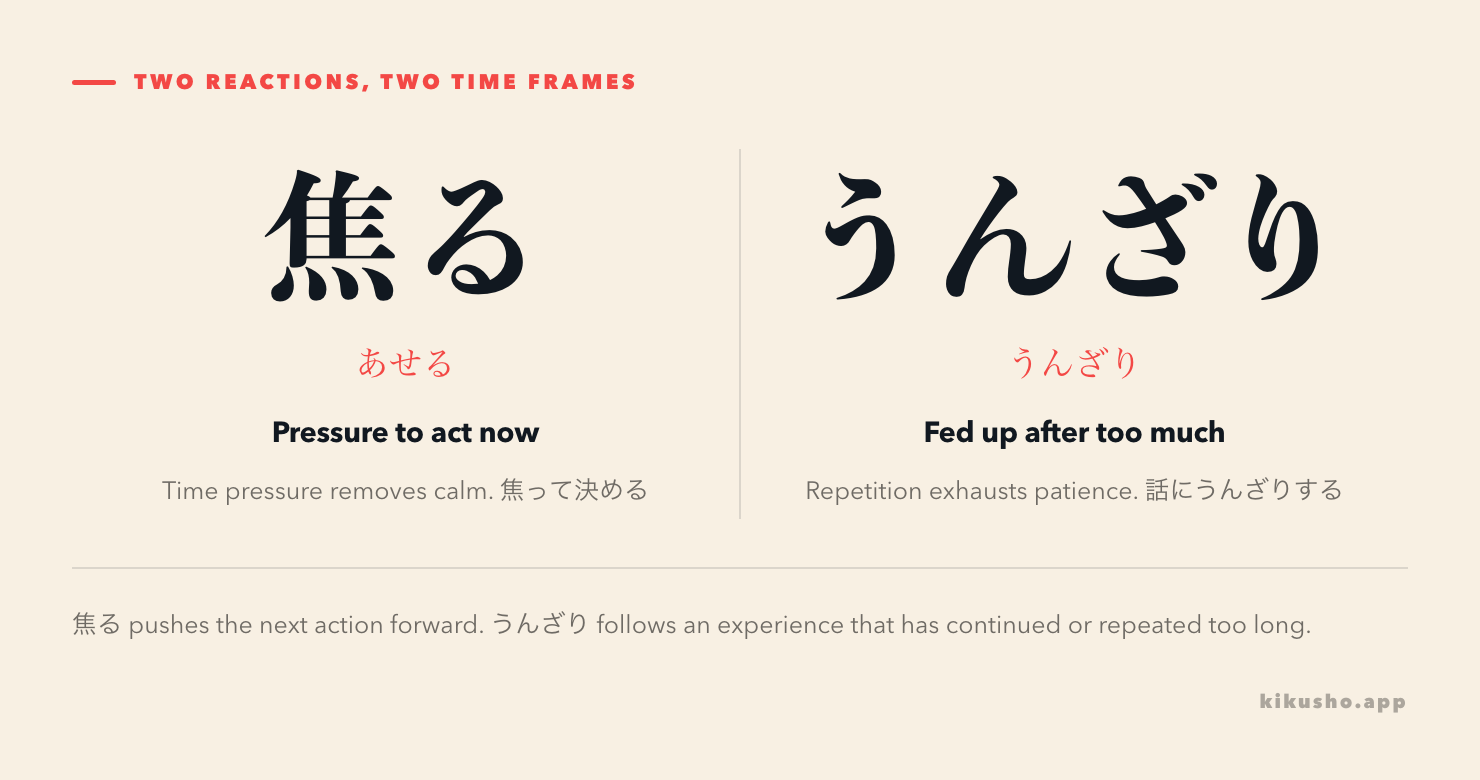
焦る(あせる) is the loss of calm caused by feeling that something must happen quickly. A deadline, slow progress or fear of falling behind can trigger it.
周りが次々に内定を得るのを見て、彼は焦って最初の会社に決めてしまった。
まわりが つぎつぎに ないていを えるのを みて、かれは あせって さいしょの かいしゃに きめてしまった。
Seeing everyone around him receive job offers, he panicked and accepted the first company.
The adverbial 焦って often introduces the rash action that follows. 焦らずに tells someone to proceed without losing composure.
Shogakukan defines the central modern sense as becoming irritated and losing calm because events are not proceeding as intended. This is why 焦る is more than moving quickly: the word evaluates the person's mental pressure.
うんざり describes a different reaction. Repetition, excess or a long unpleasant experience has exhausted the person's willingness to continue.
同じ言い訳を何度も聞かされて、みんなうんざりしている。
おなじ いいわけを なんども きかされて、みんな うんざりしている。
Everyone is fed up with being made to hear the same excuse repeatedly.
The dictionary entry for うんざり classifies it as an adverb that can combine with する and highlights becoming thoroughly tired of something repeated or excessive. 退屈 may simply mean that an activity is boring. うんざり usually adds accumulated aversion: the person has had too much of it.
惜しむ connects value, restraint and regret
惜しむ(おしむ) is a transitive godan verb. Its object is something the person values enough to resist losing, spending or giving up.
二人は駅のホームで別れを惜しんだ。
ふたりは えきの ホームで わかれを おしんだ。
The two lingered on the station platform, reluctant to part.
締め切りが近いので、一分でも時間を惜しんで作業した。
しめきりが ちかいので、いっぷんでも じかんを おしんで さぎょうした。
Because the deadline was close, I worked without wanting to waste even a minute.
The negative pattern Nを惜しまない is especially productive. It says that the subject willingly gives the named resource.
彼女は後輩を育てるための努力を惜しまない。
かのじょは こうはいを そだてるための どりょくを おしまない。
She spares no effort in developing her junior colleagues.
Shogakukan records three relevant senses: regretting a loss, being reluctant to spend something, and valuing it highly. This range explains 別れを惜しむ, 時間を惜しむ and 努力を惜しまない without treating them as unrelated idioms.
Do not replace the verb mechanically with the N2 adjective 惜しい. 時間が惜しい evaluates time as too valuable to waste; 時間を惜しむ describes the person's reluctance to waste it. 惜しい試合 can also mean a close loss, but 試合を惜しむ does not reproduce that reading.
嫉妬 compares; 憎しみ rejects
嫉妬(しっと) can refer to envy of someone more successful or jealousy when valued affection seems directed elsewhere. It combines with する, and the trigger commonly takes に.
彼は同期の昇進に嫉妬して、素直に祝えなかった。
かれは どうきの しょうしんに しっとして、すなおに いわえなかった。
He was jealous of his colleague's promotion and could not congratulate them sincerely.
Shogakukan records both resentful envy of a superior person and jealousy about a loved person's attention. The N2 verb 羨む can express envy, but it can remain closer to wishing for another person's favourable state. 嫉妬 more readily carries rivalry, threat or resentment.
憎しみ(にくしみ) is the noun formed from 憎む. It names hatred directed at a person, group, act or system.
被害者の家族は犯人への憎しみを長く抱えていた。
ひがいしゃの かぞくは はんにんへの にくしみを ながく かかえていた。
The victim's family carried hatred toward the offender for a long time.
Useful combinations include 憎しみを抱く, 憎しみに満ちる, 憎しみを向ける and 憎しみを乗り越える. Shogakukan defines it directly as the feeling of regarding someone or something with hate.
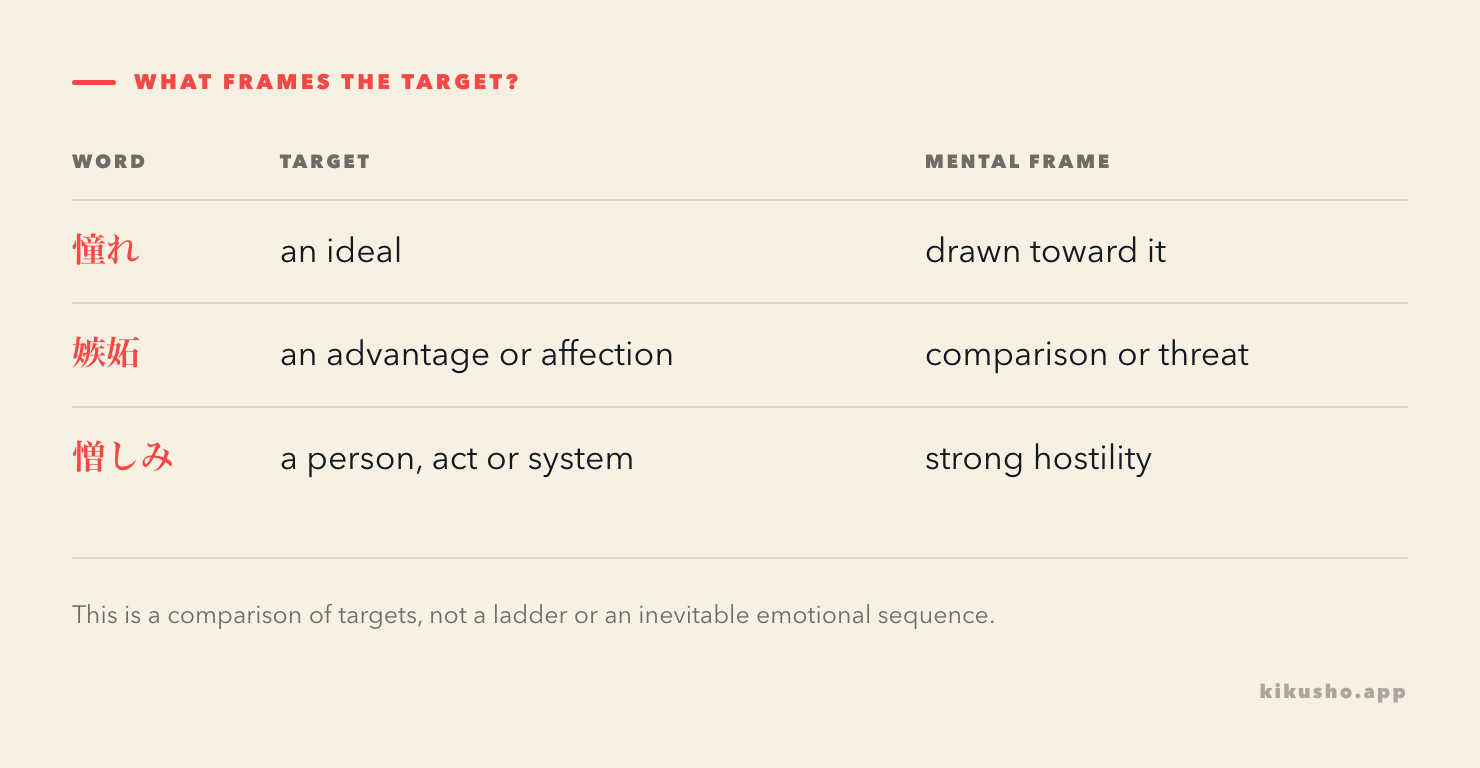
These are not stages of one process. 憧れ idealises, 嫉妬 compares or feels threatened, and 憎しみ rejects with strong hostility.
失望, 悲観 and 絶望 answer different questions
The N3 word 失望(しつぼう) describes disappointment after an expectation is not met. 悲観(ひかん) concerns a negative view of the present situation or future course. 絶望(ぜつぼう) says hope has been lost.
期待していた結果が出ず、失望した。
きたいしていた けっかが でず、しつぼうした。
The expected result did not appear, so I was disappointed.
一度の失敗だけで将来を悲観する必要はない。
いちどの しっぱいだけで しょうらいを ひかんする ひつようは ない。
There is no need to be pessimistic about the future because of one failure.
支援が完全に途絶え、住民は復旧の見込みに絶望した。
しえんが かんぜんに とだえ、じゅうみんは ふっきゅうの みこみに ぜつぼうした。
Support stopped completely, and the residents despaired of the prospect of recovery.
Shogakukan defines 悲観 as becoming disappointed because matters do not proceed as hoped or regarding life negatively. Its examples include 前途を悲観する. Its entry for 絶望 is narrower and stronger: losing hope and reaching a point where nothing can be expected.
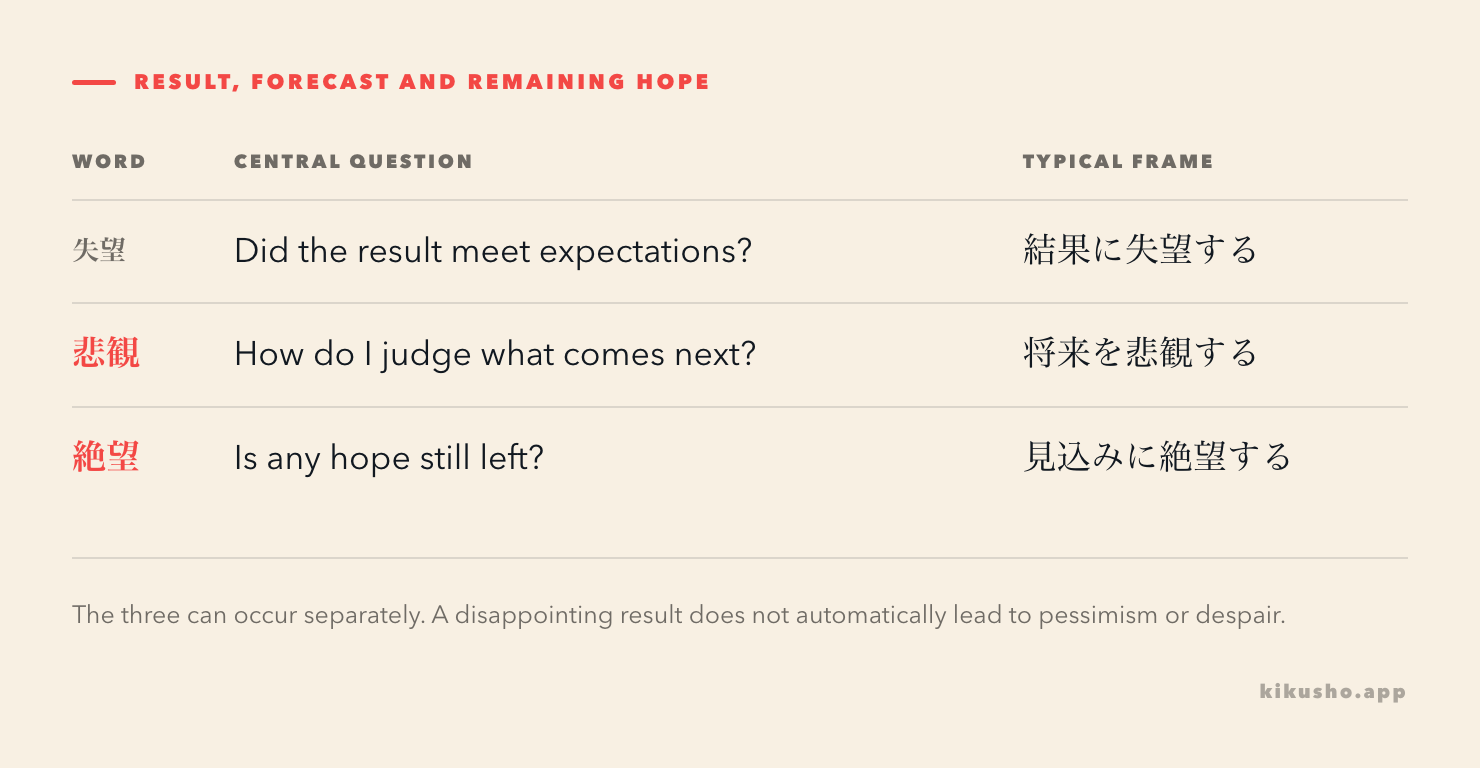
The figure is a contrast, not a required progression. Someone can be 失望する yet remain optimistic about the next attempt. A cautious analyst can 先行きを悲観する without feeling personal despair. 絶望 becomes appropriate when the remaining possibility or hope is itself denied.
楽観 is a positive forecast, not proof
楽観(らっかん) is the conventional opposite of 悲観. It presents the future course positively or treats the situation as unlikely to require concern.
専門家は、需要が年末までに回復すると楽観している。
せんもんかは、じゅようが ねんまつまでに かいふくすると らっかんしている。
The experts are optimistic that demand will recover by the end of the year.
現在の数字だけを見て状況を楽観視するのは危険だ。
げんざいの すうじだけを みて じょうきょうを らっかんしするのは きけんだ。
It is dangerous to view the situation optimistically based only on the current figures.
Both 楽観する and 楽観視する are possible. The compound 楽観的 modifies a noun or forms a predicate: 楽観的な見通し, an optimistic outlook; 見方が楽観的すぎる, the view is too optimistic. Shogakukan records 状況を楽観する, 楽観視 and the warning expression 病状は楽観を許さない.
Positive does not mean accurate. 楽観 describes the direction of the judgment, while evidence determines whether that judgment is justified. The same applies to 悲観: the word labels the outlook, not the truth of the prediction.
Follow all nine words through one research project
真理には、災害に強い町をつくる仕事への憧れがあった。大学院では同世代の研究者の成果に嫉妬することもあり、結果が出ない時期には焦って無理な実験を繰り返した。失敗の報告ばかりする会議にうんざりし、研究の将来を悲観したことさえある。それでも、指導教員は支援を惜しまず、「一度の失敗で絶望する必要はない。根拠のない楽観も危険だが、方法はまだ残っている」と言った。その言葉で、真理は失敗した自分への憎しみを手放し、別れを惜しみながら研究室を出て、現場で調査を続けた。
まりには、さいがいに つよい まちを つくる しごとへの あこがれが あった。だいがくいんでは どうせだいの けんきゅうしゃの せいかに しっとする ことも あり、けっかが でない じきには あせって むりな じっけんを くりかえした。しっぱいの ほうこくばかり する かいぎに うんざりし、けんきゅうの しょうらいを ひかんした ことさえ ある。それでも、しどうきょういんは しえんを おしまず、「いちどの しっぱいで ぜつぼうする ひつようは ない。こんきょの ない らっかんも きけんだが、ほうほうは まだ のこっている」と いった。その ことばで、まりは しっぱいした じぶんへの にくしみを てばなし、わかれを おしみながら けんきゅうしつを でて、げんばで ちょうさを つづけた。
Mari aspired to work on creating disaster-resilient towns. In graduate school she sometimes felt jealous of the achievements of researchers her age, and when results failed to appear, she became impatient and repeated unreasonable experiments. She grew fed up with meetings that reported nothing but failures and even became pessimistic about the future of the research. Even so, her adviser spared no support and said, “There is no need to despair over one failure. Groundless optimism is also dangerous, but methods still remain.” Those words helped Mari let go of her hatred of her own failure. Reluctant to say goodbye, she left the laboratory and continued her investigation in the field.
The passage keeps the grammatical frames visible. The ideal is packaged as 仕事への憧れ; another person's result triggers 成果に嫉妬する; repeated meetings trigger 会議にうんざりする; and the valued support appears in the negative pattern 支援を惜しまない. 悲観, 絶望 and 楽観 then express three different judgments rather than three interchangeable degrees of sadness.
Why these nine words are grouped under N1
Kikusho's September 2026 source index places all nine spelling-and-reading records at N1, with no disagreement attached to an individual record. Its two initial snapshots belong to one Waller-derived lineage and are therefore treated as a single family of evidence.
Current independent resources add partial corroboration. NihongoDoya's current N1 list includes 憧れ and 焦る; PassJapanese publishes a current N1 lesson organised around feelings; and current N1 study resources separately label 嫉妬 and 楽観 at this level. None constitutes an official syllabus. The official JLPT FAQ explains that the revised test does not publish a fixed exhaustive list of vocabulary items. “N1” here is practical study guidance supported by current sources, not a promise that a particular word must appear on an exam form.
In Kikusho, save a word with the combination that reveals its logic: 将来を悲観する, 希望を失って絶望する, 努力を惜しまない. A bare English label cannot preserve the particle, strength or point of view you will need in reading.
Practice: identify trigger, construction and degree
Work through all ten prompts before opening the answer key at the bottom.
1 · Kanji reading. Select the reading of 憧れ.
- イ. あこがれ
- ロ. あきらめ
- ハ. うらみ
- ニ. ためらい
2 · Written form. Complete the warning “Do not be pessimistic about the future.”
将来を( )するな。
- イ. 楽感
- ロ. 悲観
- ハ. 絶望み
- ニ. 嫉妬み
3 · Pressure or repetition. Fill both blanks in order.
締め切りが迫って( 前 )。同じ修正の繰り返しに( 後 )。
- イ. 前:うんざりした / 後:焦った
- ロ. 前:焦った / 後:うんざりした
- ハ. 前:絶望した / 後:憧れた
- ニ. 前:惜しんだ / 後:楽観した
4 · Productive negative. Which sentence means “The team spared no effort in the rescue operation”?
- イ. チームは救助活動に必要な努力が惜しかった。
- ロ. チームは救助活動に必要な努力を惜しまなかった。
- ハ. チームは救助活動に必要な努力に惜しんだ。
- ニ. チームは救助活動に必要な努力を惜しくなかった。
5 · Jealousy and target. Which sentence naturally expresses jealousy about a colleague's promotion?
- イ. 同僚の昇進に嫉妬した。
- ロ. 同僚の昇進を絶望した。
- ハ. 同僚の昇進が憎しみした。
- ニ. 同僚の昇進へうんざりをした。
6 · Disappointment or despair. A grant application is rejected, but the researcher says she will improve it and apply again. Which word best fits her immediate reaction without claiming that all hope is gone?
- イ. 失望
- ロ. 絶望
- ハ. 憎しみ
- ニ. 楽観
7 · Outlook. Which pair correctly completes the contrast?
データを見て、回復は難しいと( 前 )した。一方、責任者は状況を( 後 )していた。
- イ. 前:悲観 / 後:楽観
- ロ. 前:楽観 / 後:絶望
- ハ. 前:嫉妬 / 後:惜しみ
- ニ. 前:憧れ / 後:うんざり
8 · Noun or verb. Which pair correctly preserves the N1 noun and the N2 verb?
- イ. 宇宙への憧れ / 宇宙飛行士に憧れる
- ロ. 宇宙に憧れ / 宇宙飛行士を憧れる
- ハ. 宇宙を憧れ / 宇宙飛行士が憧れる
- ニ. 宇宙が憧れ / 宇宙飛行士へ憧れるを
9 · Meaning of うんざり. Which situation best matches the sentence 同じ話にうんざりした?
- イ. The story was difficult, so I read it slowly.
- ロ. I admired the person who told the story.
- ハ. I had heard the same story too many times and was fed up.
- ニ. I feared there would never be another story.
10 · Follow the evidence. Which interpretation is supported by the sentence?
彼は失敗に失望したが、将来を悲観してはいない。
- イ. He lost all hope for the future.
- ロ. He was disappointed by the failure but does not view the future pessimistically.
- ハ. He was jealous of another person's failure.
- ニ. He is optimistic because the failure never happened.
Answers and explanations
イ, あこがれ. 憧れ is the noun for longing or aspiration toward an ideal. ためらい is hesitation, and うらみ is resentment.
ロ, 悲観. 将来を悲観する means to take a pessimistic view of the future. 絶望 is a complete noun as written and normally combines with に or する, not the invented form 絶望み.
ロ, 焦った / うんざりした. The approaching deadline creates pressure to act quickly, so 焦る fits the first blank. Repeated revisions create accumulated aversion, so うんざりする fits the second.
ロ. 努力を惜しまない literally removes the reluctance to give effort and means to spare no effort. 惜しい is an adjective and cannot replace 惜しむ in this transitive pattern.
イ. The promotion is the trigger for jealousy and takes に: 同僚の昇進に嫉妬する. The other options combine the nouns and particles incorrectly.
イ, 失望. The rejection failed to meet an expectation, but the plan to apply again preserves hope. 絶望 would claim that hope or the prospect of success had been lost.
イ, 悲観 / 楽観. The first judgment predicts difficulty, while the second treats the situation positively. Both nouns can combine with する and take the matter being evaluated with を.
イ. 宇宙への憧れ uses the N1 noun in a modifying phrase. 宇宙飛行士に憧れる uses the N2 verb and marks the ideal with に.
ハ. うんざり describes being thoroughly fed up after too much repetition, duration or unpleasant experience. It is stronger and more cumulative than merely finding something uninteresting.
ロ. The clause before が reports disappointment about the result; the clause after が explicitly denies a pessimistic view of the future. The sentence demonstrates that 失望 does not entail 悲観 or 絶望.
Common questions
What is the difference between 失望 and 絶望?
失望 is disappointment when a person or result fails to meet an expectation. 絶望 is stronger: hope or the prospect of success has been lost. A disappointing result does not automatically produce despair.
What is the difference between 焦る and うんざりする?
焦る is the restless pressure to act quickly, often because time is short or progress is slow. うんざりする is becoming thoroughly fed up after too much repetition, duration or unpleasant experience.
How do 悲観 and 楽観 work in a sentence?
Both are nouns that can take する. The matter being judged commonly takes を, as in 将来を悲観する and 状況を楽観する. Their adjective forms are 悲観的 and 楽観的, and 楽観視する means to view a situation optimistically.
What does 努力を惜しまない mean?
It means to spare no effort or to be willing to make every necessary effort. 惜しむ can mean to be reluctant to give something up, so the negative 惜しまない removes that reluctance.