On this page
甥, 少女(おとめ), 姉妹(きょうだい), 出産, 新婚, 妊娠 and 恋愛 cover one exact family tie, two marked readings, and four words for relationships or major life events. At N1, recognising the spelling is only half the task: you must notice when a writer assigns an uncommon reading, and you must keep pregnancy, childbirth, romance and newly married life from collapsing into one assumed sequence.
Seven entries split into relations, readings and life contexts
| Word | Reading | Word type and core sense | Anchor phrase |
|---|---|---|---|
| 甥 | おい, oi | noun; one's sibling's son, a nephew | 兄の息子は私の甥だ: my brother's son is my nephew |
| 少女 | おとめ, otome | noun; marked literary spelling for a maiden or young woman | 少女に「おとめ」とルビを振る: gloss 少女 as おとめ |
| 姉妹 | きょうだい, kyōdai | noun; marked reading that presents female siblings as きょうだい | 姉妹(きょうだい)で店を継ぐ: the sisters inherit the shop together |
| 出産 | しゅっさん, shussan | noun; suru verb; childbirth or giving birth | 第一子を出産する: give birth to one's first child |
| 新婚 | しんこん, shinkon | noun; newly married or a new marriage | 新婚生活: newly married life |
| 妊娠 | にんしん, ninshin | noun; suru verb; pregnancy or becoming pregnant | 妊娠中: pregnant; during pregnancy |
| 恋愛 | れんあい, ren'ai | noun; suru verb; romantic love or romance | 恋愛関係: romantic relationship |
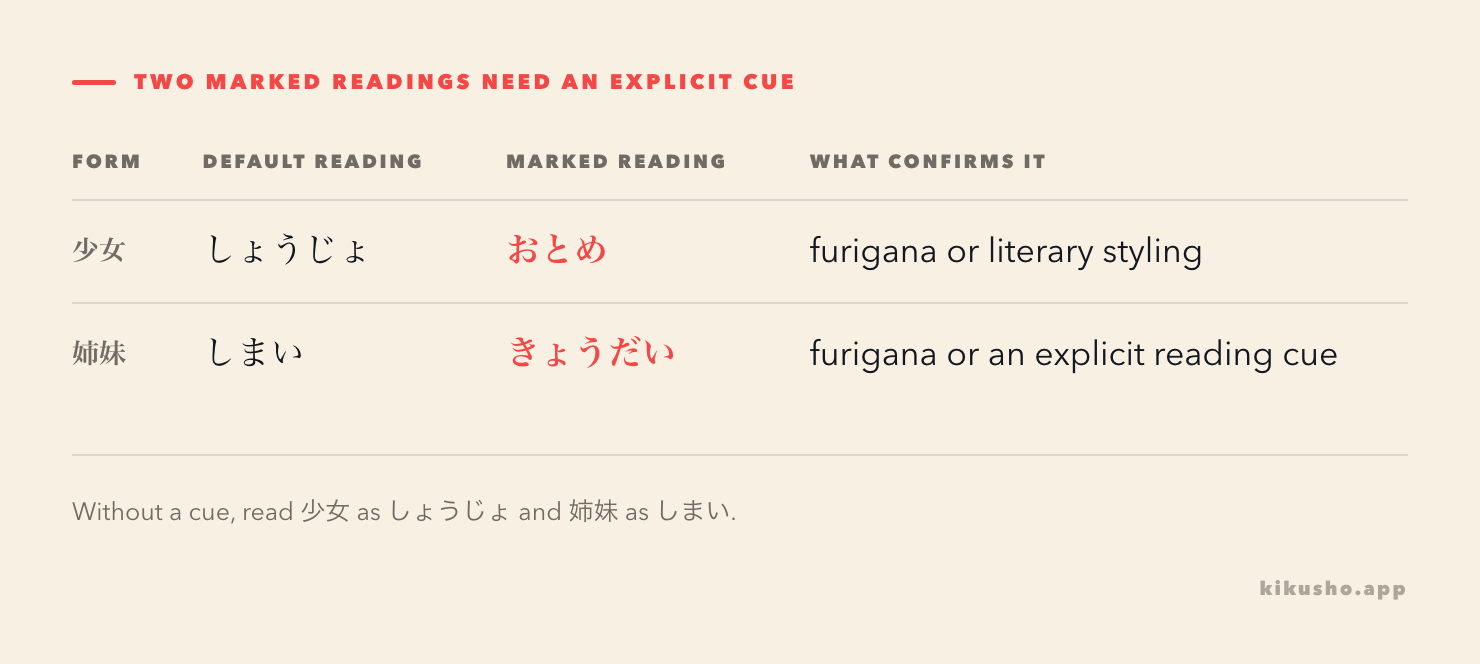
The unusual pair needs visible readings. In unannotated modern prose, 少女 normally prompts しょうじょ, and 姉妹 normally prompts しまい. This lesson teaches the inventory's distinct spelling-and-reading records rather than pretending those are the default pronunciations.
The current GyanMirai N1 family list independently displays 甥(おい), 少女(おとめ), 姉妹(きょうだい) and 出産(しゅっさん) together. Its 少女 gloss includes “daughter,” but dictionaries do not support that kinship sense for おとめ; the lesson corrects it below. Kikusho's assigned inventory places all seven records at N1, while the JLPT organisers publish no exhaustive official vocabulary list.
The N2 family-life lesson covers childcare, spouse-reference choices and reconciliation. The N1 layer here focuses on marked readings and more precise event language.
少女(おとめ) and 姉妹(きょうだい) are marked readings
少女 has an ordinary Sino-Japanese reading, しょうじょ, meaning a girl or young female person. The same spelling can also represent おとめ, but that choice is literary, historical or stylistically marked. The dictionary record for おとめ lists 乙女/少女 and describes a young woman or unmarried woman. 乙女 is the spelling readers are more likely to expect for おとめ today.
詩の題名では、少女に「おとめ」とルビが振られていた。
In the poem's title, 少女 was glossed with the reading おとめ.
That sentence makes the reading explicit. Without the quotation or furigana, 少女が歩いていた will normally be read しょうじょがあるいていた, “a girl was walking.” Neither reading inherently means someone's daughter. That family relation is 娘(むすめ).
姉妹 normally reads しまい and means sisters. It may be written 姉妹 but read きょうだい when the writer wants the spoken umbrella term “siblings” while the characters make the siblings' gender visible. The usage note in the Shogakukan thesaurus explicitly says 姉妹, 兄妹 and 姉弟 can be written for the reading きょうだい.
その姉妹(きょうだい)は、祖父の店を一緒に継いだ。
The sisters inherited their grandfather's shop together.
If a test or book supplies no furigana, context alone may not prove which reading the author intends. Treat しまい as the default lexical reading and きょうだい as a deliberate reading instruction.
甥 fixes one branch of the family tree
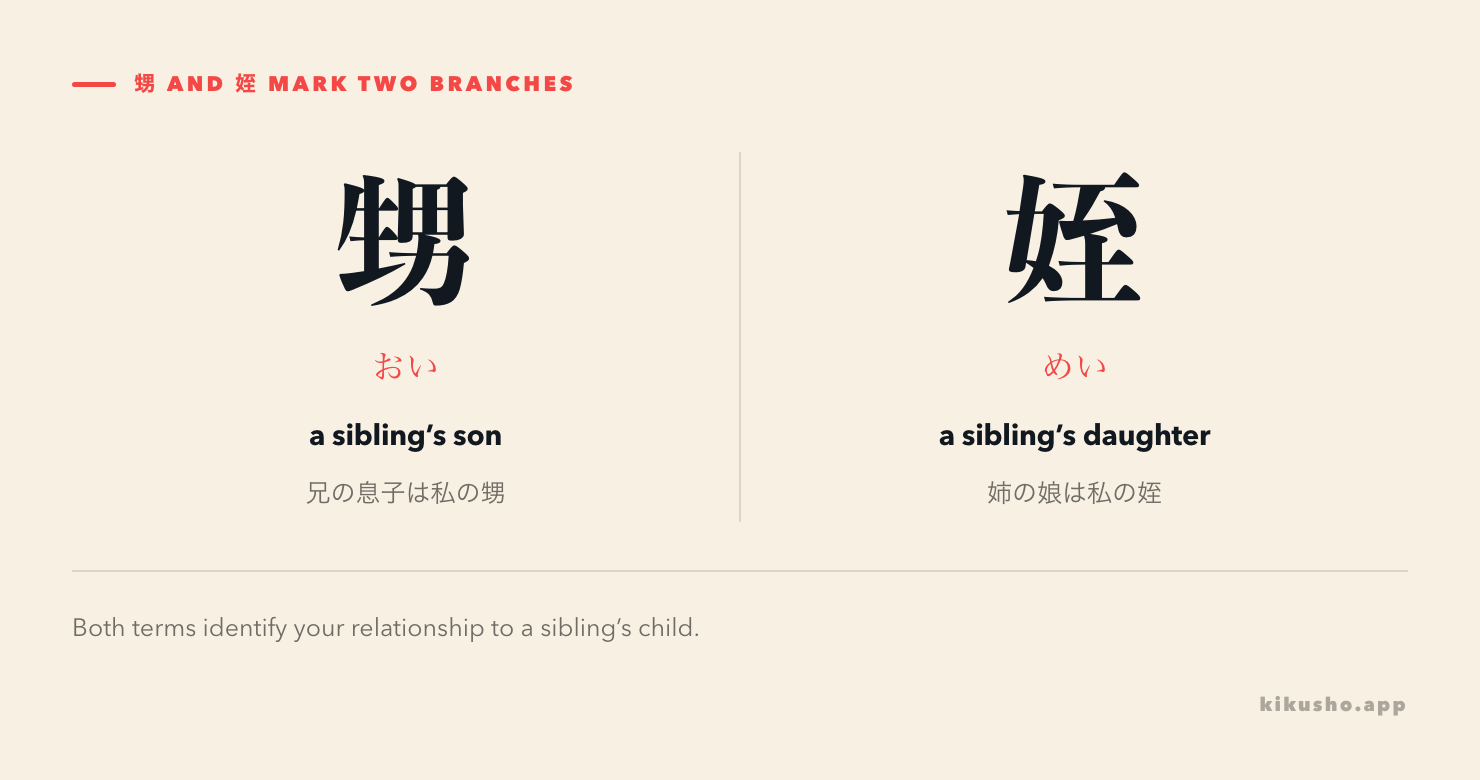
甥(おい) is your brother's or sister's son. The dictionary definition contrasts it directly with 姪(めい), your sibling's daughter.
兄の息子は私の甥です。
My older brother's son is my nephew.
甥は来年、大学を卒業します。
My nephew will graduate from university next year.
Age is irrelevant to the kinship label. An adult can still be someone's 甥, and a nephew can be older than an aunt or uncle in families with wide age gaps. The word identifies the branch of the family tree, not childhood.
恋愛 and 新婚 describe different facts about a relationship
恋愛(れんあい) is romantic love, romance or the state of being romantically involved. The dictionary entry treats it as a noun and suru verb. Its compounds are often more useful than an isolated translation:
- 恋愛関係: a romantic relationship
- 恋愛感情: romantic feelings
- 恋愛小説: romance novel
- 自由に恋愛する: pursue romance freely
二人が恋愛関係にあるという事実は公表されていません。
It has not been announced that the two are in a romantic relationship.
新婚(しんこん) describes being newly married or the period just after marriage. The dictionary definition supports both “newly married” and “new marriage.” Common compounds include 新婚生活, newly married life; 新婚夫婦, newlyweds; and 新婚旅行, honeymoon.
新婚夫婦は駅の近くに引っ越しました。
The newly married couple moved near the station.
恋愛 does not prove marriage, and 新婚 does not describe how the marriage began. A biography may mention one, both or neither.
妊娠 is the state; 出産 is the birth event
妊娠(にんしん) names pregnancy or becoming pregnant. 妊娠する takes the pregnant person as its subject, while 妊娠中 describes the period. The medical dictionary entry defines the state as extending through the process that ends in delivery.
姉は妊娠中なので、長い旅行は控えています。
My older sister is pregnant, so she is avoiding long trips.
出産(しゅっさん) is childbirth or giving birth. It can focus on the event, the person giving birth or planning around it:
- 無事に出産する: give birth safely
- 第一子を出産する: give birth to one's first child
- 出産予定日: expected date of delivery
- 出産祝い: a gift celebrating a birth
姉は春に第一子を出産する予定です。
My older sister is expected to give birth to her first child in spring.
The 出産 definition centres on giving birth. One retained source gloss also says “production of goods,” but modern Japanese uses 生産(せいさん) for industrial or agricultural production. Do not transfer that gloss into an ordinary sentence about factories.
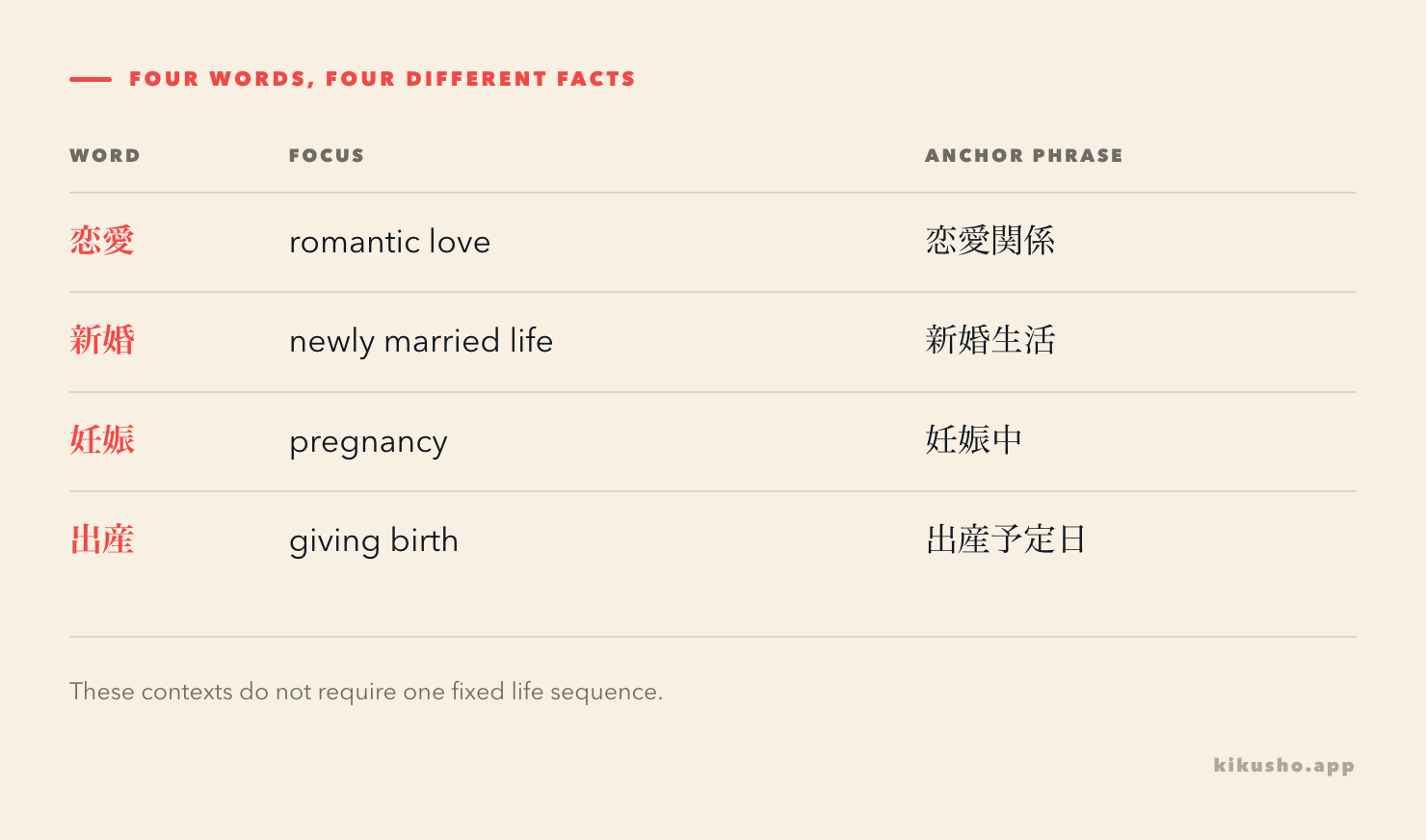
These four words can appear in chronological writing, but the vocabulary itself does not assert a required path. It is possible to discuss 恋愛 without 新婚, 新婚 without 妊娠, and 妊娠 without stating anything about 恋愛 or marriage.
A short profile makes the readings and viewpoints explicit
小説の主人公は、二人の姉妹(きょうだい)の姉です。若いころは「夢見る少女(おとめ)」と呼ばれていましたが、今は出版社で恋愛小説を編集しています。最近、甥が新婚旅行から帰ってきました。また、妹は妊娠中で、冬に第一子を出産する予定です。
The novel's protagonist is the older of two sisters. In her youth she was called “a dreaming maiden,” and she now edits romance novels at a publishing house. Recently, her nephew returned from his honeymoon. Her younger sister is also pregnant and expects to give birth to her first child in winter.
The parenthetical readings prevent the two marked forms from being mistaken for しまい and しょうじょ. 甥 identifies the protagonist's sibling's son. 恋愛 modifies the type of novel, 新婚 modifies the trip, and 妊娠 and 出産 distinguish a present state from a planned event.
Read the cues before opening the answer block
1 · Reading in context. Which pronunciation belongs to 甥 in 甥が遊びに来た?
- A. おい
- B. めい
- C. おとめ
- D. しまい
2 · Marked reading. A poem prints 少女 with the furigana おとめ. What meaning best fits?
- A. an industrial product
- B. a maiden or young woman
- C. a nephew
- D. a newly married couple
3 · Reading cue. A memoir prints 姉妹(きょうだい)で店を継いだ. What does the marked form identify?
- A. sisters who inherited the shop together
- B. a wife who inherited her husband's shop
- C. a niece who opened a new shop
- D. newlyweds who sold the shop
4 · Context. Which sentence takes the person giving birth as its subject?
- A. 姉が第一子を出産しました。
- B. 姉が工場を出産しました。
- C. 姉が恋愛小説を妊娠しました。
- D. 姉が甥を新婚しました。
5 · Paraphrase. What does 妹は妊娠中です state?
- A. My younger sister is on her honeymoon.
- B. My younger sister is pregnant.
- C. My younger sister has a nephew.
- D. My younger sister writes romance novels.
6 · Context. Which compound conventionally means “honeymoon”?
- A. 恋愛関係
- B. 出産予定日
- C. 新婚旅行
- D. 姉妹都市
7 · Usage. Which phrase naturally means “romantic feelings”?
- A. 恋愛感情
- B. 新婚感情
- C. 出産感情
- D. 甥感情
8 · Relationship. Your older brother's son visits you. Which sentence is correct?
- A. 姪が遊びに来ました。
- B. 甥が遊びに来ました。
- C. 少女が新婚しました。
- D. 姉妹を出産しました。
9 · Default versus marked reading. With no furigana or special cue, which pair gives the expected readings?
- A. 少女=おとめ, 姉妹=きょうだい
- B. 少女=しょうじょ, 姉妹=しまい
- C. 少女=めい, 姉妹=おい
- D. 少女=にんしん, 姉妹=しゅっさん
10 · Connected text. In the profile above, which statement is supported?
- A. The protagonist's nephew is currently pregnant.
- B. The protagonist gave birth during a honeymoon.
- C. The protagonist edits romance novels, and her sister expects to give birth.
- D. The two sisters manufacture goods together.
Lock in all ten responses before opening the answer panel.
Answers and explanations
1 · A, おい. 甥 means a nephew, specifically one's sibling's son. 姪, read めい, is the corresponding word for a niece.
2 · B. The furigana instructs the reader to take 少女 as おとめ, a maiden or young woman. It does not create the kinship meaning “daughter.”
3 · A. The characters 姉妹 specify female siblings, while the supplied reading きょうだい gives the spoken sibling term. The sentence says the sisters inherited the shop together.
4 · A. 人が子を出産する is the natural frame for a person giving birth to a child. Factory production takes 生産, and the other options assign incompatible objects or verbs.
5 · B. 妊娠中 means pregnant or during pregnancy. It describes a current state rather than the later event 出産.
6 · C, 新婚旅行. 新婚旅行 is a honeymoon. The other compounds mean a romantic relationship, expected delivery date and sister city.
7 · A, 恋愛感情. 恋愛感情 is romantic feeling. The other nouns do not form the intended conventional compound with 感情.
8 · B. Your brother's son is your 甥. 姪 would identify your sibling's daughter.
9 · B. 少女 normally reads しょうじょ and 姉妹 normally reads しまい. The N1 inventory readings おとめ and きょうだい are valid marked choices, but they need furigana or another clear cue.
10 · C. The profile says the protagonist edits 恋愛小説 and that her younger sister is 妊娠中 with a winter 出産 planned. The other options move roles or meanings to the wrong people.
Common questions
Can 少女 be read おとめ?
Yes, 少女 can represent おとめ in literary or deliberately styled writing, although 乙女 is the usual modern spelling and 少女 is normally read しょうじょ. Furigana or context should establish the marked reading.
Can 姉妹 be read きょうだい?
Yes. A writer may use 姉妹 for female siblings while assigning the spoken reading きょうだい. Without furigana or a clear reading cue, the expected reading of 姉妹 is しまい.
What is the difference between 妊娠 and 出産?
妊娠(にんしん) is pregnancy, a state or process before birth. 出産 (しゅっさん) is giving birth or childbirth. 妊娠中 means pregnant, while 出産予定日 means expected date of delivery.
Does 少女(おとめ) mean daughter?
Not as a family relationship. 少女(おとめ) is a literary or styled way to write a maiden or young woman. 娘(むすめ) identifies someone's daughter.