On this page
These seven N4 Japanese childhood, family life and relationships vocabulary records let you describe a baby, name a spouse or child, and say that family members argued. Their meanings are simple, but natural use depends on affection, whose family you mean and whether a noun needs する.
The two baby words overlap without being identical in tone. The four relationship nouns are not normally used to call someone directly, and 喧嘩 becomes an action only through patterns such as けんかする and けんかになる.
Seven words with the context that makes each one safe
| Target | Reading | Kind | Core use | Anchor phrase |
|---|---|---|---|---|
| 赤ちゃん | あかちゃん, akachan | noun | baby, said with affection or familiarity | 赤ちゃんが生まれる: a baby is born |
| 赤ん坊 | あかんぼう, akanbō | noun | newborn; infant; baby | 赤ん坊を抱く: hold a baby |
| 夫 | おっと, otto | noun | husband | 夫は会社員です: my husband is an office worker |
| 喧嘩 | けんか, kenka | noun; suru verb | quarrel; fight | 兄とけんかする: quarrel with one's older brother |
| 妻 | つま, tsuma | noun | wife | 妻と買い物に行く: go shopping with one's wife |
| 息子 | むすこ, musuko | noun | son | 息子が二人いる: have two sons |
| 娘 | むすめ, musume | noun | daughter; in another sense, young woman | 娘は大学生です: my daughter is a university student |
Current N4 lists repeatedly group these records together; one recent N4 list shows all seven with their readings. The useful lesson is not the English column alone. A learner must know that 赤ちゃん carries warmth, that 息子さん usually points outside the speaker's family and that 喧嘩 is grammatically a noun.
The N5 family-life lesson supplies 奥さん, 兄弟, 子供 and 誕生日. This N4 layer adds specific nuclear-family relationships and a common event inside family life.
赤ちゃん adds affection; 赤ん坊 names the baby directly
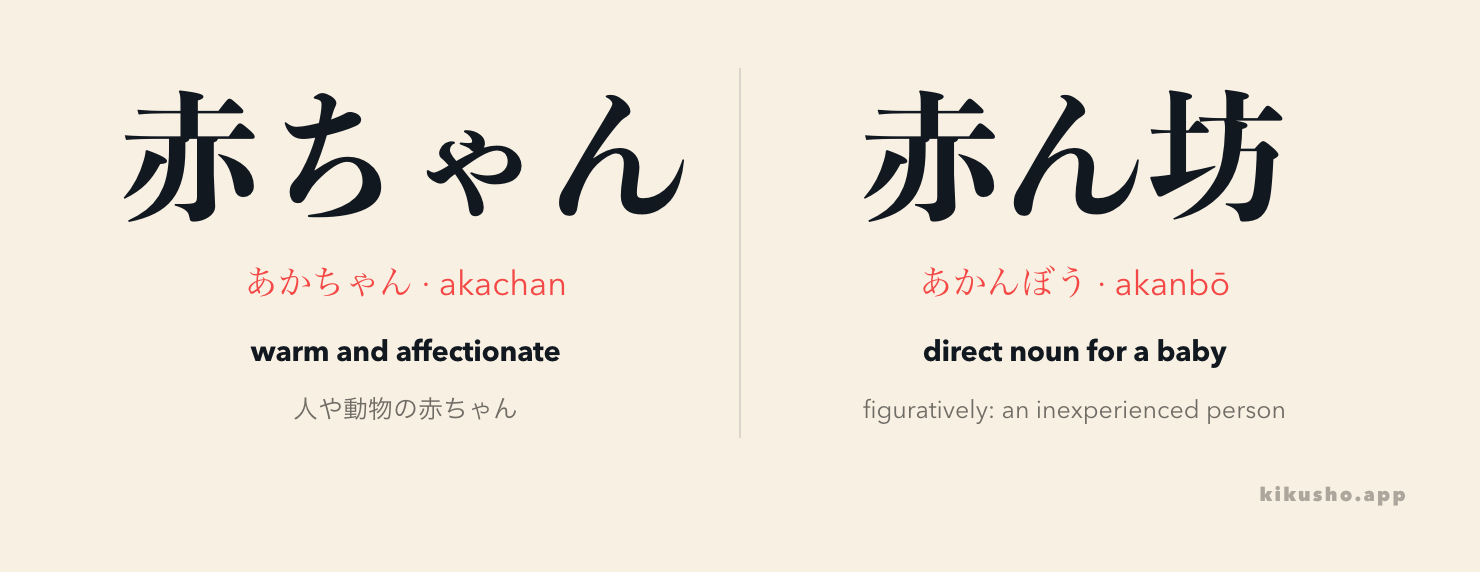
Both 赤ちゃん(あかちゃん) and 赤ん坊(あかんぼう) can refer to the same infant. The distinction is tone rather than age measured by a strict boundary.
赤ちゃん contains the affectionate suffix ちゃん. It is warm, familiar and common when adults speak about a human baby or the young of an animal.
隣の家に赤ちゃんが生まれました。
となりのいえにあかちゃんがうまれました。
A baby was born to the family next door.
The dictionary definition of 赤ちゃん explicitly says that the word refers to a human or animal baby with affection.
赤ん坊 is a direct noun for a child who has only recently been born and can include the foetal or infant period depending on context. It does not add the same affectionate stance.
父親は眠っている赤ん坊をそっとベッドに置きました。
ちちおやはねむっているあかんぼうをそっとベッドにおきました。
The father gently placed the sleeping baby in the bed.
The 赤ん坊 entry also records a figurative use for an immature or inexperienced person. That extension can be critical rather than affectionate: まだ仕事では赤ん坊だ, still a complete beginner at work.
For clinical precision, other terms exist: 新生児(しんせいじ) is a newborn and 乳児(にゅうじ) an infant. At N4, keep 赤ちゃん as the warmer everyday choice and recognise the more direct 赤ん坊.
夫 and 妻 identify spouses; they are not usual forms of address
夫(おっと) means husband and 妻(つま) means wife. They are standard when a speaker mentions their own spouse to someone else.
A:夫は料理が好きです。
A:おっとはりょうりがすきです。
A: My husband likes cooking.\B:私の妻はパンを焼くのが好きです。
B:わたしのつまはパンをやくのがすきです。
B: My wife likes baking bread.
The dictionaries define 夫 and 妻 as the male and female spouses in relation to each other. Older learner glosses often label the self-family use “humble.” A clearer practical rule is that 夫 and 妻 do not add respect to someone inside the speaker's group.
They are relationship labels, not the normal way to call a spouse across the room. Couples may use a name, nickname, or a household role chosen within the family. When speaking about another person's spouse, ご主人 and 奥さん remain common beginner forms, but preferences vary. Names, パートナー and 配偶者 may fit better when gender, marital status or personal preference calls for them.
Official and documentary writing can use 夫 and 妻 for people other than the writer: 申請者の夫, the applicant's husband. The self-versus-other contrast is therefore a safe conversational default, not an absolute grammar rule.
息子 and 娘 name a child through the parent relationship
息子(むすこ) is a son and 娘(むすめ) is a daughter. Neither word sets an age limit: a parent can use 息子 or 娘 for an adult child.
息子は来年、高校を卒業します。
むすこはらいねん、こうこうをそつぎょうします。
My son will graduate from high school next year.
娘は結婚して、大阪に住んでいます。
むすめはけっこんして、おおさかにすんでいます。
My daughter is married and lives in Osaka.
The primary family senses are confirmed in the dictionary entries for 息子 and 娘. 娘 also has a broader sense, “young woman,” in expressions and older narrative contexts. Possession resolves most ordinary ambiguity: 私の娘 is my daughter.
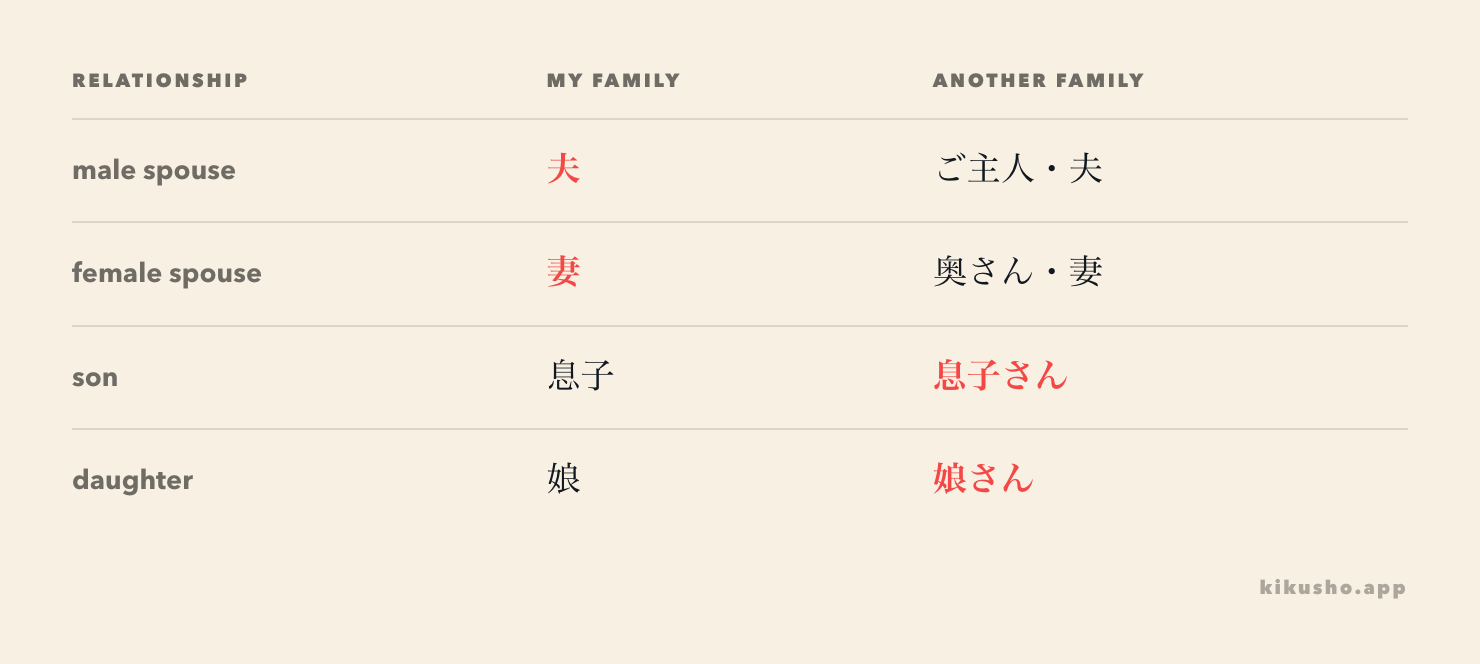
When speaking outside the family, do not normally add さん to your own child: 私の息子, 私の娘. For another person's children, 息子さん and 娘さん add respect. The Japan Foundation's Irodori guidance explicitly notes that さん is not attached to one's own younger family members in this setting.
| Relationship | Speaker's own family | Another person's family |
|---|---|---|
| male spouse | 夫 | ご主人, or 夫 in neutral written identification |
| female spouse | 妻 | 奥さん, or 妻 in neutral written identification |
| son | 息子 | 息子さん |
| daughter | 娘 | 娘さん |
お子さん means someone else's child and avoids specifying son or daughter. It is useful when that detail is unknown or irrelevant.
喧嘩 is a noun that joins several action patterns
喧嘩(けんか) means a verbal quarrel or a physical fight. The dictionary classifies it as a noun that can combine with する. Everyday writing often uses the kana form けんか, especially in material for children.
息子と娘がおもちゃのことでけんかしました。
むすことむすめがおもちゃのことでけんかしました。
My son and daughter argued about a toy.
Three particles divide the scene cleanly:
- 兄とけんかする: quarrel with an older brother
- お金のことでけんかする: quarrel about money
- 学校でけんかする: fight at school
The noun also works without する.
| Pattern | Change in the situation | Example |
|---|---|---|
| けんかになる | a disagreement turns into a quarrel | 話し合いがけんかになった |
| けんかを始める | someone starts fighting | 二人がけんかを始めた |
| けんかをやめる | someone stops fighting | もうけんかをやめて |
| けんかのあとで仲直りする | people make up afterward | 姉とけんかのあとで仲直りした |
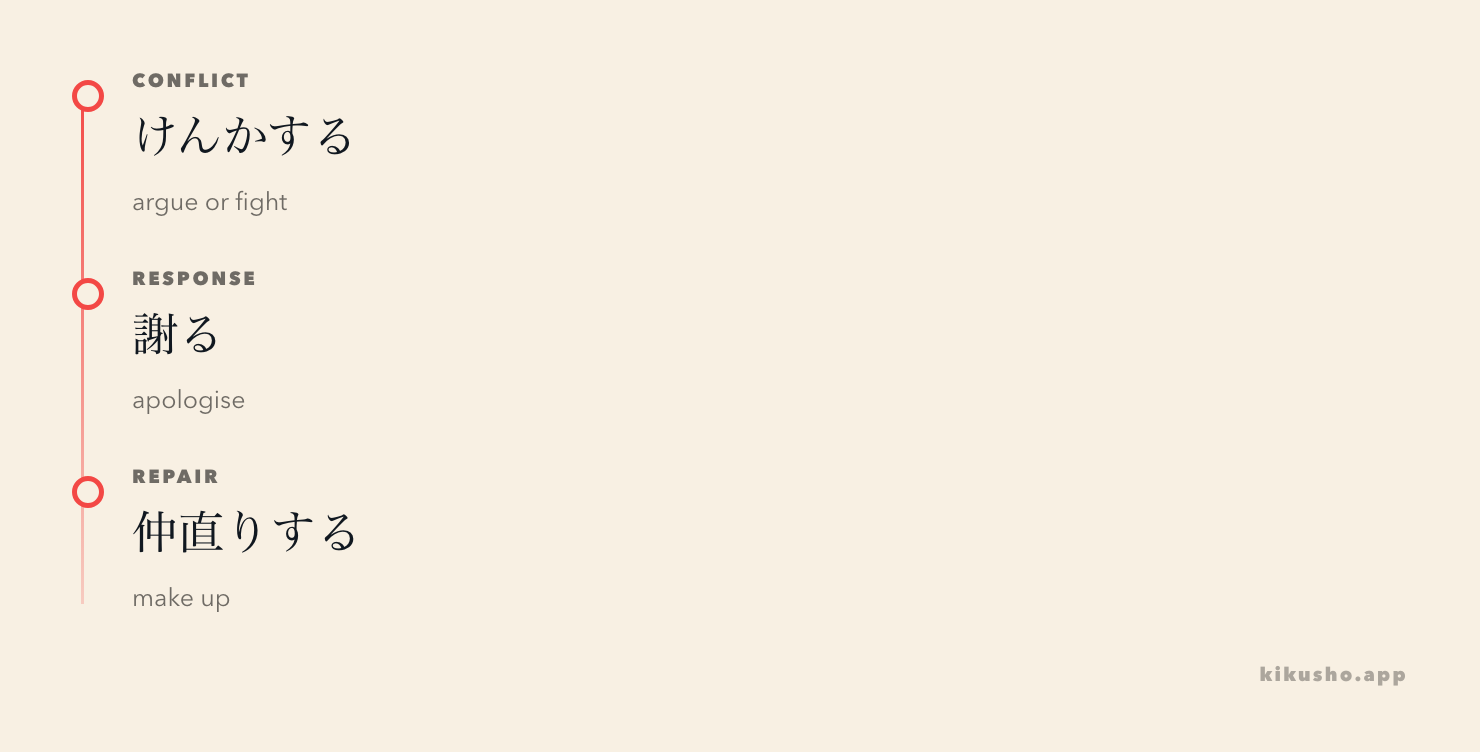
Do not translate every 喧嘩 as a physical fight. Family context often supports “argument” or “quarrel.” A sentence mentioning hitting or injury makes physical conflict clearer.
One evening at home connects all seven records
佐藤さん夫婦には、息子と娘と、生まれたばかりの赤ちゃんがいます。ある晩、夫が「赤ん坊が寝ているよ」と言いました。しかし、息子と娘はおもちゃのことで喧嘩を始めました。妻が「静かにして」と言うと、二人は謝って、すぐに仲直りしました。
さとうさんふうふには、むすことむすめと、うまれたばかりのあかちゃんがいます。あるばん、おっとが「あかんぼうがねているよ」といいました。しかし、むすことむすめはおもちゃのことでけんかをはじめました。つまが「しずかにして」というと、ふたりはあやまって、すぐになかなおりしました。
Mr and Mrs Sato have a son, a daughter and a newborn baby. One evening, the husband said, “The baby is sleeping.” However, the son and daughter began arguing about a toy. When the wife told them to be quiet, they apologised and quickly made up.
The passage uses 赤ちゃん and 赤ん坊 for one child. The first introduces the baby warmly; the second identifies the sleeping infant inside the father's warning. 夫, 妻, 息子 and 娘 describe roles from the narrator's viewpoint rather than forms anyone uses to address a relative directly.
Test the family scene before opening the key
1 · Read the spouse noun. In 夫は料理が好きです, what sound does 夫 take?
ア. おっと
イ. つま
ウ. むすこ
エ. おとこ
2 · Read the other spouse noun. What is the ordinary reading of 妻 in 妻は看護師です?
ア. さい
イ. つま
ウ. よめい
エ. むすめ
3 · Orthography. Which spelling represents むすこ, “son”?
ア. 娘
イ. 夫
ウ. 息子
エ. 妻
4 · Orthography. Which spelling represents むすめ, “daughter”?
ア. 娘
イ. 赤ん坊
ウ. 息子
エ. 喧嘩
5 · Affectionate context. A speaker warmly says that a neighbour's new baby is cute. Which word fits best?
ア. 夫
イ. 喧嘩
ウ. 赤ちゃん
エ. 妻
6 · Paraphrase. What does まだ仕事では赤ん坊です mean in context?
ア. The person brings an infant to work.
イ. The person is still inexperienced at the job.
ウ. The person's son works there.
エ. The person fought at work.
7 · Family reference. You politely ask Tanaka about his adult son. Which form fits the blank? 田中さんの__はお元気ですか。
ア. 息子さん
イ. 私の息子さん
ウ. 赤ん坊
エ. 夫
8 · Grammar. Which sentence naturally means “I argued with my older brother about money”?
ア. 兄がお金をけんかしました。
イ. 兄とお金のことでけんかしました。
ウ. 兄にお金で赤ちゃんでした。
エ. 兄のけんかが妻しました。
9 · Usage. Which sentence is natural when speaking to a colleague about your own family?
ア. 私の娘さんは高校生です。
イ. 私のご主人は会社員です。
ウ. 私の娘は高校生です。
エ. 私の息子を息子さんです。
10 · Connected context. In the family scene above, why does the wife ask the two older children to be quiet?
ア. The husband is studying.
イ. The newborn baby is sleeping.
ウ. The daughter is at school.
エ. The son is cooking.
Answers and explanations
1 · ア, おっと. 夫(おっと) means husband. The sentence identifies the speaker's spouse without using the word as direct address.
2 · イ, つま. 妻(つま) means wife. The on-reading さい appears in compounds such as 夫妻, but it is not the standalone reading here.
3 · ウ, 息子. 息子 is read むすこ and means son. 娘 is the contrasting relationship, daughter.
4 · ア, 娘. 娘 is read むすめ. In a family context, it identifies a daughter even when she is already an adult.
5 · ウ, 赤ちゃん. 赤ちゃん adds affection and familiarity, fitting warm talk about a baby. The other choices name a spouse or a quarrel.
6 · イ. 赤ん坊 can figuratively describe someone who is still immature or inexperienced in a field. No literal infant is present at work.
7 · ア, 息子さん. Adding さん respectfully marks another person's son. 私の in option イ would switch the possessor to the speaker and still incorrectly honor the speaker's own child in the standard outside-family pattern.
8 · イ. The other participant takes と, while the topic or reason for the quarrel appears as お金のことで. 喧嘩 then combines with する.
9 · ウ. Plain 娘 is the standard way to mention one's own daughter to someone outside the family. The other choices add honorific forms to the speaker's own family or are ungrammatical.
10 · イ. The husband has already said that the baby is sleeping. The son and daughter then begin arguing about a toy, so the wife asks them to lower their voices.
Store these words with their social and grammatical frames: 赤ちゃん/赤ん坊, 夫/妻, 息子/息子さん, 娘/娘さん, and 人と理由のことでけんかする. Those pairs carry the information that an isolated English translation loses.
The N3 childhood, family life and relationships lesson continues from these household roles to 誕生 and 成長, life-stage labels, family structures and relationship status.
Kikusho's September 2026 inventory places the seven spelling-and-reading records at N4, but one baseline file also places 赤ちゃん at N1. Independent current N4 lists and Japanesetest4you place it at N4, and the N1 row belongs to the same Waller/Tanos source family rather than an independent exam specification. Because the JLPT organisers do not publish an exhaustive vocabulary list, this lesson uses N4 as a practical editorial placement and records the disagreement instead of hiding it.
Common questions
What is the difference between 赤ちゃん and 赤ん坊?
Both refer to a baby. 赤ちゃん adds affection or familiarity and is common for human and animal babies. 赤ん坊 is a direct noun for a newborn or infant and can sound less affectionate; it can also describe an immature or inexperienced person.
Are 夫 and 妻 humble words?
They are plain relationship nouns for a husband and wife and are standard when mentioning one's own spouse to someone else. Some learner materials call that use humble because the terms do not honor one's own group, but the words themselves are also neutral in writing and official contexts.
Should I add さん to 息子 and 娘?
Use 息子 and 娘 for your own children when speaking outside the family. 息子さん and 娘さん can respectfully refer to another person's children. お子さん is useful when gender is unknown or irrelevant.
Is 喧嘩 a verb?
喧嘩 is a noun that combines with する: けんかする means to quarrel or fight. It also appears in けんかになる, become a quarrel, and けんかをやめる, stop fighting.
Can 娘 refer to an adult daughter?
Yes. 娘 identifies a female child in relation to a parent and can refer to an adult daughter. It can also mean a young woman in other contexts, so possession and family context matter.