On this page
誕生, 成長, 少年, 少女, 青年, 成人 and 成年 describe points or changes across a life, while 姉妹, 双子, 孫, 愛情, 恋人, 婚約, 独身, 夫婦 and 離婚 describe family and relationship contexts. This N3 set teaches all sixteen with readings, word types and collocations, including the three easily confused adult and youth terms.
Sixteen words form a life and relationship map
| Word | Reading | Word type and core sense | Anchor phrase |
|---|---|---|---|
| 愛情 | あいじょう, aijō | noun; love or affection | 子供に愛情を注ぐ: give a child affection |
| 恋人 | こいびと, koibito | noun; romantic partner | 恋人と旅行する: travel with one's partner |
| 婚約 | こんやく, kon'yaku | noun; suru verb; engagement to marry | 恋人と婚約する: become engaged to one's partner |
| 姉妹 | しまい, shimai | noun; sisters | 三人姉妹: three sisters |
| 少女 | しょうじょ, shōjo | noun; young girl | 一人の少女: a young girl |
| 少年 | しょうねん, shōnen | noun; boy or young person | 少年時代: boyhood |
| 成人 | せいじん, seijin | noun; suru verb; adult or becoming an adult | 成人になる: become an adult |
| 成長 | せいちょう, seichō | noun; suru verb; growth or development | 子供が成長する: a child grows |
| 成年 | せいねん, seinen | noun; legal majority or adult age | 成年に達する: reach legal adulthood |
| 青年 | せいねん, seinen | noun; youth or young person, often a young man | 一人の青年: a young man |
| 誕生 | たんじょう, tanjō | noun; suru verb; birth or emergence | 赤ちゃんが誕生する: a baby is born |
| 独身 | どくしん, dokushin | noun; unmarried, without a spouse | 独身生活: single life |
| 夫婦 | ふうふ, fūfu | noun; married couple | 田中さん夫婦: Mr and Mrs Tanaka |
| 双子 | ふたご, futago | noun; twins or one twin | 双子の姉: the older twin sister |
| 孫 | まご, mago | noun; grandchild or grandchildren | 孫が二人いる: have two grandchildren |
| 離婚 | りこん, rikon | noun; suru verb; divorce | 夫と離婚する: divorce one's husband |
The table is a selectable reference, not a claim that every person follows one family path. 独身, 婚約, 夫婦 and 離婚 describe states or events when they apply; none is a required stage of life.
Current N3 study resources repeatedly group family and relationship words. The inspected Japanese Compass N3 list independently includes 恋人, 夫婦, 独身, 孫, 姉妹, 双子 and 成人. The assigned reference inventory supplies this exact sixteen-item scope. Neither source is an official exhaustive JLPT vocabulary syllabus.
誕生 and 成長 describe an event and a process
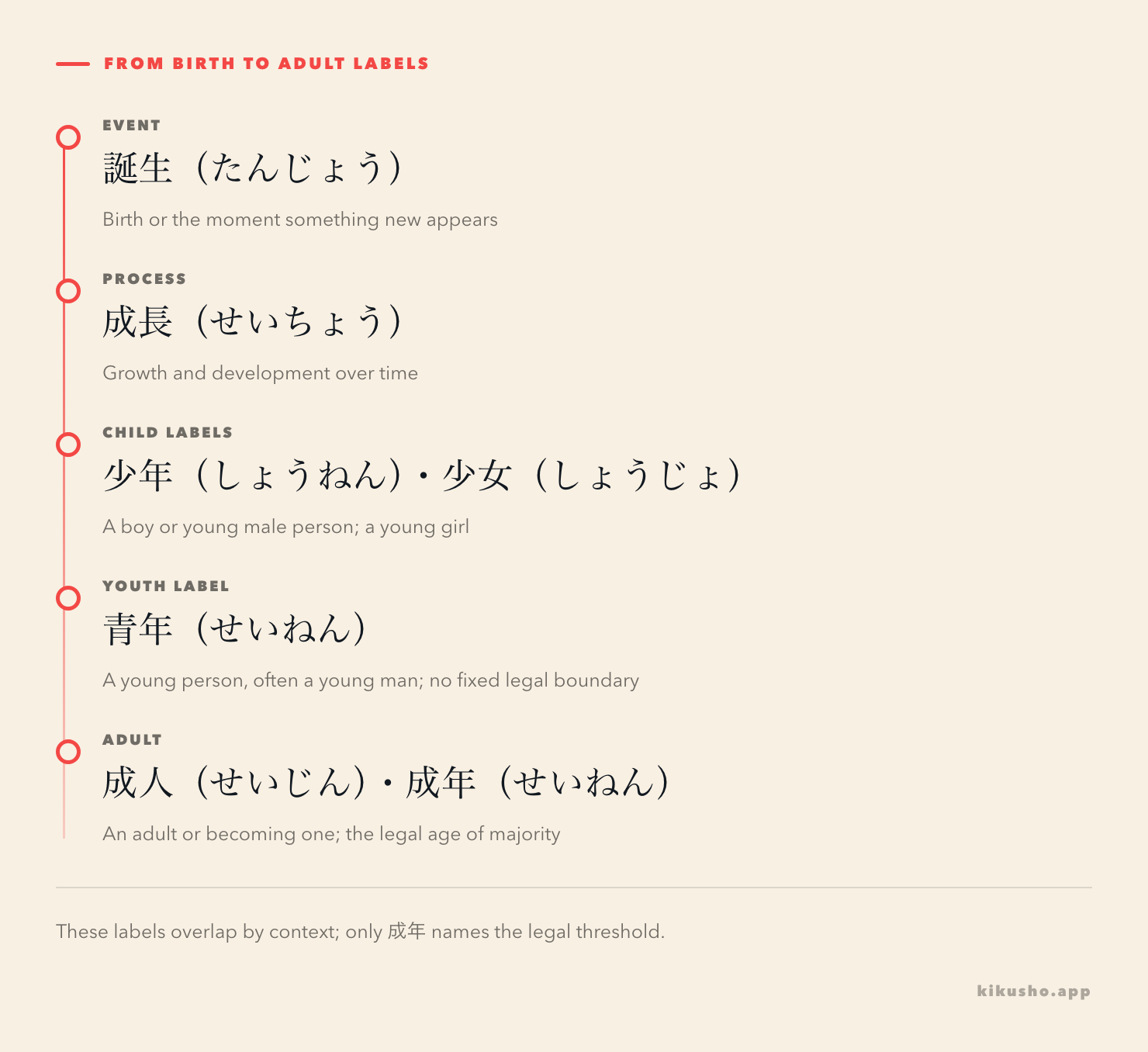
誕生(たんじょう) marks a birth or the moment something new comes into existence. 成長(せいちょう) describes the growth that follows.
昨日、姉夫婦に双子が誕生しました。
Yesterday, my older sister and her spouse welcomed twins.
二人は元気に成長しています。
The two are growing well.
The subject of 誕生する is what comes into existence: 赤ちゃんが誕生する, a baby is born. For an ordinary active sentence about the mother, 姉が双子を産みました means “My older sister gave birth to twins.” Keep the viewpoints separate.
Both words extend beyond people. 新しいサービスが誕生した announces the launch or emergence of a service, and 会社が成長した says a company grew. The core contrast remains a point versus a process.
少年, 少女 and 青年 describe people, not exact birthdays
少年(しょうねん) usually identifies a boy or young male person. 少女(しょうじょ) identifies a young girl. These are more common in news, organisations, literature and category labels than as direct forms of address.
公園で一人の少年が犬と遊んでいました。
A boy was playing with a dog in the park.
その少女は物語の主人公です。
That girl is the protagonist of the story.
少女 does not mean “daughter.” A daughter is 娘(むすめ), taught in the N4 family-life lesson. A girl in a story may also be someone's daughter, but the two nouns answer different questions.
青年(せいねん) refers to a young person and often, though not exclusively, a young man. The dictionary definition gives late teens through the twenties as a usual range while noting wider use. Treat that as a usage tendency, not a legal boundary.
駅で親切な青年が道を教えてくれました。
A kind young man showed me the way at the station.
成人, 成年 and 青年 separate adulthood, law and youth
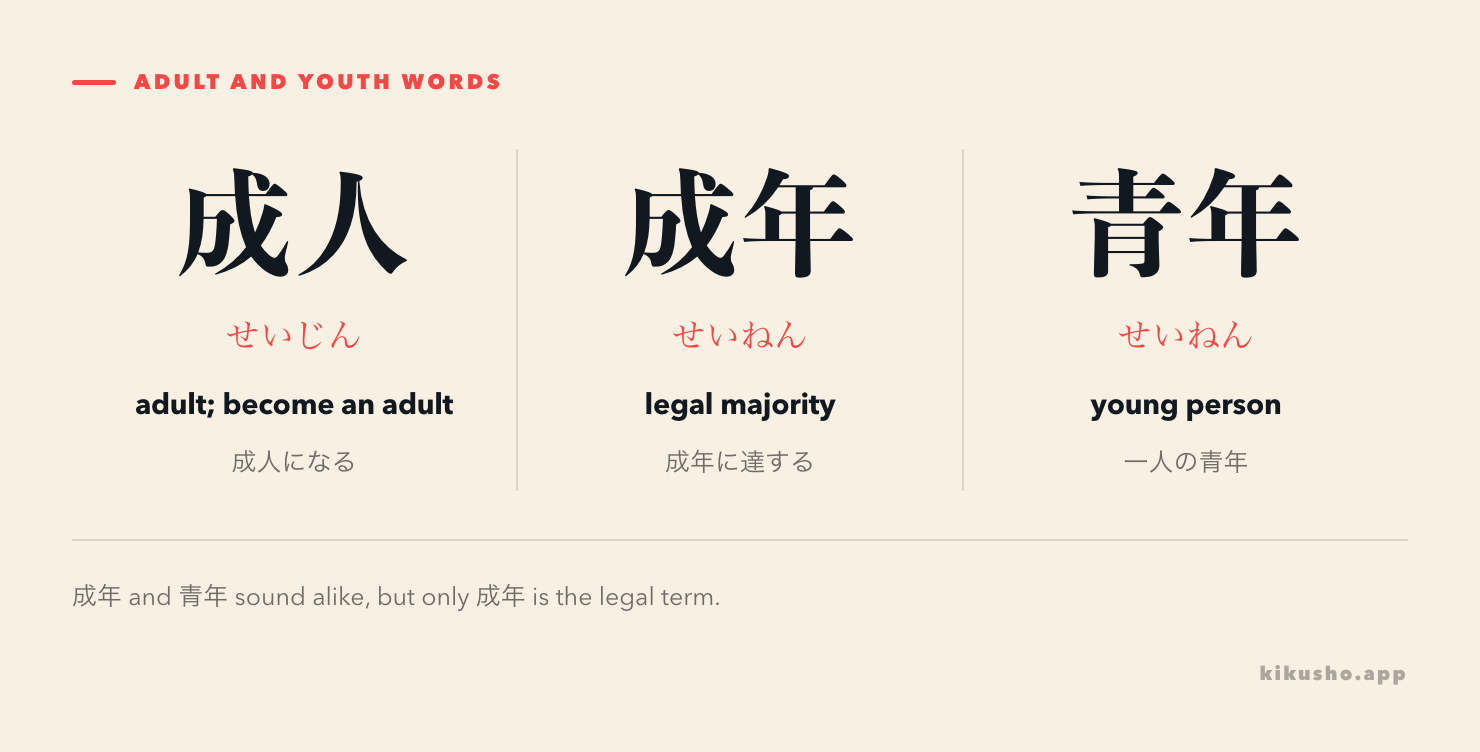
The first reading distinction is essential:
| Form | Reading | Main question it answers |
|---|---|---|
| 成人 | せいじん | Is this person an adult, or have they become one? |
| 成年 | せいねん | Have they reached the legal age of majority? |
| 青年 | せいねん | Are they being described as a young person? |
成人 names an adult and can describe becoming one: 成人になる, 成人した息子. Its scope can be social or developmental as well as legal. 成年 is the narrower legal term. The Japanese Ministry of Justice states that Japan's Civil Code age of majority changed from 20 to 18 on 1 April 2022. Therefore 成年に達する means reaching that legal threshold; it does not by itself say that someone is emotionally mature.
The dictionaries likewise define 成人 as an adult or becoming an adult and 成年 as legal majority. 青年, despite sharing the reading せいねん with 成年, is a young-person label rather than a legal status.
The level boundary is not perfectly stable. Kikusho's retained inventory assigns this set to N3 but records an N3/N1 conflict for 成年 between two descendants of one baseline family. Japanese Compass places 成人 in N3, while Bunpro labels 成人 N4. Learn the contrast here because the reading and legal meaning matter; treat the JLPT labels as study estimates.
姉妹, 双子 and 孫 name family structure
姉妹(しまい) means sisters. 三人姉妹 is a group of three sisters. It can also form extended labels such as 姉妹校, sister schools, but this lesson keeps the family noun.
双子(ふたご) can name the pair or one member of it. Context and a number settle the reference:
私たちは双子です。
We are twins.
姉は双子を産みました。
My older sister gave birth to twins.
私は双子の姉です。
I am the older twin sister.
孫(まご) behaves similarly with number. 孫がいます only says that the speaker has at least one grandchild; 孫が三人います gives the count. Do not confuse 孫 with 甥(おい), nephew, or 姪(めい), niece.
The earlier guide to own-family and other-family words explains why a speaker may choose different forms when introducing relatives. The present three nouns identify the family structure itself.
愛情 and relationship nouns need different kinds of evidence
愛情(あいじょう) is affection, not exclusively romantic love. The dictionary entry covers care toward people and things as well as romantic feeling.
- 子供に愛情を注ぐ: give a child affection
- 家族の愛情を感じる: feel one's family's affection
- 恋人に愛情を抱く: feel affection for a romantic partner
恋人(こいびと) names a romantic partner without encoding that person's gender. It describes the relationship; 彼氏 and 彼女 can identify a boyfriend or girlfriend in ordinary conversation. The dictionary defines 恋人 as the person one loves, typically in a mutual romantic relationship.
婚約(こんやく) is a promise to marry. It combines with する and forms 婚約者, fiancé or fiancée. 恋人と婚約する says “become engaged to one's partner”; it does not mean that the marriage has already taken place.
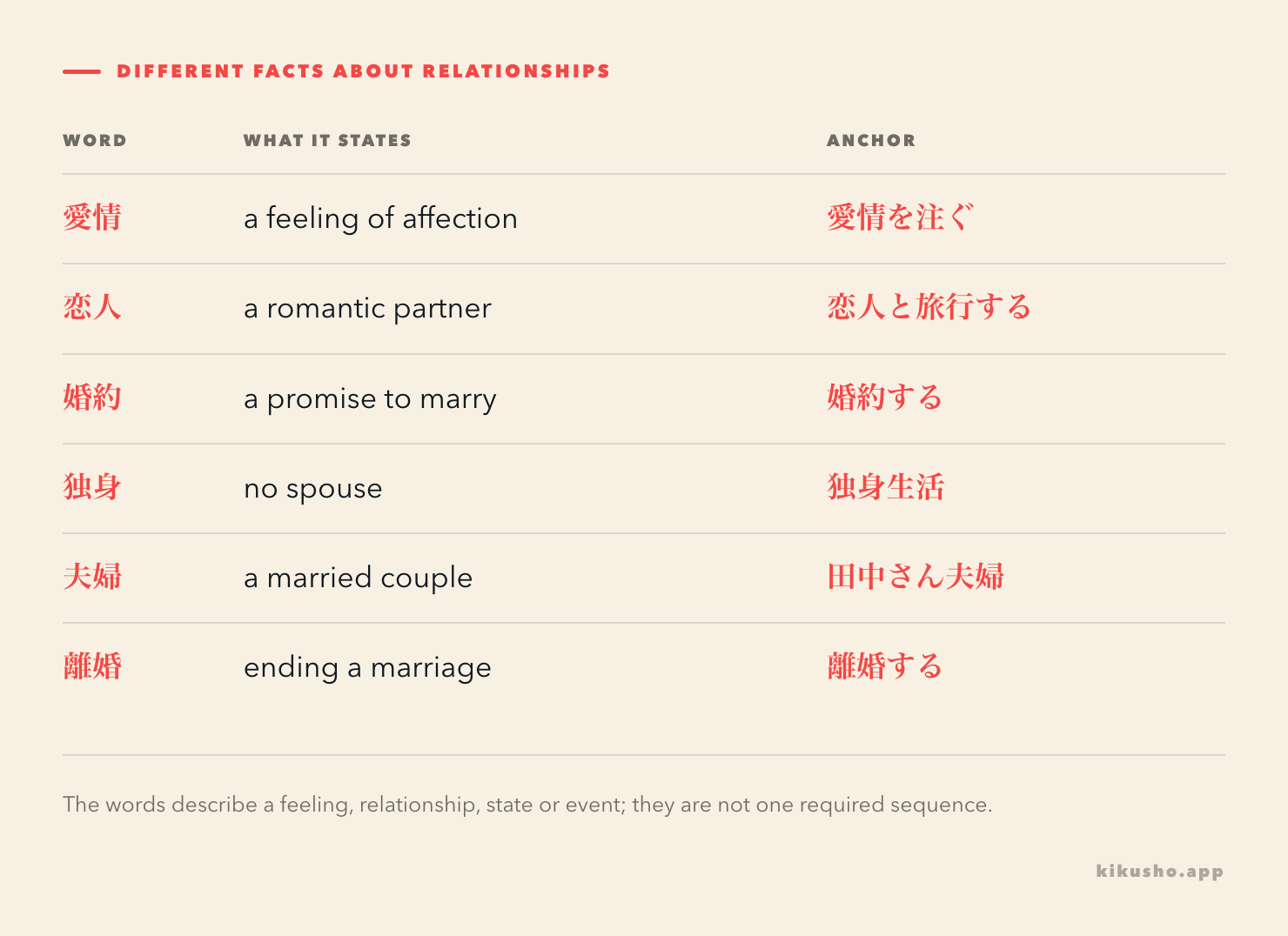
独身(どくしん) means that a person has no spouse. It does not mean living alone. 夫婦(ふうふ) identifies a married couple as a unit: 田中さん夫婦, the Tanakas or Mr and Mrs Tanaka. 離婚(りこん) means ending a legal marriage and works as a suru verb.
叔父は独身で、両親と暮らしています。
My uncle is unmarried and lives with his parents.
佐藤さん夫婦には孫が二人います。
Mr and Mrs Sato have two grandchildren.
二人は話し合って離婚しました。
The two discussed it and divorced.
The 独身 definition centres on having no spouse, while 婚約 and 離婚 name the promise to marry and the dissolution of marriage. These meanings let you read a biography without assuming that one state caused the next.
Follow one family account without confusing the labels
祖母には三人の孫がいます。上の二人は双子の姉妹で、去年成人しました。二人は少女のころから性格が違いましたが、家族の愛情を受けて元気に成長しました。下の孫は大学生の青年です。最近、恋人と婚約しました。祖母はその知らせを聞いて喜びました。
My grandmother has three grandchildren. The two older ones are twin sisters and became adults last year. Their personalities have differed since they were girls, but they grew up healthy with their family's affection. The youngest grandchild is a young university student. He recently became engaged to his partner. Their grandmother was delighted by the news.
成人 describes a transition to adulthood, while 青年 describes the younger grandchild as a young person. Neither sentence claims that the sisters reached 成年 last year; that legal threshold might have occurred at another time. The family nouns establish three grandchildren and a twin pair, and the final relationship words report a partner and an engagement without predicting a wedding.
The N2 childhood, family life and relationships lesson continues with childcare, wider kinship, spouse-reference choices and the contrast between a close relationship and reconciliation after conflict.
Check the reading and relationship before opening the key
1 · Sound check. Choose the standard reading for 愛情.
- A. あいじょ
- B. あいしょう
- C. こいじょう
- D. あいじょう
2 · Kanji reading. Which word is read ふたご?
- A. 夫婦
- B. 孫
- C. 双子
- D. 姉妹
3 · Orthography. Which spelling means “legal age of majority” and is read せいねん?
- A. 青年
- B. 成年
- C. 成人
- D. 成長
4 · Context. A news story describes a young man who helped at a station. Which word fits 親切な__?
- A. 青年
- B. 成年
- C. 婚約
- D. 誕生
5 · Paraphrase. What does 叔父は独身ですが、一人暮らしではありません mean?
- A. My uncle is married and lives alone.
- B. My uncle is unmarried, but he does not live alone.
- C. My uncle is engaged and lives with his partner.
- D. My uncle divorced because he lived alone.
6 · Context. Which phrase means “pour affection into raising a child”?
- A. 子供に愛情を注ぐ
- B. 子供と成年に達する
- C. 子供を独身する
- D. 子供に夫婦を感じる
7 · Word choice. The person is your parent's child and is female. Which sentence specifically says she is your sister, rather than merely a young girl?
- A. 彼女は少女です。
- B. 彼女は姉妹です。
- C. 私たちは姉妹です。
- D. 私たちは少年です。
8 · Context. Which sentence says that a couple promised to marry?
- A. 二人は成長しました。
- B. 二人は婚約しました。
- C. 二人は誕生しました。
- D. 二人は独身しました。
9 · Paraphrase. What is the clearest meaning of 佐藤さん夫婦には孫が二人います?
- A. The Satos are twin grandchildren.
- B. The Satos have two grandchildren.
- C. Two young people are engaged to the Satos.
- D. The Satos have two daughters only.
10 · Connected text. In the family account above, which sequence correctly identifies the two older grandchildren?
- A. 双子の姉妹 → 成人した
- B. 少年 → 離婚した
- C. 独身の夫婦 → 誕生した
- D. 青年の恋人 → 成年に達した
Record a ten-item answer string. The explanations stay hidden below.
Answers and explanations
1 · D, あいじょう. 愛 is あい and 情 is じょう in 愛情. The final long vowel is part of the standard reading.
2 · C, 双子. 双子 means twins or one twin. 夫婦 is ふうふ, 孫 is まご and 姉妹 is しまい.
3 · B, 成年. 成年 is the legal-majority term and is read せいねん. 青年 shares that reading but means a young person. 成人 is read せいじん.
4 · A, 青年. 親切な青年 describes a kind young person, often a young man. 成年 is a legal status rather than the ordinary person label required here.
5 · B. 独身 says that the uncle has no spouse. The second clause explicitly denies living alone, proving that the two ideas are independent.
6 · A. 愛情を注ぐ is the taught collocation for giving or devoting affection. The other choices combine unrelated nouns with incompatible particles or verb uses.
7 · C. 私たちは姉妹です means “We are sisters.” 少女 only describes a young girl, and one person alone cannot normally be 姉妹 without a wider group understood.
8 · B. 婚約する means to become engaged or promise to marry. 独身 is not normally used as 独身する.
9 · B. 佐藤さん夫婦 identifies the married couple, and 孫が二人いる says they have two grandchildren. The sentence does not specify the grandchildren's gender.
10 · A. The passage calls the two older grandchildren 双子の姉妹 and then says 去年成人しました. The other sequences assign words or events to people in ways the passage never states.
Common questions
What is the difference between 成人, 成年 and 青年?
成人 means an adult or becoming an adult. 成年 is the legal age of majority, currently 18 in Japan. 青年 means a young person, often a young man, and is not a fixed legal status. 成年 and 青年 are both read せいねん.
Does 少女 mean daughter?
No. 少女 means a young girl. A daughter in relation to her parent is 娘 (むすめ). The surrounding story may feature someone's daughter, but 少女 itself describes age and gender rather than a family relationship.
Does 独身 mean living alone?
No. 独身 means having no spouse. Someone can be 独身 while living with family or housemates, and someone can live alone while still married.
Can 愛情 describe family affection?
Yes. 愛情 can describe affection toward children, relatives, friends, animals or a romantic partner. Common patterns include 愛情を注ぐ, pour affection into, and 愛情を感じる, feel affection.