On this page
幼児, 育児, 姪, 親類, 主人, 夫妻, 仲良し and 仲直り let you describe a young child, the work of childcare, family ties, spouses and the condition of a relationship. The important N2 step is choosing the word that matches the speaker's viewpoint: a person is not an activity, one relative is not the whole kin group, and a close relationship is not the same event as repairing one.
Eight words connect people, roles and changing relationships
| Word | Reading | Word type and core sense | Anchor phrase |
|---|---|---|---|
| 育児 | いくじ, ikuji | noun; suru verb; childcare or child-rearing | 育児を分担する: share childcare |
| 主人 | しゅじん, shujin | noun; one's own husband in a wife's speech; also host, owner or master | 主人は会社員です: my husband is an office worker |
| 親類 | しんるい, shinrui | noun; relatives or kin | 親類が集まる: relatives gather |
| 仲直り | なかなおり, nakanaori | noun; suru verb; reconciliation | 友達と仲直りする: make up with a friend |
| 仲良し | なかよし, nakayoshi | noun; being close or a close friend | 二人は仲良しだ: the two are close friends |
| 夫妻 | ふさい, fusai | noun; a married couple, usually referred to from outside | 佐藤さんご夫妻: Mr and Mrs Sato |
| 姪 | めい, mei | noun; one's sibling's daughter, a niece | 姪が二人いる: have two nieces |
| 幼児 | ようじ, yōji | noun; a young child | 幼児向けの絵本: a picture book for young children |
All eight are nouns, but they do different grammatical jobs. 育児 and 仲直り readily combine with する. 幼児, 姪, 親類, 主人 and 夫妻 identify people or groups. 仲良し can identify a close friend or describe a relationship with だ.
The N3 life-and-relationship lesson supplies the earlier terms for growth, marriage status and the basic family unit. This N2 set starts where those broad labels stop: it narrows the person, task and viewpoint inside a family account.
The N1 continuation adds two marked kanji readings, one exact nephew term and the distinctions among romance, newly married life, pregnancy and childbirth.
Current study references show sustained N2 demand without providing an official syllabus. Japanese Compass's N2 list includes 育児, while the inspected PassJapanese people lesson places 親類 and 仲良し in an N2 study set. Kikusho's assigned inventory places all eight here. These are editorial level estimates because the JLPT organisers do not publish an exhaustive vocabulary list.
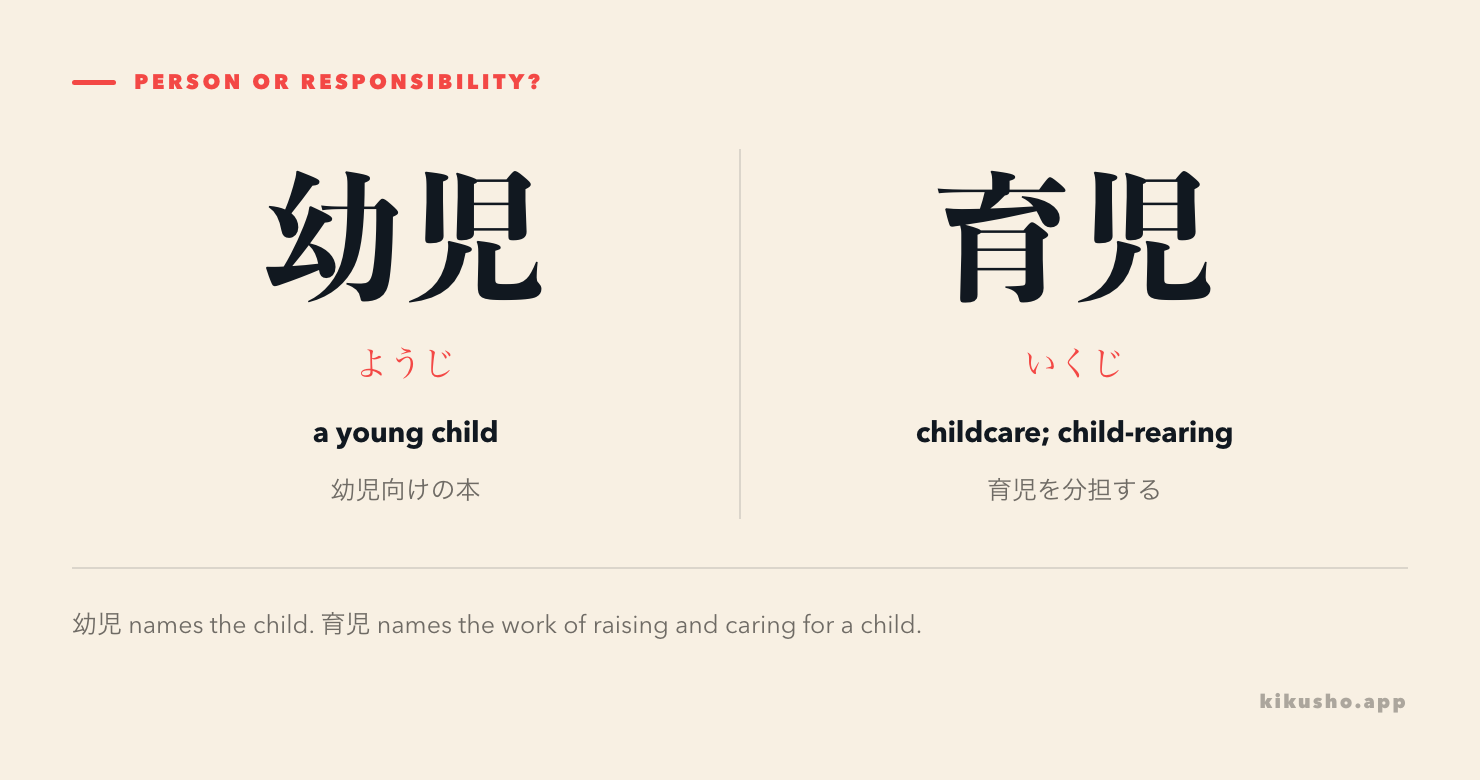
幼児 names the child; 育児 names the work
幼児(ようじ) is a young child. In everyday language its boundary can be loose, but institutional writing may define it precisely. The dictionary entry for 幼児 notes the Child Welfare Act definition: a child from age one until entering elementary school.
この図書館には幼児向けの本があります。
This library has books for young children.
幼児は必ず大人と一緒に入ってください。
Young children must enter with an adult.
育児(いくじ) is raising and caring for a child. It focuses on the work, responsibility or period of care. The 育児 definition gives 子を養い育てること, caring for and bringing up a child.
- 育児をする: care for and raise a child
- 育児を分担する: share childcare
- 育児に参加する: take part in childcare
- 育児休業: childcare leave
- 育児中: currently raising a child
二人は仕事を続けながら、育児を分担しています。
The two share childcare while continuing to work.
The kanji 児 appears in both words, but the first kanji controls the viewpoint: 幼 makes 幼児 the young person; 育 makes 育児 the act of raising that person.
姪 is one exact relation; 親類 is the wider circle
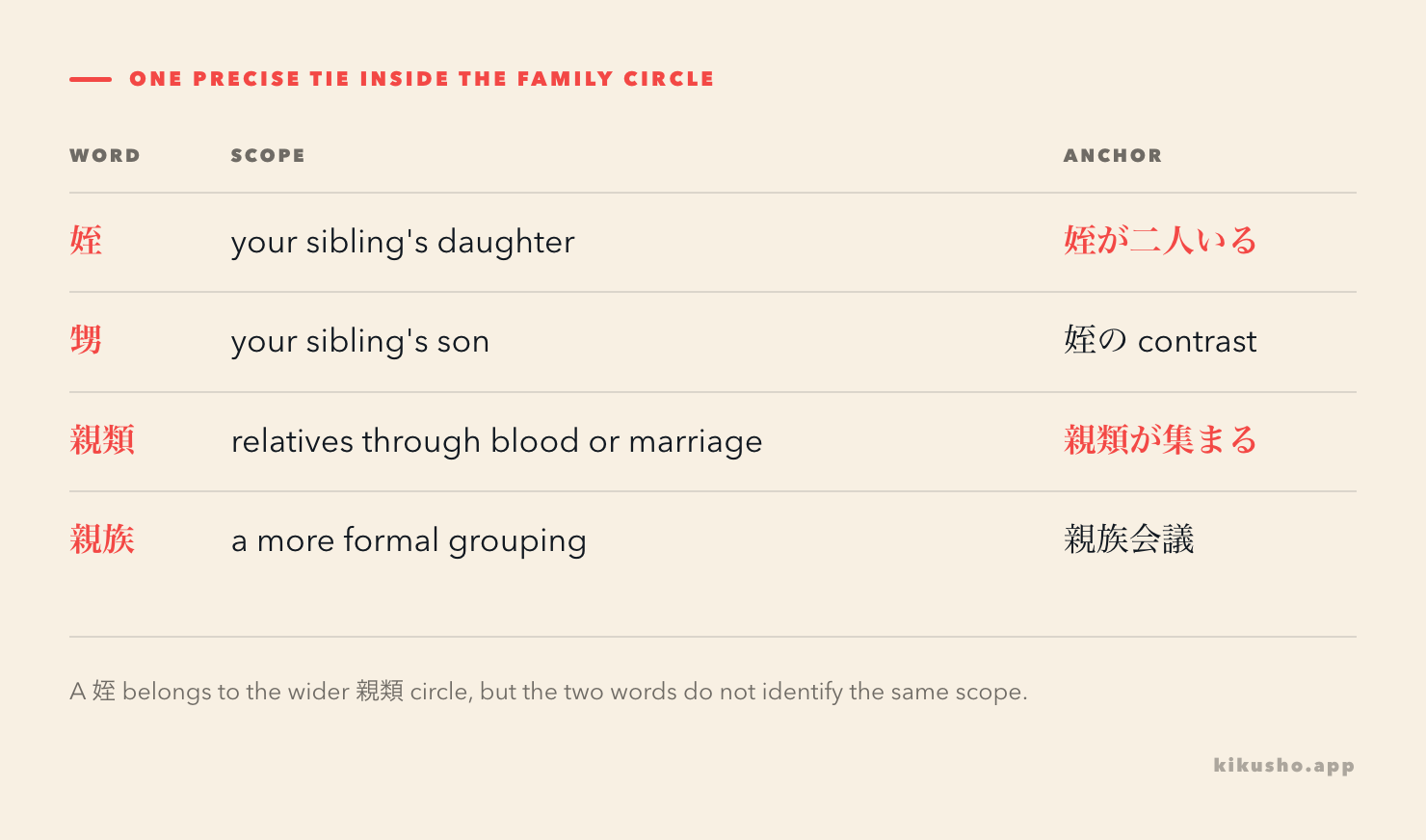
姪(めい) means a niece: your brother's or sister's daughter. Its opposite-sex pair is 甥(おい), nephew. The dictionary definition is exact about the relationship, so 姪 does not mean any younger female relative.
姉の娘、つまり私の姪は、来年中学生になります。
My older sister's daughter, in other words my niece, will start junior high next year.
親類(しんるい) is an umbrella term for relatives connected through blood or marriage. It often overlaps with 親戚. The 親類 usage note says 親類 and 親戚 are normally interchangeable in everyday family reference, while 親族 is the more formal grouping in expressions such as 親族会議.
正月には親類が祖母の家に集まります。
At New Year, the relatives gather at my grandmother's house.
A niece can belong to your 親類, but the two words cannot replace each other. 姪が来た identifies the relationship of one person. 親類が来た only says that one or more relatives came.
主人 and 夫妻 depend on who is speaking about whom
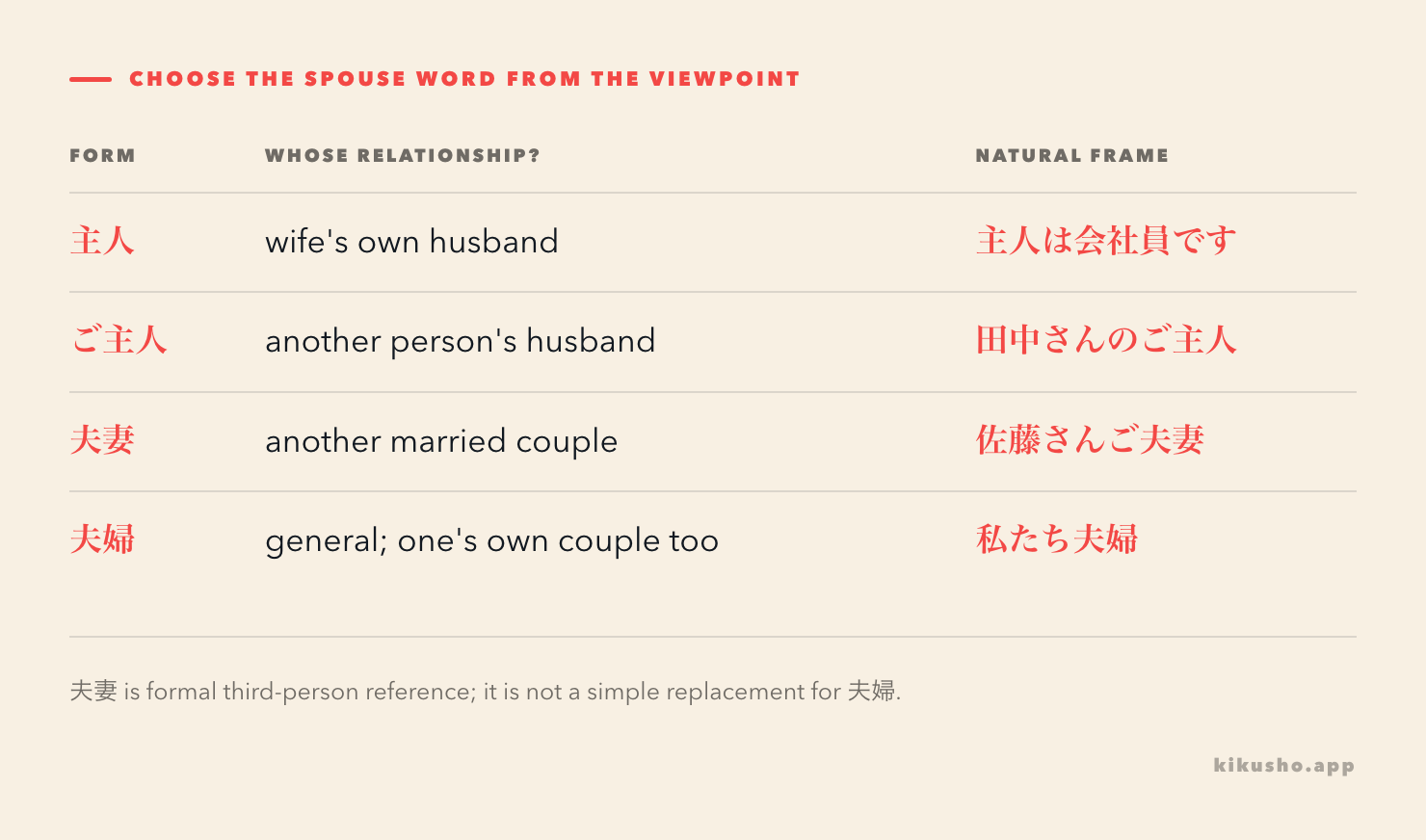
主人(しゅじん) has several meanings. It can name the host, householder, owner or master. In family conversation, a wife may also use it when mentioning her own husband to someone outside the family. That spouse meaning appears explicitly in the 主人 dictionary entry.
「主人は今、育児休業を取っています」と佐藤さんは話しました。
“My husband is currently taking childcare leave,” Ms Sato said.
The direction reverses with ご主人: it commonly refers politely to someone else's husband. Because preferences differ and 主人 also carries older hierarchy-related meanings, many speakers choose 夫 for their own husband or 夫/配偶者/パートナー when a neutral label suits the situation. The lesson's job is to let you recognise 主人 accurately, not to require it as your only choice.
夫妻(ふさい) names a husband and wife together in somewhat formal third-person reference. The 夫妻 usage note gives ご夫妻 and labels such as 有名人夫妻, while advising against 私たち夫妻 for one's own couple.
山田さんご夫妻を式に招待しました。
We invited Mr and Mrs Yamada to the ceremony.
私たち夫婦は京都に住んでいます。
My spouse and I live in Kyoto.
The second sentence needs 夫婦(ふうふ), the general word for a married couple. 夫妻 is not simply a more advanced spelling of 夫婦; its ordinary viewpoint is narrower.
仲良し is a relationship; 仲直り is a repair
Both words begin with 仲(なか), the relationship between people, but they describe different points on a timeline.
仲良し(なかよし) means being on good terms or a person with whom one is close. The dictionary entry allows both the relationship and the person.
姪と隣の子は幼稚園のころから仲良しです。
My niece and the child next door have been close since kindergarten.
あの二人は大の仲良しです。
Those two are very close friends.
仲直り(なかなおり) presupposes that the relationship became bad and then returned to a good state. It works as a suru verb, most often with the other person marked by と: 友達と仲直りする. The dictionary definition describes people whose relationship had worsened becoming close again.
二人はおもちゃのことでけんかしましたが、すぐに仲直りしました。
The two argued about a toy, but soon made up.
私は弟に謝って、弟と仲直りしました。
I apologised to my younger brother and made up with him.
The particle pattern records two different roles: 弟に謝る directs the apology toward him, while 弟と仲直りする treats the reconciliation as something the two people do together.
One family visit uses all eight words without flattening them
佐藤さんご夫妻には五歳の幼児がいます。佐藤さんは「主人も育児を分担してくれるので助かります」と話していました。先週、親類が集まったとき、佐藤さんの姪も遊びに来ました。二人の子供は以前から仲良しですが、その日はおもちゃのことでけんかをしました。しばらく別々に遊んだあと、お互いに謝って仲直りしました。
Mr and Mrs Sato have a five-year-old child. Ms Sato said, “It helps that my husband shares the childcare too.” Last week, when the relatives gathered, Ms Sato's niece came to play. The two children had long been close friends, but that day they argued about a toy. After playing separately for a while, they apologised to each other and made up.
The narrator uses 佐藤さんご夫妻 to refer to another married couple. Inside the quotation, Ms Sato uses 主人 for her own husband. 幼児 identifies the child, while 育児 identifies the adults' shared work. 姪 gives one exact connection inside the wider 親類 group. Finally, 仲良し describes the standing relationship and 仲直り names the change after the argument.
Test the viewpoint before revealing the explanations
1 · Sound match. Which line pairs 育児 with its standard pronunciation?
- A. 育児 — ようじ
- B. 育児 — いくじ
- C. 育児 — そだち
- D. 育児 — いくに
2 · Written form. You hear めい in a sentence about someone's niece. Which word belongs on the page?
- A. 親類
- B. 幼児
- C. 姪
- D. 夫妻
3 · Word formation. Complete the compound meaning “childcare leave”: __休業.
- A. 幼児
- B. 育児
- C. 親類
- D. 仲良し
4 · Context. A public notice means “Young children must enter with an adult.” Which word fits __は必ず大人と一緒に入ってください?
- A. 幼児
- B. 育児
- C. 主人
- D. 仲直り
5 · Usage. Which invitation uses the standard formal label for another married couple?
- A. 山田さんご夫妻を式に招待しました。
- B. 私たち夫妻は式を開きました。
- C. 山田さん育児を式に招待しました。
- D. 私たち親類は二人だけです。
6 · Meaning in context. A family diary says 正月には親類が集まります. Which English summary is accurate?
- A. Young children begin school at New Year.
- B. The relatives gather at New Year.
- C. A married couple reconciles at New Year.
- D. My niece takes childcare leave at New Year.
7 · Context. Ms Sato is speaking to a colleague about her own husband. Which inventory word fits __は今、育児休業中です?
- A. 夫妻
- B. 親類
- C. 主人
- D. 幼児
8 · Usage. Which sentence correctly says “I made up with my younger brother”?
- A. 弟に仲良ししました。
- B. 弟と仲直りしました。
- C. 弟を親類しました。
- D. 弟が夫妻しました。
9 · Context. Two children have been close friends since kindergarten. Which sentence fits?
- A. 二人は幼稚園のころから仲良しです。
- B. 二人は幼稚園のころから仲直りです。
- C. 二人は幼稚園のころから夫妻です。
- D. 二人は幼稚園のころから育児です。
10 · Connected text. In the family visit, what happened after the children argued?
- A. They became relatives.
- B. They started childcare leave.
- C. They apologised and made up.
- D. They were introduced as a married couple.
Write down the ten letters in order. Open the block only after the last choice is fixed.
Answers and explanations
1 · B, いくじ. 育児 means childcare or child-rearing. ようじ is the reading of 幼児, the young child receiving care.
2 · C, 姪. 姪 is read めい and identifies one's sibling's daughter. 親類 is the wider kin group, 夫妻 is a married couple and 幼児 is a young child.
3 · B, 育児. 育児休業 is childcare leave. 幼児休業 would wrongly put the person label where the activity belongs.
4 · A, 幼児. The blank is the person who must enter with an adult. 育児 names childcare rather than a child.
5 · A. ご夫妻 is a formal way to refer to another married couple. Standard usage prefers 私たち夫婦 for the speaker's own couple, so option B fails the viewpoint test.
6 · B. 親類 means relatives or kin, and 集まる means gather. The sentence does not specify which individual family relations attend.
7 · C, 主人. In this quoted viewpoint, the wife uses 主人 for her own husband. 夫妻 would refer to two married people as a pair, not one husband.
8 · B. 仲直りする means reconcile, and the other participant takes と. 仲良し describes closeness; it is not normally used as 仲良しする in this sentence.
9 · A. 仲良しです describes the children's continuing close relationship. 仲直り would require an earlier disagreement and a later repair.
10 · C. The passage says お互いに謝って仲直りしました: they apologised to each other and reconciled. Their relationship was already described as 仲良し before the argument.
Common questions
What is the difference between 幼児 and 育児?
幼児(ようじ) is a young child, while 育児(いくじ) is the activity of raising and caring for a child. The first names a person; the second names work or a process.
What is the difference between 主人 and ご主人?
A wife may use 主人(しゅじん) for her own husband when speaking to someone else. ご主人 commonly refers politely to another person's husband. 主人 also has older meanings such as host, owner or master, so context matters.
Can I use 夫妻 for my own spouse and me?
Standard dictionary guidance treats 夫妻(ふさい) as a somewhat formal label for another couple, as in 佐藤夫妻 or ご夫妻. Use 私たち夫婦 for your own married couple rather than 私たち夫妻.
How are 仲良し and 仲直り different?
仲良し(なかよし) describes people who are close or a close friend. 仲直り(なかなおり) is reconciliation after a disagreement and commonly appears as 人と仲直りする.