On this page
At N1, “progress” is not one scale. A document is 改訂され, a product is 改良され, an unfair condition is 是正され, a skill 向上する, and an institution may 後退する, 衰える, or finally 滅びる. The words for effort and results are just as selective: 励ます acts on another person, 励む names sustained application, 奮闘 frames a struggle, 成果 names a good result, and 業績 evaluates a body of work or business performance.
No single headword covers every kind of achievement. The object, direction and evaluation select the word.
The 13 words form four working groups
| Headword | Grammar | Core job | Anchor phrase |
|---|---|---|---|
| 改訂(かいてい) | Noun / する | revise a publication or document | 教科書を改訂する |
| 改良(かいりょう) | Noun / する | improve a concrete design, material or variety | 装置を改良する |
| 是正(ぜせい) | Noun / する | correct a fault, injustice or imbalance | 格差を是正する |
| 励ます(はげます) | Transitive godan verb | encourage or cheer someone | 仲間を励ます |
| 励む(はげむ) | Godan verb | apply oneself steadily to an activity | 研究に励む |
| 奮闘(ふんとう) | Noun / する | struggle energetically against difficulty | 問題解決に奮闘する |
| 成果(せいか) | Noun | a good result produced by work | 研究の成果 |
| 業績(ぎょうせき) | Noun | performance or a body of professional work | 会社の業績 |
| 向上(こうじょう) | Noun / する | move toward a better level or state | 品質が向上する |
| 後退(こうたい) | Noun / する | move backward or regress | 改革が後退する |
| 衰える(おとろえる) | Ichidan verb | lose strength, force or vitality | 体力が衰える |
| 発育(はついく) | Noun / する | grow physically or biologically | 作物が発育する |
| 滅びる(ほろびる) | Ichidan verb | perish or cease to exist | 文明が滅びる |
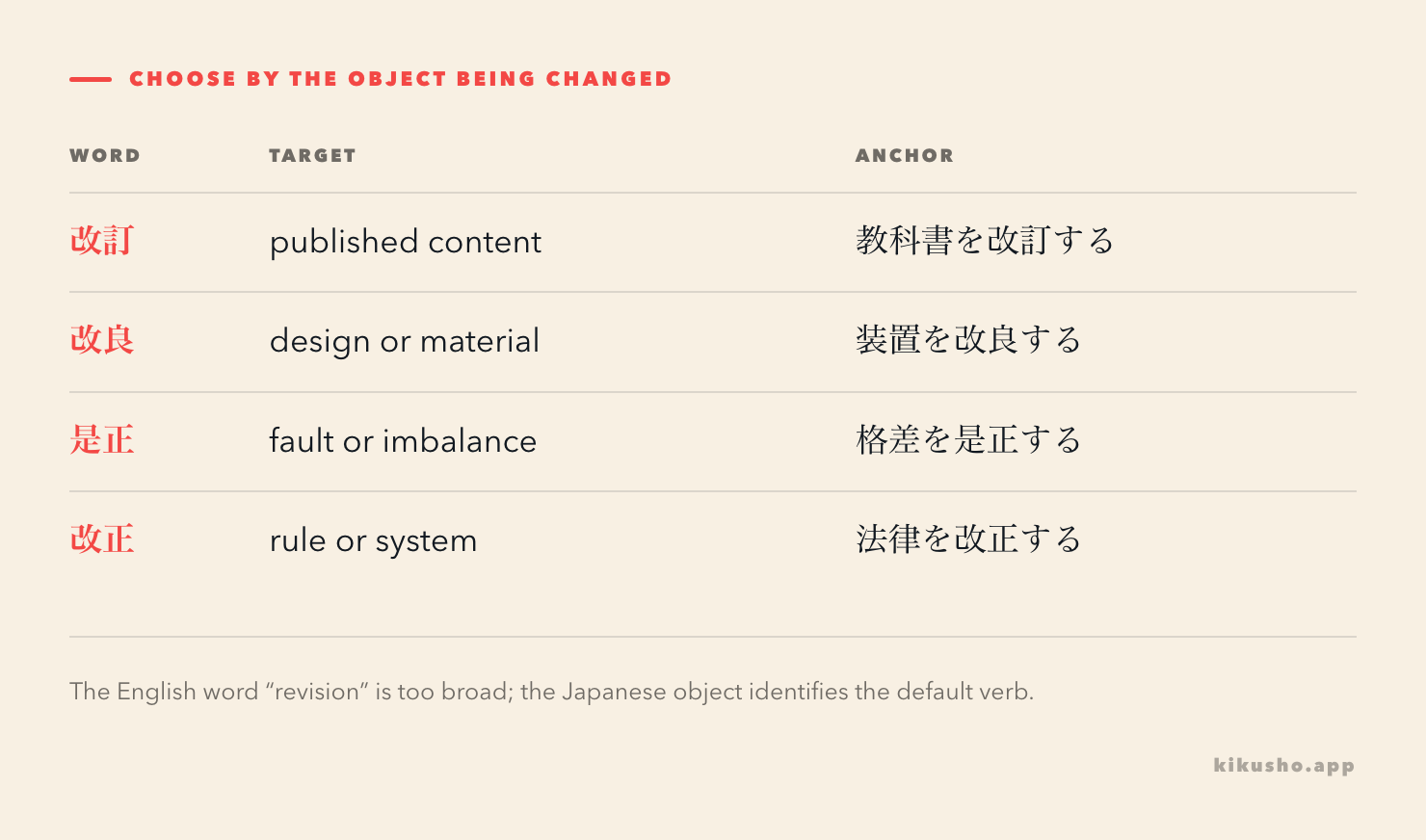
改訂 changes content, 改良 improves a thing, and 是正 remedies a problem
改訂(かいてい) most readily takes a publication or organized body of content: a textbook, dictionary, manual, edition, guideline or curriculum. Shogakukan's definition starts with changing and correcting a book's contents.
編集部は統計を更新し、来年度の教科書を改訂した。
へんしゅうぶは とうけいを こうしんし、らいねんどの きょうかしょを かいていした。
The editorial team updated the statistics and revised next year's textbook.
改良(かいりょう) improves something designed, made, bred or materially changed. Typical objects include 製品, 装置, 品種, 材質 and 土壌. The Shogakukan synonym guide contrasts those concrete objects with 改善 for conditions, relationships and situations.
技術者は部品の形を変え、装置を軽くするために改良を重ねた。
ぎじゅつしゃは ぶひんの かたちを かえ、そうちを かるくするために かいりょうを かさねた。
The engineers repeatedly improved the device by changing the shape of its parts to make it lighter.
是正(ぜせい) begins from the judgment that something is wrong, harmful, unfair or out of balance. It does not merely update content or enhance performance. Shogakukan defines it as putting right a bad or inconvenient point; recurring objects include 格差, 不均衡, 違反, 偏り and 誤り.
調査結果を受け、自治体は地域間の支援格差を是正する方針を示した。
ちょうさけっかを うけ、じちたいは ちいきかんの しえんかくさを ぜせいする ほうしんを しめした。
In response to the survey results, the municipality announced a policy to correct regional disparities in support.
The neighbouring N2 word 改正 revises a rule, law or formal system. A reliable first choice is manual → 改訂, machine → 改良, disparity → 是正, regulation → 改正.
励ます changes another person's state; 励む describes one's own work
The shared kanji does not make 励ます and 励む interchangeable.
励ます(はげます) is transitive. A subject acts on a person who is worried, tired or attempting something: 友人を励ます, 選手を励ます, 互いに励まし合う. It can also mean raising or strengthening one's voice, though encouragement is the central use here.
結果が出ずに落ち込む後輩を、研究室の仲間が励ました。
けっかが でずに おちこむ こうはいを、けんきゅうしつの なかまが はげました。
The laboratory members encouraged their junior colleague, who was discouraged by the lack of results.
励む(はげむ) describes the actor devoting energy to an activity. The productive frame is Nに励む: 学業に励む, 研究に励む, 練習に励む, 仕事に励む. Shogakukan defines the modern core as concentrating on a task and working hard at it.
彼女は失敗の原因を記録しながら、毎日実験に励んだ。
かのじょは しっぱいの げんいんを きろくしながら、まいにち じっけんに はげんだ。
She applied herself to experiments every day while recording the causes of each failure.
- 先生が学生を励ます: the teacher encourages the student.
- 学生が研究に励む: the student applies themself to research.
- 先生の言葉が学生の励みになる: the teacher's words become a source of encouragement.
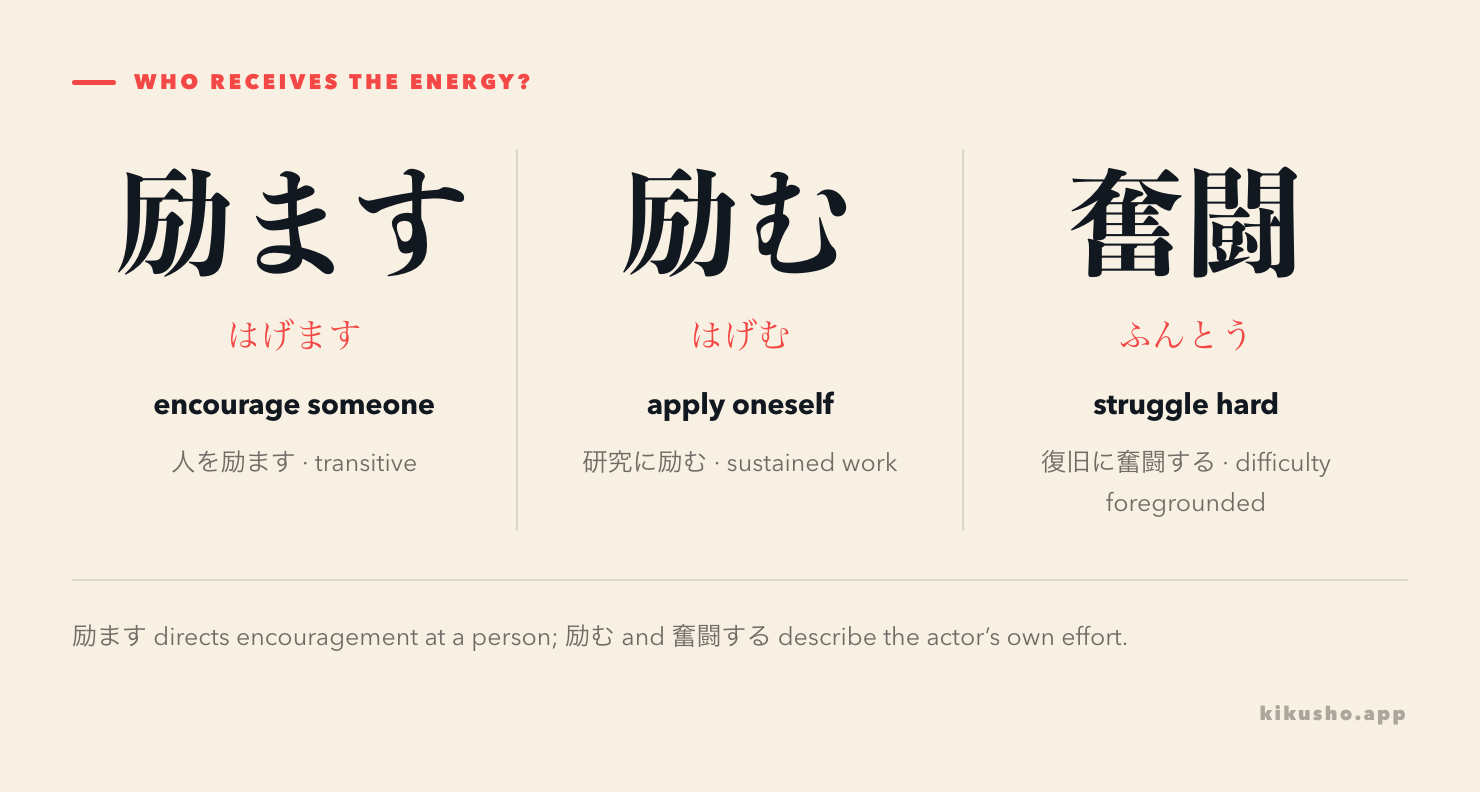
奮闘(ふんとう)する adds the image of a fight. It originally names fighting with all one's strength and now also frames energetic effort against a difficult problem. The dictionary entry gives both forceful combat and wholehearted effort.
限られた予算の中で、担当者たちは制度の立て直しに奮闘した。
かぎられた よさんの なかで、たんとうしゃたちは せいどの たてなおしに ふんとうした。
Working within a limited budget, the staff struggled hard to rebuild the system.
研究に励む can describe a long, steady period of application without presenting an obstacle. 問題解決に奮闘する makes the difficulty and the actors' exertion part of the scene.
成果 is a good result; 業績 evaluates work or performance
成果(せいか) is a favorable result obtained through action or effort. Shogakukan gives the frames 成果が出る, 成果を上げる, 研究の成果 and 努力の成果.
長年の観測が実を結び、研究チームは大きな成果を上げた。
ながねんの かんそくが みを むすび、けんきゅうチームは おおきな せいかを あげた。
Years of observation bore fruit, and the research team achieved a major result.
業績(ぎょうせき) narrows the field to business, professional activity or academic research. It can mean achievements, a body of work, or company performance. Shogakukan defines it as results obtained in business or academic research.
原材料費の上昇により、今期の会社業績は悪化した。
げんざいりょうひの じょうしょうにより、こんきの かいしゃぎょうせきは あっかした。
The company's performance deteriorated this term because raw-material costs rose.
成果 is favorable in ordinary modern use, so 悪い成果 is unusual. 業績 can be 好調, 低迷, 悪化 or 回復 because it names performance being evaluated. In academia, 研究成果 highlights what a project produced; 研究業績 treats publications and discoveries as a researcher's record.
The preceding N2 lesson separates 実績, demonstrated results or a track record, from 功績, a contribution worthy of recognition. Add N1 業績 when the domain is professional, corporate or scholarly work, and use 成果 when the sentence points to the beneficial result itself.
向上 and 後退 show direction; 衰える shows lost strength
向上(こうじょう)する means moving toward a better or more advanced state. It often describes 能力, 品質, 生産性, 安全性, 意識 or 生活水準. The subject changes, while a deliberate intervention can take Nを向上させる.
研修を続けた結果、職員の対応力が向上した。
けんしゅうを つづけた けっか、しょくいんの たいおうりょくが こうじょうした。
Continued training improved the staff's ability to respond.
The dictionary definition explicitly builds in movement toward a better condition. A numerical rise is not automatically 向上: costs can 上昇する, but calling that 向上 would evaluate it as improvement.
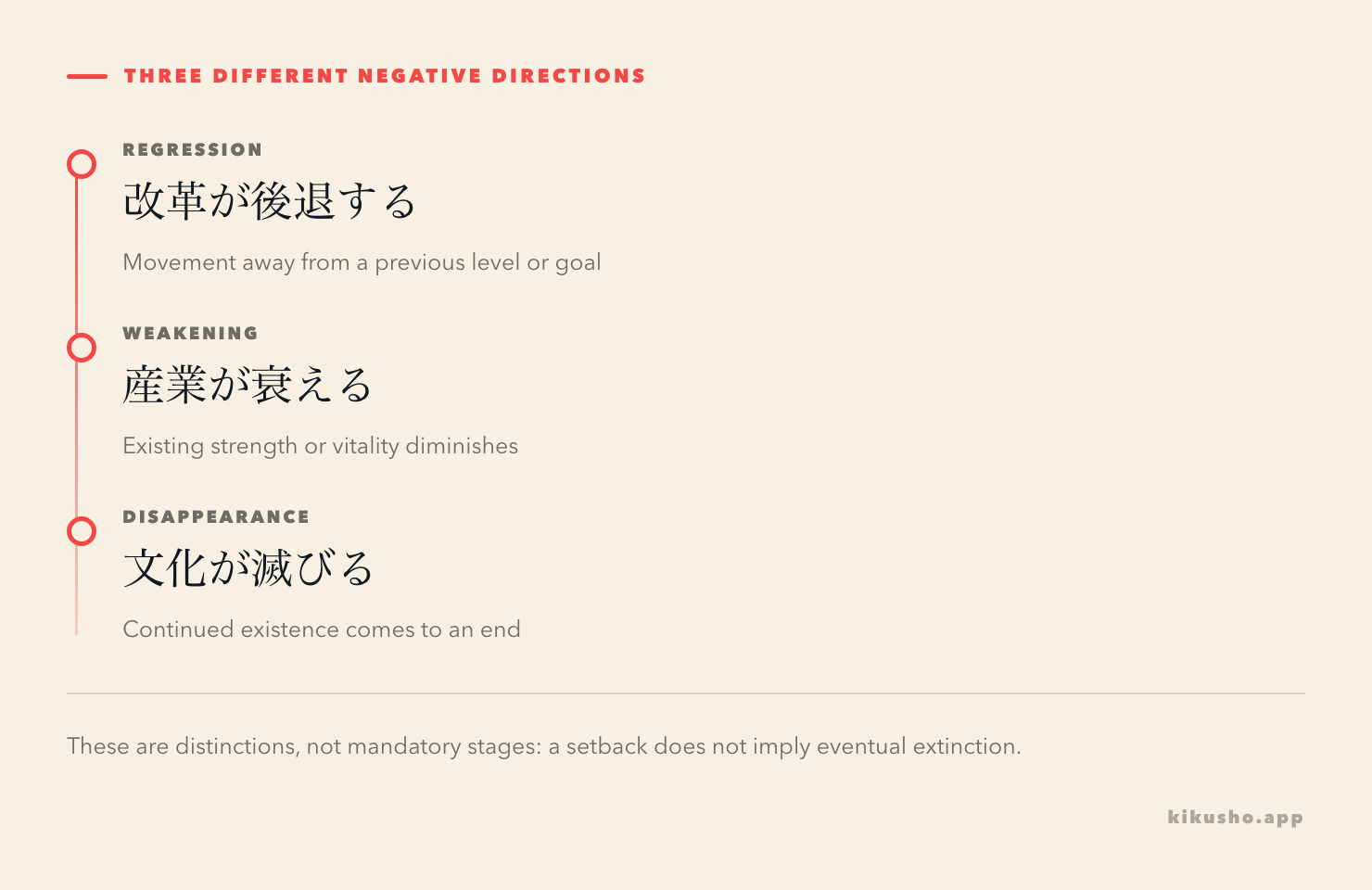
後退(こうたい)する can be physical retreat or figurative regression. Shogakukan records both moving backward and losing force or moving toward an undesirable state.
新しい規制によって、透明性の確保がかえって後退した。
あたらしい きせいによって、とうめいせいの かくほが かえって こうたいした。
The new regulations actually set transparency back.
衰える(おとろえる) focuses on strength, force, function or vitality becoming weaker. Natural subjects include 体力, 記憶力, 勢い, 視力, 文化, 産業 and even 雨脚. Shogakukan gives the core as losing force or no longer flourishing.
後継者が減り、地域の伝統産業は次第に衰えていった。
こうけいしゃが へり、ちいきの でんとうさんぎょうは しだいに おとろえていった。
As the number of successors fell, the region's traditional industry gradually weakened.
The three words answer different questions. 向上/後退 evaluates direction relative to a level or goal. 衰える describes the loss of existing strength. A reform can 後退する after one policy decision; an industry may 衰える over decades.
発育 is living growth; 滅びる is the end of continued existence
発育(はついく)する is growth in a living organism, especially physical or biological growth. It applies to children, bodies, organs, crops and living tissue. The dictionary and specialist definitions emphasize growing larger and the morphological side of development.
日照不足のため、今年は苗の発育が遅れている。
にっしょうぶそくのため、ことしは なえの はついくが おくれている。
Because of insufficient sunlight, the seedlings' growth is delayed this year.
Use 発達 when the focus is the development or differentiation of a function, structure or ability: 言語能力が発達する. Use 向上 when an already measured quality or performance becomes better: 読解力が向上する. A child's body can 発育する without the writer evaluating it against a performance target.
滅びる(ほろびる) is much stronger than 衰える or 後退する. A civilization, dynasty, state, species or tradition ceases to exist. Kanjipedia defines it concisely as something once prosperous disappearing.
記録と技術が受け継がれなければ、その文化はやがて滅びるかもしれない。
きろくと ぎじゅつが うけつがれなければ、その ぶんかは やがて ほろびるかもしれない。
If its records and techniques are not passed on, that culture may eventually perish.
A tradition can 衰える and still survive. It 滅びる only when continued existence ends. The transitive partner is 滅ぼす: 戦争が国を滅ぼした, “war destroyed the country.”
One renewal project connects all 13 words
A research institute discovers that crop yields are falling. Editors first 栽培マニュアルを改訂する so the documented method matches current evidence. Engineers 灌水装置を改良する, while administrators 地域間の支援格差を是正する. A senior scientist 若手を励まし, and the younger researchers 品種開発に励む. During a drought, the whole team 問題解決に奮闘する.
The new method produces a measurable 成果. Publications and field trials add to the institute's 研究業績, and water-use efficiency が向上する. If funding cuts reverse the program, the reform が後退し, local research capacity が衰える. Seedlings may fail to 発育し, and a locally adapted variety could eventually 滅びる.
This chain keeps three layers separate: what people change, how they work, and how the outcome moves. In Kikusho, save the whole frame rather than a loose translation: 格差を是正する, 研究に励む, 成果を上げる, 業績が悪化する, and 体力が衰える retain the object, particle and evaluation that guide recall.
N1 is a source-backed study placement
The two retained reference files agree on the N1 placement and readings of all 13 records, but both descend from the Waller/Tanos source family. Japanesetest4you separately indexes 業績 and 成果 at N1, although the provenance of its level list is not fully independent.
The official JLPT FAQ says that vocabulary, kanji and grammar specifications have not been published for the revised test since 2010. The dictionaries above verify meanings, readings and collocations; they do not establish an official level. Treat N1 as the curriculum placement for this set.
Practice: ten questions
Complete all ten before opening the explanations.
1 · Read 衰える. Choose the correct reading.
- ① うったえる
- ② おとろえる
- ③ こごえる
- ④ そなえる
2 · Read 発育. Choose the reading for the word meaning biological or physical growth.
- ① はつたつ
- ② はっせい
- ③ はついく
- ④ はっき
3 · Complete the effort frame.
彼は博士論文の完成を目指し、資料の分析に__いる。
- ① 励んで
- ② 励まして
- ③ 滅びて
- ④ 是正して
4 · Match the object to the kind of correction. Choose the best sequence.
辞書を( 前 )。装置を( 中 )。不当な格差を( 後 )。
- ① 前 是正する / 中 改訂する / 後 改良する
- ② 前 改訂する / 中 改良する / 後 是正する
- ③ 前 改良する / 中 是正する / 後 改訂する
- ④ 前 改訂する / 中 是正する / 後 改良する
5 · Encourage the person. Which sentence says that a coach encouraged a disappointed athlete?
- ① 監督は落ち込んだ選手を励ました。
- ② 監督は落ち込んだ選手に励んだ。
- ③ 監督は落ち込んだ選手を向上した。
- ④ 監督は落ち込んだ選手に発育した。
6 · Result or performance. Choose the pair that preserves both evaluations.
実験は大きな( 前 )を上げたが、会社全体の( 後 )は赤字で悪化した。
- ① 前 業績 / 後 成果
- ② 前 成果 / 後 業績
- ③ 前 奮闘 / 後 発育
- ④ 前 後退 / 後 改訂
7 · Identify the stage of decline. Which sentence says the industry is losing vitality but still exists?
- ① 産業が向上している。
- ② 産業が発育している。
- ③ 産業が衰えている。
- ④ 産業が滅びた。
8 · Preserve the meaning. What does 長年の研究成果が実用化された say?
- ① A beneficial result of years of research was put into practical use.
- ② The company's financial performance was erased.
- ③ A researcher was encouraged to revise a dictionary.
- ④ A living organism stopped growing.
9 · Choose sustained work or struggle. Which option best completes the contrast?
平常時は基礎研究に( 前 )。事故が起きた夜は復旧作業に( 後 )。
- ① 前 励む / 後 奮闘する
- ② 前 奮闘する / 後 励ます
- ③ 前 励ます / 後 発育する
- ④ 前 是正する / 後 改訂する
10 · Follow the renewal project. Choose the only account that keeps direction, biological growth and disappearance distinct.
研修後、職員の技能はよくなった。だが苗は十分に育たず、在来種は地域から完全に姿を消した。
- ① 技能が向上し、苗の発育が遅れ、在来種が滅びた。
- ② 技能が発育し、苗が是正され、在来種が励んだ。
- ③ 技能が滅び、苗の業績が上がり、在来種が改訂された。
- ④ 技能が後退し、苗が奮闘し、在来種が向上した。
Answers and explanations
Choice ②: おとろえる. 衰える means to lose strength, force or vitality. うったえる is 訴える, こごえる is 凍える, and そなえる can be 備える.
Choice ③: はついく. 発育 names physical or biological growth. The other readings belong to different compounds: 発達, 発生 and 発揮.
Choice ①: 励んで. 分析に励む means to apply oneself to analysis. 励ます requires a person as the object, and the remaining verbs do not describe sustained study.
Choice ②. A dictionary's content is 改訂する, a device is 改良する, and an unjust disparity is 是正する. Each verb frames a different object and reason for change.
Choice ①. The coach acts on the discouraged athlete, so the transitive pattern is 選手を励ます. Nに励む instead marks the activity to which the subject applies themself.
Choice ②: 前 成果 / 後 業績. The experiment produces a good result, while company performance can be in deficit and deteriorate. Ordinary 成果 already evaluates the result as favorable.
Choice ③. 衰える describes lost vitality while the industry still exists. 滅びた would say that it ceased to exist, while 向上 and 発育 move in a positive growth direction.
Choice ①. 研究成果 is the beneficial result produced by the research; 実用化された says it was made practical. The sentence makes no claim about company finances or biological growth.
Choice ①: 前 励む / 後 奮闘する. Regular, sustained research suits 励む. Emergency recovery foregrounds difficulty and forceful effort, so 奮闘する is the stronger choice.
Choice ①. Better skill is 向上, insufficient biological growth is delayed 発育, and total disappearance is 滅びる. The other choices assign human actions or document verbs to unsuitable subjects.
Common questions
What is the difference between 改訂, 改良 and 是正?
改訂 revises the contents of a publication or document. 改良 improves a product, material, variety or other concrete design. 是正 corrects a recognized fault, injustice or imbalance and restores a more acceptable condition.
What is the difference between 成果 and 業績?
成果 is a good result produced by an effort or project. 業績 evaluates the work or performance of a business, researcher or field over a period; it can therefore be described as strong or poor.
What is the difference between 励ます and 励む?
励ます is transitive: someone encourages or cheers another person. 励む describes the person applying themselves to an activity, commonly in the pattern Nに励む.
Are all 13 words officially JLPT N1 vocabulary?
The retained reference rows consistently place the 13 spelling-reading records at N1, but their two main files share Waller ancestry. The JLPT publishes no exhaustive official vocabulary list, so N1 is a practical study placement rather than an official boundary.