On this page
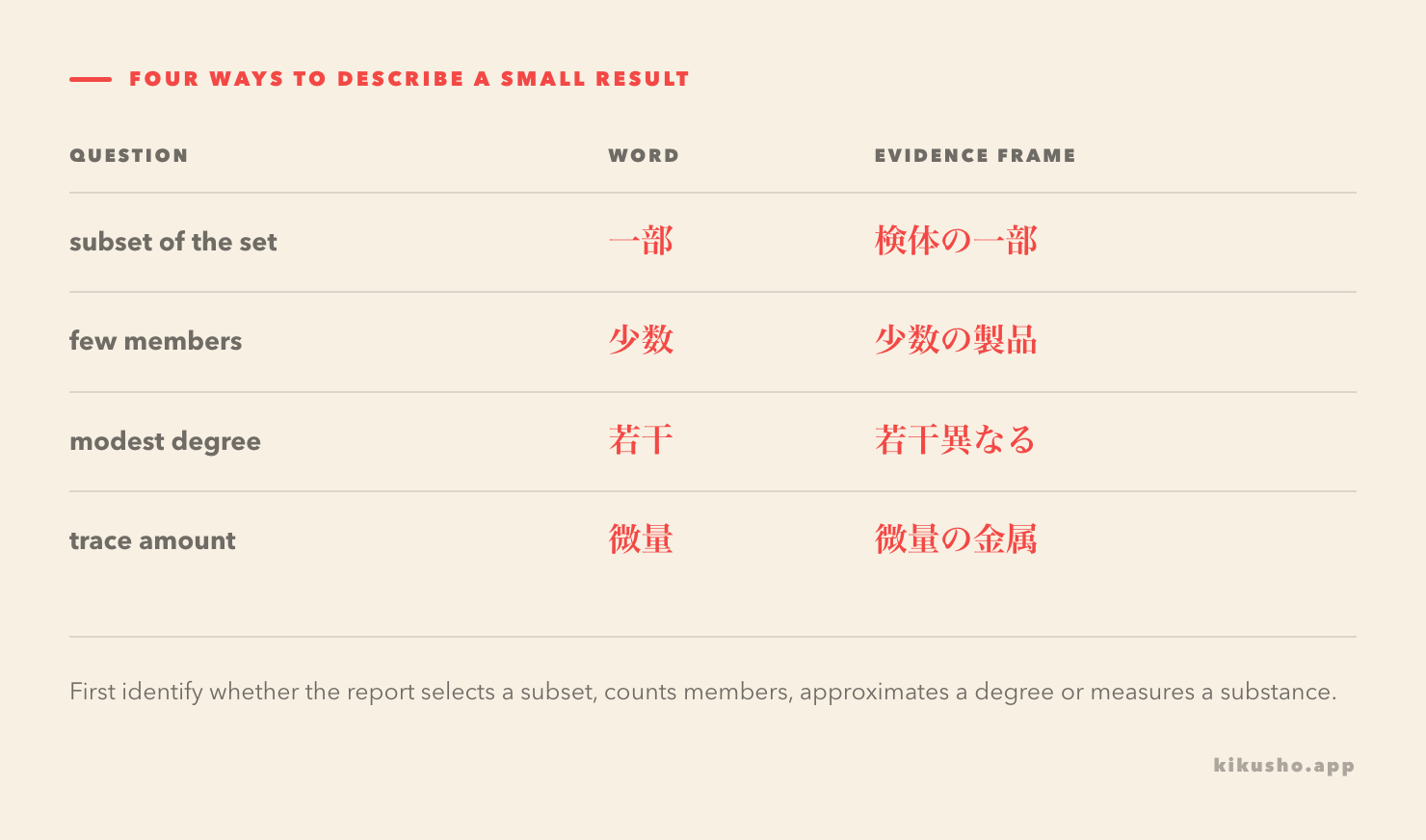
Use 一部 for part of a whole, 少数 for a small count, 若干 for a modest unspecified number or degree, and 微量 for a trace quantity. あんまり…ない lowers a degree in conversation, while 余地 leaves scope for another action or judgment.
At N1, “a little” is not one category. Imagine reviewing a laboratory quality report: a subset of samples contains a trace substance, only a minority of lots is affected, readings vary slightly, and the procedure still leaves room for improvement. Each claim answers a different question.
Six words, six questions about the evidence
| Word | Reading | What it measures | Report frame |
|---|---|---|---|
| 余り | あんまり | low or excessive degree in conversation | あんまり変わらない |
| 一部 | いちぶ | a part, some members, or one copy | 検体の一部 |
| 少数 | しょうすう | few countable members; a minority | 少数の製品 |
| 若干 | じゃっかん | a small unspecified count or degree | 若干異なる |
| 微量 | びりょう | an extremely small physical quantity | 微量の物質 |
| 余地 | よち | room for another action or conclusion | 改善の余地 |
The decisive clue may be the noun, the particle or the register. 微量の担当者 is unsuitable because people are counted; 少数の物質 would describe a few kinds or units, not the trace amount of a substance.
一部 selects a subset or counts one complete copy
一部(いちぶ) first means one part within a larger whole. With Nの一部, the noun before の supplies that whole.
検体の一部から異物が検出されました。
けんたいの いちぶから いぶつが けんしゅつされました。
Foreign matter was detected in some of the samples.
The claim does not say how many samples were affected. It only says that the affected set is smaller than the whole. 一部の検体 can likewise mean some of the samples, and 文章の一部 means one portion of the text. Shogakukan's 一部 entry defines this part-of-a-whole sense in opposition to 全部.
The same word also counts a complete copy of a book, newspaper or document.
最終報告書を一部、監査室に提出してください。
さいしゅうほうこくしょを いちぶ、かんさしつに ていしゅつして ください。
Please submit one copy of the final report to the audit office.
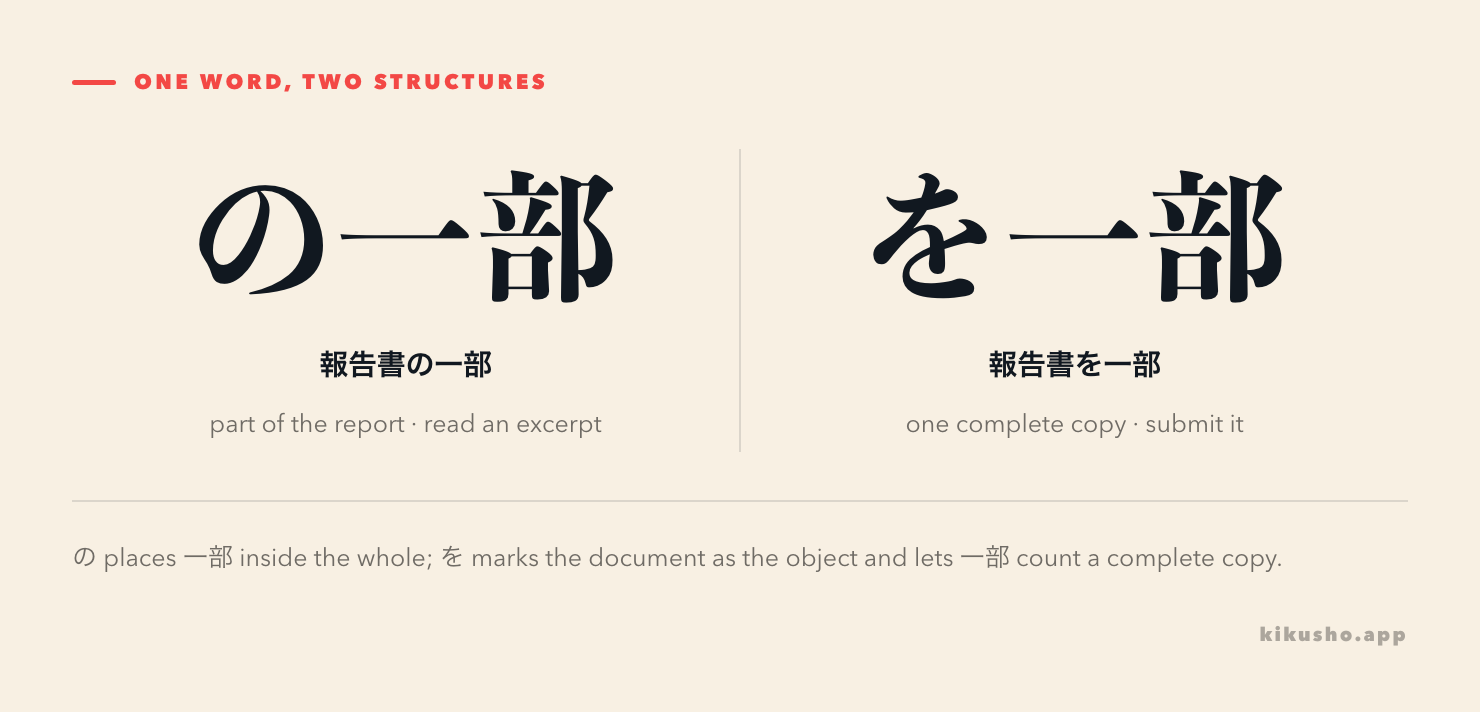
Here, 一部 does not mean an excerpt. The particle を already marks 報告書 as the object, and 一部 gives the number of complete copies. Compare the frames directly:
- 報告書の一部を読む: read part of the report.
- 一部の報告書を読む: read some of the reports.
- 報告書を一部提出する: submit one copy of the report.
少数 counts members and contrasts with a majority
少数(しょうすう) means a small number or a minority. It fits people, products, cases and other countable members.
基準を外れた製品は少数にとどまりました。
きじゅんを はずれた せいひんは しょうすうに とどまりました。
The number of products outside the standard remained small.
Common frames include 少数の参加者, a small number of participants; 少数意見, a minority opinion; and ごく少数, only a very few. The dictionary definition of 少数 explicitly contrasts it with 多数.
Do not confuse 少数 with 小数(しょうすう). Their readings are identical, but 小数 is a decimal.
影響を受けた製品は少数ですが、その割合は小数で示します。
えいきょうを うけた せいひんは しょうすうですが、その わりあいは しょうすうで しめします。
Few products were affected, but their proportion is expressed as a decimal.
The kanji gives the test: 少 asks whether members are few; 小 says a numerical value is smaller than a whole unit or contains a decimal part.
若干 leaves a small number or degree approximate
若干(じゃっかん) presents a number or degree as small without fixing it precisely. It sounds at home in reports, notices and formal explanations.
測定値は前回と若干異なります。
そくていちは ぜんかいと じゃっかん ことなります。
The measured values differ slightly from the previous ones.
As an adverb, 若干 can modify a change, difference or delay: 若干増加した, increased slightly; 若干遅れる, be somewhat delayed. With の, it can modify a noun: 若干の修正, some minor revisions. 若干名 advertises a small, unspecified number of openings or recruits.
The 若干 dictionary entry describes a quantity that is unclear but not large and gives all three frames. The point is not that the quantity cannot be counted. The writer chooses not to state the exact count or degree.
This makes 若干 different from 少数. 応募者は少数だった evaluates the applicants as a small group. 若干名を募集する announces a few openings while leaving the exact number open.
微量 names a trace quantity of a substance
微量(びりょう) is an extremely small amount, usually of something material, chemical or measurable.
一部の検体から微量の金属が検出されました。
いちぶの けんたいから びりょうの きんぞくが けんしゅつされました。
A trace amount of metal was detected in some of the samples.
Frequent compounds include 微量成分, trace component; 微量元素, trace element; and 微量分析, microanalysis. Shogakukan defines 微量 simply as an extremely small quantity, while the specialist entry for 微量成分 shows how the term operates with concentrations and components.
Use the head noun to separate neighboring choices:
- 少数の検体: a few countable samples.
- 若干の変動: a modest, unspecified degree of fluctuation.
- 微量の金属: a trace physical amount of metal.
- 一部の検体: a subset of the full sample set.
あんまり lowers degree in conversation
The assigned inventory row writes 余り and reads it あんまり. Dictionaries treat あんまり as the nasal, conversational form of あまり. Modern prose normally writes this adverb in kana, so learners are much more likely to meet あんまり than 余り in an ordinary sentence.
今回の結果は前回とあんまり変わらないね。
こんかいの けっかは ぜんかいと あんまり かわらないね。
This time's results are not very different from the previous ones, are they?
With a negative predicate, あんまり…ない means “not very” or “not much.” It is conversational; a formal report would prefer 大きな差はない, there is no major difference, or state the measured difference directly.
Without a negative, あんまり can mark excess or an unreasonable situation. それはあんまりだ means “That is too much” or “That is unfair.” The dictionary entry for 余り records あんまり as a sound-expanded form of あまり and covers both the negative-degree and excessive-degree uses.
Keep its spelling and role separate from the noun 余り(あまり), a remainder, and from 余る(あまる), to be left over. The N2 lesson teaches 容量が余る for surplus capacity. In the spoken line above, あんまり modifies 変わらない and does not name a remainder.
余地 is room for another action or interpretation
余地(よち) literally began with open space, but its most productive advanced use is scope, opportunity or room for something further.
現在の検査方法には、なお改善の余地があります。
げんざいの けんさほうほうには、なお かいぜんの よちが あります。
The current testing method still has room for improvement.
The frame Nの余地がある/ない evaluates whether N remains possible. Common choices include 検討の余地, room for consideration; 再考の余地, room to reconsider; 解釈の余地, room for interpretation; and 疑いの余地がない, leave no room for doubt. The dictionary definition of 余地 moves from literal open space to scope for further thought or action.
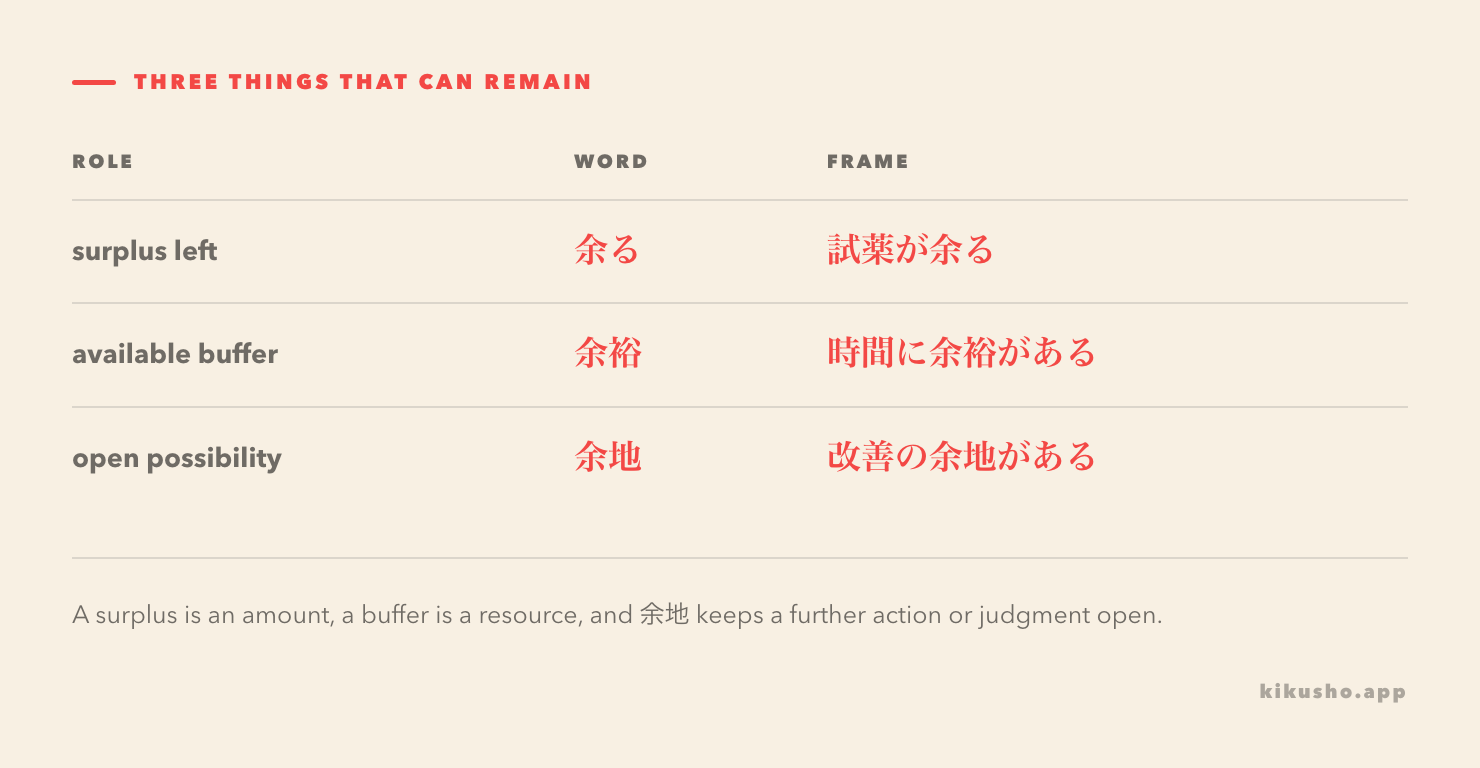
Compare three words built around something remaining:
- 試薬が余る: reagent is left over beyond what is needed.
- 時間に余裕がある: spare time or buffer is available.
- 手順には改善の余地がある: the procedure allows further improvement.
The N3 quantity lesson explains 余裕 as reserve before a limit. 余地 is less about possessing a resource and more about whether another move, judgment or possibility remains open.
Read the laboratory finding from subset to next action
検査対象の一部から微量の金属が検出されたが、基準を外れた製品は少数にとどまった。測定値は前回と若干異なるものの、結論を左右するほどではない。担当者は「あんまり変わらない」と説明したが、報告書では差を数値で示した。現時点で重大な危険を疑う余地はない一方、検査方法には改善の余地がある。最終報告書を一部、監査室に提出する。
けんさたいしょうの いちぶから びりょうの きんぞくが けんしゅつされたが、きじゅんを はずれた せいひんは しょうすうに とどまった。そくていちは ぜんかいと じゃっかん ことなるものの、けつろんを さゆうするほどでは ない。たんとうしゃは「あんまり かわらない」と せつめいしたが、ほうこくしょでは さを すうちで しめした。げんじてんで じゅうだいな きけんを うたがう よちは ない いっぽう、けんさほうほうには かいぜんの よちが ある。さいしゅうほうこくしょを いちぶ、かんさしつに ていしゅつする。
A trace amount of metal was detected in some of the samples, but only a small number of products fell outside the standard. The readings differ slightly from the previous results, though not enough to affect the conclusion. A staff member said conversationally that they had “not changed much,” but the report expressed the difference numerically. There is currently no room to suspect a serious danger, while the testing method does have room for improvement. One copy of the final report will be submitted to the audit office.
Save the complete frames in Kikusho rather than six English glosses: 一部から検出する, 少数にとどまる, 若干異なる, 微量の金属, あんまり変わらない and 改善の余地がある preserve the evidence needed to choose naturally.
Why this set appears at N1 in Kikusho
Kikusho's September 2026 reference snapshot files these six exact spelling-and-reading records under N1 without a recorded disagreement. Two baseline rows derive from the same Waller/Tanos family, so they supply one lineage rather than independent confirmation. A separately maintained N1 index also lists examples including 一部, 少数 and 余地.
Several surface forms are common below N1; the advanced work lies in reading dense prose, controlling register and resolving frames such as 報告書を一部 versus 報告書の一部. The JLPT organisation's FAQ explains why it does not release a fixed vocabulary list. The N1 label therefore records this curriculum's study placement, while the dictionary evidence above supports the actual language claims.
Practice: audit each quantity claim before opening the findings
1 · Reading under approximation. Choose the reading of 若干異なる.
A. わかせん
B. じゃくかん
C. じゃっかん
D. にゃっかん
2 · Reading remaining scope. Choose the reading of 改善の余地.
A. よち
B. よじ
C. あまち
D. よどころ
The next line moves from sound to the kanji used for a measurable trace.
3 · Trace spelling. Select the written form for びりょう, an extremely small amount.
A. 美量
B. 未量
C. 尾量
D. 微量
4 · Same reading, different evidence. The report says only a few products were affected, not that it is displaying a decimal. Select the correct pair.
A. 小数の製品 / 少数点
B. 少数の製品 / 小数点
C. 少数の製品 / 少数点
D. 小数の製品 / 小数点
5 · Subset frame. Only some samples contained the substance. Complete 検体_から検出された.
A. の一部
B. を一部
C. の微量
D. を若干
6 · Copy counter. The audit office needs one complete copy, not an excerpt. Complete 報告書_提出する.
A. の一部を
B. の少数を
C. を一部
D. を余地
7 · Formal degree. A written report leaves the small difference unspecified. Only one line belongs in the written findings.
A. 測定値は少数異なります。
B. 測定値は一部異なりますほど。
C. 測定値は微量名異なります。
D. 測定値は前回と若干異なります。
8 · Register control. A colleague speaking casually says the results did not change very much. Choose the natural line.
A. 結果は余地変わらないね。
B. 結果はあんまり変わらないね。
C. 結果は少数変わらないね。
D. 結果は一部変わらないね。
9 · Paraphrase the opening. What does 再考の余地がある assert?
A. Some complete copies remain.
B. A trace substance was found.
C. Reconsideration is still possible.
D. The minority opinion is decisive.
10 · Evidence logic. Which sentence keeps count, amount and scope in their proper roles?
A. 少数の検体から微量の物質が検出され、手順には改善の余地がある。
B. 微量の検体から少数の物質が検出され、手順には一部がある。
C. 若干名の金属から余地の製品が検出され、手順には少数がある。
D. 一部名の検体からあんまりの物質が検出され、手順には微量がある。
The answer record below follows the report's own sequence: identify the set, classify its size, measure the substance, then decide what remains possible.
Answers and explanations
Use the noun and particle as evidence before relying on an English translation.
- C. 若干 is read じゃっかん; the small っ belongs in both speech and kana representation.
- A. 余地 is read よち and names room for an action, judgment or possibility.
- D. 微量 begins with 微, the kanji associated with minuteness and trace degree.
- B. 少数の製品 describes few products; 小数点 is a decimal point.
- A. 検体の一部 selects a subset of the full sample set, and から marks that subset as the source.
- C. 報告書を一部提出する uses 一部 as the counter for one complete copy.
- D. 若干異なる is the established formal frame for differing by a modest unspecified degree.
- B. あんまり…ない naturally lowers the degree in conversation: not very different.
- C. 再考の余地がある keeps reconsideration open as a possible next action.
- A. 少数 counts the samples, 微量 measures the substance, and 余地 leaves scope to improve the procedure.
Common questions
What is the difference between 報告書の一部 and 報告書を一部?
報告書の一部 means one part or excerpt of the report. 報告書を一部 uses 部 as a counter and asks for one complete copy of the report.
What is the difference between 少数 and 小数?
Both are read しょうすう. 少数 means a small number or minority of countable members. 小数 is a decimal, such as 0.25, and uses the kanji 小 for small rather than 少 for few.
What is the difference between 若干 and 微量?
若干 leaves a small number or degree unspecified and can modify people, changes or differences. 微量 is an extremely small physical quantity, especially a substance or component that can be detected or measured.
What is the difference between 余地 and 余裕?
余地 is scope or an opening for another action, judgment or interpretation. 余裕 is spare time, money, capacity or composure already available before a limit is reached.