On this page
These twelve words describe how formal decisions move between people and institutions. Someone 申し出る, an organization makes a 要請, a superior issues a 指示 or 指令, and the receiving side may give 承諾, 同意, 了解 or 了承—or answer with 拒否 or 拒絶.
Despite “promises” in the curriculum title, this assigned list does not contain 約束(やくそく). Its subject is institutional requests, instructions, acceptance and rejection.
Twelve words map a formal decision
| Headword | Reading | Grammar | Core role | Anchor phrase |
|---|---|---|---|---|
| 拒絶 | きょぜつ | Noun / する | reject; shut out | 要求を拒絶する |
| 拒否 | きょひ | Noun / する | refuse; deny | 入場を拒否する |
| 禁ずる | きんずる | Transitive verb | forbid; suppress | 使用を禁ずる |
| 指示 | しじ | Noun / する | indicate; instruct | 指示に従う |
| 承諾 | しょうだく | Noun / する | accept a request or offer | 承諾を得る |
| 指令 | しれい | Noun / する | authoritative directive | 指令を出す |
| 同意 | どうい | Noun / する | agree; give consent | 提案に同意する |
| 申出 | もうしで | Noun | offer; request; report | 援助の申し出 |
| 申し出る | もうしでる | Ichidan verb | come forward with an offer or request | 協力を申し出る |
| 要請 | ようせい | Noun / する | formally request needed action | 支援を要請する |
| 了解 | りょうかい | Noun / する | understand and acknowledge | 事情を了解する |
| 了承 | りょうしょう | Noun / する | understand circumstances and accept | 了承を得る |
Learn the particle with the word. A proposal takes に in 提案に同意する; a request takes を in 依頼を承諾する; the person whose acceptance is needed takes の in 本人の了承を得る.
申し出る starts with the person who comes forward
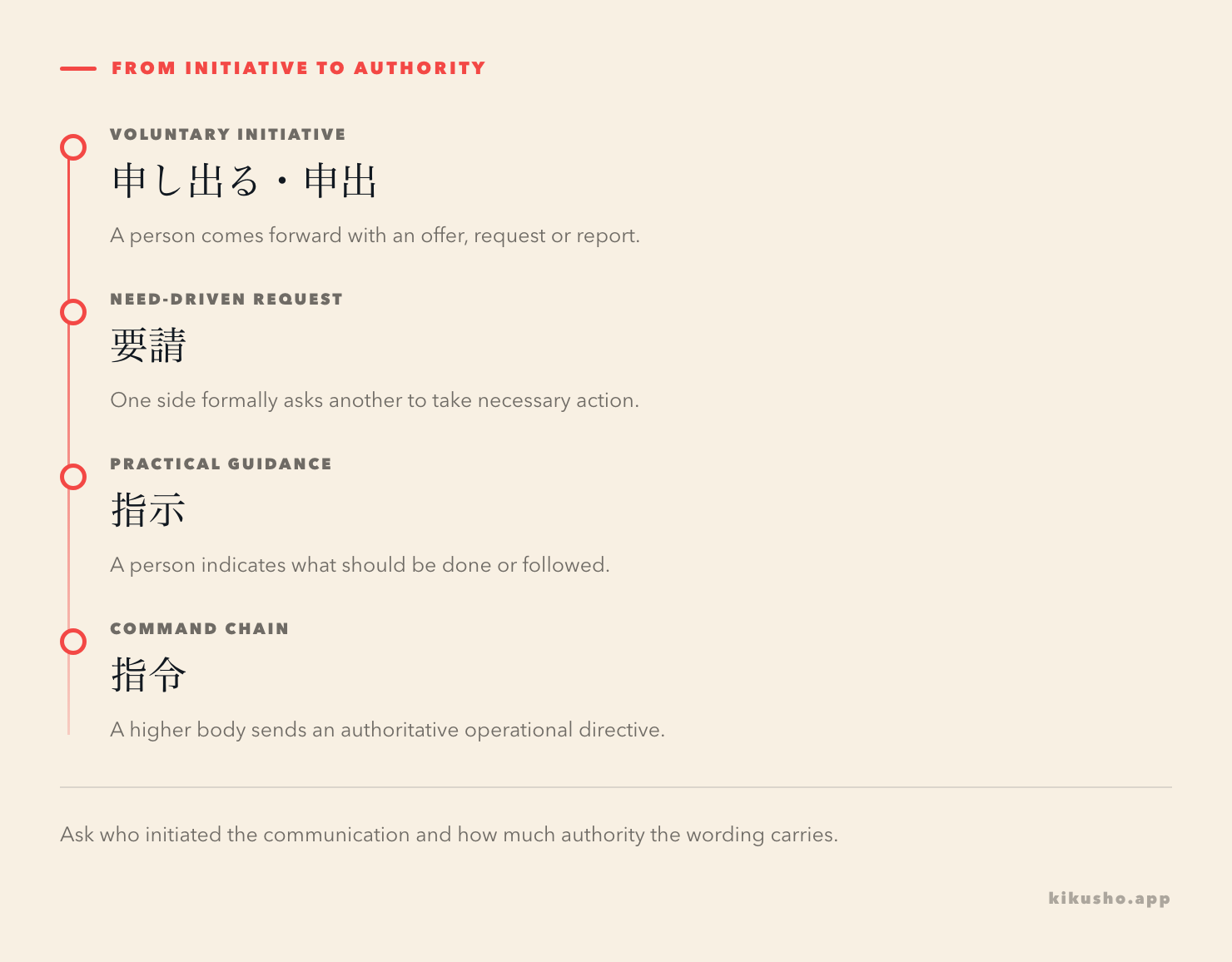
申し出る(もうしでる) describes voluntarily making an offer, request, report or claim known to the relevant person. The subject initiates the contact rather than merely answering a question.
事故を目撃した乗客が、警察への協力を申し出た。
じこを もくげきした じょうきゃくが、けいさつへの きょうりょくを もうしでた。
A passenger who witnessed the accident offered to cooperate with the police.
Common frames include 援助を申し出る, offer help; 辞任を申し出る, tender one's resignation; and 担当者に面会を申し出る, request a meeting with the person in charge. The object reveals who benefits.
申出(もうしで) is the corresponding noun. Ordinary prose often writes it with kana as 申し出, while official forms and legal headings frequently use the compact spelling 申出. Shogakukan's entry records both an offer or proposal and a report, request or claim made to another party.
会社は、社員からの在宅勤務の申し出を受けた。
かいしゃは、しゃいんからの ざいたくきんむの もうしでを うけた。
The company received an employee's request to work from home.
要請 is a need-driven request from one side to another
要請(ようせい)する asks another party to take action because the speaker or institution considers that action necessary. It often appears in news, administration and organizational communication: 政府に支援を要請する, 企業に改善を要請する, 住民に避難を要請する.
市は鉄道会社に対し、終電の延長を要請した。
しは てつどうがいしゃにたいし、しゅうでんの えんちょうを ようせいした。
The city formally requested that the railway company extend the last-train service.
Shogakukan defines it around strongly requesting the realization of something considered necessary. That does not automatically make every 要請 legally binding. It names a strong, formal request; the surrounding law, role or policy determines whether the recipient must comply.
Compare 住民が支援を申し出る, residents offer assistance, with 市が住民に支援を要請する, the city calls on residents to assist. The noun appears in 住民から支援の申し出がある.
指示 guides an action; 指令 carries institutional authority
指示(しじ) has two connected senses. It can point something out or indicate it, and it can tell someone what to do. In workplace and procedural scenes, learn 指示を出す, give instructions; 指示に従う, follow instructions; and 指示を仰ぐ, ask a superior for instructions.
担当者の指示に従って、申請書を修正してください。
たんとうしゃの しじに したがって、しんせいしょを しゅうせいして ください。
Please revise the application form according to the staff member's instructions.
The dictionary entry connects showing something clearly with directing another person.
指令(しれい) is more institutional. A higher authority sends a directive to a subordinate body, unit, operator or system. Natural collocations are 指令を出す/下す, issue a directive; 指令を受ける, receive it; and 指令に従う, comply with it.
本部は現地の部隊に、直ちに撤退するよう指令を出した。
ほんぶは げんちの ぶたいに、ただちに てったいするよう しれいを だした。
Headquarters directed the unit on the ground to withdraw immediately.
Shogakukan emphasizes an order from a superior organization to a subordinate one. A manager may give routine 指示; emergency headquarters may send a 指令 through a command chain.
禁ずる marks a formal prohibition
禁ずる(きんずる) is a formal transitive verb meaning to forbid or suppress. It is the literary or official-looking sibling of 禁じる and appears in rules such as 無断転載を禁ずる, unauthorized reproduction prohibited, and 関係者以外の立入りを禁ずる, entry by unauthorized persons prohibited.
規則は、職員が個人情報を外部に持ち出すことを禁じている。
きそくは、しょくいんが こじんじょうほうを がいぶに もちだすことを きんじている。
The rules prohibit staff from taking personal information outside.
Running text normally inflects the modern 禁じる stem: 禁じない, 禁じて, 禁じた. Shogakukan also records 感情を禁じ得ない, being unable to suppress a feeling.
判決を聞いて、驚きを禁じ得なかった。
はんけつを きいて、おどろきを きんじえなかった。
On hearing the verdict, I could not suppress my surprise.
The N3 lesson on requests, commands and permission teaches the broader noun 禁止, the verb 命じる and the noun 命令. This N1 set adds formal written 禁ずる and separates an everyday instruction from an institutional 指令.
Four words can look like “agreement” in English
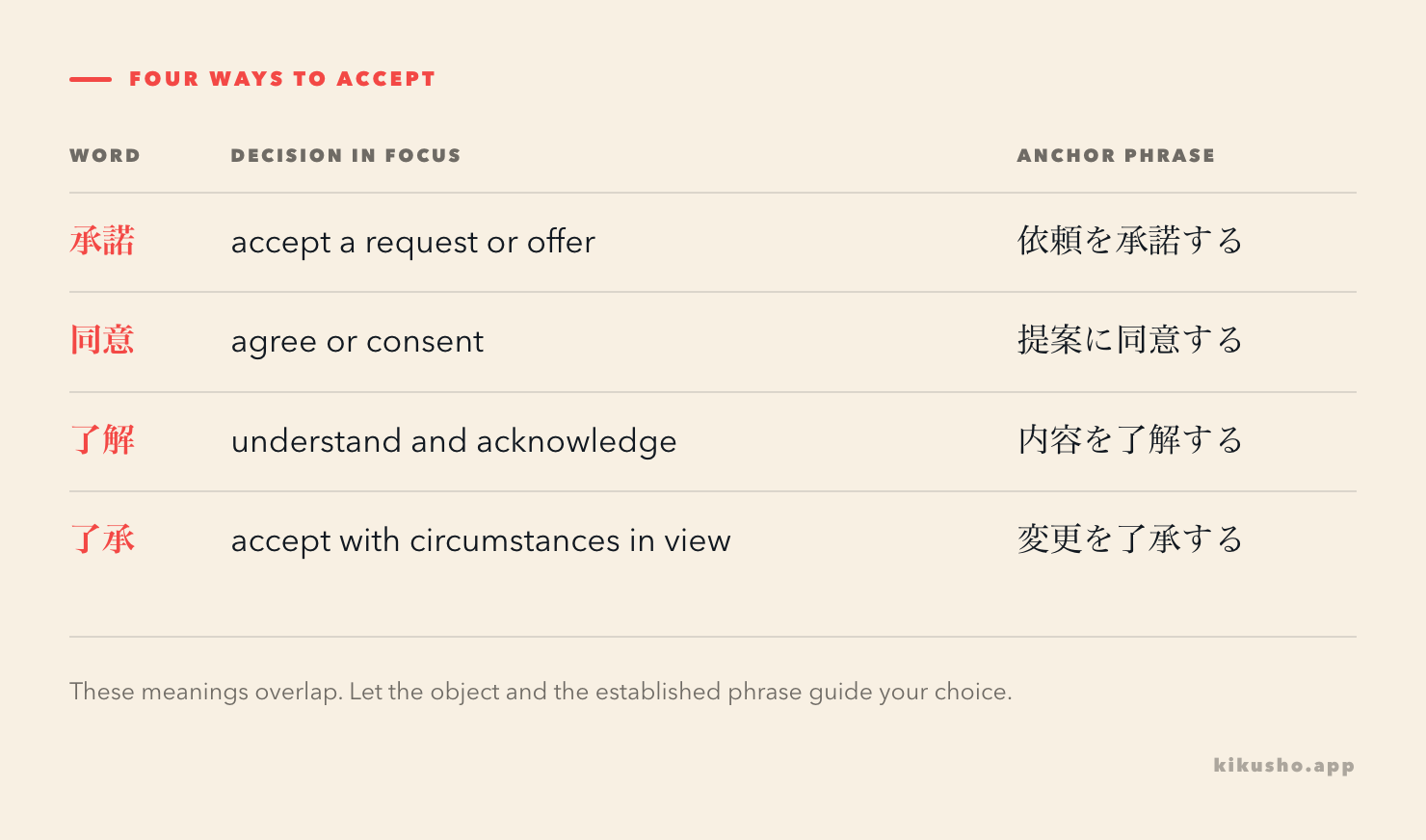
承諾, 同意, 了解 and 了承 overlap, but they do not frame the decision in the same way. First identify what is being accepted: a request, an opinion, an act requiring consent, information, or circumstances the other party should take into account.
| Word | What the decision foregrounds | Typical phrase |
|---|---|---|
| 承諾 | accepting another person's request or offer | 依頼を承諾する |
| 同意 | sharing a view or consenting to a proposal or act | 計画に同意する |
| 了解 | understanding and acknowledging information or arrangements | 内容を了解する |
| 了承 | understanding circumstances and accepting the resulting condition | 変更を了承する |
承諾 accepts a request or offer
承諾(しょうだく) presents one party as accepting what another party has asked or proposed. Learn 承諾を得る, obtain permission or acceptance; 依頼を承諾する, accept a request; and 本人の承諾なしに, without the person's consent.
著者の承諾を得て、記事の一部を転載した。
ちょしゃの しょうだくを えて、きじの いちぶを てんさいした。
We reproduced part of the article with the author's permission.
Kanjipedia and Shogakukan center on hearing and accepting another party's request. In contracts, 承諾 can conclude an agreement.
同意 agrees with a view or gives consent
同意(どうい) can mean sharing another person's opinion—提案に同意する, agree with a proposal—or authorizing an act that requires consent—治療に同意する, consent to treatment. It also appears in 同意書, consent form, and 本人の同意, the person's consent.
委員の過半数が新しい方針に同意した。
いいんの かはんすうが あたらしい ほうしんに どういした。
A majority of the committee members agreed to the new policy.
Shogakukan also records “same meaning”: 同意語 is a synonym, whereas 計画への同意 is agreement with a plan.
了解 acknowledges after understanding
了解(りょうかい) combines comprehension with acknowledgement or acceptance. Radio communication uses 了解, “roger”; organizations use 事情を了解する and 了解を得る; 暗黙の了解 is a tacit understanding.
条件は了解しました。正式な回答は明日お送りします。
じょうけんは りょうかいしました。せいしきな かいとうは あす おおくりします。
I understand the conditions. I will send our formal response tomorrow.
Understanding need not grant the final request: this speaker acknowledges the conditions but postpones a decision. The Shogakukan synonym guide preserves that focus on comprehension and recognition.
了承 accepts with the circumstances in view
了承(りょうしょう) asks the listener to understand a circumstance and accept what follows from it. That is why notices so often use ご了承ください, “please understand/accept this in advance,” and procedures use 了承を得る or 了承済み.
天候により予定が変更される場合がありますので、あらかじめご了承ください。
てんこうにより よていが へんこうされる ばあいが ありますので、あらかじめ ごりょうしょうください。
Please be aware that the schedule may change because of the weather.
Shogakukan defines it as understanding and accepting the circumstances. A notice seeks acceptance of a condition, not mere comprehension.
Real documents combine the four: someone may 説明を了解した上で治療に同意する, understand the explanation and then consent to treatment.
拒否 refuses; 拒絶 presents a stronger shutting out
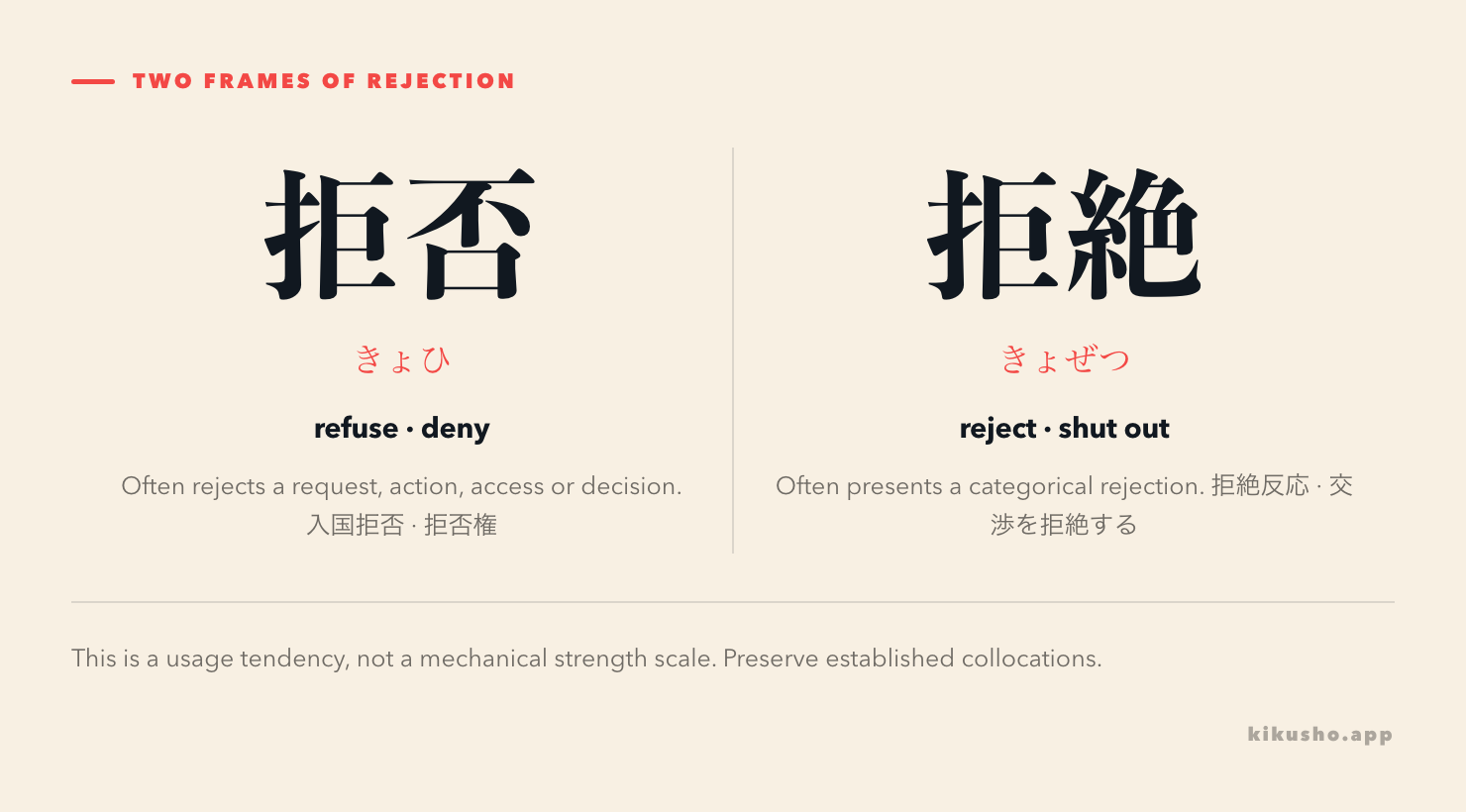
拒否(きょひ) commonly refuses a request, proposal, access, action or decision. Its compact collocations include 要求を拒否する, reject a demand; 回答を拒否する, refuse to answer; 入場を拒否する, deny entry; and 拒否権, veto power.
会社は、根拠が不十分だとして返金の要求を拒否した。
かいしゃは、こんきょが ふじゅうぶんだとして へんきんの ようきゅうを きょひした。
The company rejected the refund request on the grounds that the evidence was insufficient.
拒絶(きょぜつ) often presents the rejection as more categorical: the other party, proposal or outside influence is shut out. It also extends beyond deliberate decisions in fixed expressions such as 拒絶反応, rejection reaction, including the body's rejection of transplanted tissue.
交渉団は、条件を修正する余地さえないとして提案を拒絶した。
こうしょうだんは、じょうけんを しゅうせいする よちさえ ないとして ていあんを きょぜつした。
The negotiating team rejected the proposal outright, saying there was not even room to revise the terms.
Shogakukan includes the biological use. The contrast is a tendency, not a strength scale: 入国拒否, 拒否権 and 拒絶反応 are fixed collocations.
One emergency decision uses all twelve words
Read the flow as a chain of participants rather than twelve isolated translations.
大雨で道路が寸断されたため、市は自衛隊に救助を要請した。民間会社からは車両を提供したいとの申出があり、担当者も協力を申し出た。対策本部は現場に避難経路を確保するよう指令を出し、職員には住民を安全な場所へ誘導するよう指示した。同時に、危険区域への立入りを禁じた。土地の使用について所有者の承諾を得た後、関係機関も計画に同意した。現場は変更点を了解し、住民にも交通規制を了承してもらった。一部の会社は追加の車両提供を拒否したが、救助計画そのものを拒絶したわけではなかった。
The chain moves from 要請, 申出 and 申し出る to 指令, 指示 and 禁ずる. Its responses then separate 承諾, 同意, 了解, 了承, 拒否 and 拒絶 by their object and decision frame.
The N1 label is a study sequence, not an official list
The retained Waller/Tanos baseline records place all twelve items at N1. Independent resources do not draw the boundary identically: Bunpro currently teaches 拒否, 拒絶, 指令 and 承諾 in N1 vocabulary, while it places 同意, 了解 and 了承 in N2 material.
Since the 2010 revision, the JLPT's own FAQ says no exhaustive word, kanji or grammar specification is issued. Use N1 here as a study estimate and focus on who initiates the decision, what is accepted and how much authority the wording carries.
Practice: twelve decisions
Complete every question before opening the single answer panel.
1 · Kanji reading. Which reading belongs to 拒絶?
- ① きょぜつ
- ② きょせつ
- ③ こぜつ
- ④ きょうぜつ
2 · Choose the written noun. Which word is read もうしで and means an offer, request or report made to another party?
- ① 申出
- ② 指令
- ③ 要請
- ④ 了承
3 · Who initiates it? Choose the pair.
住民が空き部屋の提供を( 前 )。市はホテルに避難者の受入れを( 後 )した。
- ① 前 要請した / 後 申し出た
- ② 前 申し出た / 後 要請した
- ③ 前 了承した / 後 拒絶した
- ④ 前 指示した / 後 同意した
4 · Instruction or directive? Headquarters sends an authoritative operational order to regional units. Which noun fits best?
- ① 申出
- ② 承諾
- ③ 指令
- ④ 了解
5 · Formal prohibition. Complete the notice: 関係者以外の立入りを__。
- ① 同意する
- ② 禁ずる
- ③ 申し出る
- ④ 了承する
6 · Accept a request. The publisher asks the author for permission to reproduce a diagram and obtains it. Which phrase describes the result?
- ① 著者の承諾を得る
- ② 著者の指令を拒否する
- ③ 著者の了解を禁ずる
- ④ 著者の申出に指示する
7 · Agree with a proposal. Complete: 委員の全員が改革案__同意した。
- ① を
- ② で
- ③ に
- ④ から
8 · Acknowledge a message. Which reply most naturally means “Understood; I will proceed as instructed” in operational communication?
- ① 拒絶しました。指示どおり進めます。
- ② 了解しました。指示どおり進めます。
- ③ 禁じました。指示どおり進めます。
- ④ 申し出ました。指示どおり進めます。
9 · Accept the circumstances. A notice warns that delivery may be delayed by weather. Which request fits?
- ① あらかじめご了承ください
- ② あらかじめご指令ください
- ③ あらかじめご拒否ください
- ④ あらかじめお申し出ください
10 · Refusal or rejection. Choose the established pair.
ビザの条件を満たさず入国( 前 )となった。移植後に( 後 )反応が起きた。
- ① 前 拒絶 / 後 拒否
- ② 前 了承 / 後 同意
- ③ 前 拒否 / 後 拒絶
- ④ 前 指示 / 後 要請
11 · Interpret 禁じ得ない. What does 事故の映像を見て、怒りを禁じ得なかった mean?
- ① The speaker was forbidden to watch the footage.
- ② The speaker could not suppress their anger.
- ③ The speaker agreed to hide the footage.
- ④ The speaker requested permission to become angry.
12 · Follow the whole decision. Choose the only coherent summary.
会社は提携を提案した。取締役会は内容を理解したが、条件には賛成せず、提案を受け入れなかった。
- ① 取締役会は内容を了解したが、条件に同意せず、提案を拒否した。
- ② 取締役会は内容を禁じたが、条件を指令し、提案を申し出た。
- ③ 取締役会は内容を要請したが、条件を了承し、提案を承諾した。
- ④ 取締役会は内容を拒絶したが、条件に同意し、提案を了解した。
Answers and explanations
①, きょぜつ. 拒 is read きょ here and 絶 is ぜつ. The word presents rejection or shutting something out.
①, 申出. The compact spelling appears especially in official headings; ordinary prose commonly writes 申し出. The verb is 申し出る.
②: 前 申し出た / 後 要請した. Residents voluntarily offer the rooms. The city formally asks a hotel to perform an action considered necessary.
③, 指令. The command moves from headquarters through an operational hierarchy. 指示 would be possible for instructions, but 指令 foregrounds the authoritative chain described here.
②, 禁ずる. 立入りを禁ずる is a formal notice prohibiting entry. In running text its inflected forms normally use the 禁じる stem.
①, 著者の承諾を得る. The author accepts another party's request, which is the central frame of 承諾.
③, に. A person agrees 提案に/改革案に同意する. The item receiving agreement takes に.
②, 了解しました. 了解 acknowledges the received information or instruction. The following sentence confirms compliance.
①, あらかじめご了承ください. The notice asks readers to understand the possible delay and accept that condition in advance.
③: 入国拒否 / 拒絶反応. These are established collocations. The answer does not imply that the two nouns can never overlap elsewhere.
②. 感情を禁じ得ない means that one cannot hold the feeling back. Here the footage made the speaker unable to suppress anger.
①. The board understands the content (了解) but does not agree with the conditions (同意せず) and refuses the proposal (拒否した). Comprehension alone does not guarantee acceptance.
Common questions
What is the difference between 承諾, 同意, 了解 and 了承?
承諾 accepts another person's request or offer; 同意 agrees with an opinion, proposal or act requiring consent; 了解 combines understanding with acknowledgement; 了承 accepts after taking the circumstances into account. The words overlap, so the noun being accepted and the conventional phrase matter more than a rigid one-word translation.
What is the difference between 拒否 and 拒絶?
拒否 commonly refuses a request, access, action or decision. 拒絶 often presents rejection as more categorical and also occurs in fixed expressions such as 拒絶反応. This is a tendency rather than an absolute boundary.
What is the difference between 指示 and 指令?
指示 can indicate something or tell someone what to do. 指令 is an authoritative directive, especially from a higher body to a subordinate organization, unit or system.
How are 申出 and 申し出る related?
申し出る is the verb for voluntarily coming forward with an offer, request or report. 申出, usually written 申し出 in ordinary prose, is the corresponding noun; the shorter spelling remains common in official and legal headings.