On this page
Japanese uses different words for meeting a difficulty, taking on a challenge, correcting a flaw, improving a situation, developing, and finally making a goal real. The eleven words in this N3 set form a path from 困難 to 実現, while also separating five kinds of “progress” that English often gives the same label.
The planned title says “effort,” but 努力(どりょく) is not one of the eleven assigned headwords. Here, effort appears through the actions 挑戦する, 克服する, 修正する, and 改善する; the lesson does not quietly add a twelfth coverage item.
The eleven words form a path, not a list of synonyms
| Headword | Grammar | Meaning in this lesson | Anchor phrase |
|---|---|---|---|
| 困難(こんなん) | Noun / な-adjective | difficulty; a hard situation | 困難に直面する |
| 挑戦(ちょうせん) | Noun / する | take on a hard or new challenge | 新しい課題に挑戦する |
| 克服(こくふく) | Noun / する | overcome a difficulty or weakness | 苦手を克服する |
| 修正(しゅうせい) | Noun / する | correct a specific defect or error | 計画を修正する |
| 改善(かいぜん) | Noun / する | make a bad or weak condition better | 手順を改善する |
| 上達(じょうたつ) | Noun / する | become better at a learned skill | 日本語が上達する |
| 進歩(しんぽ) | Noun / する | advance toward a better state | 技術が進歩する |
| 発達(はったつ) | Noun / する | develop through growth or function | 交通網が発達する |
| 発展(はってん) | Noun / する | advance, expand or prosper | 町が発展する |
| 拡大(かくだい) | Noun / する | become or make larger in scale | 市場を拡大する |
| 実現(じつげん) | Noun / する | make an idea, plan or dream real | 目標を実現する |
All eleven are nouns, and ten commonly combine with する. 困難 also works as a な-adjective: 困難な課題, “a difficult task.” Several can be transitive or intransitive according to the sentence: a company can 市場を拡大する, while 市場が拡大する says the market expands.
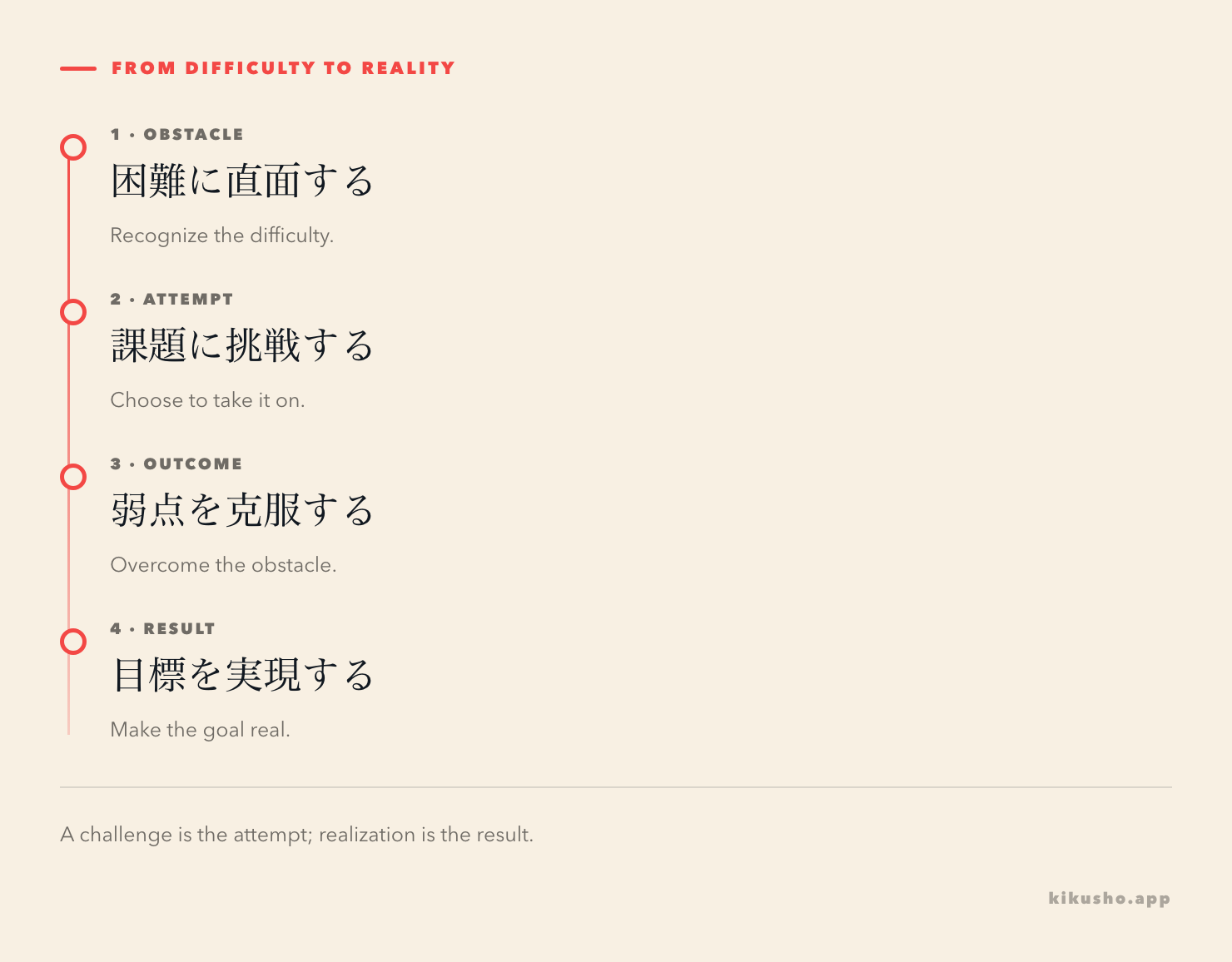
困難 is the obstacle, 挑戦 is the attempt, and 克服 is the outcome
These three words describe different positions around a hard task. 困難(こんなん) names the difficulty or says that something is very hard to do. Shogakukan's definition gives both the noun and adjectival use.
計画は予算の不足という困難に直面した。
けいかくは よさんの ふそくという こんなんに ちょくめんした。
The project faced the difficulty of an insufficient budget.
Useful patterns are 困難に直面する, 困難を乗り越える, and 実現は困難だ. The word can describe a situation without saying whether anyone chooses to act.
挑戦(ちょうせん) is the deliberate act of confronting a contest, an unfamiliar task or a difficult goal. Dictionaries give Nに挑戦する, with the target marked by に: the entry for 挑戦 includes both challenging an opponent and taking on a difficult undertaking.
チームは少ない予算で新しい機能の開発に挑戦した。
チームは すくない よさんで あたらしい きのうの かいはつに ちょうせんした。
The team took on the challenge of developing a new feature with a small budget.
克服(こくふく) looks back at a successful struggle. It takes the obstacle with を: 弱点を克服する, 困難を克服する, 病気を克服する. The dictionary definition explicitly includes overcoming difficulty through effort.
毎日発表を練習し、人前で話す苦手意識を克服した。
まいにち はっぴょうを れんしゅうし、ひとまえで はなす にがていしきを こくふくした。
By practising presentations every day, I overcame my discomfort with public speaking.
A 挑戦 can fail, so it does not imply 克服. A 困難 can remain untouched, so it does not imply 挑戦. Read them as obstacle, attempt and successful overcoming.
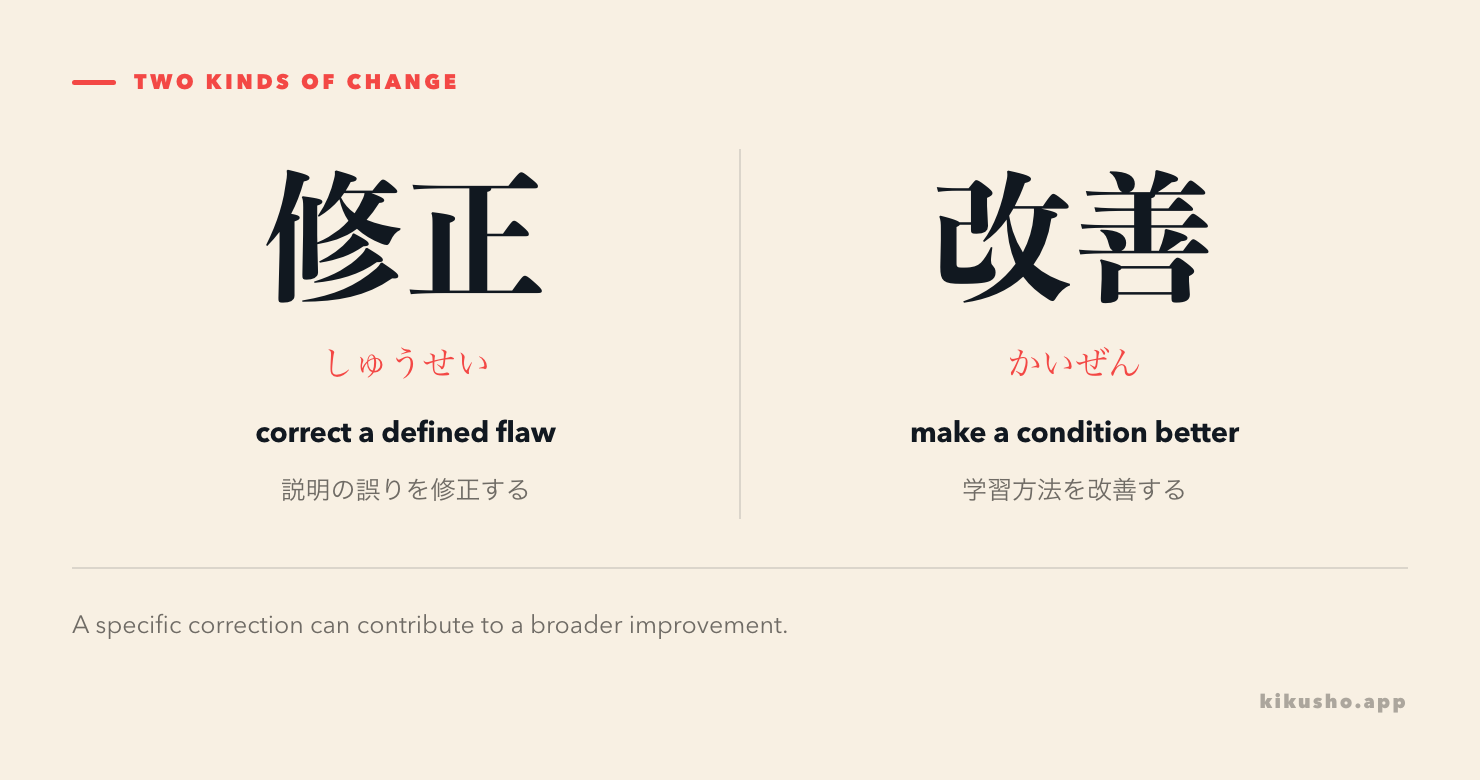
修正 fixes a point; 改善 makes the whole condition better
Both words may become “improve,” “fix,” or “revise” in English. The deciding question is whether the sentence points to a specific inadequate part or evaluates the resulting condition.
修正(しゅうせい) corrects something insufficient, unsuitable or wrong. Shogakukan's entry mentions texts, opinions, plans and proposals as common objects.
説明の誤りを修正して、日付も書き直した。
せつめいの あやまりを しゅうせいして、ひづけも かきなおした。
I corrected the error in the explanation and rewrote the date too.
Use 文章を修正する, 予定を修正する, 修正案, and 軌道修正 when a defined element is being changed. The original need not be completely useless; one part may simply be inaccurate.
改善(かいぜん) evaluates movement from a bad or unsatisfactory state toward a better one. The dictionary entry defines it as changing a bad aspect for the better.
入力項目を減らして、申込手続きを改善した。
にゅうりょくこうもくを へらして、もうしこみてつづきを かいぜんした。
We improved the application process by reducing the number of input fields.
The same project can use both words. First the team 説明の誤りを修正する; after measuring fewer user mistakes, it can say 手続きを改善した. Correction names the targeted edit. Improvement names the better condition.
The meetings and projects vocabulary lesson supplies the planning context around this pair, including 改善案を提案する, “propose an improvement plan.”
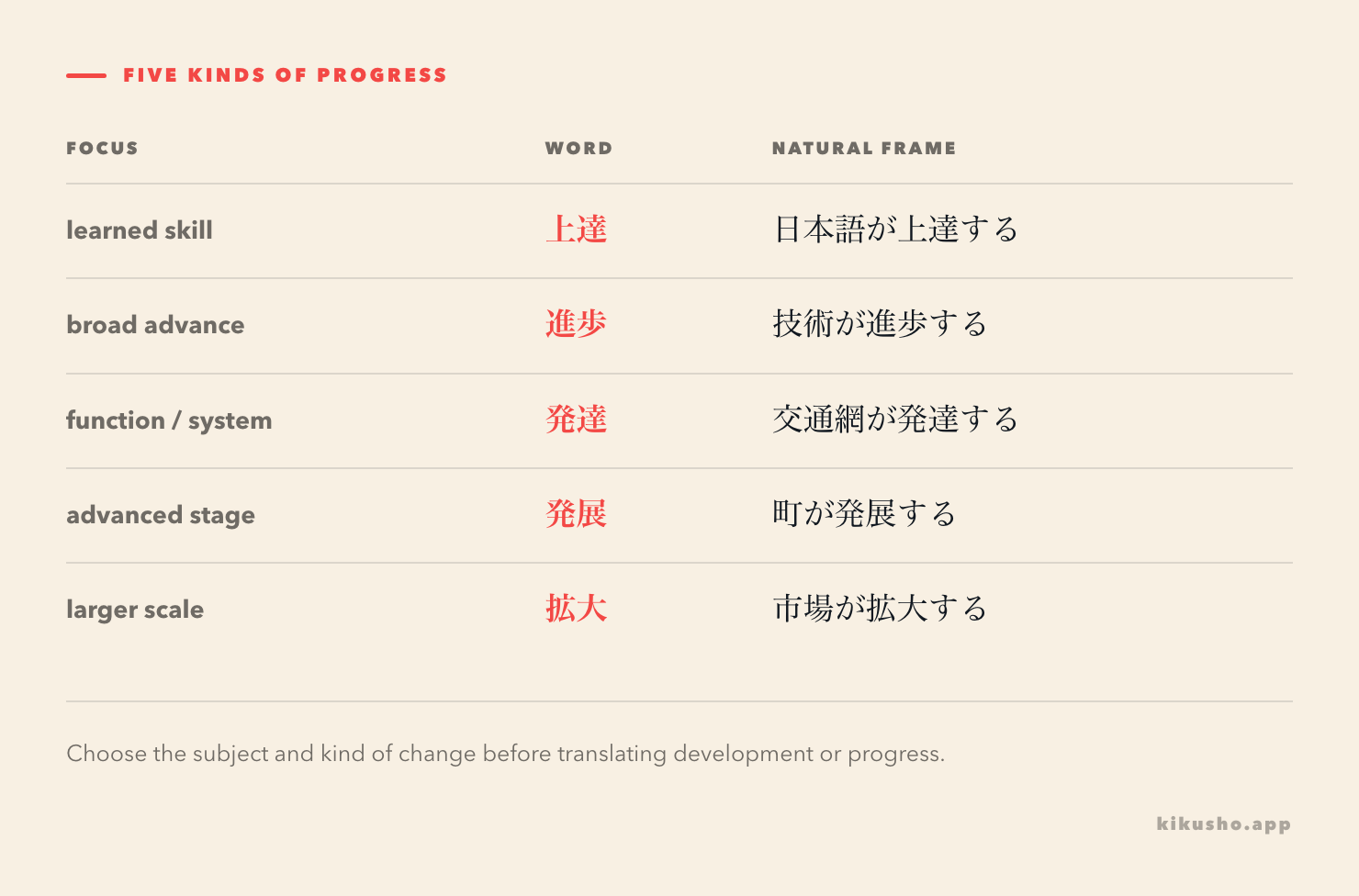
上達 belongs to skills; 進歩 describes broader advancement
上達(じょうたつ) says that a learned skill has become better through practice or experience. The subject marked by が is usually the skill: 日本語が上達する, 料理が上達する, テニスが上達する. The dictionary entry centers on acquiring and improving an art or technique.
毎週会話を録音したら、発音が少しずつ上達した。
まいしゅう かいわを ろくおんしたら、はつおんが すこしずつ じょうたつした。
After recording a conversation every week, my pronunciation gradually improved.
進歩(しんぽ) is wider. It describes movement toward a better or more advanced state in technology, medicine, knowledge, society or someone's work. Shogakukan contrasts it with 退歩, regression, and gives 技術が進歩する.
医療技術の進歩によって、治療の選択肢が増えた。
いりょうぎじゅつの しんぽによって、ちりょうの せんたくしが ふえた。
Advances in medical technology increased the treatment options.
You may hear 日本語が進歩した, but 上達した is the more focused choice when the point is a person's language skill. Conversely, 科学が上達した sounds wrong because science is not a practised personal skill. The linked-change lesson shows how 技術が進歩するにしたがって connects that advancement to another change.
発達, 発展 and 拡大 answer three different questions
The three can all translate as “development” or “expansion,” but their typical subjects reveal the difference.
発達(はったつ) asks whether a body, ability, function, network or system has grown and become more developed. Dictionaries include physical and mental growth, advancement toward a developed stage, and even a storm increasing in scale. Natural combinations include 子どもの発達, 筋肉が発達する, 交通網が発達する, and 発達した低気圧. The Kotobank entry records these growth and functional-development senses.
この地域は鉄道網が発達していて、車がなくても移動しやすい。
この ちいきは てつどうもうが はったつしていて、くるまが なくても いどうしやすい。
This region has a well-developed railway network, so it is easy to get around without a car.
発展(はってん) asks whether something has moved into a more advanced, extensive or prosperous stage. Towns, economies, industries, relations, discussions and events can 発展する. Shogakukan gives both becoming more prosperous and moving to a further stage.
駅ができてから、町は商業の中心として発展した。
えきが できてから、まちは しょうぎょうの ちゅうしんとして はってんした。
After the station was built, the town developed as a commercial centre.
拡大(かくだい) asks only whether the scale, area, amount or influence becomes larger. It can be neutral or negative: 画面を拡大する, 市場が拡大する, 被害が拡大する. The dictionary definition covers both making something larger and something growing larger.
利用者が増えたため、会社はサービスの対象地域を拡大した。
りようしゃが ふえたため、かいしゃは サービスの たいしょうちいきを かくだいした。
Because the number of users increased, the company expanded the service area.
A railway network can be 発達している because its connections and function are well developed. The town around it can 発展する into a commercial centre. The service area can 拡大する from one district to three. Growth in size alone does not prove improvement: damage can also 拡大する.
実現 is the point where a plan or dream becomes real
実現(じつげん) describes an idea, hope, plan, goal or desired condition becoming reality. The goal can be the object of a person's action or the subject of the change:
- 夢を実現する — realize a dream
- 計画を実現する — make a plan happen
- 夢が実現する — a dream comes true
- 実現可能だ — be feasible or realizable
多くの人の協力によって、無料教室を開くという目標が実現した。
おおくの ひとの きょうりょくによって、むりょうきょうしつを ひらくという もくひょうが じつげんした。
With many people's cooperation, the goal of opening a free class became a reality.
Shogakukan's Japanese–English entry gives both 夢が実現した and 計画が実現した. The word marks the result, not every step before it. A project may show 進歩 without yet reaching 実現.
The N3 label is a study estimate, especially for 挑戦
Ten words are consistently placed at N3 by the reference rows used for this lesson. 挑戦 is disputed: one baseline puts it at N3, while another baseline and JapaneseTest4You put it at N1. The two baseline lists descend from the same Waller source family, so their labels are not independent votes.
The official JLPT FAQ explains that the former Test Content Specifications with vocabulary, kanji and grammar lists are no longer published. No current official exhaustive list settles the boundary. Learn 挑戦 here because the common frame Nに挑戦する belongs naturally in this practical set, while remembering that another study resource may label it N1.
Kikusho works best when each card keeps the noun, particle and verb together. Save 課題に挑戦する, 弱点を克服する, 手順を改善する, and 夢を実現する rather than four isolated English translations. The surrounding relation is what lets you retrieve the right word later.
Practice: ten questions
Answer all ten before opening the solutions.
1 · Decode 克服. Select its correct reading.
- ① かくふく
- ② こくふく
- ③ こくふう
- ④ かっぷく
2 · Rebuild かくだい. Choose the kanji in サービスの たいしょうを かくだいする.
- ① 格大
- ② 各大
- ③ 拡大
- ④ 確大
3 · A defined problem. Choose the word that completes the sentence.
報告書の日付が間違っていたので、すぐに__した。
- ① 修正
- ② 発達
- ③ 上達
- ④ 実現
4 · Three stages. Choose the order that moves from obstacle, to attempt, to successful overcoming.
- ① 克服 → 困難 → 挑戦
- ② 挑戦 → 克服 → 困難
- ③ 困難 → 挑戦 → 克服
- ④ 困難 → 克服 → 挑戦
5 · A learned skill. Choose the natural completion.
毎日練習したので、会話がかなり__した。
- ① 拡大
- ② 上達
- ③ 発展
- ④ 実現
6 · A system, a town and an area. Choose the words for the three gaps.
鉄道網が( 甲 )し、町が観光地として( 乙 )したため、バスの運行地域も( 丙 )した。
- ① 甲 発達 / 乙 発展 / 丙 拡大
- ② 甲 発展 / 乙 拡大 / 丙 発達
- ③ 甲 拡大 / 乙 発達 / 丙 発展
- ④ 甲 上達 / 乙 進歩 / 丙 実現
7 · Paraphrase. What does 長年の夢が実現した mean here?
- ① The dream became harder to remember.
- ② The dream was corrected after many years.
- ③ The dream became reality after many years.
- ④ The dream expanded to include many people.
8 · Collocation. Which sentence uses its bold word naturally?
- ① 科学が毎日練習して上達した。
- ② 写真を二倍に拡大した。
- ③ 誤字に挑戦した。
- ④ 日本語を駅前に発展した。
9 · One project report. Choose the pair that preserves a targeted edit first and an overall better result second.
チームは画面の説明を( 前 )した。その結果、利用者の操作時間が短くなり、手続き全体が( 後 )した。
- ① 前 改善 / 後 修正
- ② 前 修正 / 後 改善
- ③ 前 克服 / 後 挑戦
- ④ 前 発達 / 後 実現
10 · Usage. Which sentence correctly marks the target of a challenge and the obstacle overcome?
- ① 新しい試験を挑戦し、緊張に克服した。
- ② 新しい試験で挑戦し、緊張が克服した。
- ③ 新しい試験に挑戦し、緊張を克服した。
- ④ 新しい試験が挑戦し、緊張で克服した。
Answers and explanations
Choice ②: こくふく. The compound combines the on-readings こく and ふく. 克服 means overcoming a difficulty, weakness or illness through effort.
③, 拡大. 拡大(かくだい) means making something larger or something becoming larger. Here the service's target scope is expanded.
①, 修正. The report contains a specific incorrect date, so 日付を修正する fits. 改善 would evaluate a broader condition or process rather than name this targeted correction.
③, 困難 → 挑戦 → 克服. 困難 is the obstacle. 挑戦 is the decision or attempt to face it. 克服 says the obstacle has been successfully overcome.
②, 上達. Conversation is a practised language skill, so 会話が上達する is natural. The other words describe growth in scale, broader development or a plan becoming real.
①, 発達 / 発展 / 拡大. A transport network becomes functionally developed, a town advances or prospers as a destination, and an operating area becomes larger.
③. 実現 says that an idea, plan, hope or dream has become real. 長年の identifies the long period during which the dream was held.
②, 写真を二倍に拡大した. 拡大 can describe magnifying an image. Science is not a personal skill that practises, 誤字 is corrected rather than challenged, and the final sentence gives 発展 an impossible object and location.
②, 修正 / 改善. The team first corrects the wording on a defined part of the screen. The shorter operation time then supports the broader judgment that the whole process improved.
③. The target of 挑戦する takes に, while the obstacle successfully overcome takes を: 試験に挑戦する and 緊張を克服する.
Common questions
What is the difference between 修正 and 改善?
修正 means correcting a specific error, weak point, plan or text. 改善 means making an unsatisfactory condition, process or result better. You can correct mistakes in a form and thereby improve the whole application process.
What is the difference between 上達 and 進歩?
上達 is improvement in a learned skill such as Japanese, cooking or tennis. 進歩 is broader forward movement toward a better state and often describes technology, medicine, knowledge or society.
What is the difference between 発達, 発展 and 拡大?
発達 focuses on growth or the development of a function or system. 発展 describes something advancing into a stronger or more prosperous stage. 拡大 simply says that its area, scale, quantity or influence becomes larger.
Is 挑戦 officially JLPT N3 vocabulary?
No official exhaustive JLPT vocabulary list exists. One reference list used by this curriculum places 挑戦 at N3, while another Waller-derived list and JapaneseTest4You place it at N1, so learners should treat the level as disputed rather than fixed.