On this page
These twelve N1 Japanese rights, duties and social-issues words let you read a policy report as a chain: migration changes households and generations, inequality distributes wealth unevenly, institutions bear responsibilities, and communities respond through compensation, service and fundraising. The difficult part is choosing between close words such as 世帯/世代, 富/富む, 貧困/貧乏, 責務/義務 and 募金/寄付.
Twelve N1 records connect social conditions with public action
| Word | Reading | Word class | Meaning here | Phrase to remember |
|---|---|---|---|---|
| 移民 | いみん, imin | noun | migration; an immigrant or emigrant | 移民を受け入れる: accept immigrants |
| 格差 | かくさ, kakusa | noun | disparity; a gap in level or outcome | 所得格差を是正する: correct income disparities |
| 責務 | せきむ, sekimu | noun | duty tied to responsibility | 責務を果たす: fulfil a responsibility |
| 世帯 | せたい, setai | noun | household | 単身世帯が増える: single-person households increase |
| 世代 | せだい, sedai | noun | generation; age cohort | 若い世代に伝える: pass on to younger generations |
| 富 | とみ, tomi | noun | wealth; riches | 富を築く: build wealth |
| 富む | とむ, tomu | intransitive verb | be rich in; be abundant in | 多様性に富む: be rich in diversity |
| 賠償 | ばいしょう, baishō | noun; suru verb | damages; reparation; compensation for harm | 損害賠償を請求する: claim damages |
| 貧困 | ひんこん, hinkon | noun; na-adjective | poverty; serious lack | 貧困に陥る: fall into poverty |
| 貧乏 | びんぼう, binbō | noun; na-adjective; suru verb | poverty; being poor | 貧乏な暮らし: a life with little money |
| 奉仕 | ほうし, hōshi | noun; suru verb | service; devotion to others or a cause | 社会に奉仕する: serve society |
| 募金 | ぼきん, bokin | noun; suru verb | fundraising; collection of funds | 募金を呼びかける: appeal for donations |
Kikusho's September 2026 reference audit assigns these twelve entries to N1 and records no conflicting placement. Its two main baselines descend from the same Waller/Tanos source family, so they are not independent confirmation. A current Shin Kanzen-based N1 social-issues unit independently places words such as 格差 and 貧困 in this study territory. The official JLPT does not publish an exhaustive current vocabulary list, which makes “N1” a practical study estimate rather than a guarantee about a particular test form.
The N3 rights and social-issues lesson supplies the prerequisite words 権利, 義務, 保障, 補償, 援助 and 寄付. This N1 set builds on those words instead of assigning them new competing definitions.
移民 is movement and a person, but not every foreign resident
移民(いみん) can name movement across national borders with the intention of settling, or a person who makes that move. English changes viewpoint between immigration and emigration; Japanese commonly keeps 移民 and lets the direction appear elsewhere in the sentence.
この地域は長年にわたり移民を受け入れてきた。
このちいきはながねんにわたりいみんをうけいれてきた。
This region has accepted immigrants for many years.
The dictionary entry includes both the act of moving and the people who move. Avoid treating it as a synonym for 外国人, foreign national, or 難民, refugee. Nationality, residence, motive and legal status answer different questions; the noun 移民 alone does not settle all four.
格差 names a structured gap, not every small difference
格差(かくさ) is a disparity in level, treatment, access or outcome. It is especially common when the difference is measurable, persistent or socially significant:
- 所得格差: income disparity
- 地域格差: regional disparity
- 教育格差: educational disparity
- 世代間格差: intergenerational disparity
The usual verbs reveal movement and policy: 格差が広がる/縮まる, a disparity widens or narrows; 格差を是正する, correct a disparity; 格差を生む, produce a disparity.
地域による教育格差を縮めるには、通信環境の整備も必要だ。
ちいきによるきょういくかくさをちぢめるには、つうしんかんきょうのせいびもひつようだ。
Improving digital access is also necessary to narrow regional disparities in education.
違い is the neutral everyday word for a difference. Calling something 格差 frames the difference as a gap along an implicit scale, often one that deserves explanation or response.
責務 adds role-based responsibility to a duty
責務(せきむ) combines duty with responsibility. It often belongs to institutional, professional and public prose: a government, company, officeholder or specialist has a responsibility because of the role it occupies. Natural patterns are 責務を負う, bear a responsibility; 責務を果たす, fulfil it; and 重大な責務, a grave responsibility.
行政には、住民に制度を分かりやすく説明する責務がある。
ぎょうせいには、じゅうみんにせいどをわかりやすくせつめいするせきむがある。
The public administration has a responsibility to explain the system clearly to residents.
The 責務 definition joins responsibility with a duty that must be carried out. The N3 word 義務(ぎむ) is broader and can arise from law, contract or social rules. 納税の義務 is the standard phrase for the obligation to pay tax; 報道機関の社会的責務 foregrounds the responsibility attached to the press's role. This is a register and emphasis distinction, not a rule that prevents overlap.
世帯 and 世代 answer different census questions
世帯(せたい) is a household: a person or group treated as one living unit. It is not automatically identical to 家族, family. A person living alone forms a 単身世帯, while relatives living separately can belong to different households. Official statistics use expressions such as 世帯主, head of household; 世帯員, household member; and 一世帯当たり, per household.
世代(せだい) is a generation. It can locate people within a family, as in 親の世代, the parents' generation, or within society, as in 若い世代, younger generations, and 同世代, the same age cohort.
三世代が同居しているが、家計は別なので二つの世帯として暮らしている。
さんせだいがどうきょしているが、かけいはべつなのでふたつのせたいとしてくらしている。
Three generations live in the same building, but they keep separate household finances and live as two households.
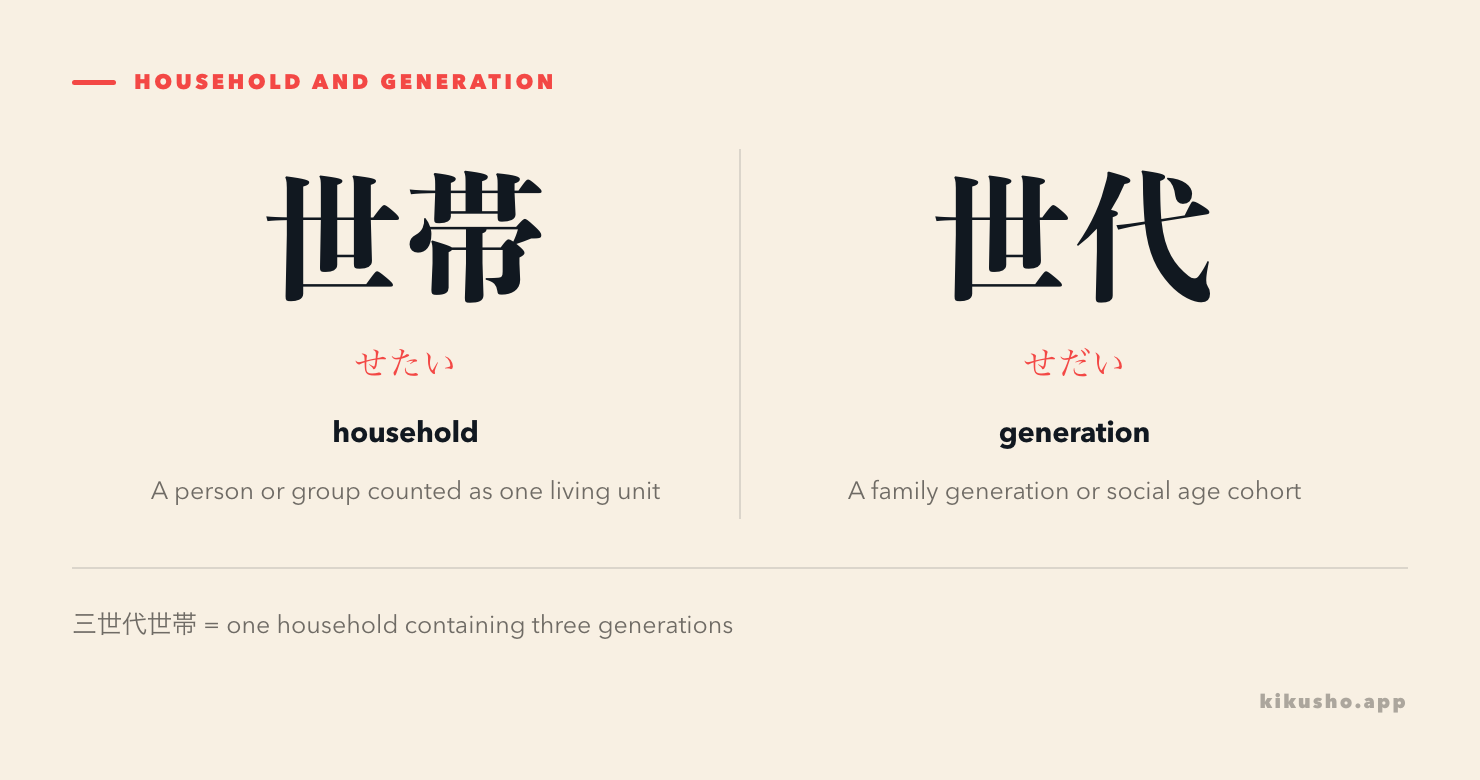
The Statistics Bureau's census guidance treats household composition as a living arrangement, while its three-generation household tables classify generational relationships within that unit. The compact phrase 三世代世帯 therefore means a three-generation household: 世代 describes who is represented, and 世帯 names the unit being counted.
富 is wealth; 富む describes what something is rich in
富(とみ) is the noun wealth or riches. It can be accumulated, possessed, distributed or lost: 富を築く, build wealth; 富を蓄える, accumulate wealth; 富を分配する, distribute wealth. In social commentary, 富の集中 is the concentration of wealth.
富む(とむ) is an intransitive verb. It can mean to be wealthy, but its most productive N1 pattern is Nに富む, to be rich in or endowed with N. The dictionary examples include richness in qualities such as intelligence and variation.
この地域は天然資源に富んでいる。
このちいきはてんねんしげんにとんでいる。
This region is rich in natural resources.
変化に富んだ議論だった。
へんかにとんだぎろんだった。
It was a discussion rich in variety.
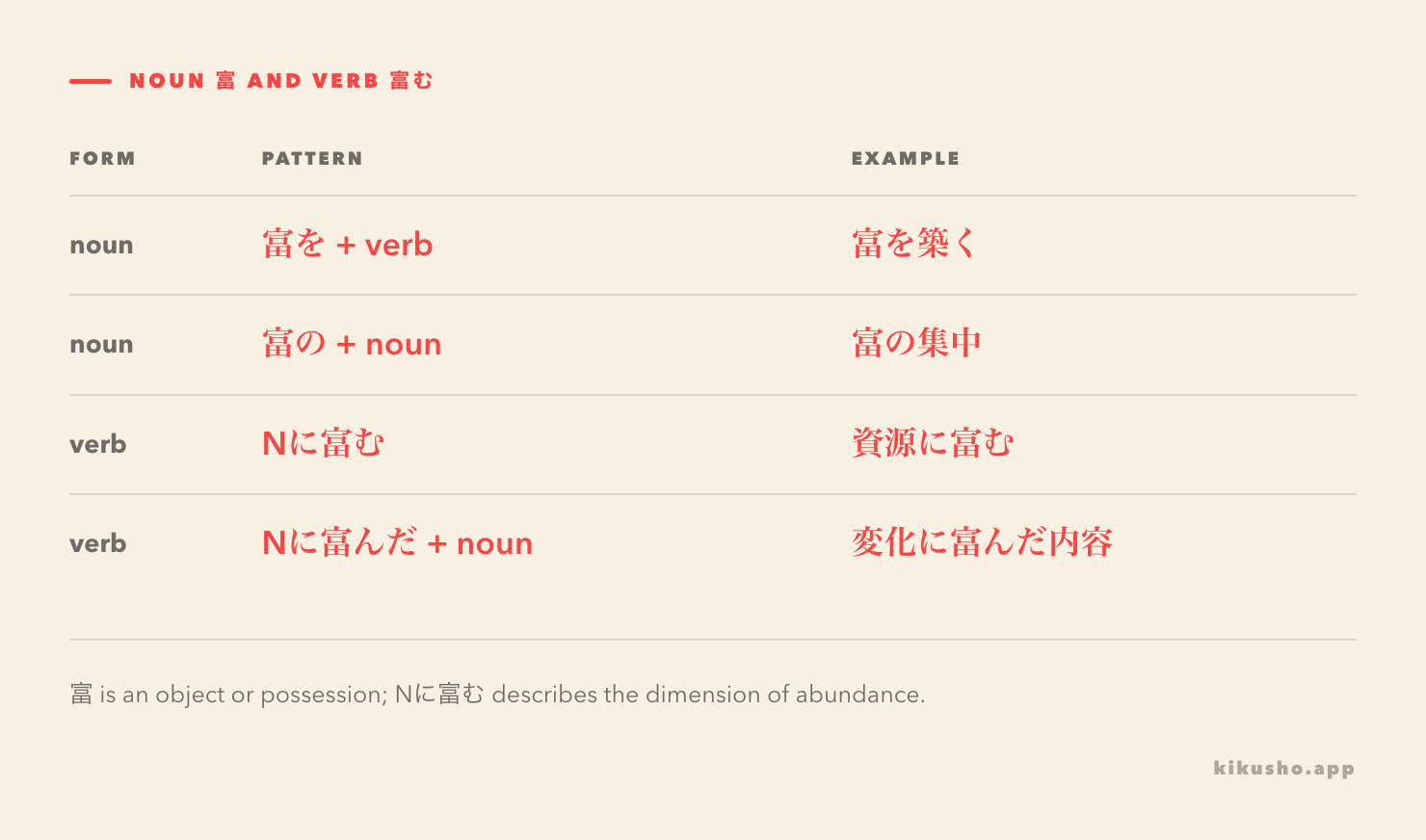
Do not translate every Nに富む phrase with financial “rich.” 創造性に富む提案 is a highly creative proposal; 経験に富む人 is a person with abundant experience. The particle に marks the dimension in which the subject is abundant.
貧困 is the policy term; 貧乏 is closer to daily life
貧困(ひんこん) is the formal noun for poverty as a condition, social problem or serious lack. It appears in 貧困対策, anti-poverty measures; 貧困率, poverty rate; 貧困に陥る, fall into poverty; and 貧困から抜け出す, escape poverty. The same word can extend beyond money in phrases such as 発想の貧困, poverty of ideas, though people and policy remain its central territory here.
貧乏(びんぼう) is more conversational. It can describe a person, household or way of living with little money: 貧乏な暮らし, a financially poor life; 若い頃は貧乏だった, I was poor when I was young. Its dictionary definition focuses on having little property or income and finding life financially difficult.
調査は子どもの貧困を社会構造の問題として分析している。
ちょうさはこどものひんこんをしゃかいこうぞうのもんだいとしてぶんせきしている。
The study analyses child poverty as a structural social problem.
収入が不安定で、当時はかなり貧乏な生活をしていた。
しゅうにゅうがふあんていで、とうじはかなりびんぼうなせいかつをしていた。
My income was unstable, and at the time I lived with very little money.
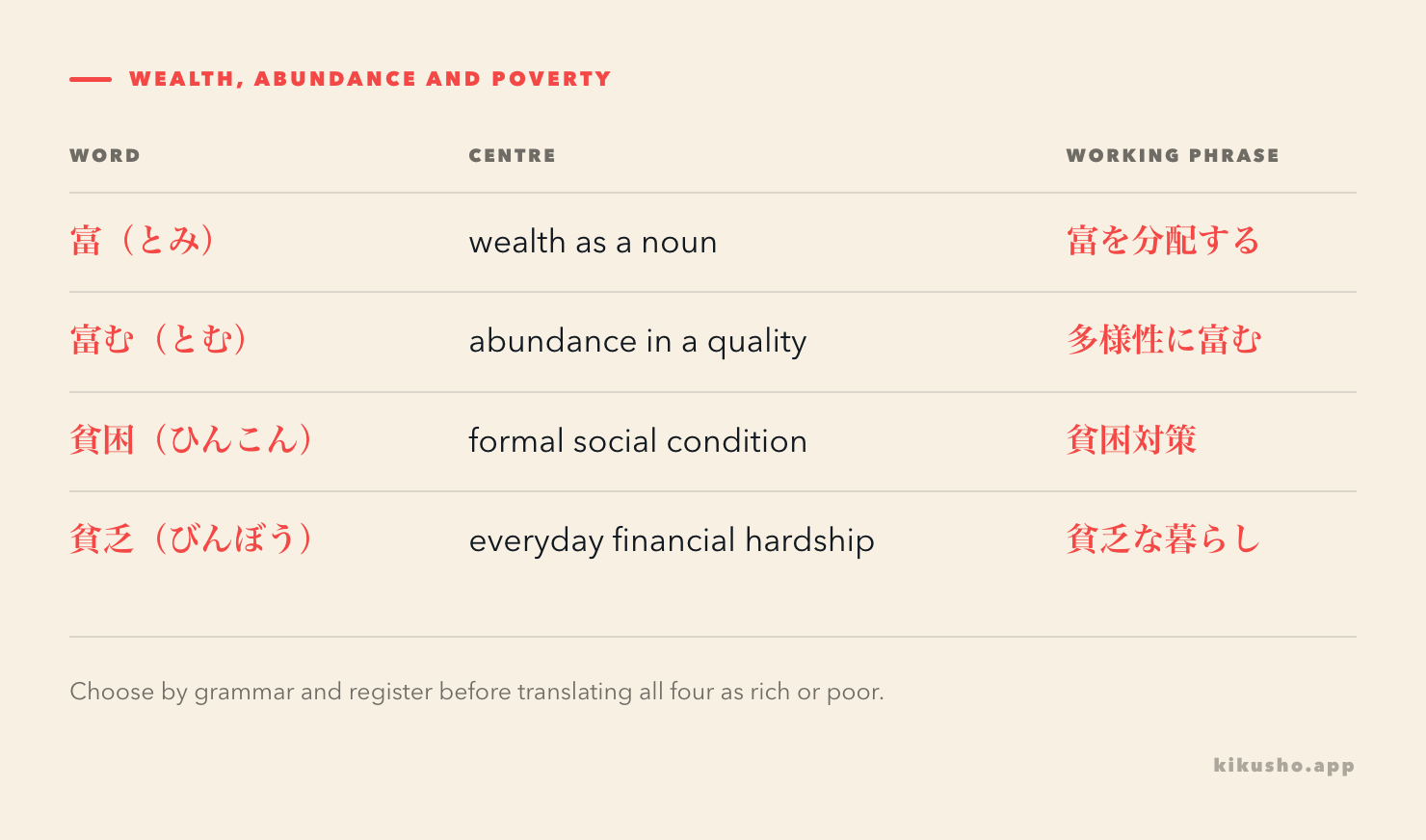
Because direct labels can reduce a person to a condition, public writing often prefers 貧困状態にある人, a person in poverty, or names the concrete difficulty. The vocabulary distinction explains register; it does not license contemptuous description.
賠償 responds to liability; 補償 makes up a loss
賠償(ばいしょう) is reparation or compensation for harm for which someone is liable. The central legal compound is 損害賠償. A claimant 損害賠償を請求する, claims damages; the responsible party 損害を賠償する, compensates for the harm. The 損害賠償 definition describes restoring the injured party, as far as possible, to the position before the damage.
裁判所は会社に損害の賠償を命じた。
さいばんしょはかいしゃにそんがいのばいしょうをめいじた。
The court ordered the company to compensate for the damage.
The prerequisite 補償(ほしょう) also offsets loss, but it is broader and can belong to insurance, employment or public schemes without alleging wrongdoing: 休業補償, compensation for lost work; 災害補償, disaster compensation. 賠償 more strongly invokes liability for harm, while 補償 foregrounds making up a loss. Real statutes and contracts choose their own term, so this distinction guides reading rather than replacing legal analysis.
奉仕 and 募金 describe action from different positions
奉仕(ほうし) is service or devotion offered to society, an organisation, a cause or other people. 社会に奉仕する, serve society; 奉仕活動, service activities; and 地域への奉仕, service to the community, are typical. It does not by itself mean that the work is unpaid, although voluntary service can be one form of it.
医師たちは休日に地域の健康相談に奉仕した。
いしたちはきゅうじつにちいきのけんこうそうだんにほうしした。
The doctors gave service at a community health consultation on their day off.
Retail advertising sometimes uses ご奉仕価格 for a specially reduced price. That commercial expression is conventional; it does not turn every discount into civic service.
募金(ぼきん) is fundraising or the collection of money for a cause. The original viewpoint is the collecting side: 募金を呼びかける, appeal for donations; 募金活動を行う, conduct a fundraising campaign; 街頭募金, street fundraising. The dictionary usage note also records modern 団体に募金する, contribute money to an organisation, from the giver's viewpoint.
The N3 prerequisite 寄付(きふ) focuses on the contribution itself. A school can 募金を呼びかける, invite contributions; residents can 学校に寄付する, donate to the school; the collected money can fund 援助, assistance.
団体は被災した世帯への支援を目的に募金を呼びかけ、三日間で多くの寄付を集めた。
だんたいはひさいしたせたいへのしえんをもくてきにぼきんをよびかけ、みっかかんでおおくのきふをあつめた。
The organisation launched a fundraising appeal to support affected households and collected many donations in three days.
A municipal report puts all twelve words to work
市の報告書によると、近年は移民を含む単身世帯が増え、世代間の所得格差も広がっている。市には、制度から取り残される人を減らす責務がある。天然資源に富む地域で生まれた富が一部に集中する一方、貧困に陥る世帯や、日々の生活を貧乏だと感じる住民もいる。市は企業に不法な損害の賠償を求め、生活上の損失には別の補償制度を設けた。さらに、地域への奉仕活動に参加する人を募り、支援基金のための募金を始めた。
According to the city's report, single-person households, including immigrants, have increased in recent years, while intergenerational income disparities have also widened. The city has a responsibility to reduce the number of people left outside support systems. Although the region is rich in natural resources, the wealth it produces is concentrated among a small group, while some households fall into poverty and some residents describe daily life as financially strained. The city sought damages from companies for unlawful harm and created a separate compensation programme for livelihood losses. It also recruited people for community service and began fundraising for a support fund.
The passage separates the unit being counted, 世帯, from the cohort comparison, 世代間. It uses 富む to describe abundance and 富 as the resulting wealth, then gives 賠償, 補償, 奉仕 and 募金 different institutional jobs. The N1 welfare lesson continues with the systems that deliver care, insurance, relief and welfare services.
Test the distinctions before opening the explanations
1 · Responsibility term. A policy document contains 責務. Select its pronunciation.
A. せきむ
B. せきぶ
C. せむ
D. せきめ
2 · Damages term. In 損害賠償, how is 賠償 pronounced?
A. ほしょう
B. ばいそう
C. ばいしょう
D. べんしょう
3 · Household or generation. Complete: 一つの___に祖父母、親、子どもの三つの___が暮らしている。
A. 世代 / 世帯
B. 世帯 / 世代
C. 移民 / 格差
D. 責務 / 奉仕
4 · Noun or verb. Which sentence uses 富 or 富む naturally?
A. この地域は水資源を富んでいる。
B. この地域は水資源に富んでいる。
C. この地域は水資源が富をいる。
D. この地域は水資源で富むをしている。
5 · Formal social condition. A policy paper analyses the percentage of children living below an income threshold. Which phrase fits best?
A. 子どもの奉仕
B. 子どもの賠償
C. 子どもの貧困
D. 子どもの富む
6 · Liability or loss support. A court finds that a company unlawfully caused damage and orders it to pay. Which term is most strongly expected?
A. 賠償
B. 奉仕
C. 募金
D. 世帯
7 · Role-based responsibility. 報道機関には事実を正確に伝える___がある。 Which word gives the sentence a formal sense of responsibility attached to the institution's role?
A. 格差
B. 責務
C. 富
D. 貧乏
8 · Fundraising viewpoint. Which sentence most clearly describes the collecting side of 募金?
A. 団体が駅前で募金を呼びかけた。
B. 裁判所が損害の募金を命じた。
C. 地域が資源に募金している。
D. 三つの世代が募金を負った。
9 · Migration. Which claim is safest?
A. Every 外国人 is necessarily described as an 移民.
B. 移民 can name cross-border settlement or a person who makes that move, while legal status and nationality require more context.
C. 移民 and 難民 always have the same motive and legal status.
D. 移民 only means someone leaving Japan.
10 · Register. Which pairing best matches the usual tendency?
A. 貧困 for policy and structural analysis; 貧乏 for more personal everyday financial hardship
B. 貧乏 only for statistics; 貧困 only for jokes
C. 貧困 for abundant resources; 貧乏 for legal damages
D. The two words differ only in reading and never in register
11 · Connected meaning. What does 地域格差を是正する most directly mean?
A. collect donations from every region
B. compensate a company for serving society
C. correct disparities between regions
D. count the generations in one household
12 · Service and contribution. Which statement is accurate?
A. 奉仕 always means unpaid work required by law.
B. 募金 only describes a court-ordered payment for harm.
C. A 奉仕活動 can serve a community, while a 募金活動 collects funds for a cause.
D. 寄付 names the generation that receives aid.
Answers and explanations
- A. 責務 is read せきむ. Both 責 and 務 carry readings found in formal responsibility vocabulary.
- C. 賠償 is ばいしょう. 補償 and 保障 are both ほしょう, which makes them useful distractors in listening and kanji questions.
- B. One 世帯, household, can contain three 世代, generations. The compound 三世代世帯 compresses the same relationship.
- B. 富む commonly takes the dimension of abundance with に: 水資源に富んでいる. 富 is a noun in patterns such as 富を築く.
- C. 貧困 is the standard formal word for poverty in social analysis and policy. 貧乏 is more conversational and personal.
- A. A finding of unlawful harm and a court-ordered payment strongly points to 賠償, especially 損害賠償.
- B. 責務 foregrounds the responsibility attached to the institution's role. 義務 can also describe obligations, but it is not among the choices.
- A. 募金を呼びかける places the organisation on the collecting side. Modern usage also allows 募金する for contributing, so the explicit appeal removes the ambiguity.
- B. 移民 can name migration or a migrant, but it does not by itself establish every question about nationality, refugee status or residence law.
- A. 貧困 is common in structural and policy prose. 貧乏 belongs more readily to personal, conversational description, although their meanings overlap.
- C. 地域格差 is disparity between regions; 是正する means correct or remedy it.
- C. 奉仕活動 centres on service, while 募金活動 centres on collecting funds. Service need not always be unpaid, and 募金 is not damages.
Common questions
What is the difference between 世帯 and 世代?
世帯(せたい) is a household, usually a person or group sharing a home and livelihood. 世代(せだい) is a generation, either within a family or as an age cohort. 三世代世帯 is therefore one household containing three generations.
What is the difference between 責務 and 義務?
Both can mean duty or obligation. 責務 foregrounds the responsibility attached to a role and often appears in formal public or institutional prose. 義務 is the broader word for something one is required to do.
What is the difference between 貧困 and 貧乏?
貧困 is the formal term for poverty as a condition or social problem and also means serious lack. 貧乏 is more conversational and describes having little money or living with financial hardship.
What is the difference between 募金 and 寄付?
募金 originally describes soliciting and collecting money for a cause, while 寄付 describes the money or goods a donor gives. Modern 募金する can also mean contributing to a collection, so the surrounding viewpoint matters.