On this page
An expectation can end in 満足 or 失望. What happens afterward separates 後悔, the pain of wishing the past were different, from 反省, the work of examining what you did and deciding what to change.
This N3 vocabulary lesson connects eleven words for anticipation, mental tension, evaluation and self-examination. Learn each reading with the grammatical frame it normally enters, because “feel” or “emotion” alone does not tell you whether the next noun takes に, を, が or な.
Eleven words form a sequence, not a flat list
| Word | Reading | Class | Meaning here | Combination to keep |
|---|---|---|---|---|
| 羨ましい | うらやましい | い-adjective | envious; finding someone or something enviable | 友達が羨ましい |
| 期待 | きたい | noun; する verb | expectation, anticipation, hope | 新人に期待する |
| 嫌う | きらう | godan verb | dislike and tend to avoid | 不誠実な人を嫌う |
| 緊張 | きんちょう | noun; する verb | tension, nervousness | 面接で緊張する |
| 後悔 | こうかい | noun; する verb | regret about a past act or choice | 選んだことを後悔する |
| 興奮 | こうふん | noun; する verb | excitement, agitation, heightened arousal | 試合を見て興奮する |
| 失望 | しつぼう | noun; する verb | disappointment; loss of hope | 結果に失望する |
| 退屈 | たいくつ | noun; な-adjective; する verb | boredom; tediousness | 退屈な会議 |
| 反省 | はんせい | noun; する verb | critical reflection on one's conduct | 自分の行動を反省する |
| 満足 | まんぞく | noun; する verb | satisfaction | 結果に満足する |
| 愉快 | ゆかい | noun; な-adjective | pleasant, cheerful, amusing | 愉快な仲間 |
The する words do not all point in the same direction. 期待する looks toward a possible future. 満足する and 失望する evaluate what happened. 後悔する and 反省する look back, but only 反省 necessarily foregrounds examining your own behaviour.
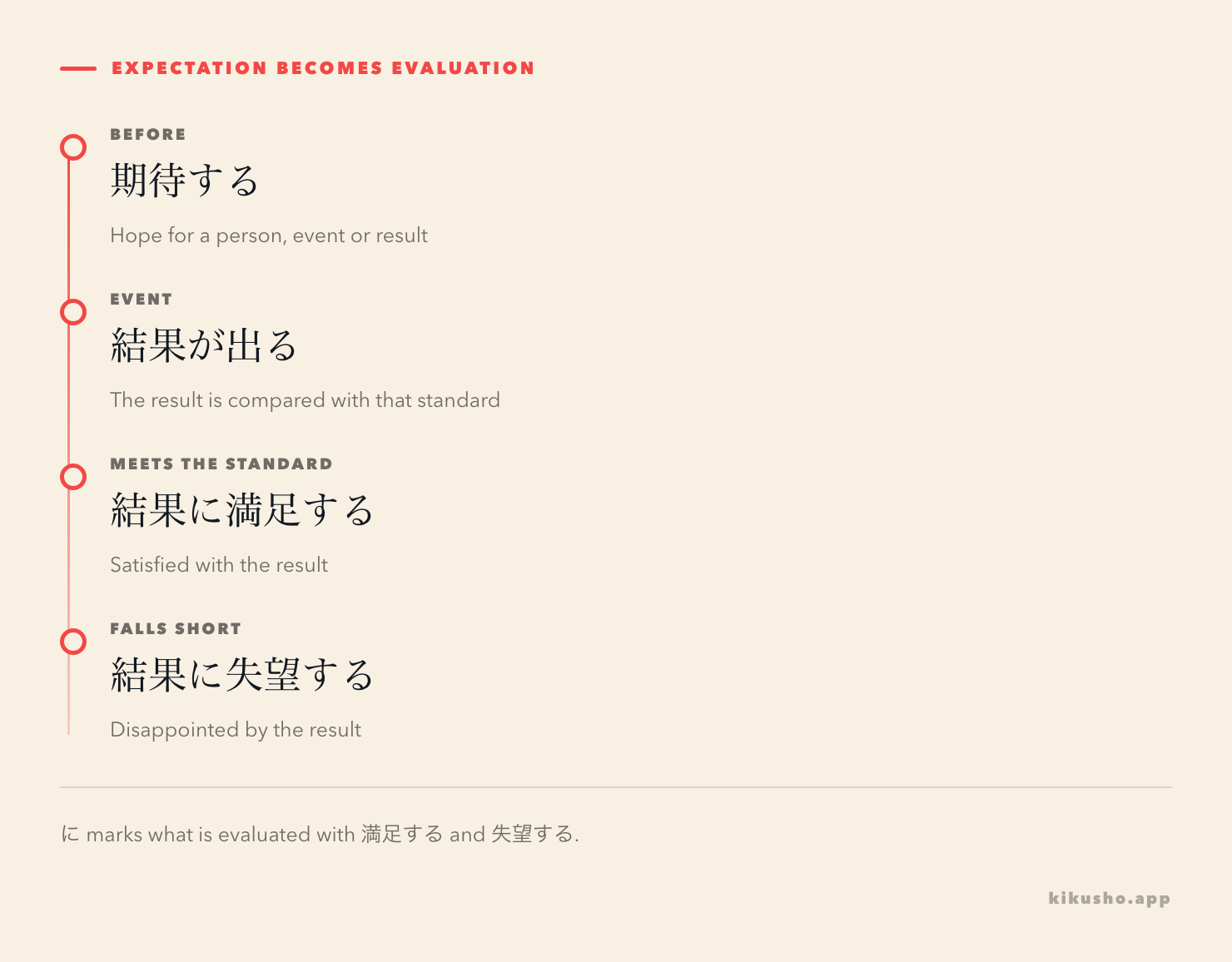
期待 sets the standard; 満足 and 失望 judge the result
期待(きたい) means placing hope in something and awaiting it. With に, it can identify the person or thing expected to perform well.
会社は新しいチームに期待している。
かいしゃは あたらしい チームに きたいしている。
The company has high hopes for the new team.
With を, the object can be the desired event or result.
私たちは計画の成功を期待している。
わたしたちは けいかくの せいこうを きたいしている。
We expect and hope for the plan's success.
Shogakukan's entry for 期待 defines it as waiting with hope that something will be realised and gives 活躍を期待している. Another common connection is 期待に応える, “live up to expectations.”
Once there is a result, 満足(まんぞく) means that it meets your needs or standard, while 失望(しつぼう) means that hope has fallen away.
私は新しい商品の品質に満足している。
わたしは あたらしい しょうひんの ひんしつに まんぞくしている。
I am satisfied with the quality of the new product.
客は説明の少なさに失望した。
きゃくは せつめいの すくなさに しつぼうした。
The customer was disappointed by the lack of explanation.
The thing evaluated commonly takes に with both words. A person can also cause the reaction: 客を満足させる means “satisfy the customer,” and 客を失望させる means “disappoint the customer.” The change from に to を comes with the causative させる.
緊張 and 興奮 both raise energy for different reasons
緊張(きんちょう) is the tension that tightens the mind or body, especially before an unfamiliar or demanding event. Shogakukan includes the state of becoming tense in the face of something unfamiliar.
初めての面接だったので、とても緊張した。
はじめての めんせつだったので、とても きんちょうした。
It was my first interview, so I was very nervous.
興奮(こうふん) is heightened excitement or agitation. It is not automatically happy: a thrilling match, an argument or shocking news can all leave someone excited or worked up.
観客は逆転した瞬間、興奮して立ち上がった。
かんきゃくは ぎゃくてんした しゅんかん、こうふんして たちあがった。
When the lead changed, the spectators jumped up in excitement.
そのニュースで興奮して、なかなか眠れなかった。
その ニュースで こうふんして、なかなか ねむれなかった。
I was so worked up by the news that I could not fall asleep easily.
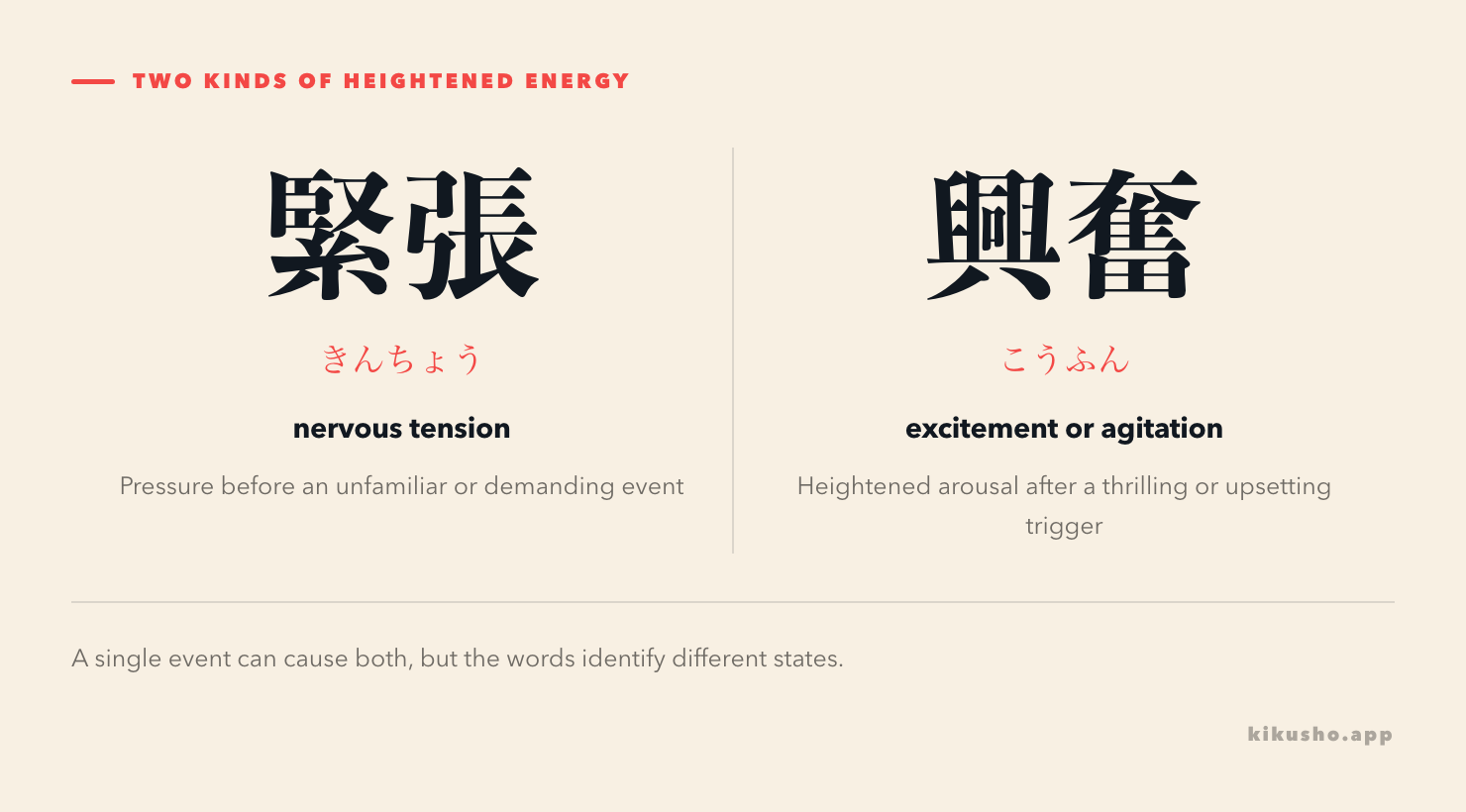
The situation can create both. A performer may be 緊張している before walking onstage and 興奮している after a powerful response from the audience. The first emphasizes pressure and self-consciousness; the second emphasizes arousal.
後悔 feels the past; 反省 examines your part in it
後悔(こうかい) is regret felt after you judge something you did as a mistake. Shogakukan defines it around regretting, afterward, what one has already done.
十分に準備しなかったことを後悔している。
じゅうぶんに じゅんびしなかった ことを こうかいしている。
I regret not preparing enough.
The full past action can be nominalised with こと and marked by を. 後悔しても遅い and 今さら後悔しても始まらない both present regret as unable to change the completed past.
反省(はんせい) turns attention toward your own conduct. It can include remorse, but it also covers reviewing a process, identifying a fault and using the lesson next time.
準備の仕方を反省し、次の計画を変えた。
じゅんびの しかたを はんせいし、つぎの けいかくを かえた。
I reflected on the way I had prepared and changed the next plan.
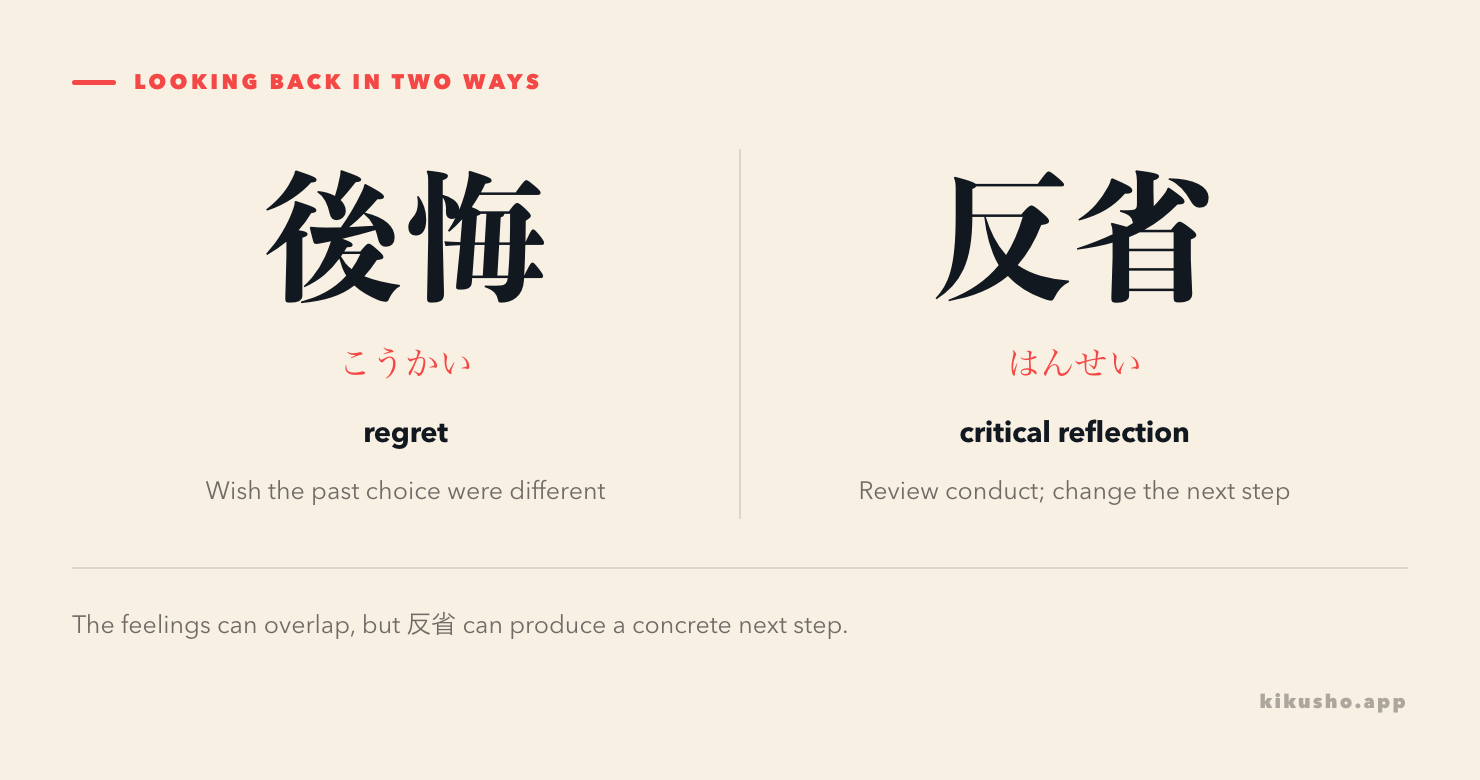
The two can occur together, but they are not interchangeable. Someone may regret choosing an unpopular plan because of the result while refusing to examine their decision. Someone else may conduct a calm 反省会, a review meeting, without intense personal regret. The futility lesson with 後悔しても develops the grammar used when regret cannot change the outcome.
羨ましい and 嫌う make viewpoint and target visible
羨ましい(うらやましい) is an い-adjective. It expresses the feeling that another person's ability or situation is desirable to you. The person or situation that prompts the envy commonly takes が.
海外で働いている友達が羨ましい。
かいがいで はたらいている ともだちが うらやましい。
I envy my friend who works abroad.
Shogakukan's 羨ましい entry describes seeing another person's ability or condition and wishing to be like that. Because the adjective directly presents a feeling, show your evidence when the experiencer is someone else.
妹は兄の自由な生活を羨ましがっている。
いもうとは あにの じゆうな せいかつを うらやましがっている。
My younger sister shows envy of our older brother's free life.
嫌う(きらう) is a transitive godan verb. Its target takes を. It can mean disliking someone or something and therefore wanting to avoid involvement with it.
彼は人前で話すことを嫌う。
かれは ひとまえで はなす ことを きらう。
He dislikes speaking in front of people.
Shogakukan gives avoidance of an undesirable target as its central modern sense. 嫌いだ describes a dislike as a noun or な-adjectival predicate; 嫌う presents the disposition as a verb and often sounds more general or deliberate.
The lesson on がる and observed feelings explains why 羨ましがる differs from reporting another person's inner state as a bare adjective.
退屈 and 愉快 evaluate an experience
退屈(たいくつ) can name boredom, modify a noun with な, or combine with する.
会議が長くて退屈した。
かいぎが ながくて たいくつした。
The meeting was long, and I got bored.
退屈な説明を短くした。
たいくつな せつめいを みじかくした。
I shortened the tedious explanation.
愉快(ゆかい) describes something pleasantly cheerful or amusing. It is a noun and な-adjective, so 愉快な仲間 and 愉快な話 are well formed. Compared with the broad everyday 楽しい, 愉快 often gives the scene a cheerful or amusing character.
愉快な仲間と一日を過ごした。
ゆかいな なかまと いちにちを すごした。
I spent the day with cheerful, entertaining companions.
Do not turn either word into an い-adjective: 退屈い and 愉快い are not the forms taught here. Use 退屈な映画 and 愉快な映画 before a noun.
Read the whole emotional sequence
私は新しい劇団の公演に期待していたが、人前で話すことを嫌うので、練習ではいつも緊張していた。堂々と演じる友達が羨ましかった。本番が始まると観客は興奮し、退屈な場面は一つもなかった。観客は公演に満足していたが、私は自分の小さな失敗に失望した。練習時間を増やさなかったことを後悔し、準備の仕方を反省した。それでも、公演の後は愉快な仲間と楽しく話した。
わたしは あたらしい げきだんの こうえんに きたいしていたが、ひとまえで はなす ことを きらうので、れんしゅうでは いつも きんちょうしていた。どうどうと えんじる ともだちが うらやましかった。ほんばんが はじまると かんきゃくは こうふんし、たいくつな ばめんは ひとつも なかった。かんきゃくは こうえんに まんぞくしていたが、わたしは じぶんの ちいさな しっぱいに しつぼうした。れんしゅうじかんを ふやさなかった ことを こうかいし、じゅんびの しかたを はんせいした。それでも、こうえんの あとは ゆかいな なかまと たのしく はなした。
I had high hopes for the new theatre company's performance, but because I dislike speaking in front of people, I was always nervous during rehearsal. I envied my friend, who acted confidently. Once the performance began, the audience became excited, and there was not a single boring scene. The audience was satisfied with the show, but I was disappointed in my own small mistake. I regretted not increasing my rehearsal time and reflected on the way I had prepared. Even so, after the performance I enjoyed talking with my cheerful companions.
The paragraph does not treat every feeling as an isolated label. Particles identify the object of expectation, dislike, disappointment and satisfaction; the last two retrospective words then separate feeling bad from examining the cause.
N3 is a study estimate, not an official word list
The reference inventory groups these eleven records in this N3 lesson. Its source families disagree about 羨ましい, 後悔, 興奮 and 反省, placing them at N2 or N1 in some lists. Independent current N3 resources also teach emotions and mental states in this range, but the JLPT does not publish a current exhaustive vocabulary list.
The official JLPT FAQ explains that the old Test Content Specifications are no longer published as a fixed syllabus for the revised test. Treat level labels as study guidance. The useful evidence is whether you can read the word, recognize its grammatical frame and distinguish it from its nearest neighbor.
In Kikusho, keep the event that produced the reaction. A card containing 結果に失望した preserves both the judgment and its particle; 失望 = disappointment does not. For 後悔 and 反省, save the earlier action and the next step too, so review brings back the distinction instead of another pair of overlapping translations. The broader emotion vocabulary lesson covers six prerequisite words with their own particle patterns.
Practice: follow the trigger, target and result
Attempt all ten original questions before opening the shared answer panel.
1 · Reading. Give the reading of 羨ましい.
- イ. うらやましい
- ロ. うらめしい
- ハ. うれやましい
- ニ. うらやしい
2 · Reading. Choose the written reading of 興奮.
- イ. きょうふん
- ロ. こうぶん
- ハ. こうふん
- ニ. きょうぶん
3 · Put hope in a person. Complete the sentence: 会社は若い社員( )期待している。
- イ. を
- ロ. に
- ハ. が
- ニ. で
4 · Pressure or excitement. A student is about to give an unfamiliar presentation and feels tense under everyone's gaze. Which word fits?
- イ. 愉快
- ロ. 興奮
- ハ. 退屈
- ニ. 緊張
5 · Judge the result. Fill both blanks in order.
商品が期待どおりなら客は( 前 )するが、品質が低ければ( 後 )するかもしれない。
- イ. 前:満足 / 後:失望
- ロ. 前:失望 / 後:満足
- ハ. 前:反省 / 後:後悔
- ニ. 前:緊張 / 後:興奮
6 · Feeling and examination. Fill both blanks in order.
練習しなかったことを( 前 )し、準備の仕方を( 後 )した。
- イ. 前:反省 / 後:期待
- ロ. 前:後悔 / 後:反省
- ハ. 前:失望 / 後:満足
- ニ. 前:興奮 / 後:緊張
7 · Another person's visible envy. Which sentence shows the speaker is describing the sister's displayed reaction?
- イ. 妹は兄の自由な生活を羨ましがっている。
- ロ. 妹は兄の自由な生活を羨ましいです。
- ハ. 妹は兄の自由な生活に羨ましくする。
- ニ. 妹は兄の自由な生活が羨ましする。
8 · な-adjective use. Which phrase is well formed?
- イ. 愉快い仲間
- ロ. 愉快の仲間
- ハ. 愉快な仲間
- ニ. 愉快で仲間
9 · Paraphrase. Which sentence is closest to 彼は人前で話すことを嫌う?
- イ. 彼は人前で話すことを楽しみにしている。
- ロ. 彼は人前で話すことを好まず、避けたがる。
- ハ. 彼は人前で話したことを反省している。
- ニ. 彼は人前で話す人を羨ましがっている。
10 · Follow the scene. A lecture is long and gives the listener nothing engaging to think about. Afterward, the listener says it was tedious. Which sentence fits?
- イ. 講義が長くて退屈した。
- ロ. 講義が長くて満足した。
- ハ. 講義が長くて期待した。
- ニ. 講義が長くて反省した。
Answers and explanations
イ, うらやましい. The word begins with うら and keeps やま before the い-adjective ending. うらめしい is a different word, 恨めしい.
ハ, こうふん. Both kanji take on-readings here: 興 is こう and 奮 is ふん.
ロ, に. 若い社員に期待する places hope in the young employee. A hoped-for event or result can instead take を, as in 成功を期待する.
ニ, 緊張. The unfamiliar performance and awareness of being watched create nervous tension. 興奮 would emphasize heightened excitement or agitation rather than pressure itself.
イ, 満足 / 失望. Meeting the expected standard can produce satisfaction; poor quality can produce disappointment. Both evaluated objects can take に in 商品に満足する and 品質に失望する.
ロ, 後悔 / 反省. The first blank expresses regret about the completed failure to practise. The second examines the preparation method, which can guide a later change.
イ. 羨ましがっている presents observable envy in a third person. The other choices mix the adjective with particles or する forms it does not take.
ハ, 愉快な仲間. 愉快 is a noun and な-adjective here. It does not take the い-adjective ending.
ロ. 嫌う presents dislike and a tendency to avoid the target. The other sentences introduce anticipation, reflection or envy, which are separate reactions.
イ, 講義が長くて退屈した. 退屈した describes becoming or being bored. The context supplies no achieved standard, future hope or examination of the speaker's own conduct.
Common questions
What is the difference between 後悔 and 反省?
後悔 is the painful feeling that a past choice or action was a mistake. 反省 is the act of examining your own conduct and recognizing what should change. You can regret an outcome without analysing your behaviour, while reflection can lead to a concrete improvement.
What is the difference between 緊張 and 興奮?
緊張 is the tense, self-conscious state that often appears before an unfamiliar or demanding event. 興奮 is heightened excitement or agitation; it can be positive or negative and does not itself mean nervousness.
Which particle follows 期待?
Use に for the person or thing in which you place hopes, as in 新人に期待する. Use を for the event or result you expect, as in 成功を期待する. 期待に応える means to live up to an expectation.
How do you describe another person's envy with 羨ましい?
羨ましい directly expresses the speaker's own feeling. For another person's visible reaction, 羨ましがっている is useful; reported speech such as 羨ましいと言っている also shows how you know.