On this page
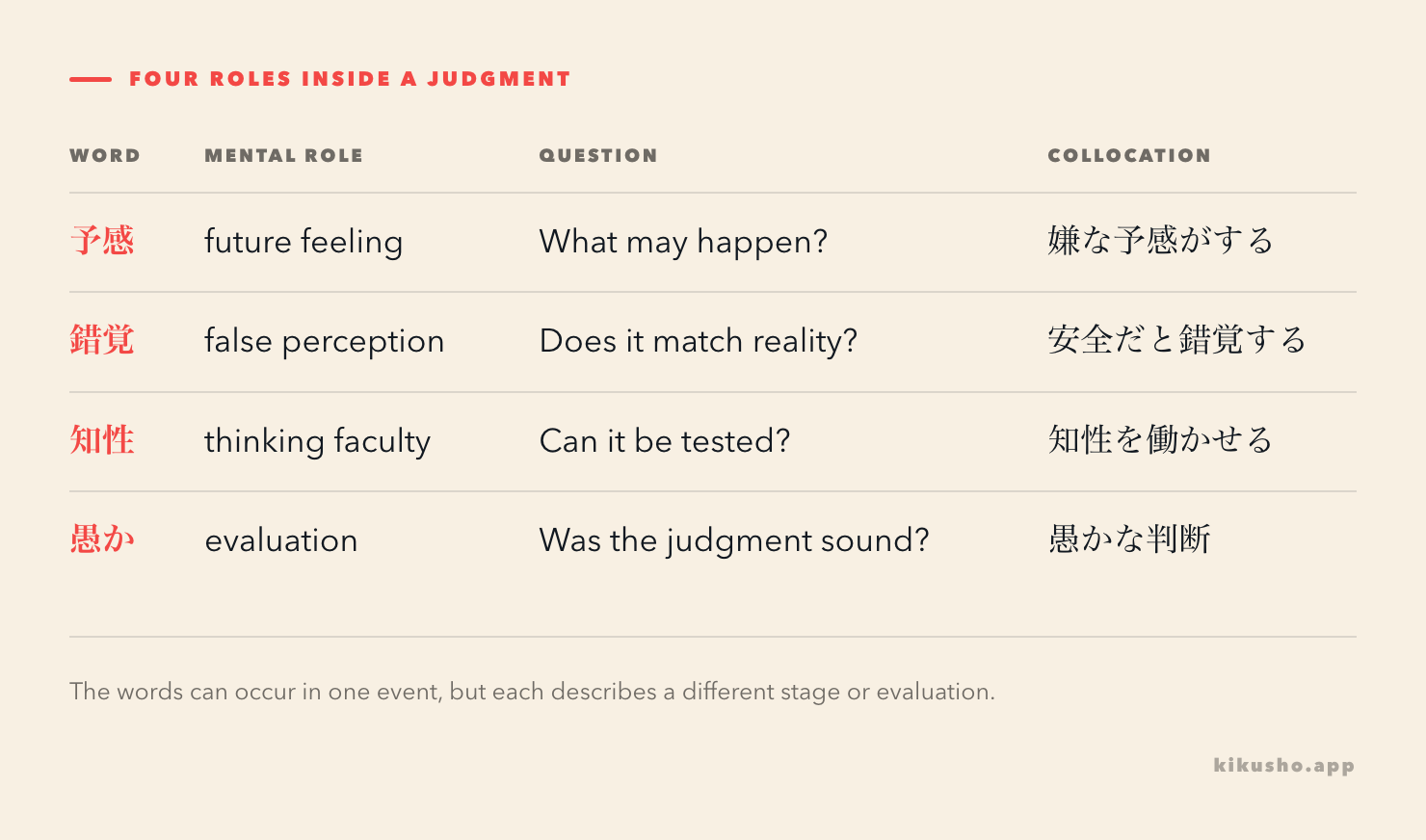
These four N1 Japanese words for judgment, perception and intuition trace different things the mind can do. 予感 is a feeling about what may happen, 錯覚 is a perception or impression that diverges from reality, 知性 is the faculty used to think and judge, and 愚か evaluates a person, choice or act as lacking sound judgment.
Four words occupy four mental roles
| Word | Reading | Word class | Core meaning | Phrase to remember |
|---|---|---|---|---|
| 愚か | おろか, oroka | noun; na-adjective | foolish; lacking sound thought | 愚かな判断: a foolish decision |
| 錯覚 | さっかく, sakkaku | noun; suru verb | illusion; mistaken perception or impression | 錯覚に陥る: fall under an illusion |
| 知性 | ちせい, chisei | noun | intellect; the faculty for knowing and judging | 知性を備える: possess intellect |
| 予感 | よかん, yokan | noun; suru verb | premonition; a feeling about a future event | 嫌な予感がする: have a bad feeling |
The doubled consonant in 錯覚(さっかく) is essential. 知性 is ちせい, not ちしょう, and 予感 is よかん. 愚か keeps its okurigana because it functions as a native na-adjective: 愚かな考え, 考えが愚かだ, 愚かにも信じた.
The N3 lesson on memory, attention and understanding teaches concrete operations such as 思い出, 集中, 想像, 知識 and 予想. This N1 continuation moves to abstract evaluation: what kind of mental faculty is involved, whether perception is reliable, and whether a future impression has evidence behind it.
愚か judges the thinking behind an act
愚か(おろか) means foolish, unwise or lacking sufficient thought. The dictionary entry includes deficient thinking, absurd conduct and immaturity. It can describe a person, but advanced writing often directs the judgment at a choice, belief or act.
短期的な利益のために安全基準を下げるのは愚かな判断だ。
たんきてきなりえきのためにあんぜんきじゅんをさげるのはおろかなはんだんだ。
Lowering safety standards for short-term profit is a foolish decision.
Useful forms show how the evaluation fits the sentence:
- 愚かな行為/選択/考え: a foolish act, choice or idea
- Nするのは愚かだ: doing N is foolish
- 愚かにもNした: foolishly did N
- 自分の愚かさを認める: acknowledge one's foolishness
The word is stronger and more formal than a casual mistake label. Calling a person 愚かだ attacks their judgment or intellect and can sound contemptuous. When the point is one correctable act, 軽率だった, “was rash,” or 判断を誤った, “made an error in judgment,” may be more precise.
Do not confuse the adjective with XはおろかY. The grammar pattern means that Y holds, to say nothing of X: 漢字はおろか、ひらがなも読めない, “cannot read even hiragana, let alone kanji.” The はおろか comparison lesson develops that construction. Lexical 愚か instead conjugates as a na-adjective and evaluates foolishness.
錯覚 needs reality to be misread
錯覚(さっかく) has a technical centre and an everyday extension. In psychology, it is a perception that differs from the objective stimulus. In ordinary language, it can be a false impression or mistaken belief. Shogakukan's 錯覚 entry records both.
周囲の線の長さによって、中央の円が大きく見える錯覚が生じる。
しゅういのせんのながさによって、ちゅうおうのえんがおおきくみえるさっかくがしょうじる。
The surrounding lines create an illusion in which the central circle looks larger.
資料を一度読んだだけで、内容を理解したと錯覚していた。
しりょうをいちどよんだだけで、ないようをりかいしたとさっかくしていた。
After reading the material once, I was under the false impression that I understood it.
Common frames are 錯覚が生じる, 錯覚を起こす, 錯覚に陥る, and XをYと錯覚する. The last pattern names the object and the mistaken identity: 影を人と錯覚する, mistake a shadow for a person.
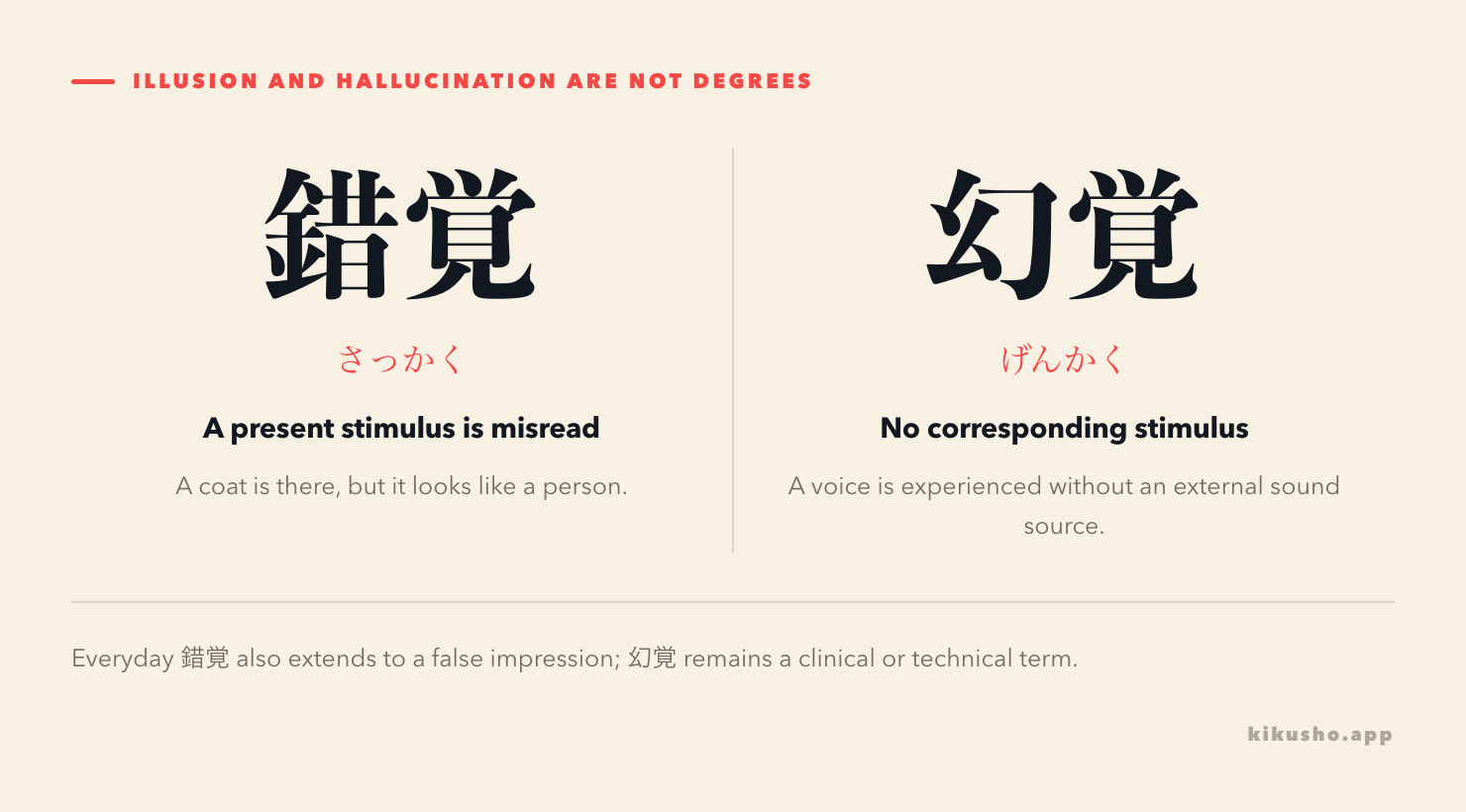
幻覚(げんかく) is not a stronger everyday synonym. It refers to a perception experienced without the corresponding external stimulus. A tree present in the dark and mistaken for a person can be 錯覚; seeing a person where no relevant object is present can be 幻覚. The medical distinction is also described by Igaku-Shoin, which defines hallucination by the absence of sensory stimulation.
誤解(ごかい) belongs to meaning and interpersonal understanding: misreading an explanation or another person's intention. 勘違い(かんちがい) is the broad conversational word for being mistaken. 錯覚 is the best choice when perception itself, or an illusion-like belief, is the focus.
知性 is a faculty, not information stored in the mind
知性(ちせい) is the capacity to know, think, compare and judge. Digital Daijisen defines it as the ability to know, think and make judgments, including abstraction, conceptualisation and inference.
感情だけでなく、知性に訴える説明が必要だ。
かんじょうだけでなく、ちせいにうったえるせつめいがひつようだ。
We need an explanation that appeals to the intellect, not only to emotion.
彼女の文章には、豊かな知性と鋭い観察力が表れている。
かのじょのぶんしょうには、ゆたかなちせいとするどいかんさつりょくがあらわれている。
Her writing reveals a rich intellect and keen powers of observation.
Keep four neighbouring nouns separate:
| Word | What it names | Typical partner |
|---|---|---|
| 知性 | the faculty for knowing and judging | 知性を備える; 知性に訴える |
| 知識 | acquired information or learning | 知識を得る; 専門知識 |
| 知能 | general mental capacity; often measured or technical | 知能が発達する; 人工知能 |
| 理性 | reason that regulates judgment, often contrasted with emotion or impulse | 理性を失う; 理性的に考える |
A person can possess extensive 知識 yet use it without 知性 or sound judgment. 知能 focuses more readily on capacity and performance, while 知性 often carries a humanistic or philosophical tone. 理性 foregrounds rational control; 知性 covers the broader intellectual faculty.
予感 is felt before it is calculated
予感(よかん) is a feeling that something is going to happen. The dictionary definition centres on sensing a future event in advance. The most common frame is Nという予感がする or simply Nの予感がする.
出発前から、この旅が人生を変えるような予感がしていた。
しゅっぱつまえから、このたびがじんせいをかえるようなよかんがしていた。
Even before leaving, I had a feeling that this journey would change my life.
彼は計画が失敗することを予感していた。
かれはけいかくがしっぱいすることをよかんしていた。
He had a premonition that the plan would fail.
The noun often takes an emotional modifier: 嫌な予感, 不吉な予感, 良い予感. Its truth is tested with 予感が当たる or the more formal 予感が的中する.
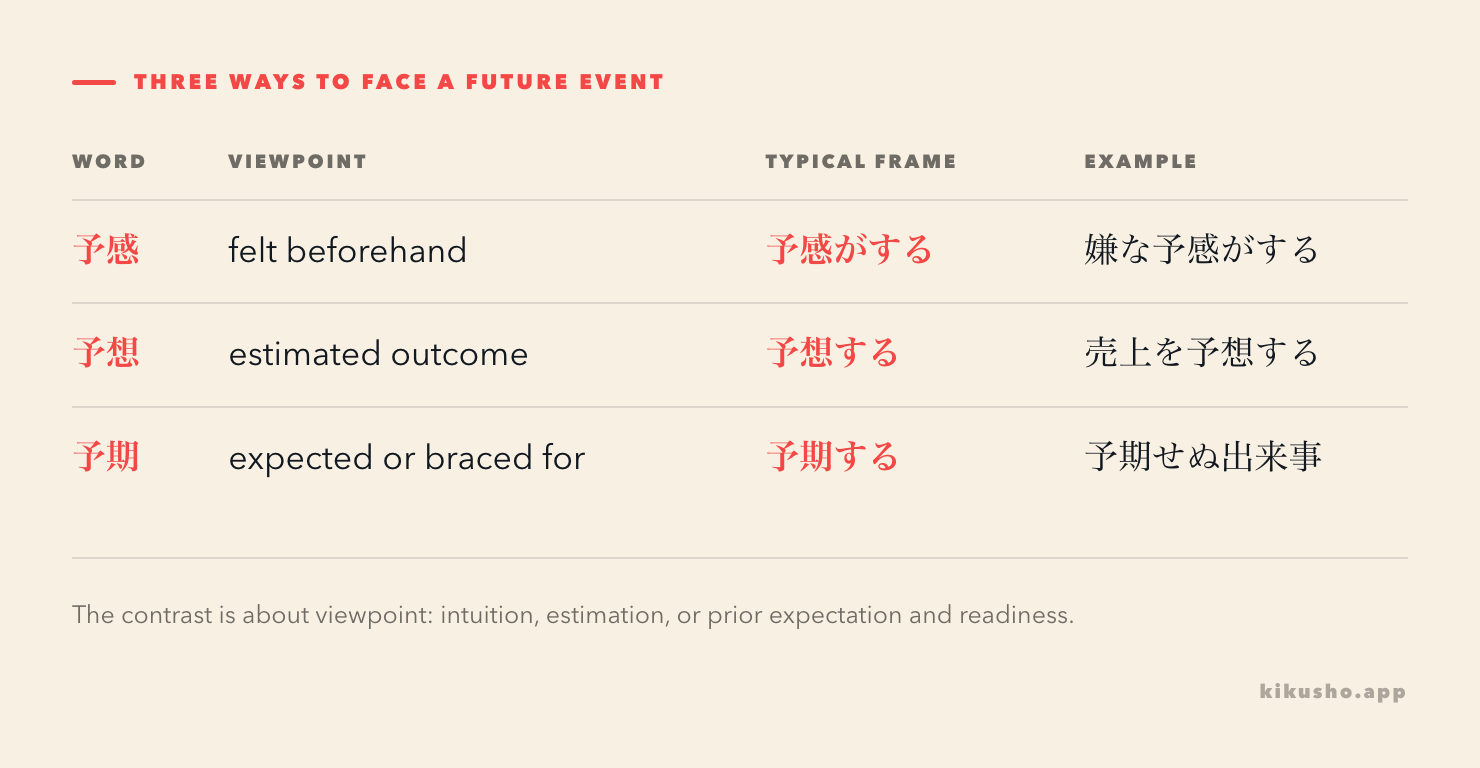
予想(よそう) is a forecast or estimate. It can be based on figures, precedent or analysis, and commonly appears with 当たる/外れる. 予期(よき) foregrounds expecting or being mentally prepared for an event, especially in 予期せぬ出来事 and 予期に反して. The distinction is one of viewpoint, not an absolute ban on overlap.
There is also a study-level disagreement worth preserving. Kikusho's source snapshot and JapaneseTest4You's N1 index place 予感 at N1, while Bunpro currently labels it N2. The official JLPT publishes no exhaustive current vocabulary list, so the label is a study position rather than a certification of the word itself.
A failed launch moves through all four mental roles
新製品の発表前、担当者には何か問題が起こるという嫌な予感があった。しかし、画面上の数字が伸びて見えたため、需要も増えていると錯覚した。知性を働かせて元のデータを確認すれば誤りに気づけたはずだが、十分に検討せず増産を決めた。後に彼は、その判断が愚かだったと認めた。
しんせいひんのはっぴょうまえ、たんとうしゃにはなにかもんだいがおこるといういやなよかんがあった。しかし、がめんじょうのすうじがのびてみえたため、じゅようもふえているとさっかくした。ちせいをはたらかせてもとのデータをかくにんすればあやまりにきづけたはずだが、じゅうぶんにけんとうせずぞうさんをきめた。のちにかれは、そのはんだんがおろかだったとみとめた。
Before the product launch, the person in charge had a bad feeling that something would go wrong. Because the figures on screen appeared to be rising, however, he formed the false impression that demand was increasing too. He could have found the error by applying his intellect and checking the original data, but he decided to increase production without sufficient review. Later, he admitted that the decision had been foolish.
The passage gives each word one job. 予感 appears before an articulated conclusion. 錯覚 conflicts with the actual data. 知性 names the faculty that could test the impression. 愚か evaluates the final decision after its weakness becomes clear.
Test the four mental roles before opening the review
1 · Read 錯覚. Which kana form matches the word in 錯覚に陥る?
A. さくかく
B. さっかく
C. さっがく
D. そうかく
2 · Build 知性. Which written form names the intellectual faculty for knowing and judging?
A. 知生
B. 地性
C. 知性
D. 知成
3 · Perception check. A straight line looks bent because it passes through water. Which word best names the experience?
A. 知性
B. 錯覚
C. 愚か
D. 予感
4 · Future feeling. Complete 理由は説明できないが、計画が成功する__がする.
A. 錯覚
B. 知性
C. 予感
D. 愚かさ
5 · Judge the action. Which sentence uses 愚か naturally while directing criticism at a choice?
A. 十分な確認をせずに契約するのは愚かだ。
B. 契約書を愚かに錯覚した。
C. 契約の知性が予感した。
D. 愚かを備えて説明した。
6 · Knowledge or faculty. Which sentence says that someone has information but lacks sound intellectual judgment?
A. 知性は多いが、知識が短い。
B. 知識は豊富だが、それを生かす知性に欠ける。
C. 知能を予感に保存している。
D. 理性が資料を錯覚した。
7 · Existing stimulus or none. In the technical contrast, which situation is best described as 幻覚 rather than 錯覚?
A. Mistaking a coat on a chair for a person
B. A printed line appearing longer because of surrounding arrows
C. Hearing a voice when no corresponding sound source is present
D. Misunderstanding an ambiguous email
8 · Forecast or premonition. Analysts calculate next month's sales from several years of data. Which noun is the most neutral choice?
A. 予想
B. 予感
C. 錯覚
D. 愚か
9 · Build the collocation. Which phrase means “fall under the mistaken impression that one is safe”?
A. 安全だと錯覚する
B. 安全を知性にする
C. 安全が愚かをする
D. 安全に予感を備える
10 · Follow the reasoning. A manager feels trouble coming, misreads a chart, fails to check it carefully, and later condemns the decision. Which order fits?
A. 知性 → 愚か → 予感 → 錯覚
B. 予感 → 錯覚 → 知性を働かせない → 愚かな判断
C. 錯覚 → 予感 → 愚か → 知性を備える
D. 愚か → 知性 → 錯覚 → 予感
Review the answers for judgment, illusion, intellect and premonition
- B, さっかく. The first kanji is 錯 and the following k sound is doubled. さくかく misses the small っ.
- C, 知性. 知 supplies knowing and 性 forms the abstract noun. The distractor compounds do not name this faculty.
- B, 錯覚. The line exists, but refraction makes its direction look different. That is a mistaken perception of an external stimulus.
- C, 予感. The speaker has a future-oriented feeling without an articulated basis. 予感がする is the standard frame.
- A. Nするのは愚かだ evaluates the unchecked decision as foolish. The other options misuse the adjective or assign impossible roles to the nouns.
- B. 知識 is the stored information; 知性 is the faculty used to interpret and judge with it. The contrast is coherent even though the two can support each other.
- C. 幻覚 lacks the corresponding external stimulus. A and B misperceive something present, while D is a 誤解 of meaning.
- A, 予想. The analysts are producing an evidence-based forecast. 予感 would present a felt premonition rather than the calculated estimate.
- A, 安全だと錯覚する. Xと錯覚する marks the mistaken identity or conclusion. Here the person wrongly takes the situation to be safe.
- B. 予感 supplies the initial feeling, 錯覚 the false reading, failure to apply 知性 the missed check, and 愚かな判断 the later evaluation.
Keep the diagnostic frame with each word during review: 愚かな判断, XをYと錯覚する, 知性を働かせる, and 嫌な予感がする. Those phrases preserve the boundary that four English glosses would erase.
Common questions
What is the difference between 錯覚 and 幻覚?
錯覚(さっかく) is a mistaken perception of an existing stimulus or, in everyday language, a false impression. 幻覚(げんかく) is a perception experienced without the corresponding external stimulus.
What is the difference between 予感 and 予想?
予感(よかん) is a felt premonition that something will happen, often without an articulated basis. 予想(よそう) is an estimate or forecast about an outcome and can rest on evidence or calculation.
How is 知性 different from 知識 and 知能?
知性(ちせい) is the faculty for knowing, thinking and judging. 知識 is the information a person possesses, while 知能 is general mental capacity and is common in developmental, psychological and technical contexts.
Is 愚か the same as the grammar pattern はおろか?
No. Lexical 愚か(おろか) is a na-adjective meaning foolish, as in 愚かな判断. The pattern XはおろかY means not only X but even Y, or let alone X, and has a separate grammatical function.