On this page
惜しい can praise what almost succeeded and protect what is too valuable to waste. A shot that misses by centimetres is 惜しい; so is the time you refuse to lose on an unimportant task.
The other five words in this N2 set also depend on direction and evidence. 憧れる points toward an ideal, 羨む toward another person's advantage, 嫌がる toward displayed resistance, 恨む toward a remembered wrong, and ためらう toward an action that has not begun.
Six words show where the feeling points
| Word | Reading | Class | Meaning here | Combination to keep |
|---|---|---|---|---|
| 憧れる | あこがれる | ichidan verb | admire or long for as an ideal | 映画監督に憧れる |
| 嫌がる | いやがる | godan verb | show dislike or reluctance | 行くのを嫌がる |
| 恨む | うらむ | godan verb | resent someone for a perceived wrong | 相手を恨む |
| 羨む | うらやむ | godan verb | envy another person's advantage | 友人の成功を羨む |
| 惜しい | おしい | い-adjective | too valuable to lose; narrowly short of success | 時間が惜しい/惜しい試合 |
| ためらう | ためらう | godan verb | hesitate before deciding or acting | 返事をためらう |
Four of the six are transitive godan verbs, but their objects are not interchangeable. 羨む evaluates an advantage, 恨む keeps a grievance, and 嫌がる reports resistance visible in conduct. ためらう delays an answer or action because the person has not committed to it.
憧れる moves toward an ideal; 羨む compares advantages
憧れる(あこがれる) describes being strongly drawn to a person, role, place or way of life that you regard as ideal. The target commonly takes に.
子どものころから宇宙飛行士に憧れていた。
こどもの ころから うちゅうひこうしに あこがれていた。
I had admired astronauts since childhood and longed to become one.
The target need not be a person.
都会の生活に憧れて、東京へ引っ越した。
とかいの せいかつに あこがれて、とうきょうへ ひっこした。
Drawn to city life, I moved to Tokyo.
Shogakukan defines the modern reading あこがれる as being strongly attracted to an ideal person or thing and gives 名声に憧れる and 都会生活に憧れる. Older senses and the historical reading あくがれる are outside this lesson.
羨む(うらやむ) is a transitive godan verb. It focuses on another person's favourable condition, talent or result and presents it as something the experiencer wishes they had.
彼は友人の成功を羨んでいる。
かれは ゆうじんの せいこうを うらやんでいる。
He envies his friend's success.
The て-form is 羨んで, following the same む → んで change as 読む. Shogakukan's 羨む entry records both wanting to share another person's fortunate state and a more negative envy of another's advantage.
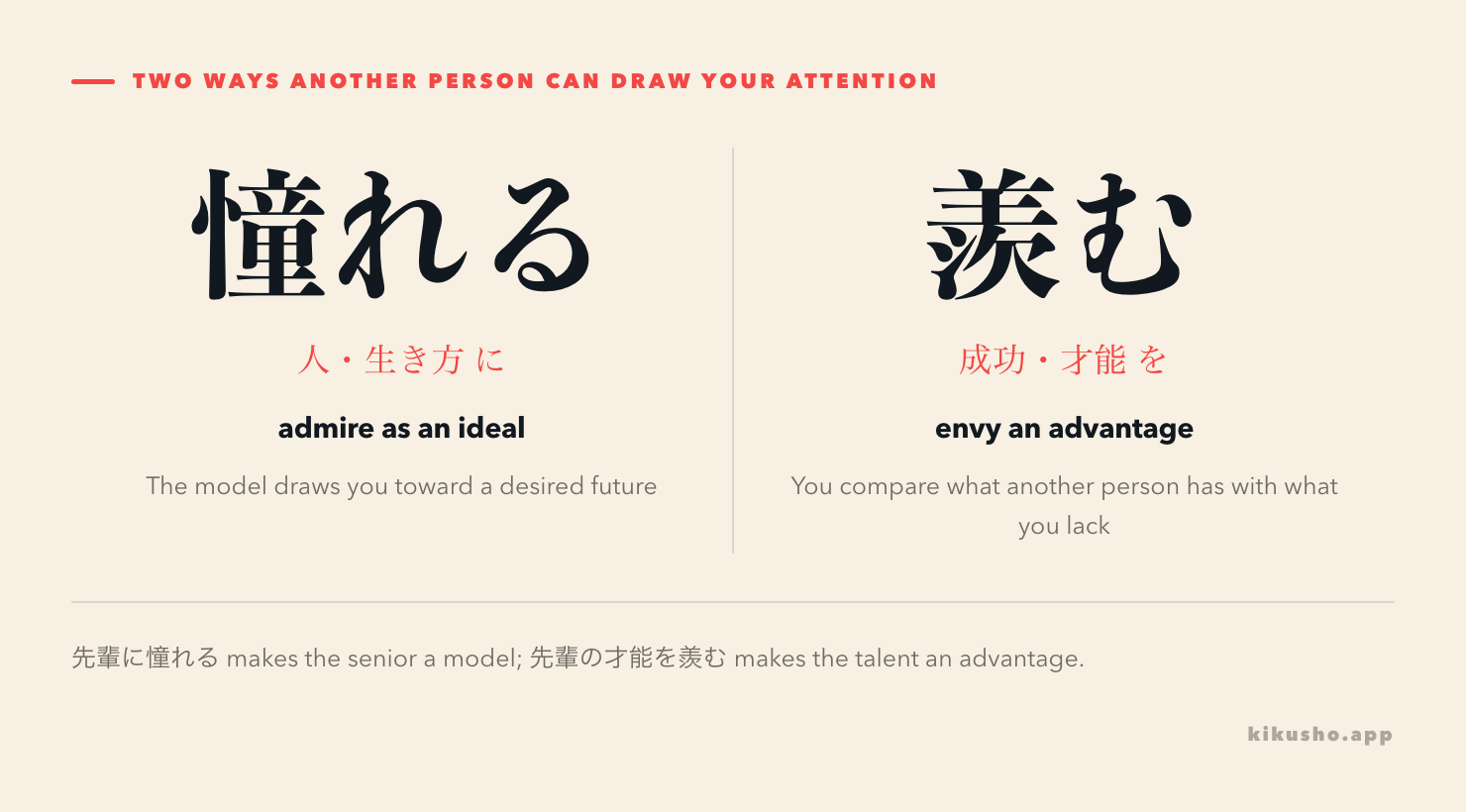
The words can describe the same person from different angles. 先輩に憧れる makes the senior a model. 先輩の才能を羨む makes the senior's talent an advantage you lack. The N3 lesson on 羨ましい compares the corresponding い-adjective and shows how viewpoint changes the sentence.
At N1, the continuing lesson on emotions and mental states turns the verb into the noun 憧れ and adds the outlook pair 悲観/楽観.
嫌がる shows resistance; 恨む keeps a grievance
嫌がる(いやがる) means that dislike or reluctance appears outwardly. It is formed from 嫌だ and がる, then behaves as a godan verb.
子どもは歯医者へ行くのを嫌がった。
こどもは はいしゃへ いくのを いやがった。
The child showed reluctance to go to the dentist.
The action 歯医者へ行く is nominalised with の and marked by を. The past form 嫌がった reports the child's visible resistance. Shogakukan defines the verb as showing outwardly that one feels something is unpleasant.
This differs from 嫌う, which readily describes a general dislike or avoidance: 彼は人前で話すことを嫌う. The full lesson on がる and observed feelings teaches the formation, conjugation and evidence rule without making 嫌がる carry every meaning of 嫌う.
恨む(うらむ) is heavier and more durable. It presents resentment toward someone because of a perceived injury, betrayal or unfair treatment.
彼は自分をだました相手を今でも恨んでいる。
かれは じぶんを だました あいてを いまでも うらんでいる。
He still resents the person who deceived him.
The target takes を, and 今でも makes the continuing grievance explicit. Useful related patterns include 恨みを持つ, “hold a grudge,” and the passive 人に恨まれる, “be resented by someone.”
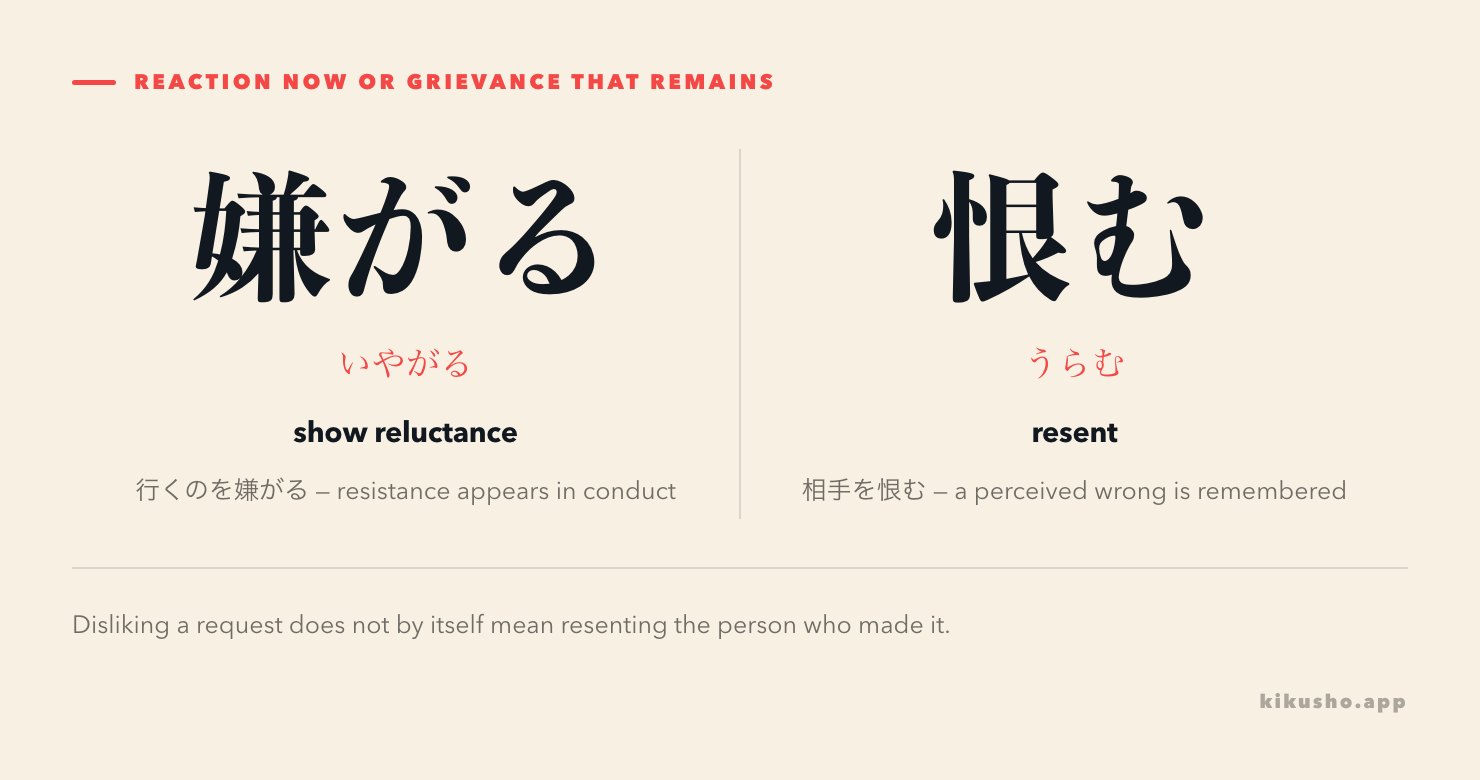
Disliking an immediate request does not imply resentment toward the requester. A colleague can 残業を嫌がる, resist working overtime, without 上司を恨む, resenting the manager. The event and time scale decide which verb fits.
惜しい protects value and marks a near miss
惜しい(おしい) is an い-adjective with two central modern uses. First, something is valuable enough that losing or wasting it feels unacceptable.
その作業に一日使うのは時間が惜しい。
その さぎょうに いちにち つかうのは じかんが おしい。
Spending a whole day on that task would be a waste of valuable time.
This is the sense behind 惜しい人を失った, losing a valuable person, and 命が惜しい, valuing one's life and not wanting to lose it.
Second, a result came close to success but fell short.
あと一点だった。惜しい試合だった。
あと いってんだった。おしい しあいだった。
It came down to one more point. It was such a close loss.
チームは惜しくも優勝を逃した。
チームは おしくも ゆうしょうを のがした。
The team narrowly missed winning the championship.
Shogakukan records both not wanting to lose or waste something important and regretting a result that missed realization by only a little. 残念 can express broad disappointment; 惜しい often adds either value or closeness.
ためらう holds an action at the threshold
ためらう means hesitating because a decision is not settled. It is a godan verb even though it is usually written in kana.
本当のことを話すのをためらった。
ほんとうの ことを はなすのを ためらった。
I hesitated to tell the truth.
The contemplated action takes のを. A noun can also be the object: 返事をためらう means to hesitate before answering. The negative adverbial form is especially useful.
分からなければ、ためらわずに質問してください。
わからなければ、ためらわずに しつもんして ください。
If you do not understand, please ask without hesitating.
Shogakukan defines the modern sense as wavering because a decision has not been reached. The National Institute for Japanese Language and Linguistics also records action objects such as 返事, 即答, 受験 and 結婚 for ためらう.
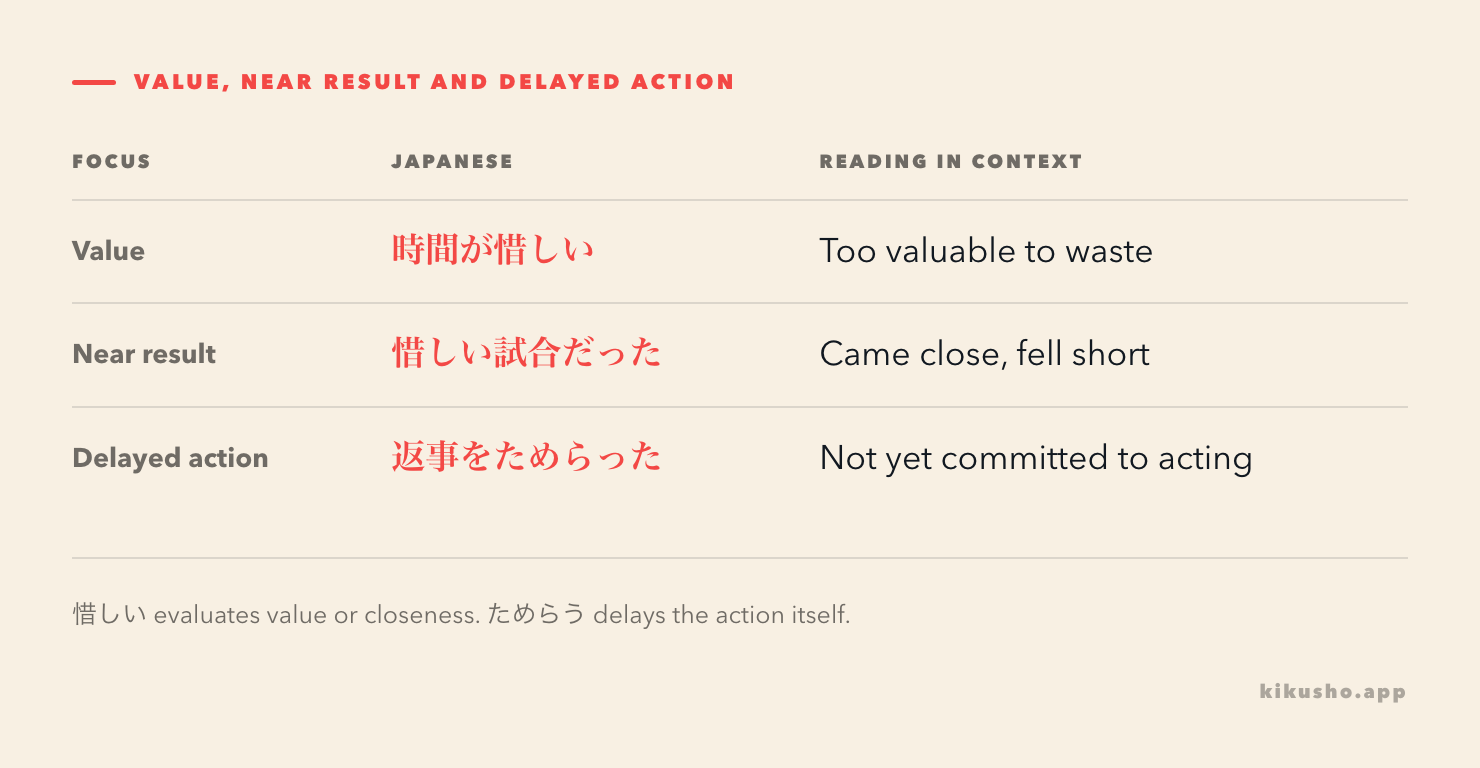
迷う is broader uncertainty. どの大学を選ぶか迷う compares alternatives; その大学に応募するのをためらう pauses before carrying out one contemplated action. The two can overlap when uncertainty produces the pause, but the constructions keep the focus different.
Follow all six words through one decision
私は昔から報道写真家に憧れていた。海外で活躍する友人を羨むこともあったが、自分の作品をコンテストに送るのをためらっていた。家族は私が安定した仕事を辞めるのを嫌がり、私は反対されたことを恨んだ時期さえあった。それでも締め切り直前に応募した。受賞を逃したが、審査員は「視点はいい。惜しい作品だった」と評価してくれた。
わたしは むかしから ほうどうしゃしんかに あこがれていた。かいがいで かつやくする ゆうじんを うらやむ ことも あったが、じぶんの さくひんを コンテストに おくるのを ためらっていた。かぞくは わたしが あんていした しごとを やめるのを いやがり、わたしは はんたいされた ことを うらんだ じきさえ あった。それでも しめきり ちょくぜんに おうぼした。じゅしょうを のがしたが、しんさいんは「してんは いい。おしい さくひんだった」と ひょうかして くれた。
I had admired documentary photographers for years. I sometimes envied a friend who worked abroad, but I hesitated to submit my own work to a contest. My family resisted my leaving a stable job, and there was even a period when I resented their opposition. Even so, I applied just before the deadline. I missed the prize, but a judge told me, “The viewpoint is good. The work came very close.”
The passage moves from an ideal to comparison, hesitation and resistance. 恨む does not merely intensify 嫌がる; it changes the object from the unwanted action to the people associated with a remembered grievance. 惜しい then evaluates the near result without claiming that the work won.
N2 is a supported study placement, not an official boundary
The September 2026 Kikusho inventory assigns all six spelling-and-reading records to N2 and records no source disagreement. Its two baseline snapshots descend from the same Waller vocabulary family, so their agreement is one family rather than two independent confirmations.
Current independent N2 resources provide additional evidence. PassJapanese's lesson on feelings and actions toward people includes 羨む, 憧れる and 恨む with closely matching distinctions, while current N2 lists also include 惜しい and ためらう. The official JLPT FAQ explains why the revised test does not publish a fixed exhaustive vocabulary specification. “N2” is therefore practical study guidance, not an official guarantee about a particular test form.
In Kikusho, keep the direction of the feeling on the card. Save 写真家に憧れる, 友人の成功を羨む and 応募をためらう, rather than three isolated English glosses. The particle and the surrounding event are what let review reconstruct the choice.
Practice: identify direction, evidence and timing
Complete all eight original questions before revealing the shared answer panel.
1 · Reading. Choose the reading of 憧れる.
- イ. あこがれる
- ロ. あきられる
- ハ. あずけられる
- ニ. うらやまれる
2 · Orthography. Which spelling completes the sentence meaning “envy another person's success”?
他人の成功を( )。
- イ. 恨む
- ロ. 羨む
- ハ. 憧れる
- ニ. 嫌がる
3 · Ideal and particle. Complete the sentence: 子どものころ、宇宙飛行士( )憧れていた。
- イ. を
- ロ. が
- ハ. に
- ニ. で
4 · Visible reluctance. A child cries and pulls away when told to enter the dentist's room. Which sentence reports that reaction?
- イ. 子どもは歯医者に憧れた。
- ロ. 子どもは歯医者へ行くのを嫌がった。
- ハ. 子どもは歯医者を羨んだ。
- ニ. 子どもは歯医者へ行くのを惜しんだ。
5 · Resentment or envy. Fill both blanks in order.
自分をだました相手を( 前 )。その人の成功を( 後 )。
- イ. 前:羨む / 後:恨む
- ロ. 前:嫌がる / 後:憧れる
- ハ. 前:恨む / 後:羨む
- ニ. 前:憧れる / 後:嫌がる
6 · Two senses of 惜しい. Which pair uses the adjective in its two central senses?
- イ. 時間が惜しい / 惜しい試合だった
- ロ. 時間を惜しい / 惜しく試合だった
- ハ. 時間がためらう / ためらう試合だった
- ニ. 時間に羨む / 羨ましい試合だった
7 · Hesitation before action. Which sentence is well formed?
- イ. 本当のことに話すのをためらった。
- ロ. 本当のことを話すのがためらった。
- ハ. 本当のことを話すのをためらった。
- ニ. 本当のことをためらって話すだった。
8 · Follow the sequence. Someone admires a photographer as an ideal, pauses before submitting a photo, then narrowly misses a prize. Which sequence matches those three stages?
- イ. 羨む → 恨む → 嫌がる
- ロ. 憧れる → ためらう → 惜しい
- ハ. 嫌がる → 憧れる → 羨む
- ニ. 恨む → 惜しい → ためらう
Answers and explanations
イ, あこがれる. The kanji spelling is 憧れる. The historical reading あくがれる has older senses and is not the modern item tested here.
ロ, 羨む. 他人の成功を羨む presents another person's success as an advantage one envies. 恨む is read うらむ and requires a grievance, while 憧れる normally marks its ideal with に.
ハ, に. The astronaut is the ideal toward which the feeling points: 宇宙飛行士に憧れる. The transitive verb 羨む would instead take an object with を.
ロ. The crying and pulling away are outward evidence of reluctance, so 行くのを嫌がった fits. The other choices introduce admiration, envy or the wrong use of 惜しい.
ハ, 恨む / 羨む. Deception supplies a remembered wrong and motivates resentment toward the person. Success supplies a favourable result that can be envied.
イ. 時間が惜しい treats time as too valuable to waste. 惜しい試合だった evaluates a match that came close to a desired result. The remaining pairs break the adjective's grammar or change the target meaning.
ハ. The contemplated action is 本当のことを話す. Nominalising it with の and marking it with を gives 話すのをためらった.
ロ, 憧れる → ためらう → 惜しい. Admiration points toward the photographer as an ideal, hesitation delays submission, and 惜しい evaluates the near success after the result is known.
Common questions
What is the difference between 憧れる and 羨む?
憧れる presents a person, role or way of life as an ideal that draws you toward it, and its target commonly takes に. 羨む presents someone else's favourable situation as something you envy, and its target takes を.
What is the difference between 嫌がる and 嫌う?
嫌がる describes dislike or reluctance being expressed outwardly, often through someone else's words or behaviour. 嫌う more readily describes a general dislike or tendency to avoid a person or thing.
What are the two common meanings of 惜しい?
惜しい can mean that something is too valuable to lose or waste, as in 時間が惜しい. It also describes a near success that narrowly fell short, as in 惜しい試合 or 惜しくも優勝を逃した.
How is ためらう used before an action?
The contemplated action can be nominalised with の and marked by を, as in 本当のことを話すのをためらった. ためらわずに means without hesitating.