On this page
家族を愛している means “I love my family”: an emotion verb with を. Japanese emotion vocabulary includes verbs, nouns and adjectives, so the word’s construction determines its particles and endings.
These six words let you distinguish loving someone, fearing an outcome, grieving a loss, naming feelings, being moved and feeling the sting of defeat. Their English translations overlap with “feel,” but that does not give them a shared Japanese sentence pattern.
This N3 vocabulary set teaches 愛する、恐れる、悲しむ、感情、感動、悔しい. Level labels are study guidance: the reference lists used for this curriculum disagree over 悔しい, placing it at N3 or N2. The labels organise study; they do not guarantee which words will appear on a test.
Learn the feeling and its construction together
The table gives the particular everyday senses taught here. The phrases are examples of useful constructions, not a claim that each word always requires that particle.
| Word | Reading | Meaning here | Word class | Phrase to keep |
|---|---|---|---|---|
| 愛する | あいする | love; deeply cherish | する verb | 家族を愛する, love one’s family |
| 恐れる | おそれる | fear; be afraid of an adverse outcome | ichidan verb | 失敗を恐れる, fear failure |
| 悲しむ | かなしむ | grieve; feel sorrow over something | godan verb | 別れを悲しむ, grieve over a parting |
| 感情 | かんじょう | emotion; feelings | noun | 感情を表す, express feelings |
| 感動 | かんどう | being deeply moved | noun; also 感動する | 演奏に感動する, be moved by a performance |
| 悔しい | くやしい | frustrated, bitterly disappointed or hurt by defeat or humiliation | い-adjective | 負けて悔しい, feel frustrated after losing |
Read 家族 as かぞく, 失敗 as しっぱい, 別れ as わかれ, 表す as あらわす and 演奏 as えんそう.
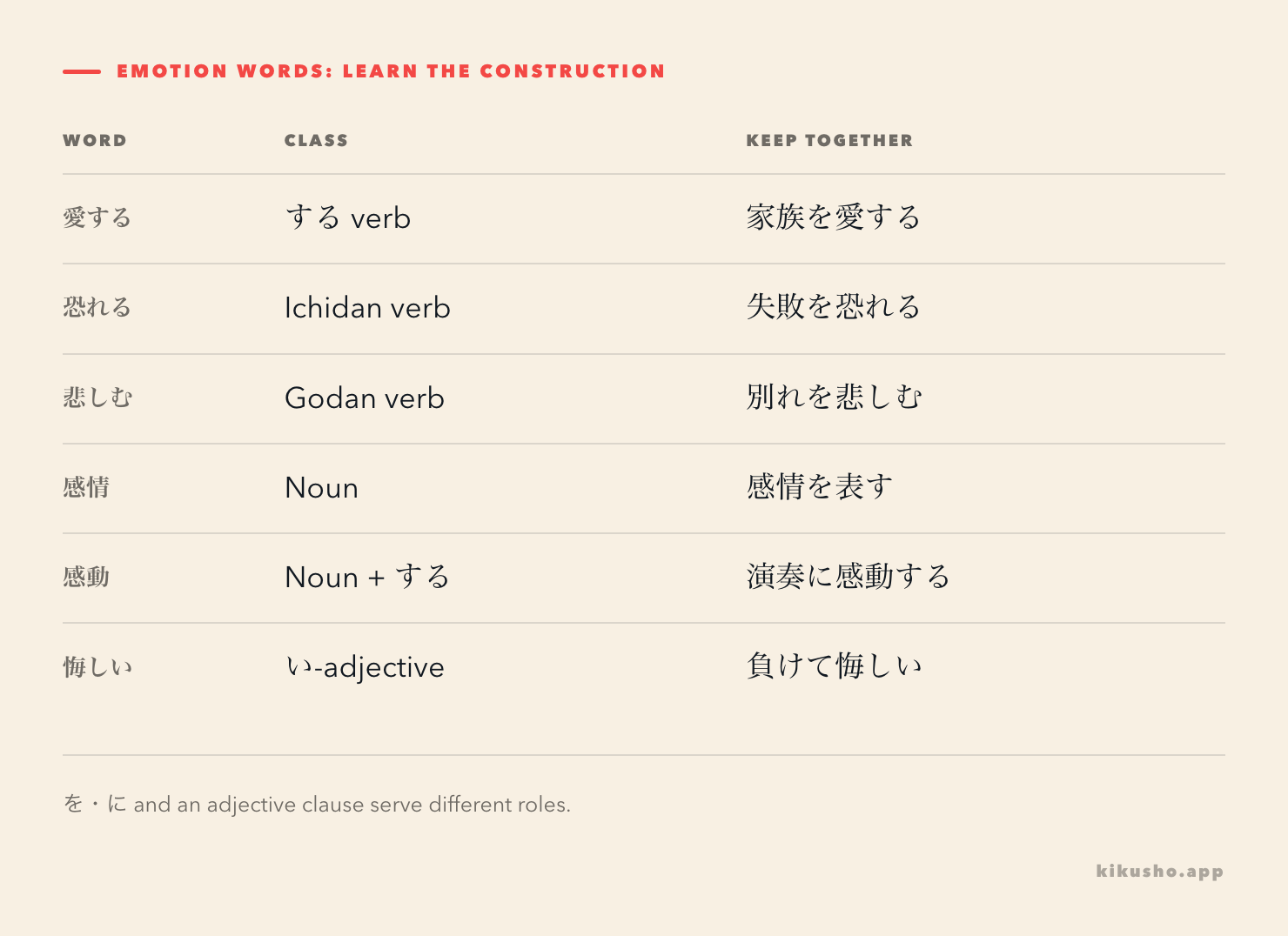
The dictionary entries in Shogakukan’s Digital Daijisen support these readings and modern senses: 愛する, 恐れる, 悲しむ, 感情, 感動 and 悔しい. Older meanings listed in the dictionaries are outside this lesson.
を names what you love, fear or grieve over
愛する is a substantial expression of love or attachment. It can refer to family, a partner or something deeply cherished, not only romantic love.
私は家族を愛しています。
わたしは かぞくを あいしています。
I love my family.
The ongoing feeling often appears as 愛している, rather than an isolated 愛する. For a casual preference, 好き may fit better; “I love this snack” in English does not automatically call for a declaration with 愛する.
恐れる concerns fear or apprehension. The feared thing can be an outcome rather than something physically frightening.
彼は失敗を恐れている。
かれは しっぱいを おそれている。
He is afraid of failing.
悲しむ is a verb for feeling or expressing sorrow. You can name what someone grieves over with を.
姉は友人との別れを悲しんでいる。
あねは ゆうじんとの わかれを かなしんでいる。
My older sister is grieving over parting from her friend.
The verb and the related adjective 悲しい have different shapes. 悲しい describes sadness; 悲しむ conjugates as a verb. Tofugu’s い-adjective guide explicitly discusses 悲しむ among verbs corresponding to emotion adjectives.
Here are the verb forms needed for the examples:
| Base | Polite form | て-form | Ongoing feeling |
|---|---|---|---|
| 愛する | 愛します | 愛して | 愛している |
| 恐れる | 恐れます | 恐れて | 恐れている |
| 悲しむ | 悲しみます | 悲しんで | 悲しんでいる |
The pattern is む → んで in 悲しむ. Dropping む and adding て would give the wrong form.
感動する takes the thing that moves you with に
感動 refers to a strong emotional response to something affecting or impressive. Add する to describe experiencing that response.
子どもたちの演奏に感動しました。
こどもたちの えんそうに かんどうしました。
I was deeply moved by the children’s performance.
The person experiencing it is understood from context. 演奏に identifies what moved them. Compare 失敗を恐れる: the English preposition in “afraid of” or “moved by” does not decide the Japanese particle.
As a noun, 感動 can take a descriptive word: 深い感動(ふかい かんどう), “a profound emotional response.” It names a particular experience of being moved. It does not mean every possible emotion.
感情 is the broader noun. It needs a predicate to say what happens to the feelings:
自分の感情を言葉で表すのは難しい。
じぶんの かんじょうを ことばで あらわすのは むずかしい。
It is difficult to express your own feelings in words.
Other useful partners include 感情を抑える(かんじょうを おさえる), “keep your emotions in check,” and 感情が顔に出る(かんじょうが かおに でる), “your feelings show on your face.” The different particles come from each full construction. 感情する is not the ordinary verb for “feel emotional.”
JapaneseTest4You’s 感情 page presents the general noun at N3; its 感動 page distinguishes the noun and する verb. These are separately published teaching pages, but their underlying level-list provenance is not established.
悔しい carries frustration in an adjective ending
悔しい fits the feeling that a result hurts, especially when you lost, failed despite effort or were humiliated. The frustration can include resentment or regret; a bland “that’s unfortunate” misses its force.
一点差で負けて、悔しいです。
いってんさで まけて、くやしいです。
I lost by one point, and I’m frustrated.
The loss gives the cause through 負けて. You do not need to insert が into every sentence about an emotion.
| Meaning | Form |
|---|---|
| I’m frustrated | 悔しいです |
| I was frustrated | 悔しかったです |
| I’m not frustrated | 悔しくないです |
| a frustrating experience | 悔しい経験(くやしい けいけん) |
These are regular い-adjective forms. 悔しいだ and 悔しいな経験 do not fit them. The lesson on Japanese adjective classes gives the broader attachment rules.
Show how you know another person’s feeling
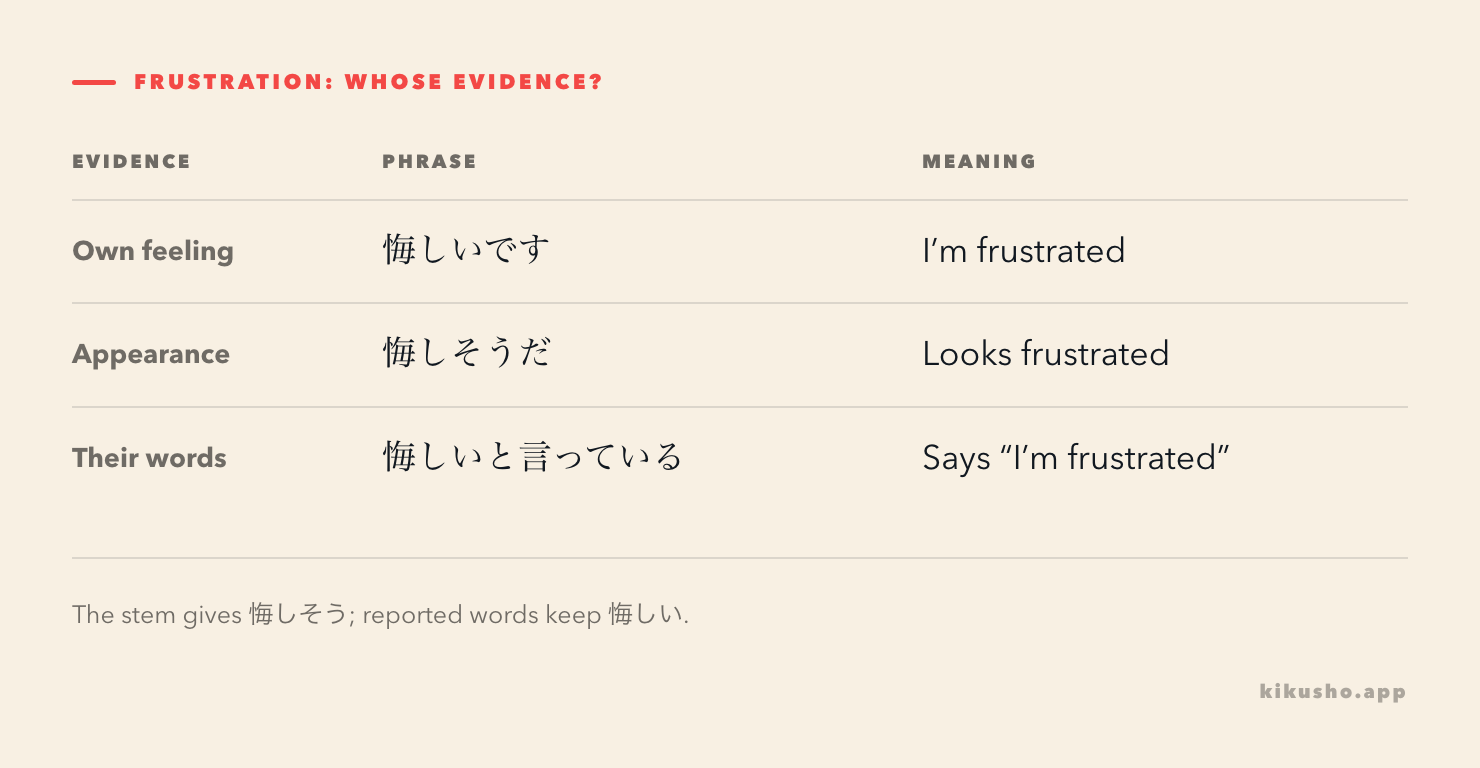
In ordinary conversation, a bare present-tense feeling adjective such as 彼は悔しい can sound as if you have direct access to someone’s inner state. Use a form that matches your evidence:
| What you know | Sentence | Translation |
|---|---|---|
| Their appearance | 彼は悔しそうだ。 | He looks frustrated. |
| Their own words | 彼は「悔しい」と言っている。 | He says, “I’m frustrated.” |
| Their displayed reaction | 彼は悔しがっている。 | He is showing frustration. |
Read 彼 as かれ. 悔しそう uses the adjective stem; it describes appearance. 悔しいと言っている preserves the adjective in the reported words. 悔しがっている uses the corresponding がる verb.
This is a conversational perspective rule, not a ban on mentioning anyone else’s feelings. Questions can ask the listener about their experience. A story’s narrator can describe a character’s feelings directly. Emotion verbs such as 悲しんでいる also allow descriptions of another person’s reaction, as the sister example above shows.
Mayumi Ito’s Mango Languages lesson explains the speaker/listener distinction, observed emotion verbs and narrative exceptions. Its adjective patterns must not be extended mechanically to every noun or verb in this set. The ~たい lesson handles the related perspective question for wants.
Follow the event when these words appear in a scene
A sports interview can turn 悔しい into determination to try again. A response to music can use 感動した even when the person is smiling rather than crying. A story can put 愛している beside a character’s actions instead of an explicit declaration to their partner. Treat these as reading contexts, not frequency rankings.
When you stop at a feeling word in manga dialogue, read what happened before the line. The event separates sorrow over a loss from frustration over a defeat, and the predicate shows whether a noun names the feeling or a verb describes the response.
If you meet 悔しい in an interview, Kikusho’s text capture can turn that word into an editable card. Keep the match result in the example you check before saving; “frustrated” without the defeat that prompted it gives you less to recall. The app’s scheduled reviews can then bring that particular word back, rather than replacing the scene with a generic emotion list.
Try eight questions before opening the answers
These original questions sample five vocabulary practice formats used at N3: kanji reading, orthography, meaning in context, paraphrase and usage. They do not assess full exam readiness. Write down your choices; the explanations follow the entire exercise.
Question 1
How is the bold word read?
怒りも喜びも感情の一つです。
- A. かんじょ
- B. かんじょう
- C. かんどう
- D. かんしょう
Question 2
Which spelling matches くやしい?
- A. 悔しい
- B. 嬉しい
- C. 悲しい
- D. 怖い
Question 3
A speaker thanks someone whose kindness moved them. Complete their response.
温かい言葉をかけてくれて、ありがとう。あなたの優しさに( )。
- A. 悲しんだ
- B. 感動した
- C. 恐れた
- D. 愛した
Question 4
A speaker means “I love my family.” Which sentence expresses that relationship with 愛する?
- A. 私は家族に愛している。
- B. 私は家族が愛している。
- C. 私は家族を愛している。
- D. 私は家族で愛している。
Question 5
Pick the closest meaning of 恐れている in this sentence.
彼は失敗を恐れている。
- A. 失敗してよかったと思っている。
- B. 失敗した人を大切にしている。
- C. 失敗するのが怖いと思っている。
- D. 失敗を見て心を動かされている。
Question 6
Supply the feeling that fits this athlete’s reaction.
あと一点で勝てたのに、負けてしまった。( )。次こそ勝ちたい。
- A. 愛している
- B. 感動した
- C. 感情だ
- D. 悔しい
Question 7
Find the natural use of the noun 感情.
- A. 私は映画に感情した。
- B. とても感情な顔をしていた。
- C. 昨日は感情くなかった。
- D. 自分の感情を言葉で表した。
Question 8
The family is grieving, rather than describing disappointment in a competition. What completes the sentence?
大好きな祖母が亡くなった。家族は祖母との別れを( )。
- A. 悲しんでいる
- B. 感動している
- C. 愛している
- D. 悔しい
Finish your notes before comparing them with the explanations below.
Answers and explanations
Answer 1. B: かんじょう. The long vowel belongs to the reading. かんどう is 感動, a different word; かんじょ loses the final long vowel, and かんしょう is not this headword’s reading. The sentence says anger and joy are both emotions.
Answer 2. A: 悔しい. 嬉しい is うれしい, “glad”; 悲しい is かなしい, “sad”; 怖い is こわい, “scared” or “frightening.” Those are related feelings, but their spellings and readings do not match くやしい.
Answer 3. B: 感動した. “Thank you for your warm words. I was moved by your kindness.” 優しさに identifies the cause of the emotional response. The other three verbs do not give this appreciative meaning or fit that same target construction.
Answer 4. C: 私は家族を愛している。 “I love my family.” を marks the people loved. A and D give the wrong particle for that role. B makes 家族 the subject of 愛している. With 私 as the topic, it can instead mean “My family loves me”; it reverses who loves whom.
Answer 5. C: “He thinks failing is frightening.” A welcomes failure, B cherishes a person, and D describes being emotionally moved. None preserves the fear in 恐れている.
Answer 6. D: 悔しい. The narrow defeat and wish to win next time motivate frustration. A says “love,” B says “was moved,” and C merely supplies the noun “emotion” with だ; they do not express the feeling requested by this context.
Answer 7. D: 自分の感情を言葉で表した。 “I expressed my own feelings in words.” A treats 感情 as a する verb; B gives the bare noun な-adjective attachment; C applies an い-adjective ending to it. Here 感情 is the object of 表した.
Answer 8. A: 悲しんでいる. “The family is grieving over parting from their grandmother.” 感動している normally identifies what moved someone with に. 愛している would make the parting itself something they love, which contradicts the grief context. 悔しい cannot complete this を + verb construction.
Common questions
Do all Japanese emotion words take が?
No. The target of 愛する, 恐れる and 悲しむ can take を. The thing that moves you takes に with 感動する. 感情 is a noun, while 悔しい is an i-adjective. Learn the construction with the word.
What is the difference between 感情 and 感動?
感情, かんじょう, names emotions or feelings in general. 感動, かんどう, names the experience of being deeply moved and also forms the verb 感動する. A film can move you: 映画に感動する.
Can I describe another person as 悔しい?
In ordinary conversation, show how you know. 悔しそうだ means they look frustrated; 悔しいと言っている reports what they say. 悔しがっている describes their displayed frustration. Fictional narration can describe a character’s feelings directly.