On this page
Choose Japanese verb register by checking the action, the sense and who receives respect. 聞く can mean hearing, listening or asking; 伺う can humbly mean asking, hearing or visiting; 承る can respectfully mean hearing or accepting a request.
This N2 vocabulary comparison teaches 聞く、尋ねる、問う、伺う、承る、参る、申す、言う. It includes both 言う(いう) and 言う(ゆう): nine spelling-and-reading records, eight written headwords. Those two 言う records do not give you two different levels of politeness.
The prerequisites cross levels. In the planning snapshot derived from Jonathan Waller's Tanos lists, 言う(いう)・聞く are N5; 伺う・尋ねる・参る・申す are N4; 問う・言う(ゆう) are N3; 承る is N2. The imported adaptations belong to one list family. 問う also has an N1 observation; the N5 comparison entry for 言う matches the headword without establishing its ゆう reading. The JLPT does not provide an exhaustive official vocabulary syllabus. Here, N2 names the comparison's place in the series.
Decide what happens before choosing how to say it
First identify the action: hearing a sound, requesting information, accepting an order, speaking or visiting. Then check whose action you describe and the relationship it expresses. Adding ます gives a polite ending, but it does not turn every verb into a respectful description of someone else's action.
Read the overview of Japanese politeness if the distinction between honorific and humble speech is new. The table below narrows each word to the senses taught on this page; it is not a catalogue of every historical or specialised use.
| Headword and reading | Verb class | Taught sense | Phrase to learn |
|---|---|---|---|
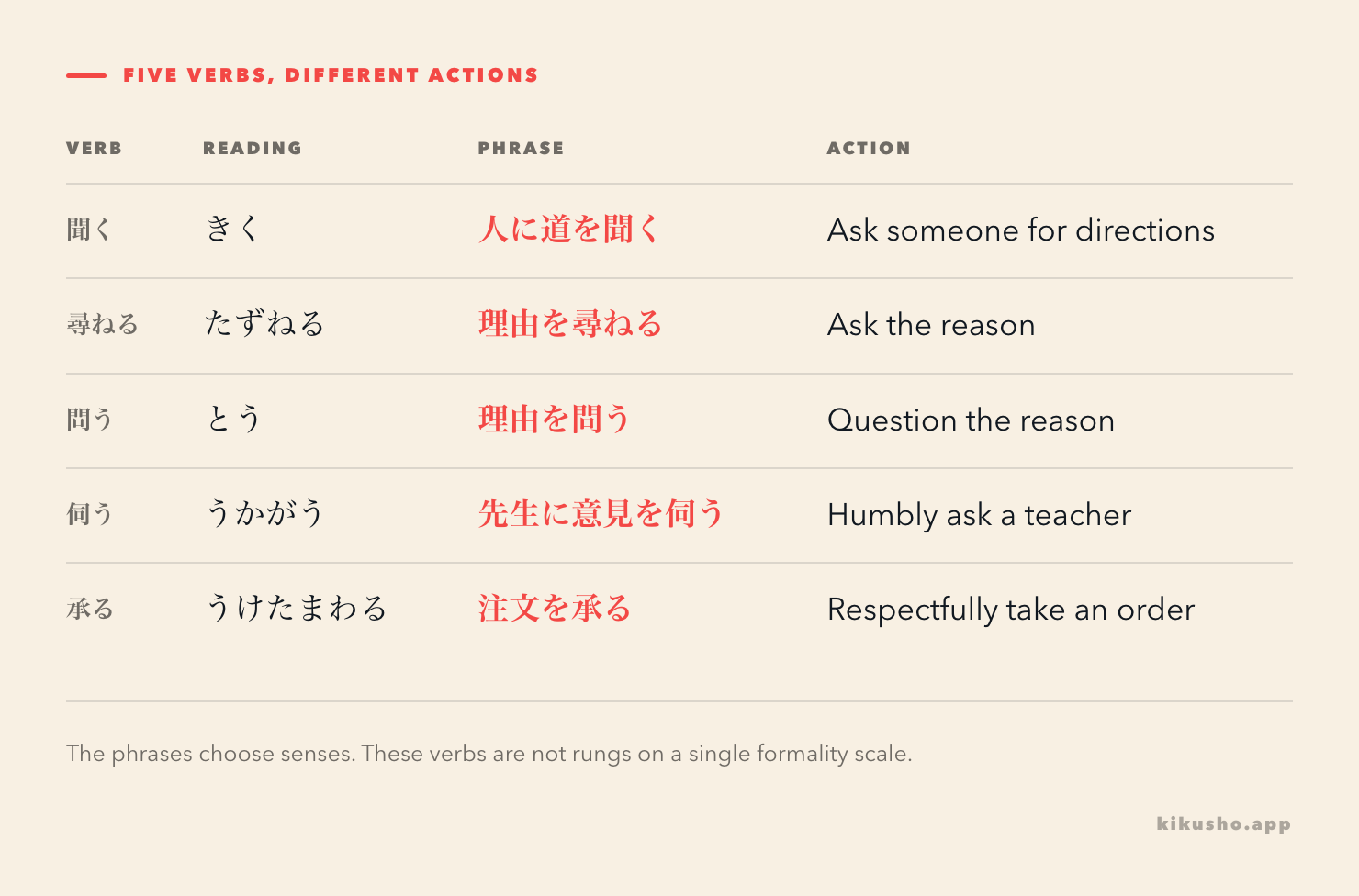
| 聞く(きく) | Godan, く | Hear; listen; ask | 人に道を聞く: ask someone for directions |
| 尋ねる(たずねる) | Ichidan | Ask; inquire | 理由を尋ねる: ask the reason |
| 問う(とう) | Godan, う | Ask; put a question to someone | 理由を問う: question the reason |
| 伺う(うかがう) | Godan, う | Humbly ask, hear or visit | 先生に意見を伺う: ask a teacher's opinion |
| 承る(うけたまわる) | Godan, る | Respectfully hear or accept a request | 注文を承る: take an order |
| 参る(まいる) | Godan, る | Courteously go or come | 会場へ参ります: I will go to the venue |
| 申す(もうす) | Godan, す | Courteously say; be called | 西田と申します: my name is Nishida |
| 言う(いう) | Godan, う | Say; be called | 名前を言う: say a name |
| 言う(ゆう) | Godan, う; variant of 言う | Say; dictionary-form pronunciation/variant | 言う is pronounced ユウ; standard 言います is いいます |
参る and 承る are godan verbs despite ending in る: 参ります・承ります. 尋ねる drops its final る before ます: 尋ねます. The respectful relationship belongs to the word and situation, alongside the ending.
聞く, 尋ねる and 問う have different ground
聞く reaches beyond questions
聞く covers several actions. 音楽を聞く means listening to music; 鳥の声を聞く means hearing birds; 人に道を聞く means asking someone for directions. The object and surrounding situation select the sense, as Daijisen's 聞く entry shows.
受付の人に開始時間を聞きました。
うけつけの ひとに かいしじかんを ききました。
I asked the person at reception what time it starts.
に marks the person asked; を marks the information requested. 聞きました is already polite toward the listener through ました, without being a special humble verb.
尋ねる makes the inquiry explicit
In the asking sense taught here, 尋ねる singles out requesting information. It cannot replace 聞く when you mean simply hearing a sound.
編集者に変更の理由を尋ねました。
へんしゅうしゃに へんこうの りゆうを たずねました。
I asked the editor the reason for the change.
理由を聞く can also describe asking for the reason. Neither is automatically humble. Daijisen's 尋ねる entry includes inquiry alongside other senses; this lesson teaches the inquiry, not its older uses. For an ordinary modern visit, you will meet the different spelling 訪ねる.
問う can put an issue under examination
問う appears when a speaker puts a question, reason or issue to someone. It often suits written or deliberate questioning, but “formal 聞く” is too narrow a definition.
委員会は計画の目的を問いました。
いいんかいは けいかくの もくてきを といました。
The committee questioned the purpose of the plan.
Daijisen's 問う entry also distinguishes testing ability, pursuing responsibility and negative expressions that disregard a condition. Those other senses require their own frames. Reading 理由を問う as merely hearing the reason would miss the questioning action.
伺う follows the person being asked, heard or visited
伺う is humble speech directed toward someone connected with your action. Three common modern senses are supported by Daijisen's entry:
| Context | Example and reading | Meaning |
|---|---|---|
| Inquiry | 先生に意見を伺います。 せんせいに いけんを うかがいます。 |
I will ask the teacher's opinion. |
| Hearing | 先生のお話を伺いました。 せんせいの おはなしを うかがいました。 |
I listened to what the teacher had to say. |
| Visit | 先生の研究室に伺います。 せんせいの けんきゅうしつに うかがいます。 |
I will visit the teacher's research office. |
It is the teacher being asked, heard or visited who receives respect. The verb does not mean “visit” in every sentence, and it is not a replacement for every use of going, coming or being somewhere.
A role reversal changes the choice. If you are politely inviting a customer to ask your colleague, 担当者に伺ってください would use a humble verb for the customer's action. The Agency for Cultural Affairs' lesson on this mistake recommends a respectful request such as お聞きください instead. Keep track of the person acting before making a substitution.
承る can receive information or a request
承る has a respectful hearing sense, and also a sense of accepting or undertaking what someone asks. Its reading has all six kana: う・け・た・ま・わ・る. Daijisen separates these receiving, hearing and undertaking uses.
ご注文を承りました。
ごちゅうもんを うけたまわりました。
I have taken your order.
The staff member accepts the order. This is different from asking what the customer wants. ご予約を承ります similarly offers to take a reservation; that wording alone does not establish availability or explain a business's confirmation procedure.
For hearing, お話を承る can overlap with お話を伺う. For asking a question, do not mechanically replace 伺う with 承る: the verb's receiving or undertaking sense must fit the sentence.
伺う and 参る can describe the same visit differently
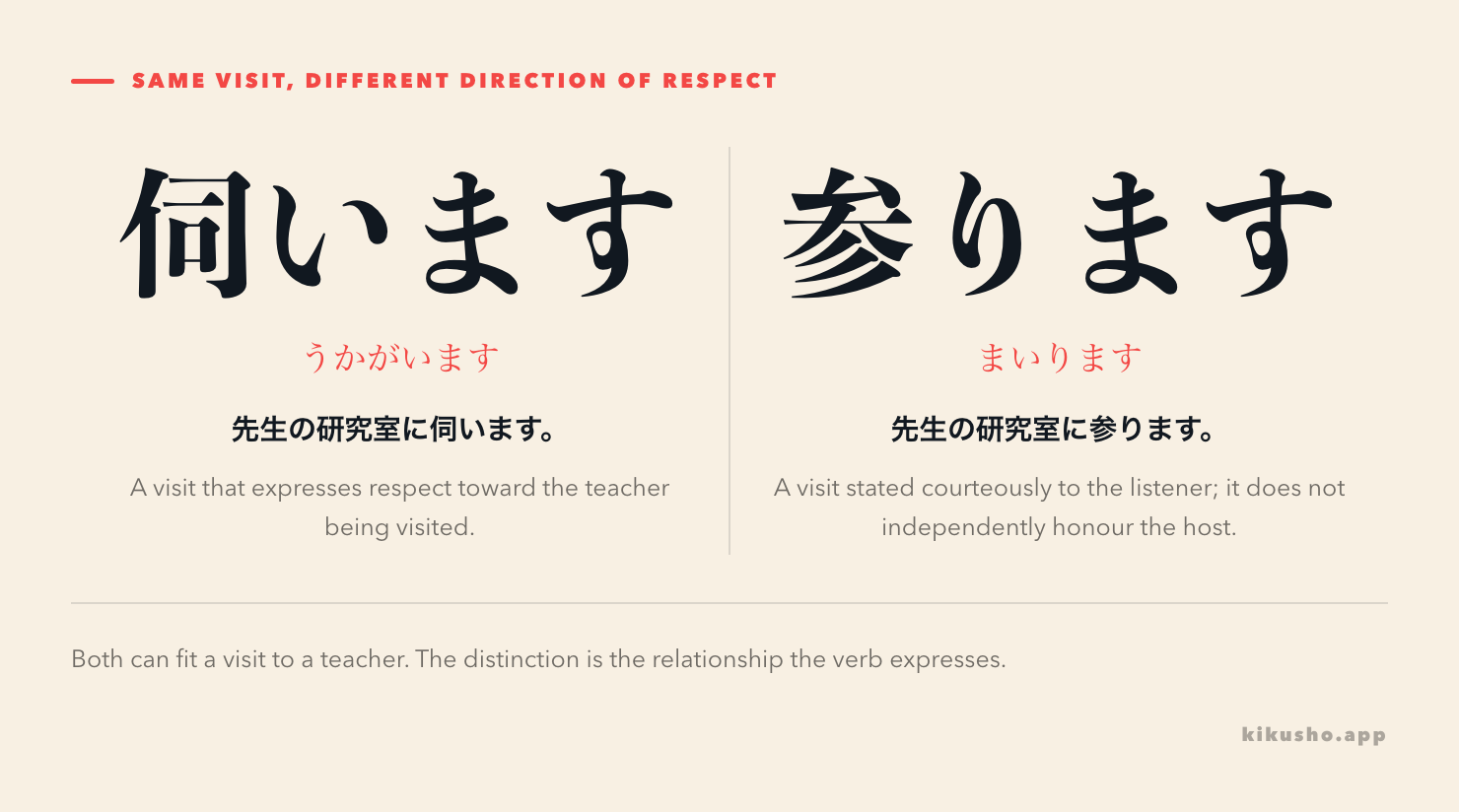
The official five-category account of keigo distinguishes 謙譲語Ⅰ from 謙譲語Ⅱ(丁重語). 伺う belongs to the first: the person involved in your action receives respect. 参る and 申す belong to the second in their courteous uses: you describe an action with courtesy toward the listener.
| Going somewhere | What the verb expresses |
|---|---|
| 先生の研究室に伺います。 | Respect toward the teacher being visited |
| 先生の研究室に参ります。 | A courteous statement to the listener |
| 会社の倉庫へ参ります。 かいしゃの そうこへ まいります。 |
“I will go to the company's warehouse,” addressed courteously to the listener |
Both teacher-office sentences can fit. 参る does not independently express the same respect toward that teacher as 伺う. Conversely, if you are going to your own warehouse with no respected host involved, 伺う lacks the relationship its visit sense needs. This is the distinction developed in the Agency's comparison of the two verbs.
The courteous go/come sense normally describes your side rather than respectfully narrating a teacher's or customer's arrival. It can also appear with nonhuman subjects: Daijisen records this use of 参る in transport announcements. Thus “a humble verb can only have 私 as its subject” is an unsafe rule. Other senses of 参る, including being overwhelmed, are outside this comparison.
申す changes how you present speech to the listener
For your own name, compare:
西田と言います。/西田と申します。
にしだと いいます。/にしだと もうします。
My name is Nishida.
Both have a polite ending. 申します additionally presents your self-introduction courteously. Daijisen's 申す entry supports this modern say/be-called sense. It is not an honorific for describing a respected teacher's speech. Do not pick it simply because the person being described has high status.
言う(いう) and 言う(ゆう) are not a register pair
Standard modern kana writes いう. The 言う dictionary page, including Nihon Kokugo Daijiten's pronunciation note, gives ユウ for the modern dictionary-form pronunciation. Daijisen also records ゆう as a variant. That pronunciation does not by itself make an utterance casual or turn the verb into a new advanced synonym.
For standard written conjugations, keep 言います(いいます) and 言った(いった). Do not manufacture ゆいます by attaching ます to the recorded ゆう form. A vocabulary list can preserve two spelling-and-reading records without identifying two different lexical choices.
Save the relationship alongside the verb
When you meet 伺います in an email, the useful detail is who will ask or visit whom. Paste the word into Kikusho through text capture, then check the editable example and politeness note against that email. A note such as “my inquiry to the teacher” gives this card a job that the single gloss “ask” cannot perform. Keep a separate note for 参ります addressed courteously to a listener.
The same care helps with formal vocabulary such as 確認 and 承認: meaning survives the change of setting. And a formal verb says nothing about the certainty of the statement around it; for that distinction, continue to the preceding N2 lesson on evidence, guesses and forecasts.
Practice
These six exercises are original study questions, not official JLPT items. Attempt the whole group; the solutions follow Question 6.
Question 1
The staff member has taken an order: ご注文を承りました。 Identify the dictionary reading of 承る.
A. うけたまる
B. うけたまわる
C. うけたわまる
D. うけたまわえる
Question 2
An editor was asked about a change: 変更の理由をたずねました。 Which written verb gives the intended modern inquiry?
A. 訪ねる
B. 尋れる
C. 尋める
D. 尋ねる
Question 3
A receptionist offers to take reservations. Complete that offer: ご予約を( )。
A. 承ります
B. 尋ねます
C. 参ります
D. 申します
Question 4
Read 担当の先生に、課題の出し方を伺いました。 Which statement preserves what happened?
A. 先生の研究室に行きました。
B. 先生に課題を出しました。
C. 先生に課題の出し方を聞きました。
D. 先生が私に課題の出し方を聞きました。
Question 5
You are courteously telling a customer about your own travel. Nobody you are showing respect to is being visited at the warehouse. Choose the verb: 私は明日、会社の倉庫へ( )。
A. 伺います
B. 承ります
C. 申します
D. 参ります
Question 6
All four sentences are grammatical. In which one does 聞く request information from someone, rather than describe hearing or listening?
A. 毎晩音楽を聞きます。
B. 警備員に駅への道を聞きました。
C. 庭で鳥の声を聞きました。
D. その話は昨日聞きました。
Answers and explanations
Answer 1: B, うけたまわる. The full reading is う・け・た・ま・わ・る. A drops わ, C switches ま and わ, and D inserts え. The sentence uses its past polite form 承りました.
Answer 2: D, 尋ねる. In this modern inquiry, 尋ねる asks the reason. A, 訪ねる, is the spelling for visiting; B and C fail to spell the taught verb. The polite past is 尋ねました, with the ichidan stem 尋ね followed by ました.
Answer 3: A, 承ります. Taking a reservation uses 承る's accepting sense. B would ask or inquire, C would go or come, and D would say something courteously. None of those three expresses accepting the reservation in this frame.
Answer 4: C. Here 課題の出し方 is information requested from the teacher. 伺う means humbly asking, so 聞く preserves the basic action while removing the special humble choice. A describes a visit, B submission of the assignment, and D reverses who asks whom.
Answer 5: D, 参ります. Courtesy is directed to the customer listening, while the speaker goes to their own company's warehouse. A would express a humble visit toward a respected person, a relationship explicitly absent here. B accepts or hears; C speaks. Neither expresses the travel.
Answer 6: B. The guard is the person asked, and the route to the station is the requested information. A is listening to music, C hearing birds in the garden, and D having heard that story yesterday. Those sentences work; they use other senses of 聞く.
Common questions
What does 伺う mean?
伺う(うかがう) can humbly mean to ask, hear or visit, depending on the sentence. In 先生に意見を伺う it means asking the teacher's opinion; in 先生の研究室に伺う it means visiting the teacher's research office. The person being asked, heard or visited receives respect.
How do 伺う and 参る differ?
For a visit, 伺う expresses respect toward the person visited. 参る(まいる) in its courteous go/come sense addresses the listener politely, even when the destination is your own company's warehouse. Both can describe visiting a teacher, but they express different relationships.
Is 言う pronounced いう or ゆう?
The standard modern kana spelling is いう. Its dictionary-form pronunciation is ユウ, and dictionaries also record ゆう as a variant. This is not a separate formal synonym. Use standard written forms such as 言います(いいます) and 言った(いった).
Are all these words N2 vocabulary?
No. The planning lists place 言う(いう) and 聞く at N5; 伺う, 尋ねる, 参る and 申す at N4; 問う and the 言う(ゆう) record at N3; and 承る at N2. 問う also has an N1 observation, and a matched N5 言う entry does not independently verify the ゆう record. These are study-list estimates, not an official syllabus.