On this page
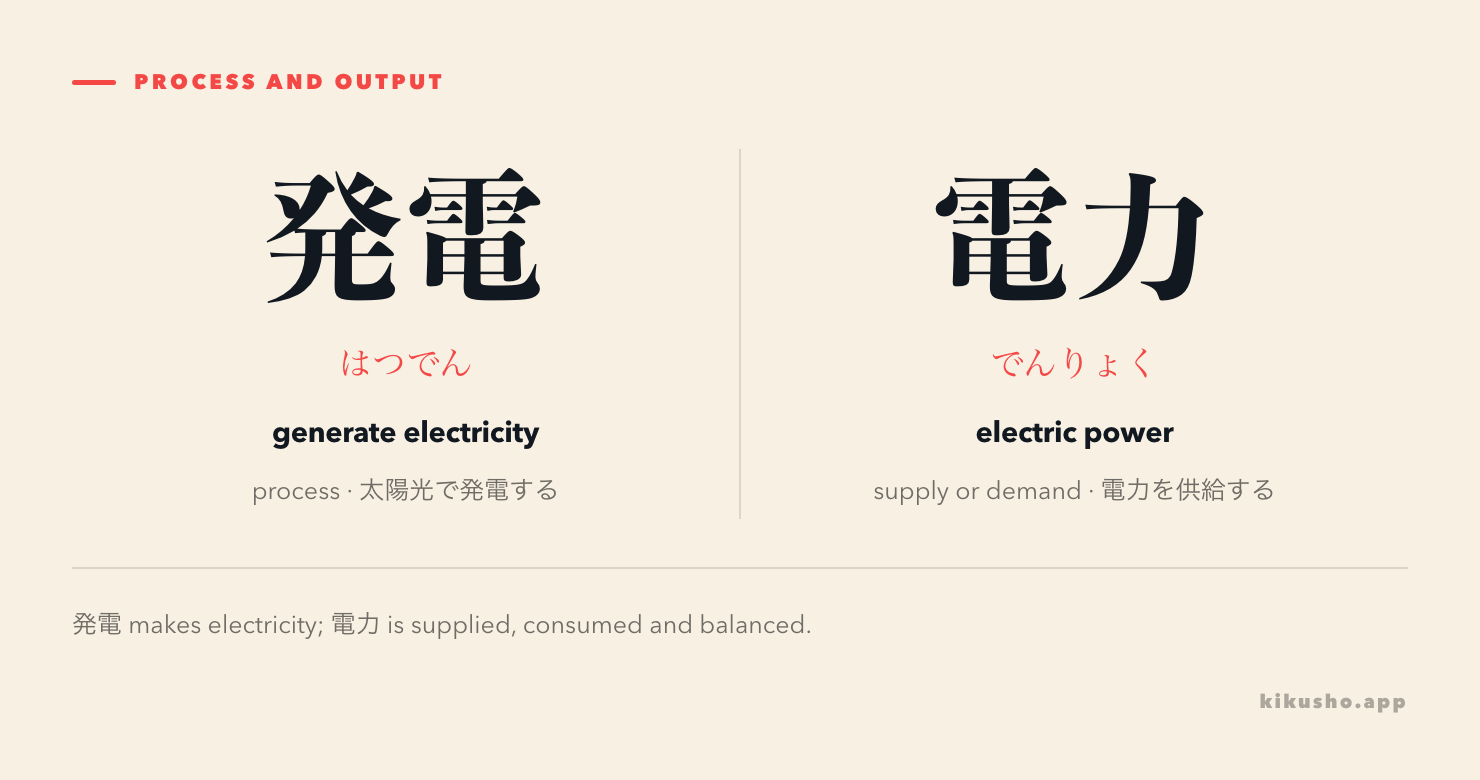
発電 is the act of generating electricity; 電力 is the power produced, supplied or consumed. This N2 lesson connects those two words with 原料, 森林, 消耗 and 公害, so a report about resources does not collapse into six vague uses of “energy” or “environment.”
Six words occupy different places in a report
Each row gives the selected sense, grammatical role and a phrase worth learning as one unit.
| Word | Reading | Part of speech | Meaning in this lesson | Useful combination |
|---|---|---|---|---|
| 原料 | げんりょう | noun | raw material; source material for a product | 紙の原料: raw material for paper |
| 公害 | こうがい | noun | public harm or pollution caused by human activity | 公害を防ぐ: prevent pollution and public harm |
| 消耗 | しょうもう | noun; suru verb | depletion, wear or exhaustion | 資源を消耗する: deplete resources |
| 森林 | しんりん | noun | forest; forested land | 森林資源: forest resources |
| 電力 | でんりょく | noun | electric power | 電力を供給する: supply electric power |
| 発電 | はつでん | noun; suru verb | electricity generation | 太陽光発電: solar power generation |
消耗 is normally read しょうもう. Dictionaries also record しょうこう, but しょうもう is the established everyday reading and the one assigned in this curriculum. Keep the final う in both long sounds: しょうもう.
原料 is what a product starts from
The dictionary entry for 原料 defines it as the material that becomes the basis of an item through manufacturing or processing.
木材は紙の原料になる。
Wood becomes a raw material for paper.
The pattern Nを原料とする means “use N as a raw material” or “be made from N”:
この製品は再生プラスチックを原料としている。
This product uses recycled plastic as its raw material.
材料 has a wider reach. It can name cooking ingredients, construction components, research evidence or material for a story. 原料 directs attention to the source substance from which a product is made. A report can therefore discuss 原料価格, raw-material prices, even when it does not list every part used in the final product.
森林 is a collective and institutional forest word
森林 refers to forest or forested land as a collective system. It fits scientific, administrative and environmental compounds such as 森林資源, 森林保護 and 森林破壊. The dictionary account of 森林 treats trees, land and the linked ecosystem as a whole.
この地域では森林を計画的に管理している。
Forests in this region are managed according to a plan.
森 is the ordinary concrete word you can use for entering, seeing or walking through a forest: 森を歩く. The boundary is not a strict size rule. Choose 森林 when the text categorises, measures, manages or protects forested land.
Japan's Forestry Agency lists biodiversity, disaster prevention, water retention and material production among the multiple functions of forests. Its terminology also connects forests with timber, fuel wood and industrial raw materials. That gives 森林 and 原料 a real relationship without making them synonyms.
公害 names harm, while 汚染 names contamination
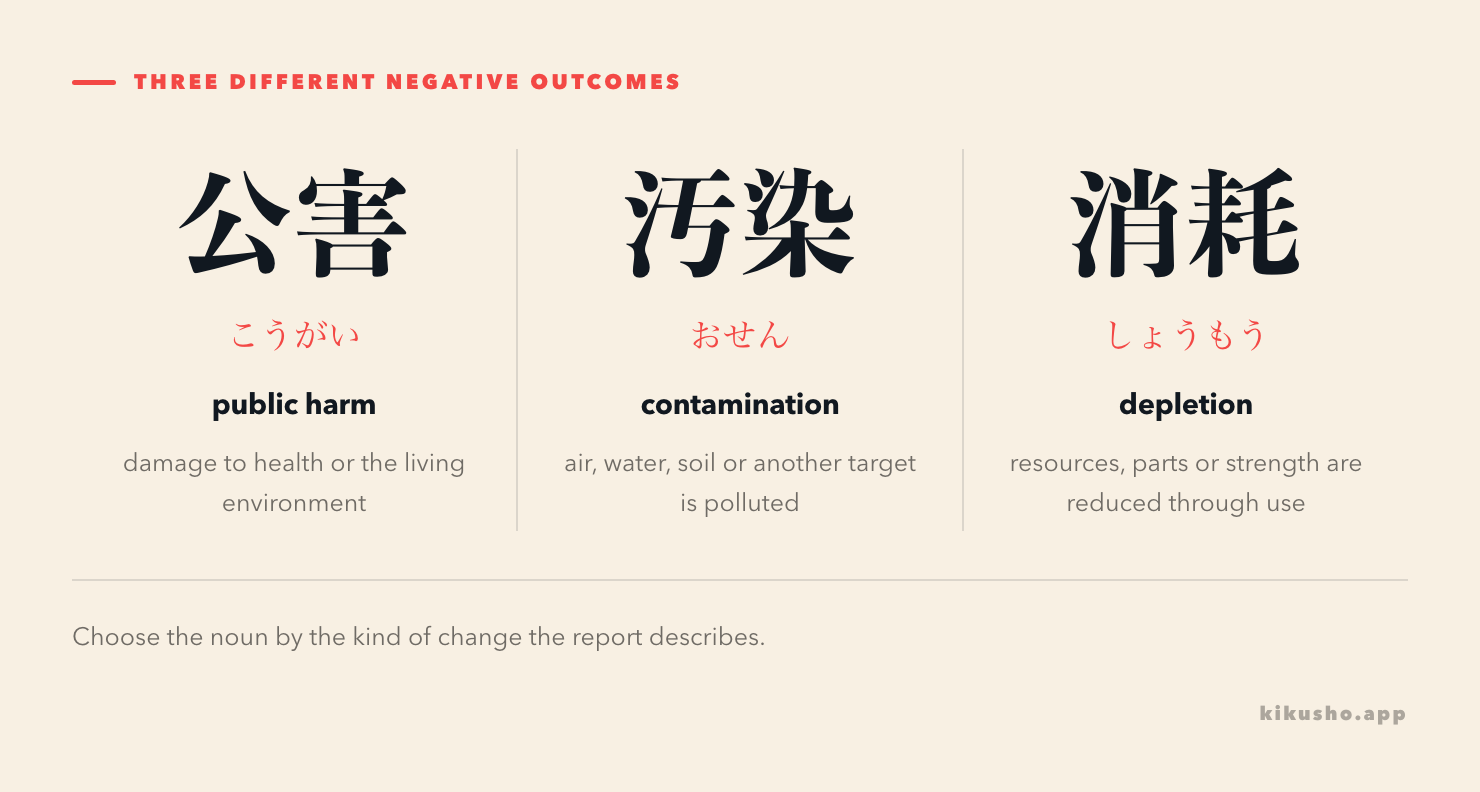
公害 is not a generic word for every environmental problem. It focuses on harm to people, property or the living environment caused by business or other human activity. Japan's legal and dictionary descriptions include air pollution, water pollution, soil contamination, noise, vibration, offensive odours and land subsidence.
工場の騒音が公害問題になった。
Noise from the factory became a public-pollution problem.
Noise need not contaminate a substance, so 汚染 would be too narrow there. 汚染 names a polluted or contaminated state, as in 大気汚染 and 土壌汚染. 公害 names the wider social harm. The Ministry of the Environment's summary of the legal definition shows why noise and vibration can fall under 公害 alongside several kinds of 汚染.
| The text describes… | Natural choice | Example |
|---|---|---|
| contamination of air, water or soil | 汚染 | 水質汚染を調べる |
| resulting public harm from human activity | 公害 | 公害を防止する |
| a problem involving noise or vibration | 公害 | 騒音公害が発生する |
消耗 foregrounds depletion, wear or exhaustion
消耗 describes something being reduced or worn out through use. It applies to fuel, supplies, machine parts, batteries, physical strength and mental energy. The inspected dictionary definitions give both “use and reduce” and “use up one's strength.”
古い機械は部品の消耗が激しい。
The parts in old machinery wear out quickly.
長時間の作業で体力を消耗した。
The long hours of work exhausted my physical strength.
消費 is the broader consumption word used for electricity, goods, services, money and household spending. 消耗 adds a view of loss, wear or exhaustion. Compare:
| Phrase | Viewpoint |
|---|---|
| 電力を消費する | use electric power; consumption is measured |
| 電池が消耗する | the battery loses usable capacity through use |
| 体力を消耗する | physical reserves are depleted |
The difference is a difference of focus, not a ban on shared objects. Dictionaries record 電力を消耗する, but reports more commonly measure 電力消費 when the intended idea is neutral consumption. Use 消耗 when depletion or wear is the point.
発電 produces electricity; 電力 is supplied and balanced
発電 names the process of generating electricity. Put the method or energy source before it:
| Form | Reading | Generation method |
|---|---|---|
| 火力発電 | かりょくはつでん | thermal power generation |
| 水力発電 | すいりょくはつでん | hydroelectric generation |
| 風力発電 | ふうりょくはつでん | wind power generation |
| 太陽光発電 | たいようこうはつでん | solar power generation |
発電所 is a power station, 発電機 a generator and 発電量 the amount generated. Japan's Agency for Natural Resources and Energy likewise describes a 発電所 as a place that makes 電気.
電力 is electric power. It appears when the text measures power or discusses a system's supply and demand:
発電所が地域に電力を供給している。
The power station supplies electric power to the region.
夏は電力の需要が増える。
Demand for electric power rises in summer.
電気 is the broad everyday word for electricity and electric light: 電気をつける, turn on the light. 電力 is more specific in technical, industrial and policy contexts. The dictionary definition of 電力 gives the physical quantity as electric energy generated, consumed or transmitted per unit time; ordinary reports extend that vocabulary into 電力供給, 電力需要 and 電力不足.
Follow the six words through one proposal
The following municipal proposal is invented for language practice:
市は森林を守りながら、木材を地域産業の原料として利用する計画を立てた。同時に、工場では設備を更新して燃料の消耗を抑え、太陽光発電で得た電力を使う。新しい設備を導入する前に、騒音などの公害が発生する可能性も調査する。
The city drew up a plan to use timber as a raw material for local industry while protecting its forests. At the same time, factories will renew their equipment, curb fuel depletion and use power obtained from solar generation. Before introducing the new equipment, they will also investigate the possibility of public harm such as noise.
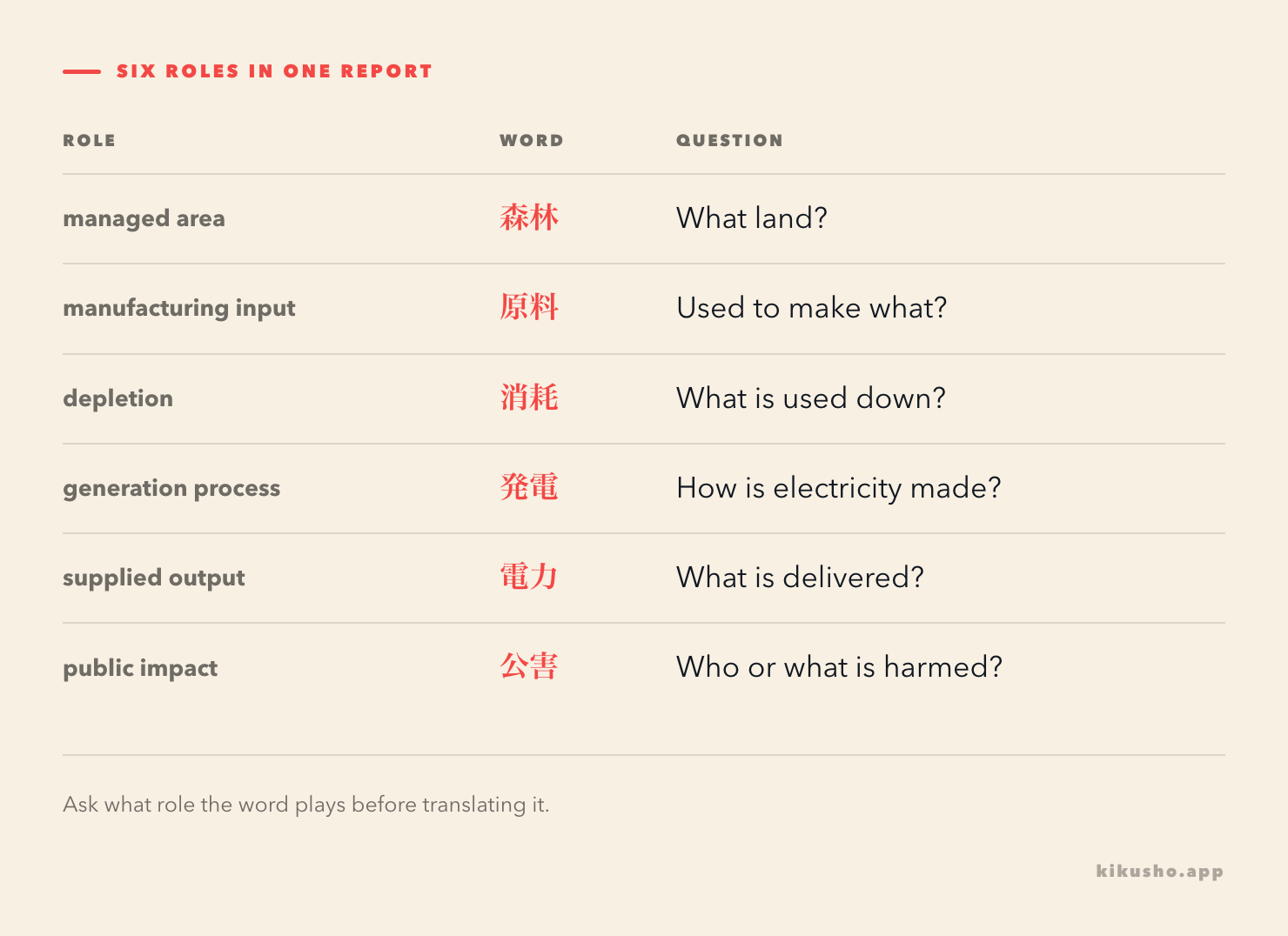
The nouns divide the proposal into stages:
- 森林 is the managed natural area.
- 原料 gives timber a manufacturing role.
- 消耗 describes fuel being depleted through use.
- 発電 names the process that produces electricity.
- 電力 is what the factories then use.
- 公害 names possible harm the plan must examine.
The N3 environment and energy lesson supplies the prerequisite contrasts 環境・自然・天然, 節約・保存・保護 and 燃える・燃やす. This N2 page advances from those objects and actions to the institutional language of production, supply, depletion and public impact.
N2 is an editorial placement
Both baseline files assign all six spelling-and-reading records to N2, but they descend from the same Waller source family and therefore count as one line of evidence. Japanesetest4you's N2 list includes 原料, its separate pages label 電力 and 発電 N2, and Bunpro independently labels 消耗 N2. These are useful study estimates rather than an official exhaustive syllabus.
The N1 continuation adds 汚す(けがす), 汚れる(けがれる), 燃焼, 燃料, 廃棄 and the uncommon しょうこう reading of 消耗.
The grammar in the examples is mostly earlier material: noun compounds, する verbs, Nを原料とする, and ordinary particles. At N2, the challenge is deciding which abstract noun a report needs and following it across a longer passage.
When a news article gives you 電力を供給する or 燃料の消耗を抑える, send the full sentence to Kikusho from the iPhone share sheet. Keep the noun's partner in the saved example. A card containing only “power” cannot test whether the source said generation, electricity or electric power; the collocation preserves that decision.
Practice
Answer all eight prompts before opening the explanations.
Question 1
How do you read 森林?
A. しんりん
B. しんばやし
C. もりりん
D. しんもり
Fix the two-kanji reading before moving on.
Question 2
Choose the spelling for しょうもう, meaning depletion, wear or exhaustion.
A. 消費
B. 消亡
C. 消耗
D. 省耗
Use both the sound and the selected meaning.
Question 3
Complete the manufacturing sentence: 木材は紙の( )になる。
A. 公害
B. 原料
C. 電力
D. 発電
Identify the role wood has before paper is produced.
Question 4
A report discusses harm to residents from factory noise. Which noun fits 工場の騒音が( )問題になった?
A. 森林
B. 汚染
C. 原料
D. 公害
Decide whether the problem requires physical contamination.
Question 5
Choose the pair that completes the process and output: 太陽光で( )し、地域に( )を供給する。
A. 発電 / 電力
B. 電力 / 発電
C. 消耗 / 原料
D. 公害 / 森林
Keep the production process separate from what is supplied.
Question 6
What does 長時間の作業で体力を消耗した mean?
A. The work generated physical strength.
B. The work measured electric power.
C. The long work period exhausted physical strength.
D. The work turned physical strength into a raw material.
Choose the interpretation that retains the depletion viewpoint.
Question 7
Which compound means wind power generation?
A. 風力電力
B. 電力風力
C. 発電風力
D. 風力発電
Place the method before the generation process.
Question 8
Read the proposal: 工場では設備を更新して燃料の消耗を抑え、太陽光発電で得た電力を使う。 Which statement is supported?
A. The factory will use more worn-out parts.
B. The factory will limit fuel depletion and use solar-generated power.
C. The factory will turn noise into a raw material.
D. The forest itself will supply electricity without equipment.
Commit to the two actions actually stated, then reveal the answer block.
Answers and explanations
1 · Forest reading — A. 森林 is しんりん. 森 is read しん in this compound, and 林 is りん. The other options mix native readings or attach readings that do not form this word.
2 · Depletion spelling — C. 消耗 is しょうもう. 消費 is しょうひ, consumption. 消亡 is a different word read しょうぼう, and 省耗 is not the assigned headword.
3 · Manufacturing source — B. 木材は紙の原料になる presents timber as a source material processed into paper. 公害 is public harm, 電力 is electric power and 発電 is generation; none can name wood's manufacturing role here.
4 · Public harm — D. Factory noise can cause 公害 because the word covers harm to the living environment from human activity, including noise. 汚染 would require contamination and does not by itself cover sound.
5 · Process and output — A. 太陽光で発電する means to generate electricity using sunlight, and 電力を供給する means to supply electric power. Reversing the nouns produces the wrong grammatical and conceptual roles.
6 · Exhausted reserves — C. 体力を消耗する means to use up or exhaust physical strength. The sentence neither creates strength nor treats it as electricity or manufacturing material.
7 · Generation compound — D. Japanese places the source or method before 発電, giving 風力発電. 風力電力 may describe wind-derived power in a specially built context, but it is not the standard name of the generation method requested.
8 · Proposal evidence — B. 燃料の消耗を抑える limits fuel depletion, while 太陽光発電で得た電力を使う uses power obtained from solar generation. The other choices introduce parts, noise or equipment-free generation that the sentence never states.
Common questions
What is the difference between 原料 and 材料?
原料 is the source material from which a product is made, often through processing. 材料 is broader: it can mean a physical ingredient or component, evidence for a decision, or material for a creative work.
What is the difference between 公害 and 汚染?
汚染 names pollution or contamination itself. 公害 names public harm to health or the living environment caused by human activity, and can also include noise, vibration, odour and land subsidence.
What is the difference between 発電 and 電力?
発電 is the process of generating electricity. 電力 is electric power, especially when discussing its supply, demand, amount or capacity.