On this page
環境を保護する means “protect the environment,” while エネルギーを節約する means “save energy.” This N3 set teaches 17 words for describing nature, pollution, resources, fuels and the actions people take around them.
The 17 words at a glance
The sense in this table is the one taught in this lesson. Several words have additional uses, which the sections below separate where they matter.
| Word | Reading | Part of speech | Core sense here | Phrase to recognise |
|---|---|---|---|---|
| エネルギー | えねるぎー | noun | energy | エネルギーを節約する: save energy |
| 汚染 | おせん | noun; suru verb | pollution; contamination | 大気汚染: air pollution |
| 環境 | かんきょう | noun | environment; surrounding conditions | 環境を保護する: protect the environment |
| 酸素 | さんそ | noun | oxygen | 酸素を含む: contain oxygen |
| 資源 | しげん | noun | resources | 天然資源: natural resources |
| 自然 | しぜん | noun; na-adjective; adverbial use | nature; natural; naturally | 自然を守る: protect nature |
| 処理 | しょり | noun; suru verb | processing; treatment; dealing with | ごみを処理する: process or dispose of waste |
| 石炭 | せきたん | noun | coal | 石炭を燃やす: burn coal |
| 石油 | せきゆ | noun | petroleum; oil | 石油資源: petroleum resources |
| 節約 | せつやく | noun; suru verb | saving; economising | 水を節約する: conserve water |
| 大気 | たいき | noun | the atmosphere | 大気を汚染する: pollute the atmosphere |
| 天然 | てんねん | noun; no-adjective | natural; from nature | 天然素材: natural material |
| 保護 | ほご | noun; suru verb | protection; care | 野生動物を保護する: protect wildlife |
| 保存 | ほぞん | noun; suru verb | preservation; storage | データを保存する: save data |
| 燃える | もえる | intransitive ichidan verb | to burn; catch fire | 木が燃える: wood burns |
| 燃やす | もやす | transitive godan verb | to burn something | 木を燃やす: burn wood |
| 汚す | よごす | transitive godan verb | to make dirty; pollute | 川を汚す: pollute a river |
Read the long vowel in エネルギー: え・ね・る・ぎー. Also keep 汚染 おせん separate from 温泉 おんせん, “hot spring.” The added ん changes both the reading and the word.
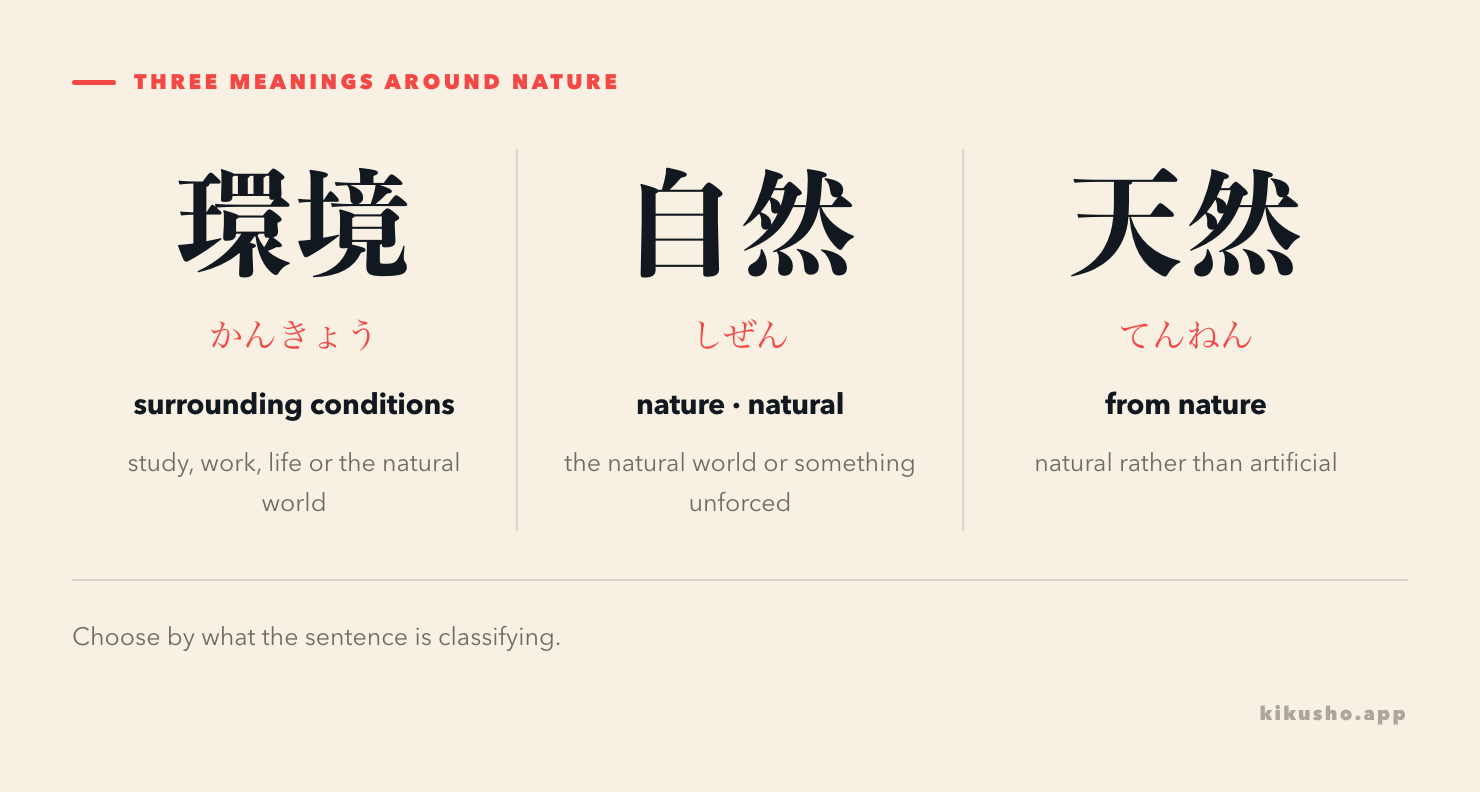
環境, 自然 and 天然 draw three different boundaries
環境 is everything around a person or living thing that affects it. It can refer to the natural environment, but it also covers working, learning and living conditions. The dictionary definition of 環境 centres on surrounding conditions that exert an influence.
静かな環境で勉強したい。
I want to study in a quiet environment.
That sentence is about study conditions, not wilderness. Add 自然 when you specifically mean the natural world:
この地域には豊かな自然が残っている。
Rich natural surroundings remain in this region.
自然 can also describe something unforced or spontaneous. 自然な日本語 is natural-sounding Japanese, and 自然に話す is to speak naturally. The environmental sense depends on the surrounding noun or situation.
天然 usually classifies something as occurring in or obtained from nature rather than being artificial. The dictionary entry for 天然 gives the underlying idea of being in a natural, untouched state.
この服には天然素材が使われている。
Natural materials are used in this clothing.
Useful compounds include 天然資源, natural resources, and 天然ガス, natural gas. Calling a forest 天然 by itself does not simply replace 自然 “nature”; 天然 normally modifies or classifies a particular thing.
大気, 酸素, 汚染 and 汚す describe the air and its condition
大気 is the atmosphere surrounding Earth. 空気 is the ordinary word for the air in a room or place, as well as the figurative mood. Environmental and scientific reporting therefore uses compounds such as 大気汚染 and 大気中.
酸素 is oxygen, one component of the atmosphere. A Ministry of the Environment introduction to the composition of the atmosphere gives nitrogen as 78.1% and oxygen as 21.0% by volume. This helps keep the relationship clear: 大気 is the mixture surrounding Earth; 酸素 is one gas in that mixture.
大気には酸素が含まれている。
The atmosphere contains oxygen.
汚染 is the noun for pollution or contamination and can join する. It suits reports, regulations and technical descriptions:
工場から出る物質が大気を汚染した。
Substances emitted by the factory polluted the atmosphere.
The Ministry of the Environment uses 大気汚染 and 大気汚染物質 in its overview of air-pollution controls. The wording shows the formal environmental register of 汚染.
汚す is a transitive verb: an actor makes something dirty or pollutes it. It works in everyday physical situations as well as environmental ones.
ごみで川を汚してはいけない。
You must not pollute the river with rubbish.
The river takes を because someone or something acts on it. To say that the river becomes dirty without naming the cause, use the related intransitive verb 汚れる, which is outside this 17-word set.
資源 and エネルギー connect to 石炭 and 石油
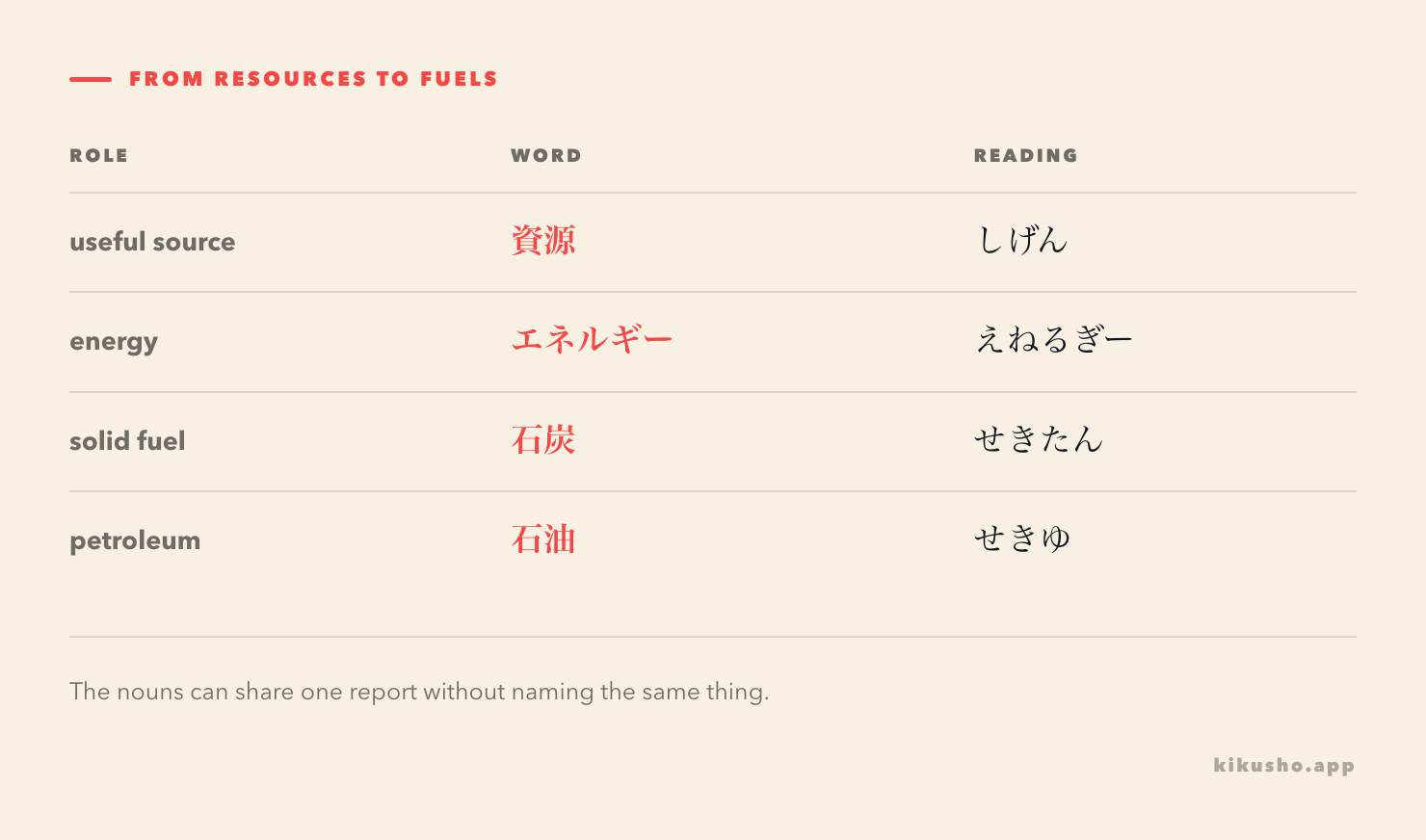
資源 is something useful that people can draw on. Natural materials, water and energy sources can all be resources. エネルギー is energy itself, whether a text discusses electricity, heat or the energy used by a machine.
石炭 is coal. 石油 is petroleum or oil, a broad material and energy-source term. Japan's Agency for Natural Resources and Energy groups coal, petroleum and natural gas as energy sources, matching the way these nouns appear together in public information.
| The sentence names… | Natural example | What the noun contributes |
|---|---|---|
| a useful source | 資源を有効に使う | use resources effectively |
| energy being reduced | エネルギーを節約する | save energy |
| a solid fuel | 石炭を燃やす | burn coal |
| a liquid fossil resource | 石油を輸入する | import petroleum |
Do not translate 石油 as cooking oil. 油 or a specific name such as 食用油 covers that use. 石油 primarily means petroleum and the products derived from it. It can colloquially refer to kerosene in some contexts, but the precise word for kerosene is 灯油; the dictionary entries for 石油 and its refined products make that whole-versus-product relationship explicit.
処理, 節約, 保存 and 保護 answer different questions
English “save” can point to several different actions. Japanese makes you choose what happens to the object.
| Action | Question it answers | Typical object | Example |
|---|---|---|---|
| 処理する | How is it dealt with or processed? | waste, wastewater, data, a problem | 排水を処理する: treat wastewater |
| 節約する | How can we use less? | water, electricity, money, time | 電気を節約する: save electricity |
| 保存する | How can we keep it available or in good condition? | food, a document, data, a specimen | 写真を保存する: save a photo |
| 保護する | How can we shield it from harm? | nature, wildlife, a child, personal data | 森林を保護する: protect forests |
処理 changes with its object. ごみを処理する may include disposal, while 排水を処理する means treating wastewater and データを処理する means processing data. The word itself does not promise that the object is thrown away.
節約 reduces use or expense:
水を節約するため、シャワーを短くした。
I shortened my shower to save water.
保存 keeps something so it remains available or usable:
この資料をパソコンに保存してください。
Please save this document on the computer.
保護 shields someone or something from damage, danger or improper access:
希少な動物を保護する必要がある。
It is necessary to protect rare animals.
A nature reserve can 動物を保護する. A researcher can 記録を保存する. A household can 電気を節約する. A facility can ごみを処理する. Replacing all four with one English gloss would erase the action each sentence actually reports.
燃える and 燃やす switch the participant marked by が or を
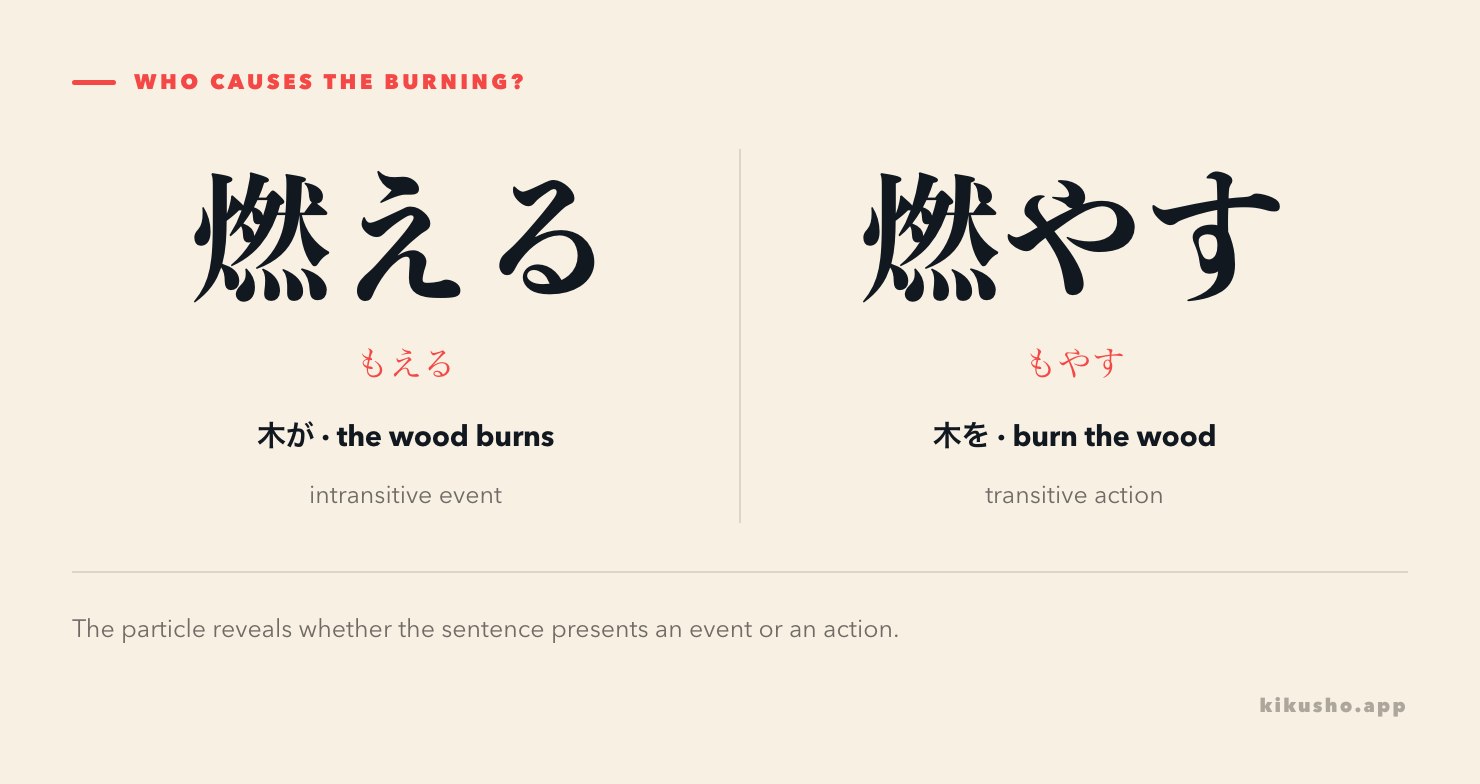
燃える is intransitive: the thing that burns takes が. 燃やす is transitive: the thing someone burns takes を. Their dictionary definitions make the direction explicit: 燃える describes combustion occurring, while 燃やす means causing something to burn.
木が燃えている。
The wood is burning.
木を燃やしている。
Someone is burning the wood.
The second sentence can omit the actor, but the を still presents 木 as the object of a deliberate action. The first sentence simply presents the fire as happening to 木.
Both verbs also have figurative uses, such as 情熱に燃える, “burn with passion,” and 闘志を燃やす, “fire up one's fighting spirit.” The physical contrast is the reliable starting point for this lesson.
Read the words as one environmental report
This short passage is invented for reading practice:
市は、豊かな自然と天然資源を保護するため、新しい計画を発表した。工場では石炭や石油を燃やす量を減らし、エネルギーを節約する。排水を正しく処理すれば、川や大気を汚す物質を減らせる。大気汚染を調べるため、空気中の酸素などのデータも保存する。
The city announced a new plan to protect its rich natural environment and natural resources. Factories will reduce the amount of coal and petroleum they burn and save energy. Properly treating wastewater can reduce substances that pollute rivers and the atmosphere. Data on oxygen and other components of the air will also be stored to study air pollution.
The passage moves through four layers:
- 自然・天然資源・保護 identify what the plan aims to protect.
- 石炭・石油・燃やす・エネルギー・節約 describe fuel and reduced use.
- 処理・汚す connect wastewater treatment to a source of pollution.
- 大気・汚染・酸素・保存 describe what the investigation measures and keeps.
燃える does not appear in the passage because the factories are intentionally burning fuels, so the transitive 燃やす is required. You could report the event separately as 石炭が燃える, “coal burns.”
The earlier business and news vocabulary lesson teaches 電力を消費する, to consume electrical power. This lesson supplies the contrasting action エネルギーを節約する, to reduce that use.
Treat N3 as a study estimate, not an official border
The reference inventory places these 17 spelling-and-reading records in the N3 lesson, but published lists disagree about three of them. The open N3 list places 保護, 燃やす and 汚す at N3; the comparison records place 保護 at N1 and the other two at N2. The inspected Japanese Compass list also includes environment terms such as 環境, 保護, 汚染, 石油, 石炭 and 天然 in its N3 category, while Japanesetest4you labels 環境 as N3 but assigns 保護 elsewhere.
This disagreement is normal because the current JLPT does not publish an exhaustive vocabulary list. Its official guidebook says the vocabulary, kanji and grammar specifications for the revised test are not published. Use N3 here as a practical study order. Basic particles, する verbs and the transitive/intransitive idea are prerequisites; the lesson's task is to make this environmental set usable together.
Next at N2: 原料・公害・消耗・森林・電力・発電.
When you encounter 大気汚染 or エネルギーを節約する on your iPhone, send the sentence to Kikusho from the share sheet. Before saving, keep the full collocation and check the reading. A card built from 川を汚す remembers what 汚す acts on; a card containing only “pollute” loses the particle pattern that distinguishes it from 川が汚れる.
Practice
Attempt all eight questions before opening the answer block.
Question 1
Which word is read たいき and means the atmosphere surrounding Earth?
A. 酸素
B. 大気
C. 自然
D. 環境
Commit to one reading before moving to the next prompt.
Question 2
Choose the best word: この資料をパソコンに( )してください。
A. 保存
B. 節約
C. 保護
D. 汚染
Keep both the object and its destination in view when choosing.
Question 3
Which sentence means “The wood is burning” without presenting a person as causing it?
A. 木を燃えている。
B. 木が燃やしている。
C. 木が燃えている。
D. 木を燃やしている。
Use the particle to decide whether the sentence presents an event or an action.
Question 4
Which phrase specifically means natural resources?
A. 自然な資源
B. 環境資源
C. 天然資源
D. 資源天然
Select the established compound, rather than assembling a literal phrase.
Question 5
Complete the environmental sentence: ごみで川を( )てはいけない。
A. 汚し
B. 汚れ
C. 保存し
D. 節約し
Check which verb can act transitively on 川 before continuing.
Question 6
A facility treats wastewater before releasing it. Which phrase reports that treatment without necessarily saying the water is discarded?
A. 排水を保護する
B. 排水を節約する
C. 排水を処理する
D. 排水を燃やす
Choose the operation described at the facility, without adding a later disposal step.
Question 7
Read the sentence: 工場では石炭を燃やす量を減らし、エネルギーを節約する。 What two actions are stated?
A. The factory stores coal and protects oxygen.
B. The factory reduces the coal it burns and saves energy.
C. The coal catches fire naturally and contaminates petroleum.
D. The factory imports petroleum and saves a computer file.
Account for both coordinated actions before making your selection.
Question 8
Complete the contrast with two different words: 大気には( )が含まれているが、工場から出る物質が大気を( )することもある。
A. 酸素 / 汚染
B. 汚染 / 酸素
C. 石油 / 保存
D. 自然 / 節約
Lock in all eight responses, then reveal the explanations together.
Answers and explanations
1 · Atmosphere — B. 大気 is たいき, the atmosphere. 酸素 is oxygen, one component of that atmosphere. 自然 is nature, and 環境 is the surrounding environment or conditions.
2 · Storage — A. 資料を保存する means to save or store the document so it remains available. 節約 would reduce use, 保護 would shield it from harm, and 汚染 would contaminate it.
3 · Intransitive burning — C. 木が燃えている uses the intransitive 燃える and marks the burning thing with が. D means that someone is burning the wood. A and B mismatch the verb with the particle pattern required here.
4 · Natural resources — C. 天然資源 is the established compound for resources occurring in nature. 自然な means natural or unforced in form or manner, but 自然な資源 is not the standard compound requested.
5 · Pollution verb — A. The completed form is 汚してはいけない, “must not make dirty or pollute.” 汚す changes to the て-form 汚して. 汚れて would describe becoming dirty and would take 川が rather than presenting 川 as the object.
6 · Wastewater treatment — C. 排水を処理する means to treat or process wastewater. 処理 takes its precise interpretation from the object and context; it does not always mean simply throwing something away.
7 · Reduced use — B. 石炭を燃やす量を減らす reduces the amount of coal burned, and エネルギーを節約する reduces energy use. The sentence does not mention storage, imports or a spontaneous fire.
8 · Component and condition — A. 大気には酸素が含まれている identifies oxygen as a component of the atmosphere. 大気を汚染する describes contaminating that atmosphere. The first blank requires a substance; the second requires a suru noun naming harmful contamination.
Common questions
What is the difference between 環境, 自然 and 天然?
環境 is the surrounding environment or conditions. 自然 is nature and can also mean natural or spontaneous. 天然 describes something that comes from nature rather than being artificial, as in 天然資源 and 天然素材.
What is the difference between 節約, 保存 and 保護?
節約 means using less of a resource, 保存 means keeping something in a usable state or storing it, and 保護 means protecting a person, animal, place or information from harm.
What is the difference between 燃える and 燃やす?
燃える is intransitive: something burns. 燃やす is transitive: someone burns something. Compare 木が燃える with 木を燃やす.