On this page
These seventeen N1 words let you read how a government forms policy, changes institutions, signs agreements and responds to international disputes. The hardest part is relational: 政権・内閣・与党 describe different parts of governing, while 協定・条約・同盟 and 国境・領土・領域 cannot be exchanged just because their English translations overlap.
Seventeen records for political and international reporting
| Headword | Reading | Core meaning | Useful combination |
|---|---|---|---|
| 改革 | かいかく, kaikaku | reform | 制度改革 |
| 協定 | きょうてい, kyōtei | agreement; pact | 協定を結ぶ |
| 国境 | くにざかい, kunizakai | national or provincial border | 国境を越える |
| 国連 | こくれん, kokuren | the United Nations | 国連加盟国 |
| 条約 | じょうやく, jōyaku | treaty | 条約を締結する |
| 政権 | せいけん, seiken | political power; administration | 政権を握る |
| 制裁 | せいさい, seisai | sanction; punitive measure | 経済制裁 |
| 政策 | せいさく, seisaku | policy | 政策を実施する |
| 同盟 | どうめい, dōmei | alliance | 同盟を結ぶ |
| 独裁 | どくさい, dokusai | dictatorship; autocratic rule | 独裁政権 |
| 内閣 | ないかく, naikaku | cabinet | 内閣を組織する |
| 紛争 | ふんそう, funsō | dispute; conflict | 紛争を解決する |
| 民主 | みんしゅ, minshu | democracy; democratic principle | 民主主義 |
| 与党 | よとう, yotō | governing party | 与党の議員 |
| 領域 | りょういき, ryōiki | domain; bounded area | 専門領域 |
| 領土 | りょうど, ryōdo | sovereign territory; land | 領土問題 |
| 連邦 | れんぽう, renpō | federation; federal union | 連邦政府 |
Kikusho's September 2026 inventory assigns all seventeen records to this N1 lesson. Sixteen have no level disagreement. 国境(くにざかい) also has a headword-only N3 record, but that page teaches the other reading, こっきょう. The JLPT organisers stopped issuing fixed vocabulary specifications for the current test, so N1 here is an evidence-backed study placement.
The prerequisite N3 government and elections lesson teaches 国境(こっきょう), 外交, 投票, 野党 and other words needed to follow a basic election report. This N1 lesson moves from individual political roles to the structures, legal instruments and territorial language used in analysis.
与党, 政権 and 内閣 locate power at three levels
与党(よとう) is a party or coalition on the governing side. It is the counterpart of 野党, the opposition. The label describes a party's current relation to government; it does not permanently classify its ideology.
政権(せいけん) is the power to govern or the administration holding it. Natural patterns include 政権を握る, take power; 政権を維持する, remain in power; 政権交代, change of government; and 新政権, new administration. The 政権 reference includes both the authority and the political body exercising it.
内閣(ないかく) is the formal cabinet under a prime minister in a cabinet system. Use 内閣を組織する, form a cabinet; 内閣が法案を提出する, the cabinet submits a bill; and 内閣改造, cabinet reshuffle. Its dictionary entry identifies a specific organ of government, narrower than 政権.
A report can therefore contain all three without repetition:
選挙で過半数を得た与党が新しい政権を発足させ、首相が内閣を組織した。
せんきょで かはんすうを えた よとうが あたらしい せいけんを ほっそくさせ、しゅしょうが ないかくを そしきした。
The governing party that won a majority in the election launched a new administration, and the prime minister formed a cabinet.
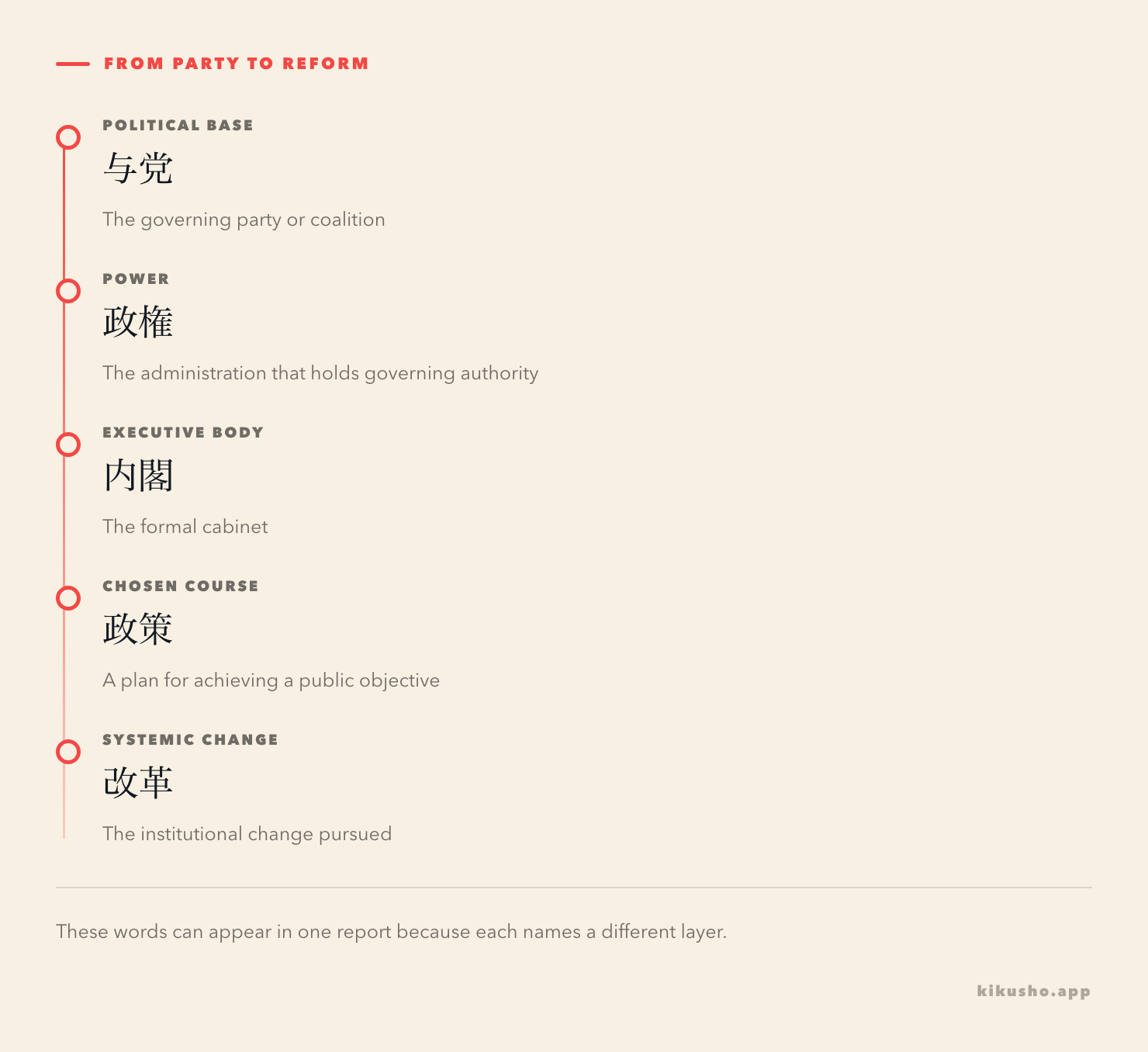
政策 chooses a course; 改革 changes a system
政策(せいさく) is a policy: a planned course of action adopted by a government, party, organisation or company. Common verbs are 政策を打ち出す, announce a policy; 政策を実施する, implement it; 政策を転換する, change course; and 外交政策, foreign policy. The 政策 definition centres on a chosen principle or method for achieving an aim.
改革(かいかく) means changing an existing institution or system to improve it. Typical compounds are 行政改革, administrative reform; 教育改革, education reform; 制度改革, institutional reform; and 抜本的な改革, fundamental reform. The 改革 entry helps distinguish it from 革命, revolution.
内閣は医療制度を改革するため、新しい政策を発表した。
ないかくは いりょうせいどを かいかくするため、あたらしい せいさくを はっぴょうした。
The cabinet announced a new policy in order to reform the healthcare system.
The policy is the chosen plan. Reform is the institutional change that the plan is meant to produce.
民主 and 独裁 describe opposing principles of rule
In current political Japanese, 民主(みんしゅ) refers to democracy or the democratic principle that political authority belongs to the people and respects freedom and equality. It most often appears inside compounds: 民主主義, democracy; 民主政治, democratic government; 民主化, democratisation; and 民主的, democratic.
One imported gloss also gives “head of the nation” for 民主. That sense exists in historical dictionaries, but it is not the ordinary meaning in a modern political report. The 民主 reference separates the modern democratic senses from that older usage.
独裁(どくさい) is autocratic rule concentrated in one ruler or a small group. Related forms include 独裁者, dictator; 独裁政治, dictatorial government; and 独裁政権, authoritarian regime. The 独裁 entry stresses power exercised without effective participation by others.
民主的な制度が弱まり、一人の指導者による独裁へ移行した。
みんしゅてきな せいどが よわまり、ひとりの しどうしゃによる どくさいへ いこうした。
Democratic institutions weakened, and the country shifted toward rule by one leader.
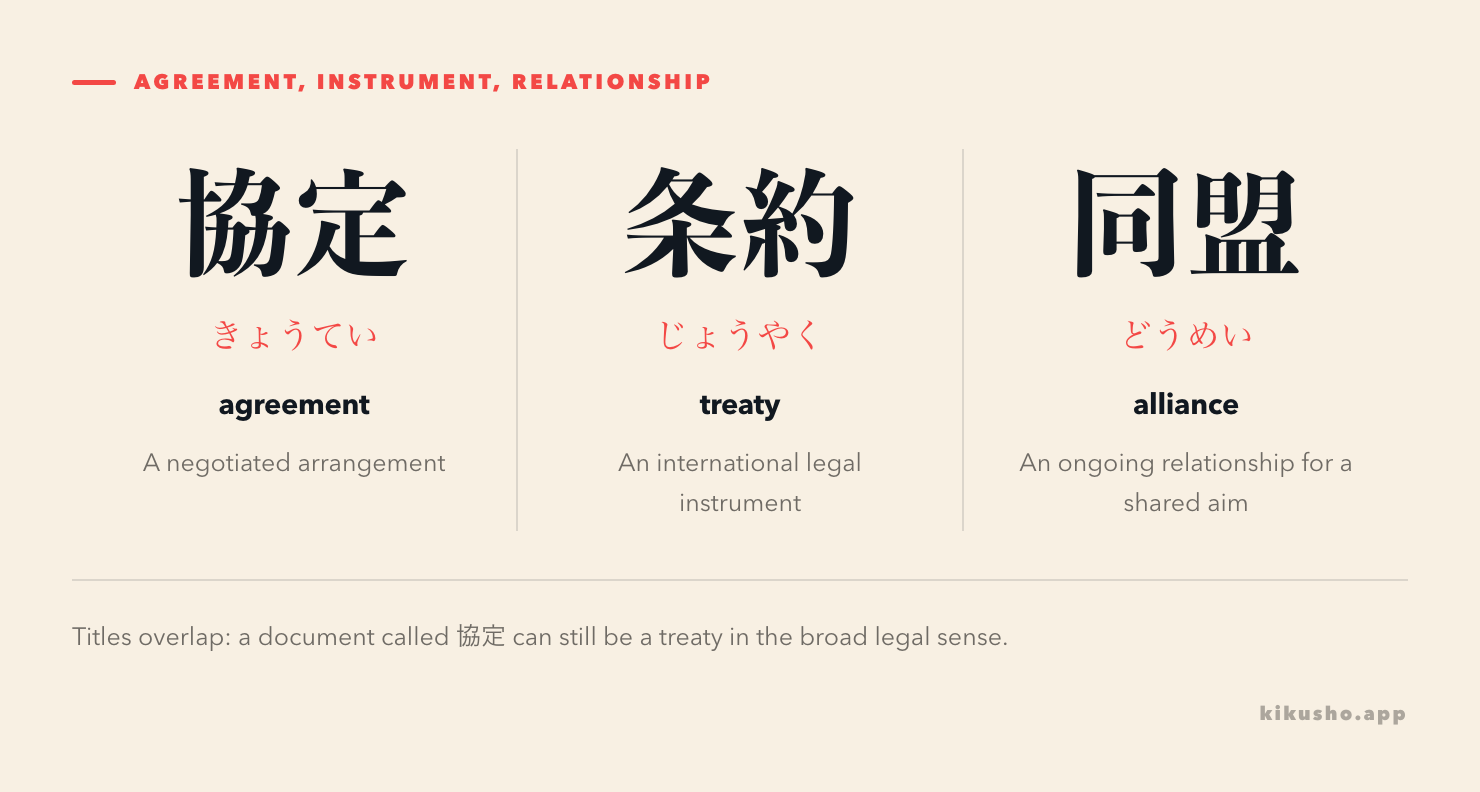
協定, 条約 and 同盟 connect states in different ways
協定(きょうてい) is an agreement or arrangement reached through negotiation. It can be domestic or international: 労使協定, labour-management agreement; 貿易協定, trade agreement; 二国間協定, bilateral agreement. Use 協定を結ぶ, conclude an agreement, and 協定に違反する, violate one.
条約(じょうやく) is a treaty or international legal agreement between states or other recognised parties. It pairs with formal verbs such as 条約を締結する, conclude a treaty; 条約を批准する, ratify it; 条約が発効する, enter into force; and 条約を破棄する, renounce it.
The names overlap. The 協定 definition covers agreed arrangements, while the 条約 reference notes that international instruments may be titled 条約, 協定, convention or protocol. A 協定 can therefore be a treaty in the broad legal sense.
同盟(どうめい) is an alliance: a sustained relationship or grouping formed for a common objective, often security. States may 同盟を結ぶ, form an alliance, and become 同盟国, allies. A treaty may establish an alliance, but the document and the continuing relationship are different things. The 同盟 entry focuses on joint action for a shared purpose.
両国は安全保障協定に署名し、その条約に基づいて同盟関係を築いた。
りょうこくは あんぜんほしょう きょうていに しょめいし、その じょうやくに もとづいて どうめい かんけいを きずいた。
The two countries signed a security agreement and built an alliance on the basis of that treaty.
国連, 制裁 and 紛争 frame international responses
国連(こくれん) is the standard abbreviation of 国際連合, the United Nations. It forms compounds such as 国連加盟国, UN member state; 国連総会, UN General Assembly; 国連決議, UN resolution; and 国連安全保障理事会, UN Security Council. It names an international organisation, not an alliance or a federal state.
制裁(せいさい) is a sanction or punitive measure imposed in response to a violation. International reporting commonly uses 経済制裁, economic sanctions; 制裁を科す, impose sanctions; 制裁を強化する, tighten them; and 制裁を解除する, lift them. The general 制裁 definition covers measures enforced by a group or institution, while 経済制裁 specifies trade, finance and similar economic means.
紛争(ふんそう) means a dispute or conflict. It is broader than war. 国際紛争 may be diplomatic, legal or armed; 労働紛争 is a labour dispute; 土地紛争 concerns land. The 紛争 entry includes disagreement and contention as well as violent conflict, so context determines the severity.
国連は紛争の平和的な解決を求め、協定に違反した当事者への制裁を協議した。
こくれんは ふんそうの へいわてきな かいけつを もとめ、きょうていに いはんした とうじしゃへの せいさいを きょうぎした。
The United Nations called for a peaceful settlement of the dispute and discussed sanctions against the party that had violated the agreement.
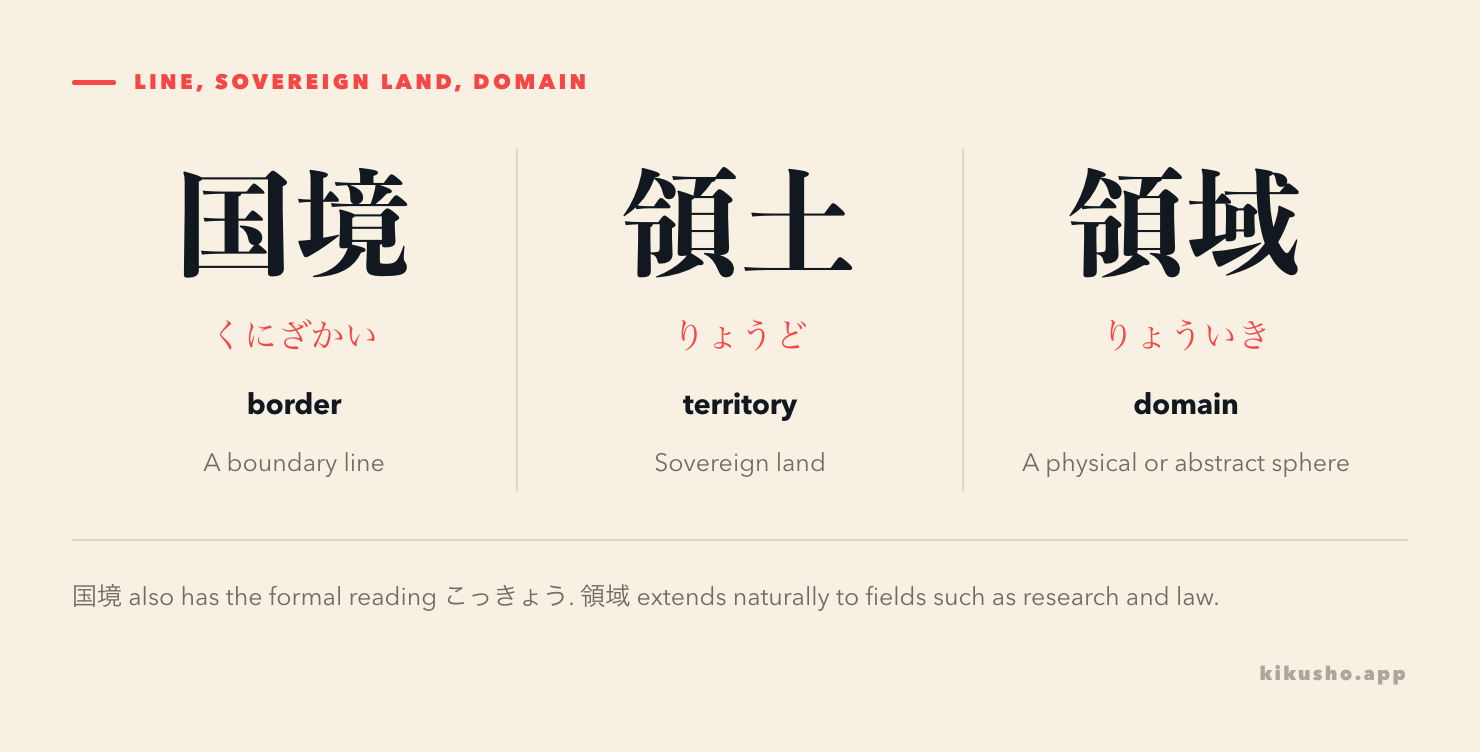
国境, 領土 and 領域 draw three different boundaries
国境(くにざかい) is a border between countries, or historically a boundary between old provinces. The assigned reading is native Japanese: 国(くに) + 境(さかい) becomes くにざかい, with voicing in the second element. It often sounds concrete, geographical or literary.
The same spelling is more commonly read こっきょう in formal modern news, law and international relations. Both readings are recorded in the 国境 dictionary entry. Choose the reading from context and the source you are reading; do not assume that the kanji spelling has only one pronunciation.
領土(りょうど) is land under a state's sovereignty, sometimes used broadly for the state's territory. It appears in 領土問題, territorial issue; 領土を主張する, claim territory; and 領土保全, territorial integrity. The 領土 reference notes the strict land sense and the broader use that can include territorial waters and airspace.
領域(りょういき) is a bounded area, domain or sphere. In public law it can mean the full space under state authority; elsewhere it readily becomes abstract: 研究領域, research field; 専門領域, area of expertise; 私的領域, private sphere. That flexibility makes it unnatural to replace every 領土 with 領域, or vice versa.
国境に沿って流れる川の両岸を、二つの国がそれぞれ自国の領土だと主張している。この問題は国際法の領域でも議論されている。
くにざかいに そって ながれる かわの りょうがんを、ふたつの くにが それぞれ じこくの りょうどだと しゅちょうしている。この もんだいは こくさいほうの りょういきでも ぎろんされている。
Two countries each claim that both banks of a river running along their border are their own territory. The issue is also debated in the field of international law.
連邦 describes the structure of a state
連邦(れんぽう) is a federation: a political union in which constituent units and a central federal government divide authority under a common constitutional order. Use 連邦政府, federal government; 連邦制, federal system; and 連邦国家, federal state.
It is not a synonym for 国連 or 同盟. A federation forms one state with shared sovereignty; an alliance connects separate parties for a common purpose; the United Nations is an international organisation. The 連邦制 reference specifically contrasts a federal state with a unitary state and a looser confederation.
この連邦では、外交は連邦政府が担当するが、教育政策は各州が決める。
この れんぽうでは、がいこうは れんぽう せいふが たんとうするが、きょういく せいさくは かくしゅうが きめる。
In this federation, the federal government handles foreign affairs, but each state decides education policy.
One fictional report connects all seventeen words
選挙後、与党は新政権を発足させ、内閣は民主的な制度を守るための改革政策を発表した。前の独裁政権が結んだ協定と条約も見直す方針だ。隣の連邦との国境、領土、海洋領域をめぐる紛争については、軍事同盟の拡大ではなく国連の仲介を求める。一方、合意に違反した組織への経済制裁は維持するという。
After the election, the governing party launched a new administration, and the cabinet announced a reform policy designed to protect democratic institutions. It also plans to review the agreements and treaties concluded by the previous dictatorship. Regarding the dispute with the neighbouring federation over the border, territory and maritime domain, it will seek UN mediation rather than an expansion of the military alliance. Economic sanctions against the organisation that violated the accord will remain in place.
The chain is deliberate. 与党 is the party, 政権 the governing administration and 内閣 the cabinet. 政策 states a course of action; 改革 names the systemic change. 協定 and 条約 are instruments, while 同盟 is a continuing relationship. 国境, 領土 and 領域 locate the dispute at a line, on sovereign land and within a broader space.
For adjacent vocabulary, the N2 politics and economics lesson covers 政府, 選挙, 税金 and 予算. The N1 legal and administrative lesson adds statutes, regulations, bills and court decisions.
Practice
1 · Reading. Which reading is assigned to 国境 in this N1 record?
- A. こくきょう
- B. こっざかい
- C. くにざかい
- D. くにきょう
2 · Reading. How is 協定 read?
- A. きょうてい
- B. きょうじょう
- C. きょてい
- D. こうてい
3 · Three levels of government. Which sentence uses the terms accurately?
- A. 与党 is the cabinet room, 内閣 is an ideology, and 政権 is one voter.
- B. The 与党 supports a 政権, while the 内閣 is the formal executive body.
- C. 政権 always means one political party, and 与党 means every ministry.
- D. 内閣 and 与党 are exact synonyms in every political system.
4 · Policy and reform. Complete the sentence: 政府は年金制度を___するため、新しい___を発表した。
- A. 政策 / 改革
- B. 制裁 / 紛争
- C. 領域 / 政権
- D. 改革 / 政策
5 · International instruments. Which statement is the most accurate?
- A. 協定 is an agreement, 条約 a treaty, and the formal titles of international instruments can overlap.
- B. Every 協定 is informal and legally meaningless.
- C. 条約 means an alliance rather than a document.
- D. 同盟 and 条約 always name the same thing.
6 · Sanctions. Which sentence uses 制裁 naturally?
- A. 国境を制裁して隣国へ渡った。
- B. 内閣を制裁に読んだ。
- C. 協定違反を理由に経済制裁を科した。
- D. 研究の制裁を広げた。
7 · Political principle. Which pairing expresses opposite systems of rule?
- A. 領土 / 領域
- B. 民主 / 独裁
- C. 協定 / 条約
- D. 与党 / 内閣
8 · Paraphrase. 紛争 does not necessarily mean a war. Which paraphrase is best?
- A. It always means a peaceful election.
- B. It is limited to personal emotions.
- C. It can only be used after troops cross a border.
- D. It is a dispute or conflict whose severity depends on context.
9 · Territory. Choose the best words: 川が二国間の___をなし、その西側の土地を両国が自国の___だと主張した。
- A. 国境 / 領土
- B. 領域 / 政策
- C. 領土 / 国連
- D. 連邦 / 協定
10 · Federation. Which description best fits 連邦?
- A. A temporary economic sanction
- B. A border treaty only
- C. A state structure in which central and constituent governments divide authority
- D. Another abbreviation for the United Nations
11 · Abbreviation. 国連 is short for which expression?
- A. 国際連邦
- B. 国際連合
- C. 国境連盟
- D. 国民連合
12 · Connected meaning. 内閣は国連の仲介を求める一方、経済制裁を維持する政策を発表した。 What did the cabinet announce?
- A. A policy seeking UN mediation while retaining economic sanctions
- B. A plan to replace the cabinet with a federation
- C. A declaration that every dispute is a military alliance
- D. A reform of the native reading of 国境
Reveal the government and international-relations answer key
- C. This record assigns 国境 the native reading くにざかい; こっきょう is also valid and is common in formal news.
- A. 協定 is read きょうてい.
- B. 与党 is the governing party or coalition, 政権 the governing administration or power, and 内閣 the cabinet.
- D. The government reforms the pension system and announces a policy to do so.
- A. 協定 and 条約 differ in focus, but document titles alone do not settle legal status.
- C. 経済制裁を科す means impose economic sanctions.
- B. 民主 refers to democratic rule; 独裁 concentrates rule in one person or a small group.
- D. 紛争 ranges from a dispute to an armed conflict, according to context.
- A. The river forms the 国境, while the land claimed under sovereignty is 領土.
- C. A 連邦 divides constitutional authority between a federal government and constituent units.
- B. 国連 abbreviates 国際連合, the United Nations.
- A. The sentence combines mediation through the UN with continued economic sanctions.
Common questions
What is the difference between 政権, 内閣 and 与党?
政権 is the political power or administration governing a country. 内閣 is the formal cabinet that exercises executive authority. 与党 is the party or coalition that supports and forms the government. They often overlap in a report, but they do not name the same institution.
What is the difference between 協定, 条約 and 同盟?
協定 is an agreement or arrangement, 条約 is a treaty or international legal agreement, and 同盟 is an alliance or durable relationship for a shared aim. Document titles overlap, so an instrument called 協定 can still function as a treaty in the broad legal sense.
How do 国境, 領土 and 領域 differ?
国境 is the boundary between countries. 領土 is land under a state's sovereignty, sometimes used broadly for its territory. 領域 is a bounded domain or sphere and can be geographical, legal, academic or abstract.
Can 国境 be read くにざかい?
Yes. 国境 has both こっきょう and くにざかい readings. こっきょう is the standard formal reading in modern international and news contexts; くにざかい is a native reading often used for a concrete border or in literary and historical contexts, including old provincial boundaries.