On this page
These thirteen N3 words let you follow a basic political report from the country and its people to candidates, voting, legislators, opposition parties and diplomacy. The key is to avoid translating every 国 word as “country” and every political title as “leader”: 国家・国民・国籍・国境, and 議員・大使・大統領, identify different institutions and roles.
Thirteen records for one political news story
| Headword | Reading | Core meaning | Useful combination |
|---|---|---|---|
| 外交 | がいこう, gaikō | diplomacy; foreign relations | 外交政策 |
| 議員 | ぎいん, giin | member of a legislature or council | 国会議員 |
| 候補 | こうほ, kōho | candidate; possible choice | 大統領候補 |
| 国籍 | こくせき, kokuseki | nationality; legal membership of a state | 国籍を持つ |
| 国民 | こくみん, kokumin | nationals; the people constituting a state | 国民の権利 |
| 国家 | こっか, kokka | state or nation as a political institution | 独立国家 |
| 国境 | こっきょう, kokkyō | national border | 国境を越える |
| 主義 | しゅぎ, shugi | principle, doctrine or -ism | 民主主義 |
| 大使 | たいし, taishi | ambassador | 駐日大使 |
| 大統領 | だいとうりょう, daitōryō | president of a republic | 大統領選挙 |
| 投票 | とうひょう, tōhyō | vote; voting | 候補者に投票する |
| 独立 | どくりつ, dokuritsu | independence; self-reliance | 国が独立する |
| 野党 | やとう, yatō | opposition party | 野党の議員 |
Kikusho's September 2026 inventory places this lesson in N3, but two rows carry evidence from another level. 国籍 appears in one N3 baseline and one N2 baseline; 野党 appears in one N3 baseline and one N1 baseline. The other eleven records have no internal conflict. A current N3 comparison list independently includes 国民, 国籍, 投票, 議員 and 大統領. The JLPT organisers publish no exhaustive official vocabulary list, so the level is a study placement and the two disagreements remain visible rather than being forced into false certainty.
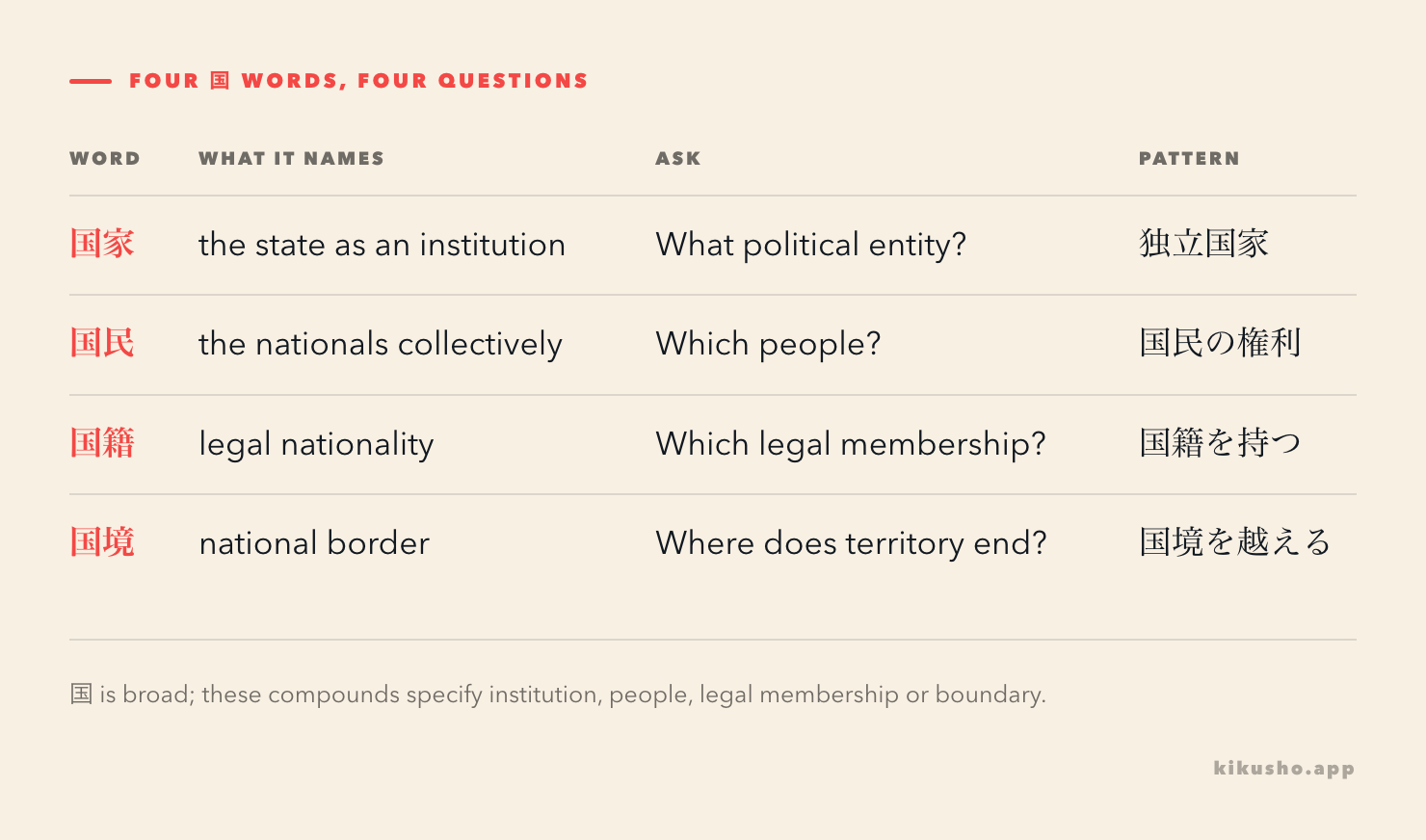
国家, 国民, 国籍 and 国境 show four sides of a country
国家(こっか) is a formal word for a state as a political and legal institution. It brings together territory, a population and governing authority. Use it in analytical compounds such as 国家予算, national budget; 国家間の関係, relations between states; and 独立国家, independent state. Ordinary conversation usually prefers 国(くに) for “country.”
国民(こくみん) names the people who constitute a state, especially its nationals as a collective political body. It appears in 国民の権利, the rights of the people; 国民生活, people's lives; and 国民投票, referendum. It does not automatically mean every person currently living inside the borders.
国籍(こくせき) is a person's legal nationality. Natural verbs make the legal status clear:
- 日本国籍を持つ: have Japanese nationality
- 国籍を取得する: acquire nationality
- 国籍を変更する: change nationality
- 二つの国籍を持つ: hold two nationalities
Do not answer 国籍は? with a city. 出身は大阪です gives a place of origin; 国籍は日本です gives nationality. The 国籍 reference defines it as the legal bond connecting a person to a particular state, while 国民 identifies the people who have that state's nationality.
国境(こっきょう) is the boundary between states and the limit of their territorial authority. Use 国境を越える, cross a border; 国境を接する, share a border; and 国境付近, near the border. The dictionary definition of 国境 includes both natural boundaries such as rivers and boundaries fixed by agreement.
その国家の国民でなくても、正しい書類があれば国境を越えられますが、国籍によって必要な手続きが違います。
その こっかの こくみんで なくても、ただしい しょるいが あれば こっきょうを こえられますが、こくせきによって ひつような てつづきが ちがいます。
Even if you are not a national of that state, you can cross the border with the correct documents, but the required procedure differs by nationality.
A 候補 receives votes; a 議員 already holds a seat
候補(こうほ) is a candidate or possible choice before a final selection. It is broader than elections: 旅行先の候補, a possible travel destination, and 受賞候補, a candidate for an award, are natural. For a person in an election, 候補者 makes the human role explicit.
- 候補に選ばれる: be selected as a candidate
- 候補を三人に絞る: narrow the candidates to three
- 立候補する: stand as a candidate
- 大統領候補: presidential candidate
投票(とうひょう) is the act of formally expressing a choice or approval. It can be a noun or a suru verb. Mark the selected candidate or party with に: 候補者に投票する. Use 選挙で投票する for the event, 投票所 for polling place and 投票率 for turnout. Japan's House of Representatives defines election voting as an elector's expression of choice for a candidate or political organisation in its election-law research material.
議員(ぎいん) is a member of a deliberative body. 国会議員 serves in the National Diet; 県議会議員 and 市議会議員 serve in prefectural and municipal assemblies. “Politician” is broader: not every 政治家 currently holds a legislative seat, and 議員 does not mean an ambassador, minister or president.
野党(やとう) is a political party that does not currently form or support the government. Its counterpart is 与党(よとう), governing party. A 野党議員 is therefore a legislator belonging to an opposition party. The definition depends on who holds power, not on whether a party's policies are permanently left-wing or right-wing. The dictionary entry centres precisely on not being responsible for the current government.
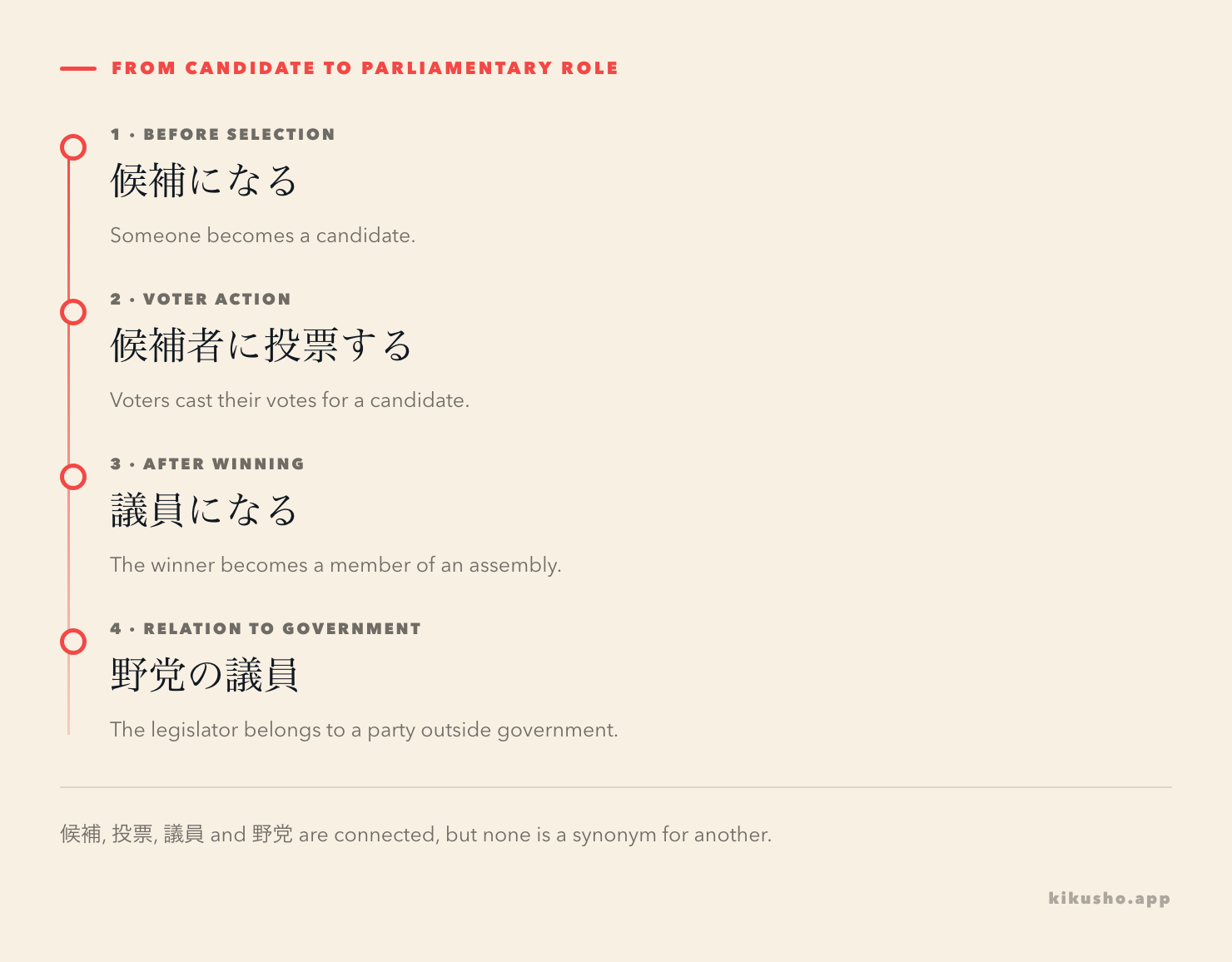
野党の候補者は多くの票を集めて当選し、国会議員になりました。
やとうの こうほしゃは おおくの ひょうを あつめて とうせんし、こっかい ぎいんに なりました。
The opposition candidate won many votes, was elected and became a member of the Diet.
The sentence uses 票, an individual vote, after introducing the activity 投票. 投票する is what voters do; 票を集める describes the candidate's result.
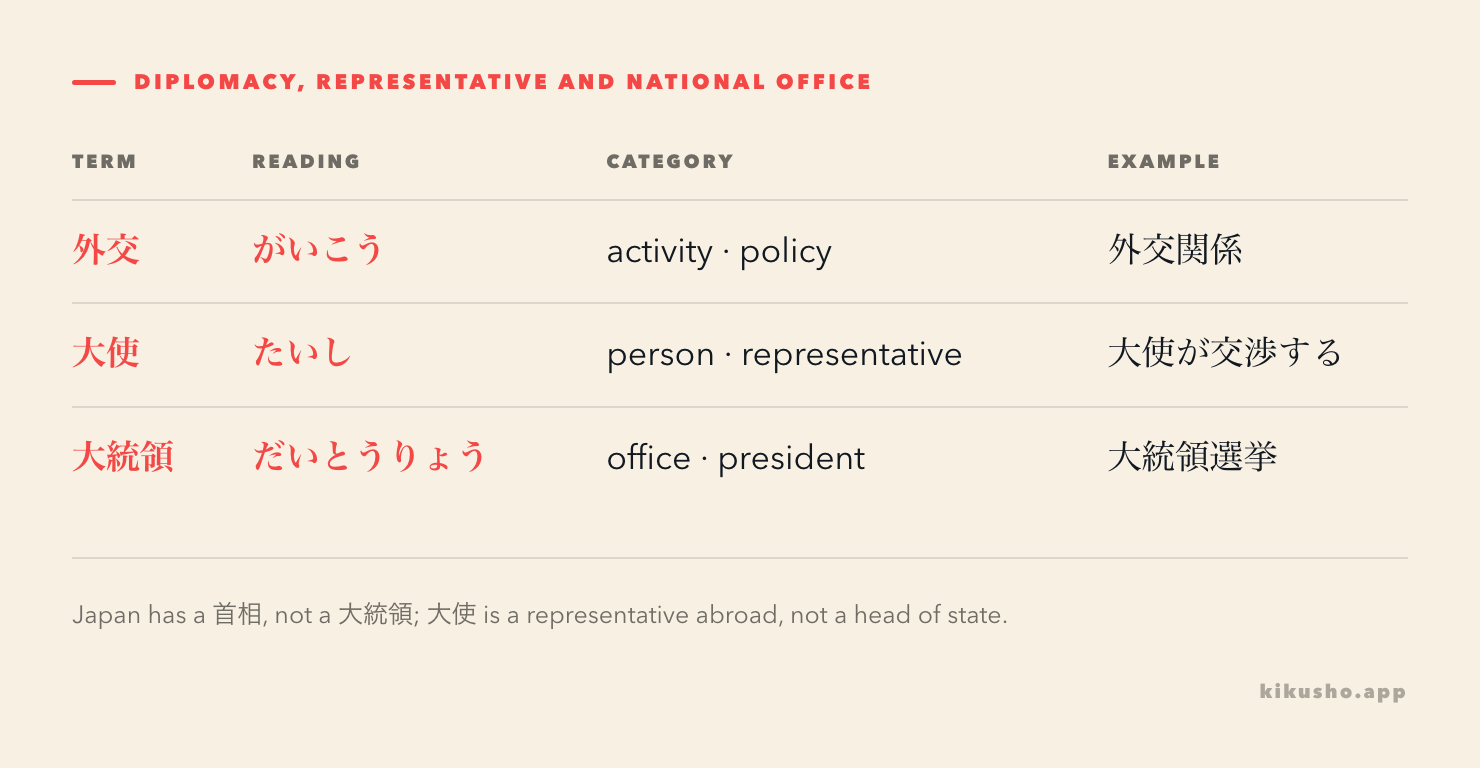
外交 is the work, 大使 the representative, 大統領 a national office
外交(がいこう) means diplomacy or relations and negotiations between states. Common combinations are 外交政策, foreign policy; 外交関係, diplomatic relations; 外交問題, diplomatic issue; and 外交官, diplomat. The dictionary definition foregrounds negotiation and intercourse with foreign countries.
大使(たいし) is an ambassador, a person sent to represent one state in another. 大使館 is the embassy, the institution or building. Do not confuse the person and place:
- 大使が首相と会う: the ambassador meets the prime minister
- 大使館で手続きをする: complete a procedure at the embassy
- 駐日フランス大使: French ambassador to Japan
Japan's Ministry of Foreign Affairs explains that diplomats at an embassy represent their country, negotiate with the receiving government and protect their nationals.
大統領(だいとうりょう) is the president of a republic. The exact powers differ by political system, but the title is not a general word for any national leader. Japan has an 内閣総理大臣, usually called 首相, not a 大統領. An ambassador represents a state abroad; a president holds a top constitutional office within a state.
大使は両国の外交関係について大統領と話し合いました。
たいしは りょうこくの がいこう かんけいについて だいとうりょうと はなしあいました。
The ambassador discussed diplomatic relations between the two countries with the president.
主義 names a principle; 独立 names freedom from control
主義(しゅぎ) can be a principle or policy someone consistently follows: それが私の主義です, that is my principle. As a suffix corresponding to “-ism,” it builds names for systems and positions:
- 民主主義: democracy
- 資本主義: capitalism
- 個人主義: individualism
- 完璧主義: perfectionism
The 主義 entry spans personal policy, intellectual doctrine and social system. The compound determines the scale; 主義 alone does not name one particular ideology.
独立(どくりつ) means being free from another power's control or support. At the state level, 植民地から独立する means become independent from colonial rule and 独立国家 means sovereign state. Everyday uses extend the same structure:
- 親から独立する: become independent of one's parents
- 経済的に独立する: become financially independent
- 会社から独立する: leave a company to work independently
その国は独立後、民主主義を国家の基本的な原則にしました。
その くには どくりつご、みんしゅしゅぎを こっかの きほんてきな げんそくに しました。
After independence, the country made democracy a fundamental principle of the state.
One report can connect all thirteen records
独立国家となって初めての大統領選挙が、来月行われます。三人の候補が外交政策と国境管理について意見を発表しました。国民は投票によって大統領を選び、同じ日に国会議員も選びます。最大の野党は民主主義を守ると訴えました。外国の大使も選挙に注目しています。国外に住む二重国籍の人について、選挙委員会は国籍と投票資格の関係を説明しました。
The first presidential election since the country became an independent state will be held next month. Three candidates presented their views on foreign policy and border control. The people will choose the president by voting and elect legislators on the same day. The largest opposition party appealed for the protection of democracy. Foreign ambassadors are also watching the election. For people with dual nationality who live abroad, the election commission explained the relationship between nationality and voting eligibility.
The report keeps roles separate. A 候補 seeks office, 国民 vote, a winning candidate may become a 議員 or 大統領, and 野党 describes a party's position relative to government. 外交 is policy work, while a 大使 is a person. 国家, 国境 and 国籍 frame the state, its territory and legal membership.
The N2 politics and economics lesson continues with 政治, 政府, 選挙, 税金, 予算 and other words used in news reports. The N1 legal and administrative lesson adds laws, regulations, bills and court decisions.
The N1 government and international-relations lesson continues from candidates and voting to 政権, 内閣, 与党, treaties, sanctions and territorial terminology.
Practice
1 · Legal status. Which word means a person's legal nationality?
- A. 国家
- B. 国民
- C. 国籍
- D. 国境
2 · State as institution. Choose the best word: 二つの___が外交関係を始めた。
- A. 国籍
- B. 国家
- C. 国民
- D. 主義
3 · 国境 in kana. Which kana match the word for a national border?
- A. こくきょう
- B. こっけい
- C. こっきょう
- D. こくざかい
4 · Before and after an election. Which sequence is logical?
- A. 議員になる → 候補になる → 投票する
- B. 候補になる → 有権者が投票する → 議員になる
- C. 投票になる → 野党を候補する → 議員する
- D. 国籍になる → 国境が投票する → 大使になる
5 · Voting pattern. Which sentence correctly means “I voted for that candidate”?
- A. その候補者を投票しました。
- B. その候補者で投票しました。
- C. その候補者に投票しました。
- D. その候補者が投票しました。
6 · Political role. A party does not currently form the government. What is it called?
- A. 野党
- B. 大使
- C. 国家
- D. 国籍
7 · Person or place. Complete the sentence: ___が大使館で記者会見を開いた。
- A. 外交
- B. 大使
- C. 国境
- D. 投票
8 · Presidential title. Which statement is accurate?
- A. Every country calls its leader 大統領.
- B. A 大使 and a 大統領 are the same office.
- C. Japan's prime minister is normally called 大統領.
- D. 大統領 is a president; Japan's head of government is the 首相.
9 · Meaning extension. Which pair uses 独立 naturally in two different domains?
- A. 国が独立する / 親から独立する
- B. 国境が独立する / 投票から独立する
- C. 大使を独立する / 国籍に独立する
- D. 候補が独立い / 議員を独立だ
10 · Connected meaning. 野党の候補者は外交政策を発表し、国民に投票を呼びかけた。 What happened?
- A. An ambassador changed every citizen's nationality.
- B. An opposition candidate announced a foreign-policy platform and called on the public to vote.
- C. A president crossed the border and dissolved the state.
- D. A legislator made the opposition party independent from democracy.
Reveal the election and diplomacy answer key
- C. 国籍 is legal nationality; 国民 names the nationals collectively.
- B. 国家 presents each country as a political institution in interstate relations.
- C. 国境 is read こっきょう, with a small っ.
- B. A candidate stands, voters vote, and the winner may become a legislator.
- C. The selected candidate takes に: 候補者に投票する.
- A. 野党 is a party outside the current government; its counterpart is 与党.
- B. 大使 is the person, while 大使館 is the embassy.
- D. 大統領 and 首相 belong to different constitutional systems and are not interchangeable titles.
- A. 独立 covers both national independence and personal self-reliance.
- B. 野党 identifies the party role, 外交政策 the subject and 投票 the requested action.
Common questions
What is the difference between 国籍 and 国民?
国籍 is the legal bond called nationality: a person has, obtains or changes a nationality. 国民 refers collectively to the nationals who constitute a state. One describes legal status; the other names the people with it.
What is the difference between 国家 and 国?
国 is the ordinary broad word for a country, its territory or someone's homeland. 国家 is more formal and presents the state as a political and legal institution with territory, a population and governing authority.
What is the difference between 候補 and 議員?
候補 is a candidate or possible choice that has not yet been selected. 議員 is already a member of a deliberative assembly such as the Diet or a local council. A 候補 may become a 議員 after winning an election.
Does Japan have a 大統領?
No. 大統領 is the standard Japanese title for a president in a republic. Japan's head of government is the 内閣総理大臣, commonly shortened to 首相. Political systems differ, so the titles are not interchangeable.