On this page
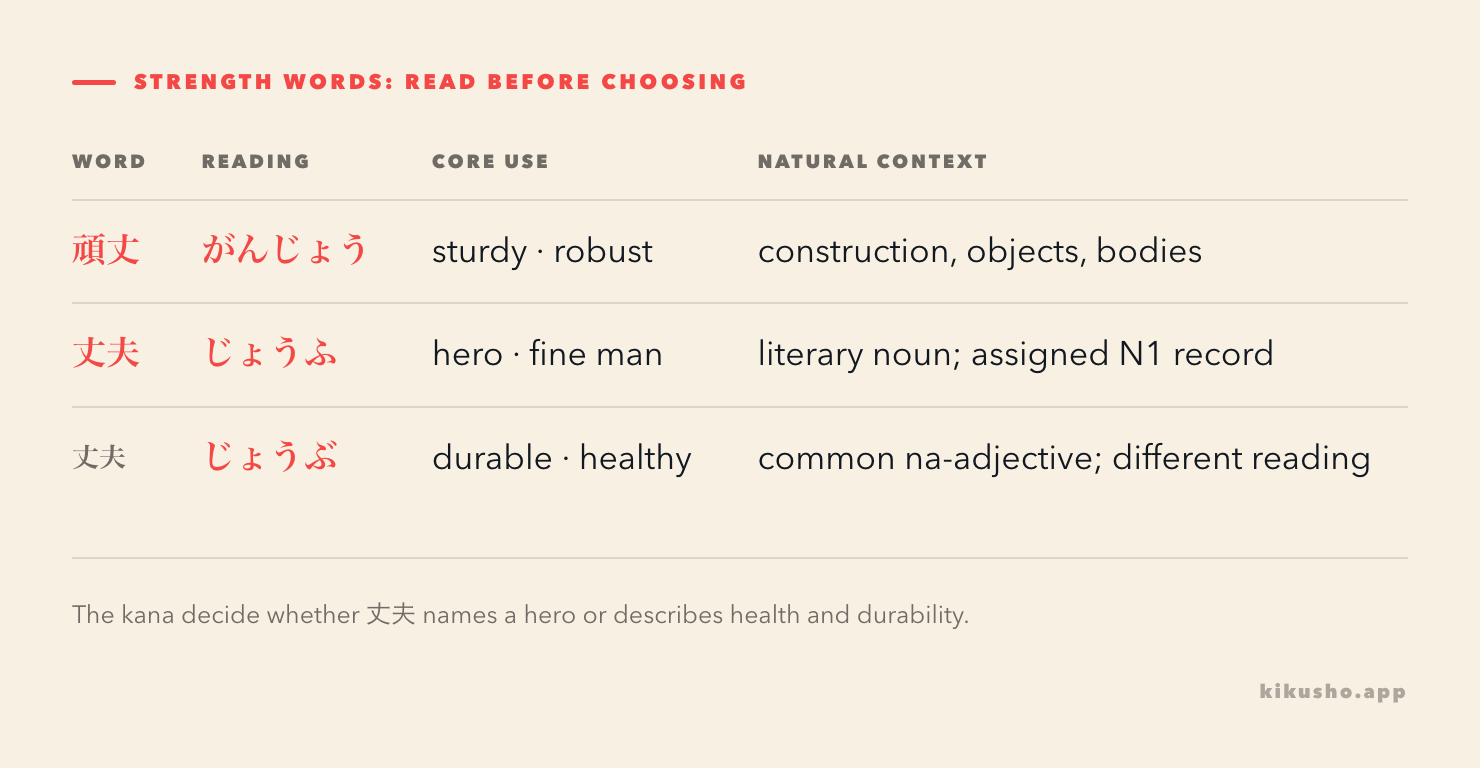
These ten N1 records let you name three materials, judge structural strength, describe a surface and talk precisely about parallel or three-dimensional form. The most important trap is not a rare material: 丈夫(じょうふ) is a literary noun for an admirable man or hero, while the familiar “durable; healthy” adjective is 丈夫(じょうぶ).
Ten records, with the reading attached
| Headword | Reading | Word class and core use | Typical combination |
|---|---|---|---|
| 銅 | あかがね, akagane | noun; copper, with an old or literary native reading | 赤銅色のあかがね |
| アルミ | あるみ, arumi | noun; aluminium, shortened from アルミニウム | アルミ製の枠 |
| 頑丈 | がんじょう, ganjō | noun; na-adjective; sturdy, solidly built, robust | 頑丈な造り |
| 丈夫 | じょうふ, jōfu | literary noun; fine man, hero, warrior | 堂々たる丈夫 |
| 陶器 | とうき, tōki | noun; pottery, earthenware or ceramic ware | 陶器の器 |
| 鉛 | なまり, namari | noun; lead, the heavy metal | 鉛を含む |
| 滑らか | なめらか, nameraka | na-adjective; smooth, fluent or uninterrupted | 滑らかな表面 |
| 平行 | へいこう, heikō | noun; na-adjective; geometrically parallel | 二本の平行線 |
| 脆い | もろい, moroi | i-adjective; brittle, fragile or easily undermined | 衝撃に脆い |
| 立体 | りったい, rittai | noun; solid or three-dimensional form | 立体として捉える |
All ten entries occupy N1 in Kikusho's reference snapshot dated September 2026. The two supporting baseline files descend from Waller, so their agreement counts as one evidence lineage. Current comparison material separately lists アルミ and 鉛 among advanced material words and treats 脆い as N1 vocabulary. The JLPT organisers do not publish an exhaustive official vocabulary list. Treat N1 as a study placement rather than a guarantee that a particular word will appear on a test paper.
銅, アルミ and 鉛 name metals, but register matters
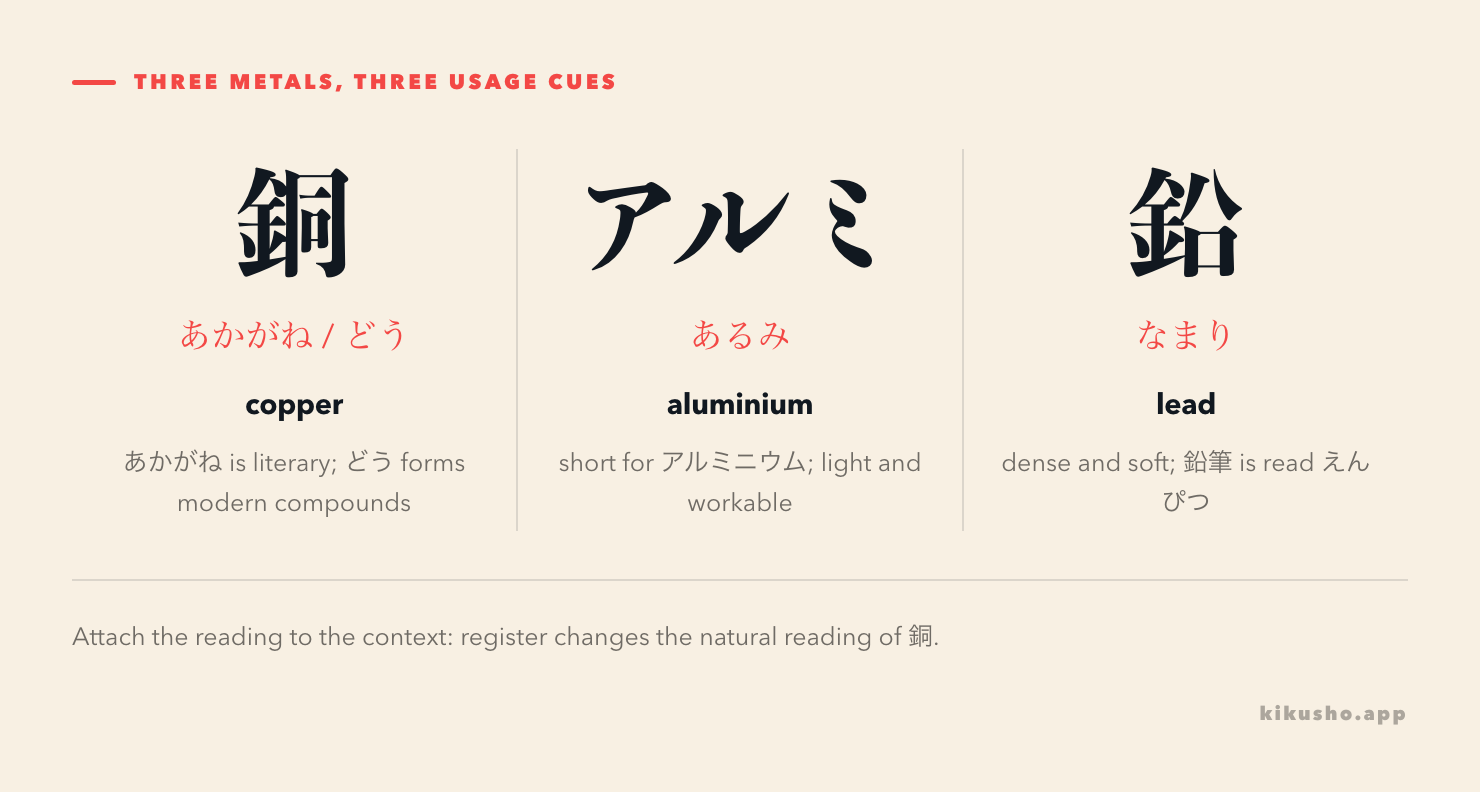
The inventory reading 銅(あかがね) is correct, but it is not the reading you will hear in every workshop. The native word literally evokes “red metal” and now feels old, literary or stylistically marked. It may appear in historical writing, poetry, craft language or the colour word 赤銅色(しゃくどういろ). In ordinary modern compounds, read 銅 as どう:
- 銅線(どうせん): copper wire
- 銅製(どうせい): made of copper
- 銅像(どうぞう): bronze or copper statue
- 銅メダル(どうメダル): bronze medal
職人は、磨いたあかがねの表面に赤い光が戻るのを見つめた。
しょくにんは、みがいた あかがねの ひょうめんに あかい ひかりが もどるのを みつめた。
The craftsperson watched the red glow return to the polished copper surface.
This sentence suits あかがね because it presents copper as a material with colour and history. A wiring specification would normally say 銅線(どうせん). The dictionary history of 銅 records both the native reading and the ordinary Sino-Japanese reading.
アルミ is the everyday shortening of アルミニウム. It is light, workable and used for frames, foil, cans and parts. Before another noun, use アルミの or a compound with 製: アルミの板, an aluminium sheet; アルミ製の枠, an aluminium frame.
鉛(なまり) is lead, a dense, soft metal. Useful combinations include 鉛を含む, contain lead; 鉛製, made of lead; and 鉛中毒, lead poisoning. The word 鉛筆(えんぴつ), pencil, uses the character but an ordinary pencil core is graphite rather than lead.
軽いアルミ製の枠に銅線を通し、鉛を含む古い部品だけを交換した。
かるい アルミせいの わくに どうせんを とおし、なまりを ふくむ ふるい ぶひんだけを こうかんした。
We ran copper wire through the light aluminium frame and replaced only the old parts containing lead.
Notice the deliberate reading switch: the assigned record is 銅(あかがね), but the natural compound here is 銅線(どうせん). Learning a spelling without its reading and register would miss that choice.
頑丈 and 丈夫 are not synonyms at these readings
頑丈(がんじょう) describes something built strongly enough to resist force, wear or damage. It works for objects, structures and bodies:
- 頑丈な箱: a sturdy box
- 頑丈な造り: robust construction
- 頑丈な体: a strong constitution or sturdy body
- 見た目より頑丈だ: sturdier than it looks
この棚は頑丈な造りで、重い陶器を並べても揺れない。
この たなは がんじょうな つくりで、おもい とうきを ならべても ゆれない。
This shelf is sturdily built and does not wobble even when heavy pottery is arranged on it.
The inventory's 丈夫(じょうふ) is a different lexical item. It is a literary noun for an admirable or manly person, a hero or warrior. Phrases such as 堂々たる丈夫 and 偉丈夫(いじょうふ) belong to elevated description rather than an ordinary product review.
困難を恐れず民を守った彼は、まさに一代の丈夫と呼ばれた。
こんなんを おそれず たみを まもった かれは、まさに いちだいの じょうふと よばれた。
He feared no hardship and protected the people, so he was called a true hero of his age.
The much more common 丈夫(じょうぶ) is a na-adjective meaning healthy, strong or durable: 丈夫な靴, durable shoes; 体が丈夫だ, be healthy. The source gloss attached both sense families to the じょうふ record, but modern dictionaries separate 丈夫(じょうふ) from 丈夫(じょうぶ). On a reading question, the kana are decisive.
陶器 is pottery, with a useful contrast to 磁器
陶器(とうき) covers pottery and ceramic ware made principally from clay. It tends to be opaque and somewhat absorbent, with a warmer or softer-looking body than porcelain. Use 陶器の皿, a pottery plate; 陶器を焼く, fire pottery; and 陶器市, a pottery fair.
ざらついていた陶器の縁を磨くと、指触りが滑らかになった。
ざらついていた とうきの ふちを みがくと、ゆびざわりが なめらかに なった。
After the rough rim of the pottery was polished, it felt smooth to the touch.
磁器(じき), introduced in the N3 materials and shapes lesson, is porcelain. It is generally fired at a higher temperature and is harder, less absorbent and sometimes translucent. The 陶器 reference describes the standard technical contrast, but real materials and regional traditions form a continuum. In an antiques catalogue, follow the maker's classification rather than guessing only from appearance.
滑らか and 脆い extend from matter to abstract situations
滑らか(なめらか) first describes a surface with little roughness: 滑らかな肌, smooth skin; 滑らかな手触り, a smooth feel. From uninterrupted physical movement, it extends naturally to speech, operation and progress:
- 滑らかな英語: fluent English
- 滑らかな話しぶり: smooth delivery
- 機械が滑らかに動く: the machine runs smoothly
- 交渉が滑らかに進む: negotiations proceed smoothly
脆い(もろい) describes a material that breaks, crumbles or loses shape under force. The particle often shows the weakness being tested: 衝撃に脆い, vulnerable to impact; 熱に脆い, vulnerable to heat. Abstract things can also lack resistance:
- 脆い信頼関係: a fragile relationship of trust
- 批判に脆い組織: an organisation vulnerable to criticism
- 誘惑に脆い: susceptible to temptation
- 情に脆い: easily moved by emotion
表面は滑らかに見えるが、この素材は急な温度変化に脆い。
ひょうめんは なめらかに みえるが、この そざいは きゅうな おんどへんかに もろい。
The surface looks smooth, but this material is vulnerable to sudden changes in temperature.
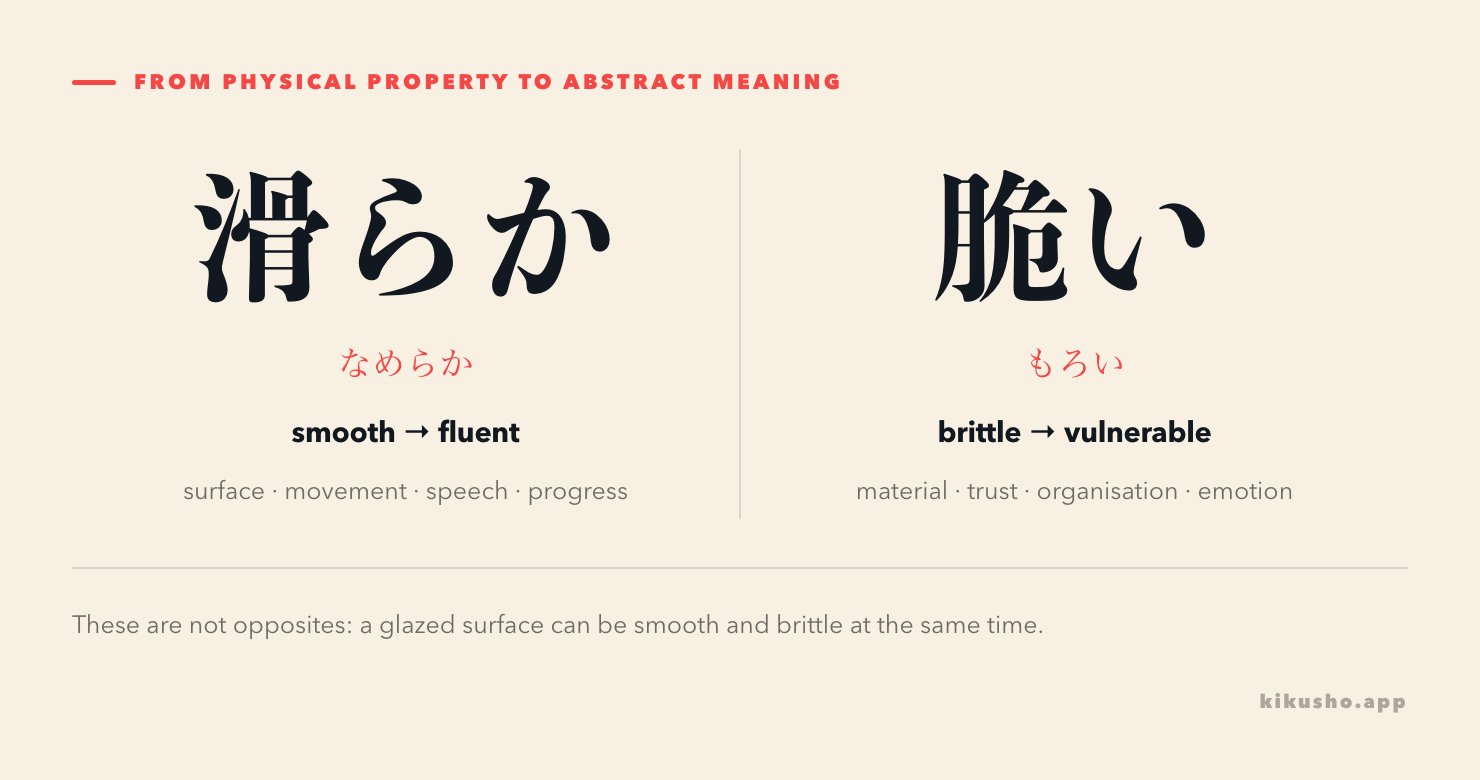
These adjectives are not exact opposites. A surface can be both smooth and brittle, as glazed ware may demonstrate. 滑らか answers “Is the surface or transition even?”; 脆い answers “How easily does it fail under stress?” Their dictionary ranges likewise move from physical qualities to uninterrupted fluency and lack of resistance.
平行 describes geometry; 並行 describes concurrent progress
平行(へいこう) is the standard spelling for geometric parallelism. Two lines in one plane are parallel when they remain the same distance apart and never meet, however far they extend. Planes can also be parallel.
二本の線が平行になるように、定規で位置を直してください。
にほんの せんが へいこうに なるように、じょうぎで いちを なおして ください。
Use a ruler to adjust the positions so that the two lines are parallel.
The same reading has another common spelling. 並行(へいこう) suits actions or processes that proceed side by side or at the same time: 二つの調査を並行して進める, conduct two investigations in parallel. Older writing and some dictionaries allow overlap, but the modern distinction is useful: choose 平行線 for a diagram and 並行作業 for concurrent work. The reference definition of 平行 foregrounds the geometric relationship.
The N2 materials and shapes lesson distinguishes straight and curved lines as well as vertical and horizontal orientation. N1 平行 adds the relationship between two lines rather than the direction or shape of one.
立体 gives a form depth
立体(りったい) is a solid or three-dimensional form: it has depth as well as height and width. Its clean contrast is 平面(へいめん), a plane or flat surface.
- 立体図形: solid or three-dimensional figure
- 立体模型: three-dimensional model
- 立体的に見える: look three-dimensional
- 平面を立体に起こす: turn a flat design into a three-dimensional form
平面の設計図だけでなく、立体模型を作れば、平行な面の位置も確認しやすい。
へいめんの せっけいずだけでなく、りったい もけいを つくれば、へいこうな めんの いちも かくにんしやすい。
If you make a three-dimensional model as well as a flat plan, it is easier to check the positions of the parallel faces.
The mathematical definition of 立体 concerns a portion of three-dimensional space bounded by planes or curved surfaces. Everyday use extends to art, models, stereoscopic appearance and figurative depth: 人物を立体的に描く means to portray a character with convincing complexity.
One conservation report can use every record
展示品は、あかがねの装飾、アルミ製の支持具、鉛を含む古い接合部から成る立体作品です。全体は頑丈に見えますが、陶器の部分は衝撃に脆く、表面を滑らかにする作業にも慎重さが必要です。二本の支柱が平行かを確認した学芸員は、作者を困難に立ち向かった丈夫になぞらえて解説しました。
The exhibit is a three-dimensional work made of copper ornament, aluminium supports and old joints containing lead. It looks sturdy overall, but the pottery section is brittle under impact, and smoothing its surface also requires care. After confirming that the two supports were parallel, the curator's commentary likened the artist to a hero who confronted hardship.
The context keeps the distinctions visible. 頑丈 evaluates construction, while 脆い identifies a specific weakness. 滑らか concerns the finish, 平行 the geometric relationship and 立体 the work's dimensional form. The marked reading あかがね gives copper an artistic register, and 丈夫(じょうふ) can only refer to the admired person.
Practice
1 · Native copper reading. In a literary description of polished copper, how is 銅 read in this lesson?
- A. どう
- B. あかがね
- C. からかね
- D. しゃくどう
2 · Abbreviation. What is アルミ shortened from?
- A. アルミナ
- B. アルマイト
- C. アルミニウム
- D. アルカリ
3 · Robust construction. Choose the most natural word: このケースは___な造りで、落としても壊れにくい。
- A. 頑丈
- B. 丈夫(じょうふ)
- C. 滑らか
- D. 平行
4 · The 丈夫 reading trap. Which statement is correct?
- A. じょうふ is the usual adjective meaning durable.
- B. じょうぶ is a literary noun meaning hero.
- C. じょうふ can be a literary noun for an admirable man or hero.
- D. Both readings always have the same meaning and function.
5 · Ceramic classification. Which description best fits 陶器 as a general contrast with 磁器?
- A. Clay pottery that is generally more porous and opaque
- B. Any transparent sheet made of glass
- C. A light metal frame
- D. A three-dimensional drawing
6 · Metal reading. Choose the reading of 鉛 when it means lead metal.
- A. すず
- B. はがね
- C. なまり
- D. どう
7 · Physical and figurative range. Which pair uses 滑らか naturally?
- A. 滑らかな表面 / 滑らかな話しぶり
- B. 滑らかな衝撃 / 滑らかな故障
- C. 滑らかな英雄 / 滑らかな鉛
- D. 滑らかな平行 / 滑らかな陶器市
8 · Two へいこう spellings. Complete the sentence with the preferred modern spellings: 二本の線は___で、二つの調査は___して進める。
- A. 並行 / 平行
- B. 平行 / 並行
- C. 平衡 / 平行
- D. 並衡 / 並行
9 · Abstract fragility. Which sentence uses 脆い figuratively?
- A. この棚は頑丈で脆い。
- B. 彼は情に脆く、頼まれると断れない。
- C. 二本の線は脆い。
- D. アルミを脆く読む。
10 · Integrated reading. A museum note says: 陶器は衝撃に脆いため、頑丈な箱に入れ、表面を滑らかに保つ。 What does it mean?
- A. The pottery is heavy, so place it on parallel lines.
- B. The hero is healthy, so keep the aluminium polished.
- C. Because the pottery is brittle under impact, put it in a sturdy box and keep its surface smooth.
- D. Because the copper is literary, build a three-dimensional box.
Show all 10 answers after completing the set
- B. The assigned native reading is あかがね. Modern compounds usually use どう.
- C. アルミ is the everyday shortening of アルミニウム.
- A. 頑丈な造り is robust construction that resists damage.
- C. 丈夫(じょうふ) is the literary noun; 丈夫(じょうぶ) is the common adjective.
- A. 陶器 is pottery and is generally more porous and opaque than porcelain.
- C. Lead metal is 鉛(なまり).
- A. 滑らか moves naturally from an even surface to fluent delivery.
- B. Use 平行 for geometric lines and 並行 for concurrent investigations.
- B. 情に脆い means easily moved by emotion.
- C. 脆い identifies vulnerability, 頑丈 the protective box and 滑らか the surface condition.
Common questions
Is 銅 read あかがね or どう?
Both readings exist. あかがね is the old native reading and can sound literary or deliberately evocative. どう is the ordinary reading in modern technical words and compounds such as 銅線 and 銅製.
What is the difference between 丈夫 read じょうふ and じょうぶ?
丈夫(じょうふ) is a literary noun for an admirable, manly person, hero or warrior. 丈夫(じょうぶ) is the familiar na-adjective meaning healthy, strong or durable. The reading changes the word's function and sense.
What is the difference between 平行 and 並行?
平行 is standard for geometric parallelism: lines or planes remain the same distance apart. 並行 is preferred when activities or processes proceed side by side or at the same time, although usage has some overlap.
How are 陶器 and 磁器 different?
陶器 is pottery made from clay and is generally more porous, opaque and softly textured. 磁器 is porcelain, usually fired hotter and typically harder, less absorbent and sometimes translucent. Real ceramic traditions form a continuum, so the boundary is not absolute.