On this page
規定, 規約, 行政, 訴訟, 判決 and 法案 give you six useful anchors in Japanese legal and administrative prose: provisions, organizational rules or terms, public administration, litigation, judgments and bills. Learn the noun together with its surrounding phrase, because 規定する, 訴訟を起こす and 判決を言い渡す identify different actions.
The six words separate rules, institutions and events
A form may point to a 規定; a service may ask you to accept its 規約. News about government can discuss 行政 or a 法案. Court reporting may describe a 訴訟 and later a 判決. These words share a reading environment, without forming a single sequence that every document follows.
This is an N1 vocabulary study set of six headwords, not a survey of legal terminology. The reference lists used for its placement descend from Jonathan Waller's Tanos resources. Their agreement is one source family. Separately published JapaneseTest4You entries also label 規定 and 訴訟 N1, though the underlying independence of those lists is unestablished. Dictionary checks establish readings and senses; they do not turn level estimates into an official exam syllabus.
Keep the headword, reading and collocation together
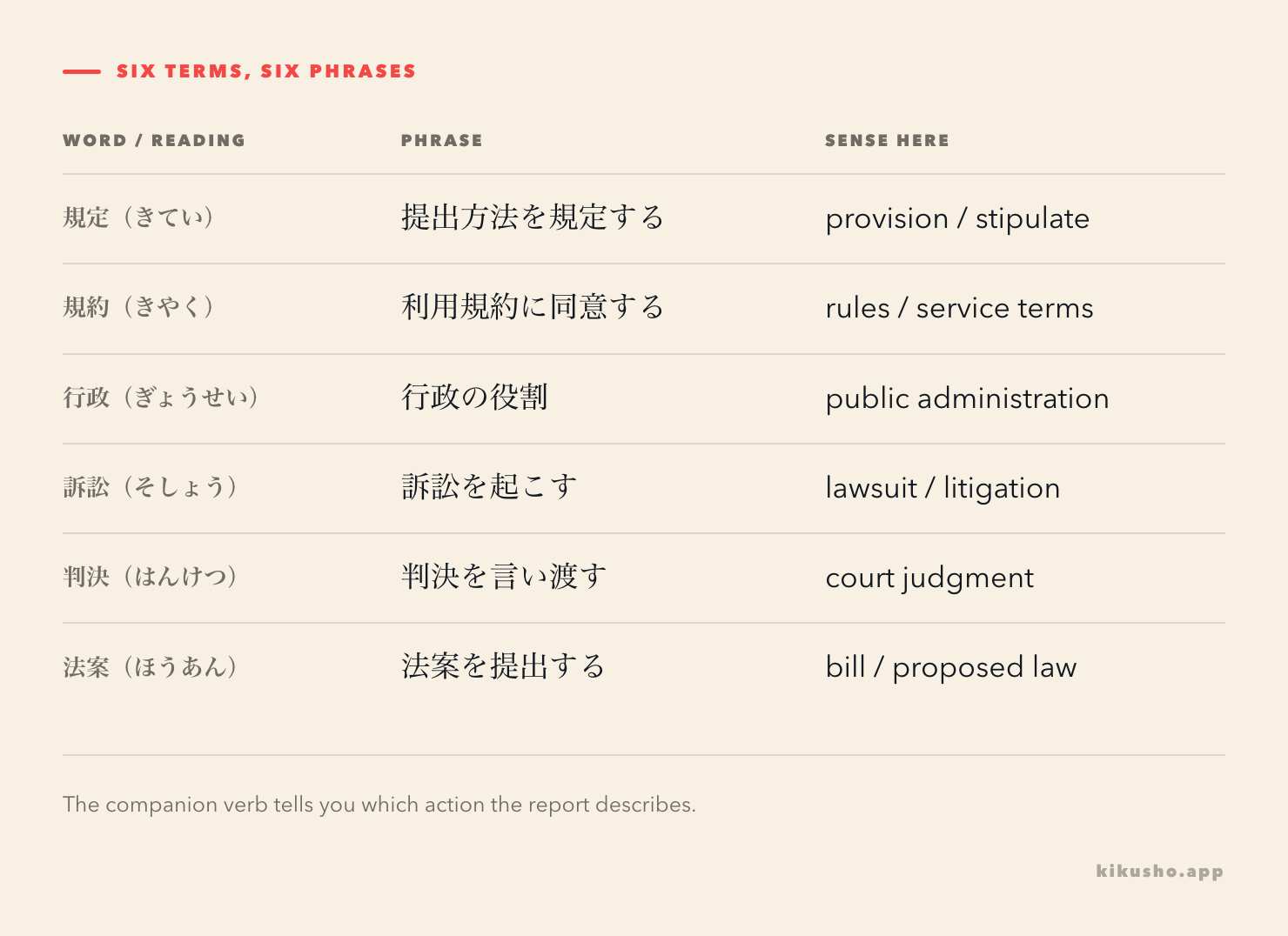
| Headword | Reading | Word class | Sense taught here | Phrase to keep |
|---|---|---|---|---|
| 規定 | きてい | Noun; also a する-verb | A stipulated rule or provision; to stipulate | 提出方法を規定する |
| 規約 | きやく | Noun | Rules of an organization; terms in 利用規約 | 利用規約に同意する |
| 行政 | ぎょうせい | Noun | Public administration | 行政の役割 |
| 訴訟 | そしょう | Noun | A lawsuit; litigation | 訴訟を起こす |
| 判決 | はんけつ | Noun | A court judgment | 判決を言い渡す |
| 法案 | ほうあん | Noun | A bill; proposed legislation | 法案を提出する |
All six can function as nouns. The table singles out 規定する because that verb is useful in this lesson; it is not a claim that every other headword is forbidden with する. In particular, learn the actual verb paired with 訴訟 or 判決 in the sentence you meet.
Read きやく with a full や, not a small ゃ. In ぎょうせい, keep the long vowel in ぎょう. そしょう has a short そ followed by しょう. The written forms and readings above are checked against the dictionary entries cited in the following sections.
規定 specifies content; 規約 often names the rules document
規定 can be a rule or a particular provision. As a verb, 規定する sets something out or stipulates it. It does not need to refer to a criminal prohibition or a national law.
提出方法は第3条に規定されている。
ていしゅつほうほうは だいさんじょうに きていされている。
“The submission method is specified in Article 3.”
The method is set out in the text. You are being directed to a provision, without being told whether the applicant has followed it. Shogakukan's 規定 entry and Kanjipedia's entry cover the rule/provision senses.
規約 is especially useful when an organization or service names its rules. 利用規約 means “terms of use” or “terms of service.”
登録の前に、利用規約を確認してください。
とうろくの まえに、りようきやくを かくにんしてください。
“Please check the terms of service before registering.”
The dictionary sense concerns rules agreed within an organization. Modern service wording also uses 規約 for the conditions offered to users: the LINE Yahoo terms provide an actual example of 利用規約に同意する. That phrase means “agree to the terms.” Shogakukan's 規約 and Kanjipedia's 規約 support the organizational-rule sense.
Both words concern rules, and their dictionary definitions overlap. Use the document's own title rather than replacing 規約 with 規定 everywhere, or assuming one always has greater legal force. A noun alone does not establish that hierarchy.
行政 names public administration, not every kind of paperwork
行政 concerns the work of national or local public bodies under law. In news, it can also stand for the administrative authorities themselves. Shogakukan and Kanjipedia distinguish this public function from legislation and judicial activity.
この報告書は、災害時の行政の役割を説明している。
この ほうこくしょは、さいがいじの ぎょうせいの やくわりを せつめいしている。
“This report explains the role of public administration during disasters.”
Here 行政 is a public function. English “administration” also describes ordinary office management, so do not automatically choose 行政 for every English sentence about an administrator or administrative task. The public-body context matters.
Nor does formal vocabulary automatically mark respect toward a person. Japanese politeness and register are a separate part of interpreting a notice.
訴訟 is the proceeding; 判決 is a judgment within that setting
訴訟を起こす means “bring a lawsuit.” 判決を言い渡す means “deliver a judgment.” Pay attention to who is performing each action.
住民は工事の中止を求めて、訴訟を起こした。
じゅうみんは こうじの ちゅうしを もとめて、そしょうを おこした。
“The residents brought a lawsuit seeking a halt to the construction work.”
The residents initiate a proceeding. The sentence does not say that they won, or that the requested halt was granted. Kanjipedia's 訴訟 and Shogakukan's 訴訟 entries support the litigation sense and its 起こす pairing.
裁判所は昨日、この訴訟の判決を言い渡した。
さいばんしょは きのう、この そしょうの はんけつを いいわたした。
“The court delivered its judgment in this lawsuit yesterday.”
Now the court acts. Another useful pairing is 判決を下す(はんけつをくだす), “hand down a judgment.” The judgment may concern a civil dispute as well as a criminal case. Translating 判決 as “sentence” in every context would incorrectly suggest a punishment each time. Kanjipedia's 判決 and Shogakukan's 判決 explain the court-decision sense.
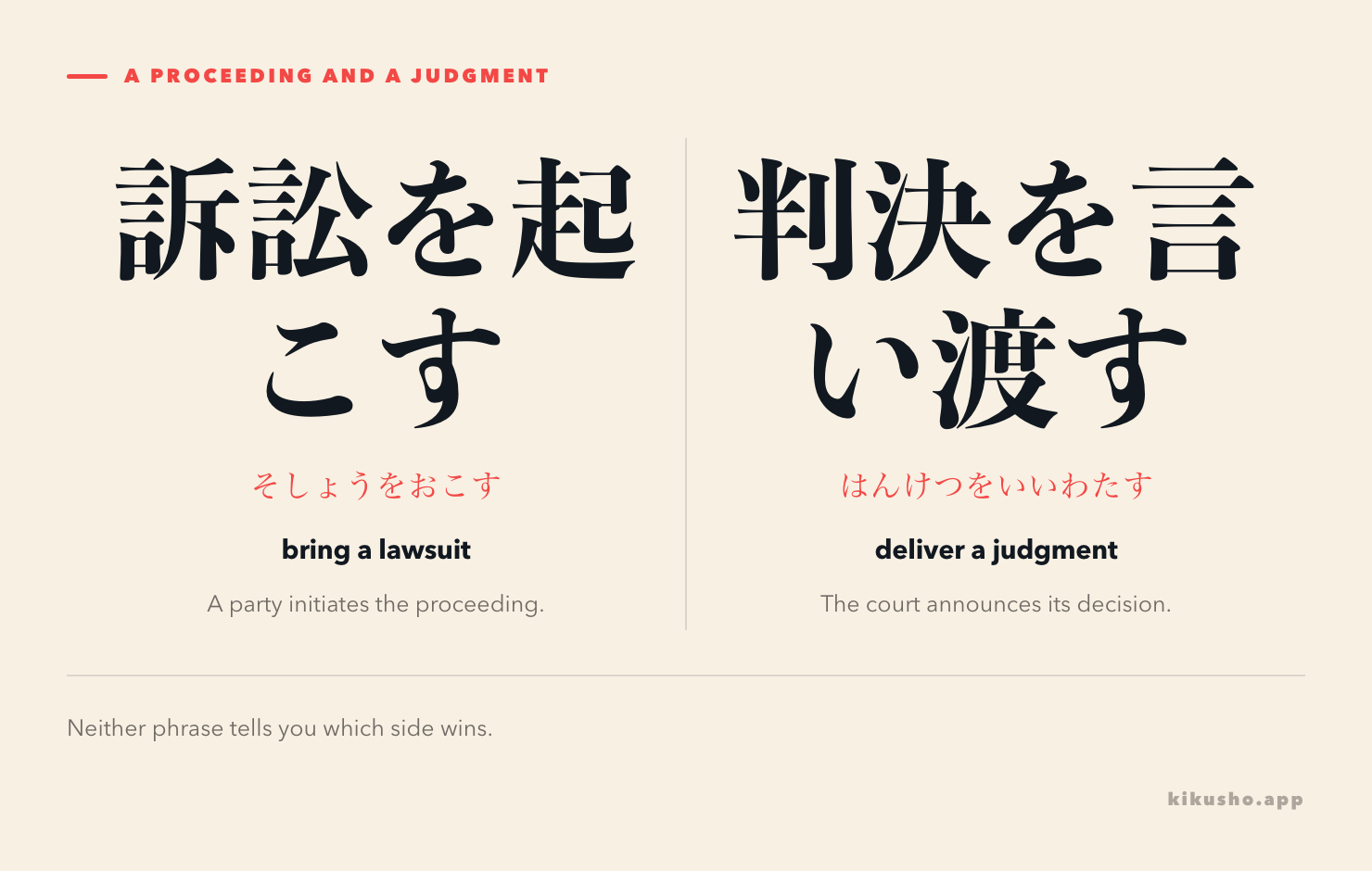
The words do not imply that every lawsuit ends in a judgment or that every judgment is beyond appeal. Read the text's actual account of the outcome. To follow how a writer argues about that outcome, continue with the N1 words for academic arguments.
法案 needs its status verb
法案 is a bill, a proposed law. It is a noun: learn 法案を提出する, “submit a bill,” rather than treating 法案 as a verb. Shogakukan's definition identifies a proposed legal text. The Cabinet Legislation Bureau's explanation separately describes submission, deliberation, passage and later commencement.
政府は個人情報の保護に関する法案を国会に提出した。
せいふは こじんじょうほうの ほごにかんする ほうあんを こっかいに ていしゅつした。
“The government submitted a bill concerning the protection of personal information to the Diet.”
This reports submission. It does not assert passage or an effective date. Compare the status phrases below as reading cues, rather than treating the word 法案 as a complete timeline.
| Phrase | Reading | Information supplied |
|---|---|---|
| 法案を提出する | ほうあんを ていしゅつする | Submit a bill |
| 法案を審議する | ほうあんを しんぎする | Deliberate on a bill |
| 法案が成立した | ほうあんが せいりつした | The bill passed / became law |
Even the third phrase does not supply an effective date. The surrounding document must do that work. When the six terms arrive in a Japanese news article, identifying whether the verb reports a proposal, a proceeding or an outcome keeps the story in order.
A word saved without its companion verb can leave you recalling the wrong event. Kikusho accepts pasted text for an editable vocabulary card; a court-news phrase gives you a useful example to keep with 訴訟 or 判決 while checking the generated reading and meaning.
Practice: six questions
Work through each item before consulting the combined solutions below. These exercises concern vocabulary in the supplied sentences.
Question 1 — reading. How do you read 行政 in 行政の役割?
- A. こうせい
- B. ぎょうせい
- C. ぎょせい
- D. ぎょうしょう
Question 2 — reading. Select the reading of 訴訟 in 訴訟を起こす.
- A. そしょう
- B. そうしょう
- C. そじょう
- D. そしゅう
Question 3 — interpret a provision. A document says 提出方法は第3条に規定されている. What does 規定されている tell you?
- A. A court has delivered a judgment about the submission.
- B. The applicant has brought a lawsuit.
- C. The submission method is set out in that article.
- D. A bill has entered into force.
Question 4 — paraphrase. Which sentence preserves the meaning of 政府は法案を国会に提出した?
- A. The government delivered a court judgment to the Diet.
- B. The government submitted proposed legislation to the Diet.
- C. The government confirmed that the law was already in force.
- D. The government completed the lawsuit.
Question 5 — usage. Which sentence uses 判決 in its usual court-judgment sense with a fitting action?
- A. 裁判所はその訴訟について判決を言い渡した。
- B. 利用者は新しいアプリの判決に同意した。
- C. 政府は税制に関する判決を国会に提出した。
- D. このサービスの判決ではパスワードの長さを規定している。
Question 6 — meaning in context. Choose the headword for the service's terms in 登録前に利用____を確認してください.
- A. 訴訟
- B. 行政
- C. 法案
- D. 規約
Keep your selections in question order; the explanations check both the headwords and the events described.
Answers and explanations
Answer 1: B. 行政 is ぎょうせい. C drops the long vowel in ぎょう; A and D substitute readings that do not belong to this compound.
Answer 2: A. 訴訟 is そしょう. The first syllable does not lengthen to そう. C and D change the second part of the compound's reading.
Answer 3: C. 規定されている presents the method as specified in Article 3. It does not report a court's decision, initiation of litigation or a bill's commencement. The rule's existence also does not establish that an applicant complied with it.
Answer 4: B. 法案 is proposed legislation, and 提出した reports its submission. C adds an effective status absent from the sentence. A imports 判決's court setting, while D substitutes an event involving 訴訟. None preserves the stated action.
Answer 5: A. The court delivers a judgment concerning the lawsuit. B needs a term for the app's conditions, such as 利用規約; C needs 法案 for the intended submission of proposed tax legislation; D needs a word for service rules or provisions. Those sentences mismatch the ordinary event described and the noun 判決.
Answer 6: D. 利用規約 is the terms-of-service phrase. The other choices would introduce litigation, public administration or a proposed law into a sentence asking the user to check service conditions. Read the whole phrase 利用規約を確認する, then distinguish checking it from 利用規約に同意する, agreeing to it.
Common questions
How are 規定 and 規約 different?
規定 can mean a stipulated rule or provision, and 規定する means to stipulate or specify. 規約 commonly names rules adopted by an organization; 利用規約 is the familiar phrase for terms of service. Their meanings overlap, so the document title and surrounding phrase help you choose.
Does 法案 mean a law already in force?
法案 means a bill or proposed law. A statement that a bill was submitted does not establish that it passed or entered into force. Read the surrounding verbs and dates to determine its status.
What is the difference between 訴訟 and 判決?
訴訟 names a lawsuit or litigation. 判決 names a judgment delivered by a court. Bringing a lawsuit and receiving a judgment are different events; neither noun by itself tells you who won.
Are these six words guaranteed JLPT N1 items?
No exhaustive official JLPT vocabulary syllabus is published. These six spelling-and-reading records are placed at N1 in the reference lists used for this curriculum. That placement is a study estimate, not a guarantee that the words appear on an exam.