On this page
These fourteen N1 records sharpen the language of surveillance, enforcement, evidence, courtroom roles and punishment. The difficult part is not memorising fourteen English labels: it is keeping 証人・証言・証拠, 捜索・捜査, and 刑罰・処罰・罰 separate when a dense report moves quickly from one stage to another.
Fourteen records, thirteen written headwords
| Headword | Reading | Core meaning | Useful pattern |
|---|---|---|---|
| 監視 | かんし, kanshi | monitoring; surveillance | 監視を続ける |
| 刑罰 | けいばつ, keibatsu | criminal punishment; legal penalty | 刑罰を科す |
| 検事 | けんじ, kenji | public prosecutor | 検事が起訴する |
| 詐欺 | さぎ, sagi | fraud; swindle | 詐欺に遭う |
| 証言 | しょうげん, shōgen | testimony | 法廷で証言する |
| 証拠 | しょうこ, shōko | evidence; proof | 証拠を提出する |
| 証人 | しょうにん, shōnin | witness | 証人を呼ぶ |
| 処罰 | しょばつ, shobatsu | punishment; the act of punishing | 違反者を処罰する |
| 捜索 | そうさく, sōsaku | search for a person or thing; search of a place | 行方不明者を捜索する |
| 取り締まり | とりしまり, torishimari | enforcement; control; crackdown | 取り締まりを強化する |
| 罰 | ばち, bachi | divine or moral retribution | 罰が当たる |
| 罰 | ばつ, batsu | punishment; penalty | 罰を受ける |
| 弁護 | べんご, bengo | legal defense; advocacy | 被告人を弁護する |
| 暴力 | ぼうりょく, bōryoku | violence; physical force | 暴力を振るう |
Kikusho's September 2026 inventory places all fourteen spelling-and-reading records at N1, with no internal level disagreement. 罰 occupies two rows because ばつ and ばち are different lexical records with different core uses. Most of the baseline observations descend from the same Waller/Tanos source family; a separately published comparison list supports some headwords, but its underlying independence is uncertain. A current N1 workbook sample groups 検事, 刑罰 and 証言 under 法律・事件, while the official JLPT FAQ explains that no fixed current vocabulary specification is published. N1 is therefore a source-backed study placement, not an official promise that a word will appear on the test.
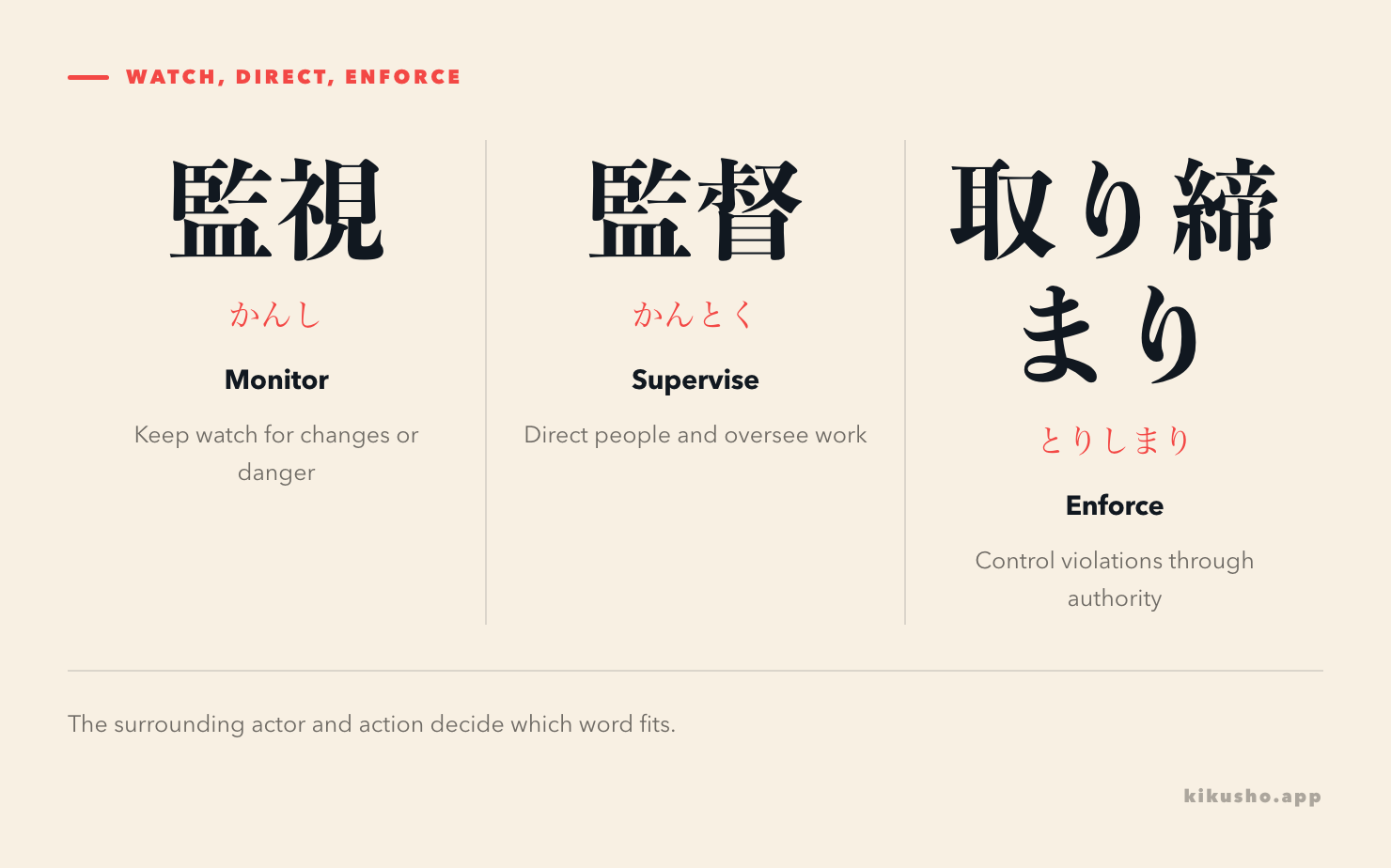
監視 watches; 監督 directs; 取り締まり enforces
監視(かんし) is sustained watching or monitoring, usually to detect danger, abnormal behaviour or rule-breaking. Natural combinations include 監視カメラ, surveillance camera; 動きを監視する, monitor movements; and 24時間監視する, monitor around the clock. The 監視 reference gives “watch” and “surveillance” as its central English equivalents.
監督(かんとく), reviewed in the N3 law and crime lesson, directs or oversees people and work. A 現場監督 can tell workers what to do and check that a project meets its requirements. A monitoring system, by contrast, may simply keep watching and alert someone when a condition changes.
取り締まり(とりしまり) is enforcement or a crackdown: action by an authority to control violations. Its verb is 取り締まる. Common phrases include 交通違反の取り締まり, enforcement against traffic violations; 違法営業を取り締まる, crack down on illegal business operations; and 取り締まりを強化する, strengthen enforcement. In a public-order context, translating it merely as “management” hides the authority-and-compliance element. The National Police Agency uses 取締り when describing operations against organised groups and fraud in its public-safety reporting.
当局は港を監視し、密輸の取り締まりを強化した。現場監督は職員に新しい確認手順を説明した。
とうきょくは みなとを かんしし、みつゆの とりしまりを きょうかした。げんば かんとくは しょくいんに あたらしい かくにん てじゅんを せつめいした。
The authorities monitored the port and strengthened enforcement against smuggling. The site supervisor explained the new inspection procedure to the staff.
The same paragraph can use all three words because they name different actions, not because they are interchangeable synonyms.
捜索 is a search; 捜査 is an investigation
捜索(そうさく) focuses on looking for somebody or something, or searching a place. Rescue teams 行方不明者を捜索する, search for a missing person. In a criminal-procedure context, investigators may 建物を捜索する, search a building, under the applicable legal authority.
捜査(そうさ) is the wider criminal investigation: investigators establish facts, collect and preserve evidence, identify possible offenders and decide what further steps are required. The N3 prerequisite lesson teaches the event-to-investigation distinction. In an investigation, a 捜索 can be one concrete evidence-gathering action.
警察は行方不明者の捜索を続ける一方、事件性があるかどうか捜査している。
けいさつは ゆくえふめいしゃの そうさくを つづける いっぽう、じけんせいが あるか どうか そうさしている。
Police are continuing the search for the missing person while investigating whether a crime may be involved.
The first noun answers “what are they looking for?” The second answers “what facts are they trying to establish?” Do not use 捜索 as a blanket replacement for every criminal investigation.
検事 presents the public case; 弁護 protects the defense
検事(けんじ) is a public prosecutor. In Japan, prosecutors investigate cases referred by police or otherwise received, decide whether to prosecute and present prosecuted cases in court. The Ministry of Justice's description of prosecutors' duties covers investigation, charging decisions and proof at trial.
弁護(べんご) is defense or advocacy, especially the act of defending a suspect or defendant and protecting that person's rights and interests. 弁護士(べんごし) is the lawyer; 弁護人(べんごにん) is defense counsel in the proceeding. Keep the action and the professional apart:
- 被告人を弁護する: defend the accused
- 弁護人が証人に質問する: defense counsel questions a witness
- 弁護士に弁護を依頼する: ask a lawyer to provide a defense
検事と弁護人は、それぞれの立場から証拠について意見を述べた。
けんじと べんごにんは、それぞれの たちばから しょうこについて いけんを のべた。
The prosecutor and defense counsel each expressed views on the evidence from their respective positions.
The court decides the case. Calling 検事 “the lawyer who declares guilt” would collapse investigation, prosecution and judgment into one role. The Ministry of Justice's criminal-procedure overview separately describes the prosecutor's proof, defense counsel's argument and the court's judgment.
証人 is the person, 証言 the statement, 証拠 the proof
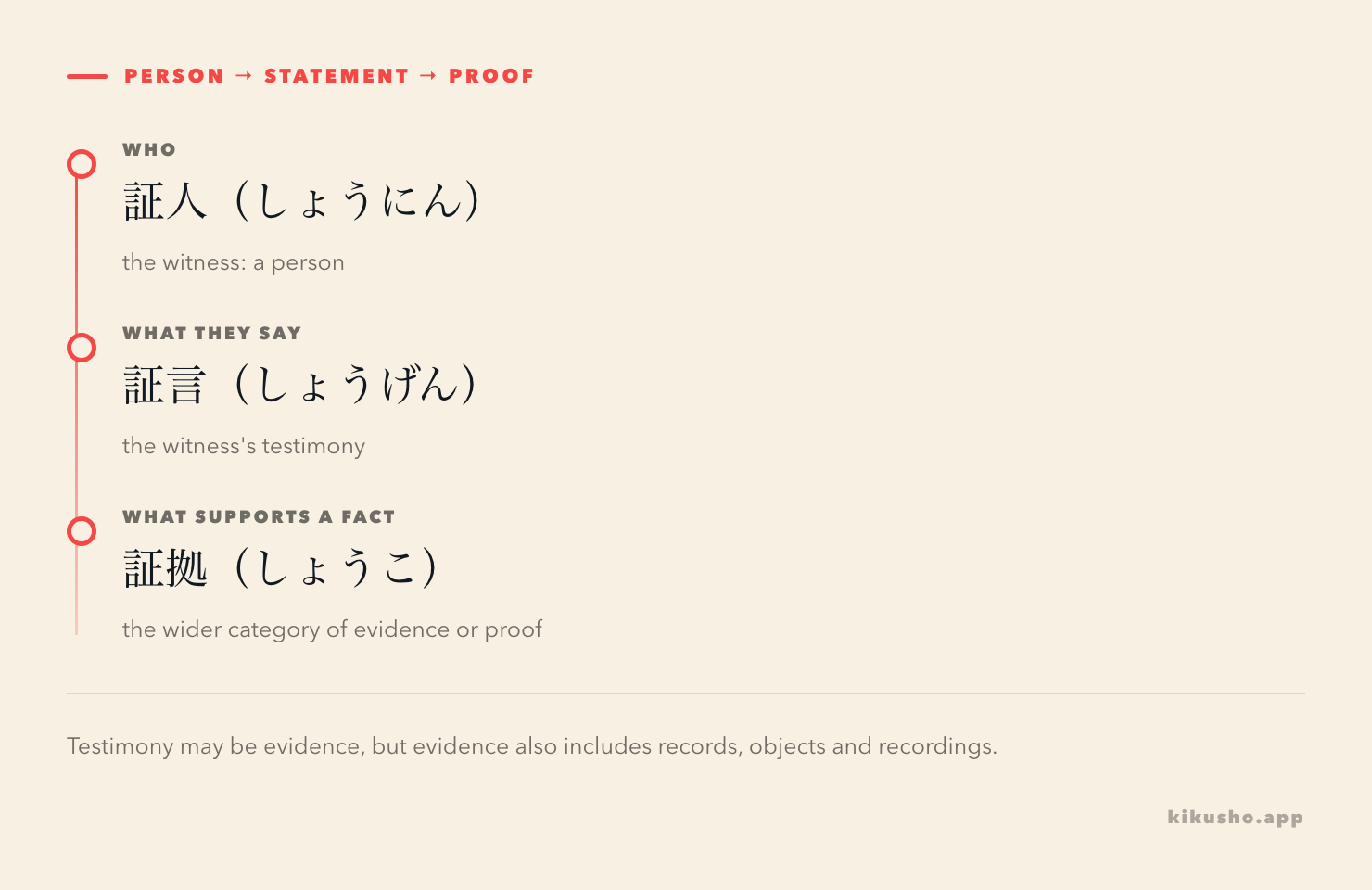
These three words share 証, but they answer three different questions.
証人(しょうにん) is the witness: the person called to state what they know. 証言(しょうげん) is testimony: what that person states in a proceeding or formal inquiry. 証拠(しょうこ) is the broader category of evidence or proof used to establish a fact. Documents, objects, recordings and witness statements may all function as evidence. Japan Legal Support Center's plain-language legal vocabulary explicitly explains that documents, objects and what witnesses say can be 証拠.
| Question | Best word | Example |
|---|---|---|
| Who saw the event? | 証人 | 証人を法廷に呼ぶ |
| What did that person state? | 証言 | 証言の内容を確認する |
| What supports the claim? | 証拠 | 証拠を提出する |
証人は「男が店を出るのを見た」と証言したが、その証言だけでは身元を特定する十分な証拠にならなかった。
しょうにんは「おとこが みせを でるのを みた」と しょうげんしたが、その しょうげんだけでは みもとを とくていする じゅうぶんな しょうこに ならなかった。
The witness testified, “I saw a man leave the shop,” but that testimony alone did not constitute enough evidence to identify him.
The sentence does not deny that testimony can be evidence. It says this particular testimony was insufficient for this particular conclusion.
詐欺 deceives; 暴力 uses force
詐欺(さぎ) is fraud or a swindle: deceiving somebody to obtain money, property or another benefit. Useful patterns are 詐欺に遭う, fall victim to fraud; 詐欺を働く, commit fraud; 詐欺の疑い, suspicion of fraud; and 特殊詐欺, organised fraud using methods such as impersonation. The Penal Code's fraud provision centres on deceiving a person in order to obtain property or an unlawful economic benefit.
暴力(ぼうりょく) is violence or physical force. 暴力を振るう means use violence against someone, while 暴力行為 is an act of violence and 暴力団 is the established term for an organised crime group. Depending on context, the word can extend metaphorically to coercive power, but the physical-force sense is the safest anchor.
犯人は暴力を使わず、銀行員を装う電話で被害者をだましたため、記事は強盗ではなく詐欺事件として報じた。
はんにんは ぼうりょくを つかわず、ぎんこういんを よそおう でんわで ひがいしゃを だましたため、きじは ごうとうではなく さぎ じけんとして ほうじた。
Because the perpetrator deceived the victim by posing as a bank employee on the phone, without using violence, the article reported it as a fraud case rather than a robbery.
That contrast identifies the conduct described; it does not determine a real person's criminal liability.
刑罰, 処罰 and 罰 point to different frames
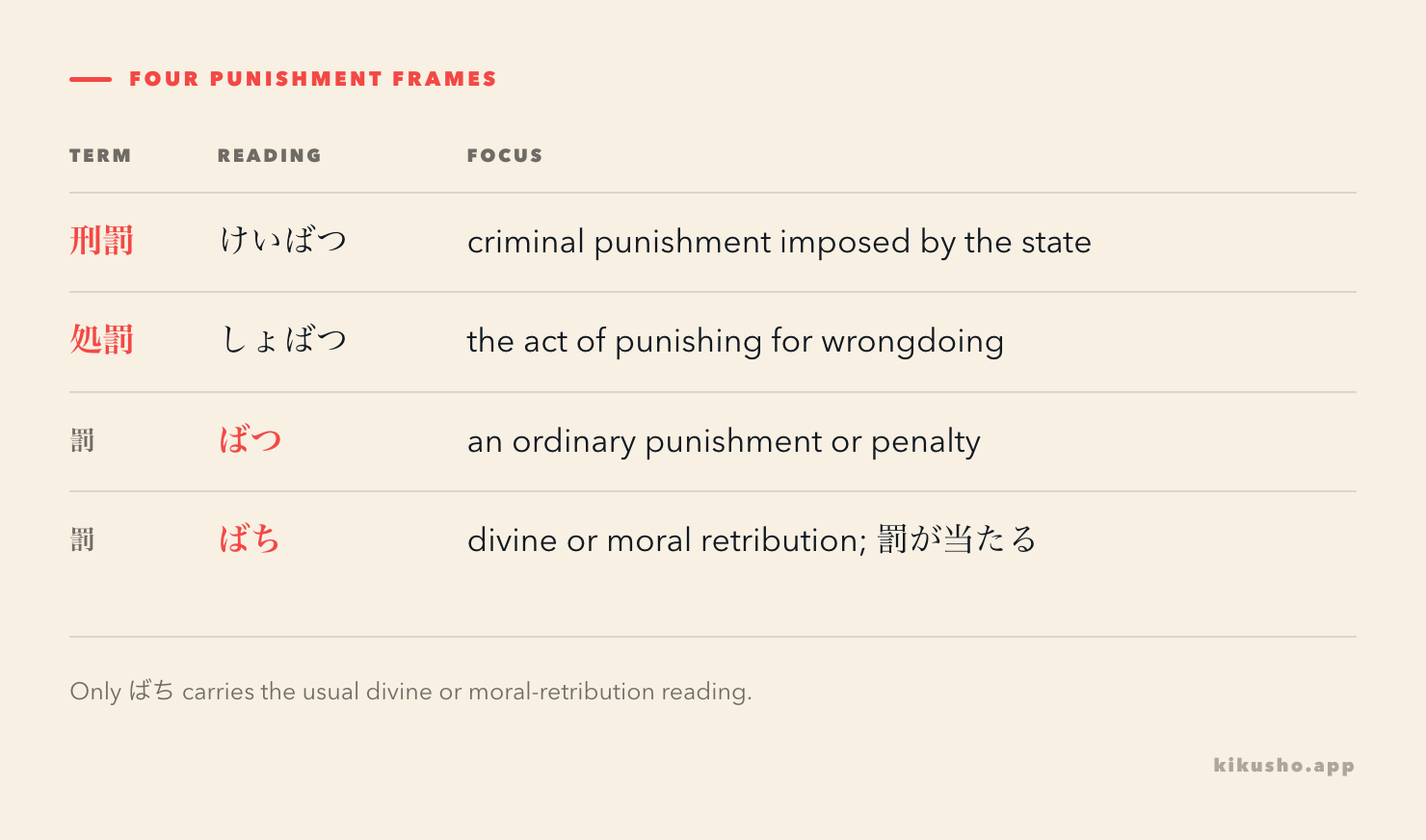
刑罰(けいばつ) is a punishment imposed by the state for a crime, or the legal institution of criminal punishment. The dictionary definition makes the state-and-crime relationship explicit. Learn 刑罰を科す, impose a criminal punishment. The imported gloss “judgment” is too broad: a court judgment is 判決, while 刑罰 is the penal consequence.
処罰(しょばつ) focuses on the act of punishing a person or organisation for wrongdoing: 違反者を処罰する, punish violators; 厳しく処罰される, be severely punished. It can occur in legal or disciplinary discussion, so the surrounding rule tells you what authority and consequence are involved.
罰(ばつ) is the broad everyday noun for a punishment or penalty. A parent, teacher, game or institution can set a 罰 without creating a criminal 刑罰. 罰を受ける means receive punishment; 罰を与える means give punishment.
罰(ばち) is conventionally divine, supernatural or moral retribution. The fixed expression 罰が当たる means that retribution befalls someone for bad conduct. The 罰 entry separates ばつ, punishment for an offence or mistake, from ばち, punishment from a deity or a sense of moral retribution.
裁判所が刑罰を科すかどうかは、法律と証拠に基づいて判断される。違反者を処罰すべきだという意見が強くても、「悪いことをすれば罰が当たる」という道徳的な表現とは分けて読む必要がある。
さいばんしょが けいばつを かすか どうかは、ほうりつと しょうこに もとづいて はんだんされる。いはんしゃを しょばつすべきだという いけんが つよくても、「わるいことを すれば ばちが あたる」という どうとくてきな ひょうげんとは わけて よむ ひつようが ある。
Whether a court imposes a criminal punishment is decided on the basis of law and evidence. Even when there are strong calls to punish a violator, that legal discussion must be read separately from the moral expression “If you do wrong, retribution will catch up with you.”
One fictional report connects all fourteen records
警察は、投資会社を装った詐欺グループの拠点を長期間監視していた。被害者への暴力は確認されなかったが、虚偽の説明で送金させた疑いがある。捜査員は裁判所の令状に基づいて事務所を捜索し、電子機器や契約書を証拠として押収した。同時に、同様の詐欺に対する取り締まりも強化された。公判では、複数の証人が勧誘の方法について証言した。検事は記録と証言が組織的な詐欺を示すと主張し、弁護人は一部の証拠の解釈に異議を唱えた。裁判所は各被告人の関与を個別に判断し、有罪と認定した者に刑罰を科した。判決後、厳しい処罰を求める声が報じられた一方、「人をだませば罰が当たる」と話す住民もいた。後者の罰は、法律上の罰(ばつ)ではなく、道徳的な報いを表す罰(ばち)である。
Police had kept the base of a fraud group posing as an investment company under surveillance for a long period. No violence against victims was confirmed, but the group was suspected of inducing transfers through false explanations. Investigators searched the office under a court warrant and seized electronic devices and contracts as evidence. Enforcement against similar fraud was also strengthened. At trial, several witnesses testified about the solicitation methods. The prosecutor argued that the records and testimony showed organised fraud, while defense counsel challenged the interpretation of some evidence. The court assessed each defendant's involvement separately and imposed criminal punishment on those it found guilty. After the judgment, reports described calls for severe punishment, while one resident said, “People who deceive others will face retribution.” The latter 罰 is read ばち and expresses moral retribution, not a legal penalty read ばつ.
The report keeps the roles and objects visible: investigators conduct a 捜索 within a 捜査; 証人 give 証言; testimony and seized records become possible 証拠; 検事 and 弁護人 argue; the court judges and may impose 刑罰. For provisions, litigation and bills outside this criminal-report sequence, continue with the N1 legal and administrative vocabulary lesson.
Check the N1 distinctions
1 · Surveillance. Select the kana reading that matches 監視.
- A. かんし
- B. かんじ
- C. けんし
- D. かんせい
2 · Prosecutor. Match 検事 to its kana.
- A. けんし
- B. けんじ
- C. げんじ
- D. けんじょう
3 · Person, statement, proof. Complete the sentence: ___が法廷で___し、その内容が重要な___になった。
- A. 証拠 / 証人 / 証言
- B. 証言 / 証拠 / 証人
- C. 証人 / 証言 / 証拠
- D. 検事 / 証拠 / 証人
4 · Search or investigation. Which sentence uses both words accurately?
- A. 警察は事件を捜索し、部屋を捜査した。
- B. 警察は事件を捜査し、令状に基づいて部屋を捜索した。
- C. 証人は証拠を捜査して証言した。
- D. 裁判所は検事を捜索として処罰した。
5 · Monitoring or enforcement. A city increases checks and penalties against illegal parking. Which noun best fits ___を強化する?
- A. 弁護
- B. 証言
- C. 取り締まり
- D. 捜索
6 · Court roles. Which statement is accurate?
- A. 検事 delivers the court's final judgment.
- B. 弁護 is the act of defending or advocating for the accused.
- C. 弁護 and 弁護士 always name exactly the same grammatical thing.
- D. 検事 is an ordinary word for every private lawyer.
7 · Fraud. Which sentence is natural?
- A. 偽の投資話による詐欺に遭った。
- B. 証人を詐欺として法廷に呼んだ。
- C. 裁判所が詐欺を証言した。
- D. 監視カメラが詐欺を弁護した。
8 · Legal punishment. Which phrase most specifically means “impose a criminal punishment”?
- A. 罰が当たる
- B. 監視を続ける
- C. 刑罰を科す
- D. 証人を呼ぶ
9 · Two readings of 罰. In 「そんなことをすれば罰が当たる」, how is 罰 normally read and understood?
- A. ばつ, a court judgment
- B. ばち, divine or moral retribution
- C. ばつ, a witness statement
- D. ばち, police surveillance
10 · Process or result. 会社は規則違反を理由に職員を処罰した。 What does 処罰した focus on?
- A. The company monitored the employee continuously.
- B. A witness testified against the company.
- C. A court necessarily imposed criminal punishment.
- D. The company took action to punish the employee for a violation.
11 · Integrated reading. 証人の証言だけでは不十分だったため、検事は別の証拠を提出した。 Which paraphrase is safest?
- A. The witness was punished because all evidence was false.
- B. The prosecutor submitted additional evidence because the testimony alone was insufficient.
- C. Defense counsel searched the witness's home.
- D. The court treated the prosecutor as the only witness.
12 · Usage. Which sentence keeps 監視, 監督 and 取り締まり distinct?
- A. システムが通信を監視し、責任者が作業を監督し、当局が違反を取り締まる。
- B. システムが責任者を取り締まり、当局が作業を証言する。
- C. 責任者が通信を刑罰し、システムが違反を弁護する。
- D. 当局が作業を証人し、責任者が通信を捜索になる。
Reveal the N1 evidence and punishment solutions
- A. Choose かんし for 監視; the voiced じ and the けん alternatives do not match this word.
- B. 検事 matches けんじ, with the final 事 voiced as じ.
- C. The 証人 is the person, that person 証言する, and the resulting statement may become 証拠.
- B. Police investigate the case as a whole and search the room as a specific authorised action.
- C. 取り締まりを強化する is the standard enforcement or crackdown pattern.
- B. 弁護 names defense or advocacy. A 弁護士 is a lawyer, and the court rather than the prosecutor delivers the judgment.
- A. 詐欺に遭う naturally means fall victim to fraud.
- C. 刑罰を科す specifically means impose a criminal punishment.
- B. In 罰が当たる, 罰 is normally ばち and refers to divine or moral retribution.
- D. 処罰する focuses on taking punitive action. The sentence does not by itself establish a criminal court sentence.
- B. The sentence distinguishes testimony from the additional evidence submitted by the prosecutor.
- A. A system monitors communications, a responsible person supervises work, and authorities enforce rules against violations.
Common questions
What is the difference between 証人, 証言 and 証拠?
証人 is a witness, the person. 証言 is testimony, what a witness states. 証拠 is evidence or proof more broadly; testimony can serve as evidence, but documents, recordings and physical objects can also be evidence.
What is the difference between 捜索 and 捜査?
捜索 is a search for a person or object, or a search of a place. 捜査 is a criminal investigation: the wider process of establishing facts and collecting evidence. A physical search can therefore be one action within an investigation.
How are 刑罰, 処罰 and 罰 different?
刑罰 is a criminal punishment imposed by the state. 処罰 focuses on the act of punishing someone for wrongdoing. 罰 read ばつ is the broader everyday word for a punishment or penalty; read ばち, it commonly means divine or moral retribution, especially in 罰が当たる.
Are all fourteen records officially guaranteed JLPT N1 vocabulary?
No. Kikusho's reference inventory places all fourteen spelling-and-reading records at N1, but the JLPT publishes no exhaustive current vocabulary list. Treat N1 as a documented study placement rather than a guarantee.