On this page
慣例 names an established convention, 周期 the interval of a cycle, and 持続 the continuity of one state or effect. 度々, 時折 and 頻繁 then describe how densely separate events occur. These six N1 words all concern repetition, but they answer different questions and cannot be exchanged just because English offers habit, regularly or often.
The prerequisite N3 habits and frequency lesson distinguishes a personal 癖, an ordinary baseline and repeated action. At N1, the focus widens from a person's routine to institutional practice, measurable cycles, sustained conditions and the way a report characterises event frequency.
Six words answer four different questions
Before choosing a word, identify what the sentence is measuring.
- 慣例(かんれい) asks whether a procedure has become an accepted convention.
- 周期(しゅうき) asks after what interval the same phase returns.
- 持続(じぞく) asks how long a state or effect remains in force.
- 度々(たびたび) says an event has happened on repeated occasions.
- 時折(ときおり) says an event happens occasionally, with substantial gaps.
- 頻繁(ひんぱん) characterises occurrence as dense or high in frequency.
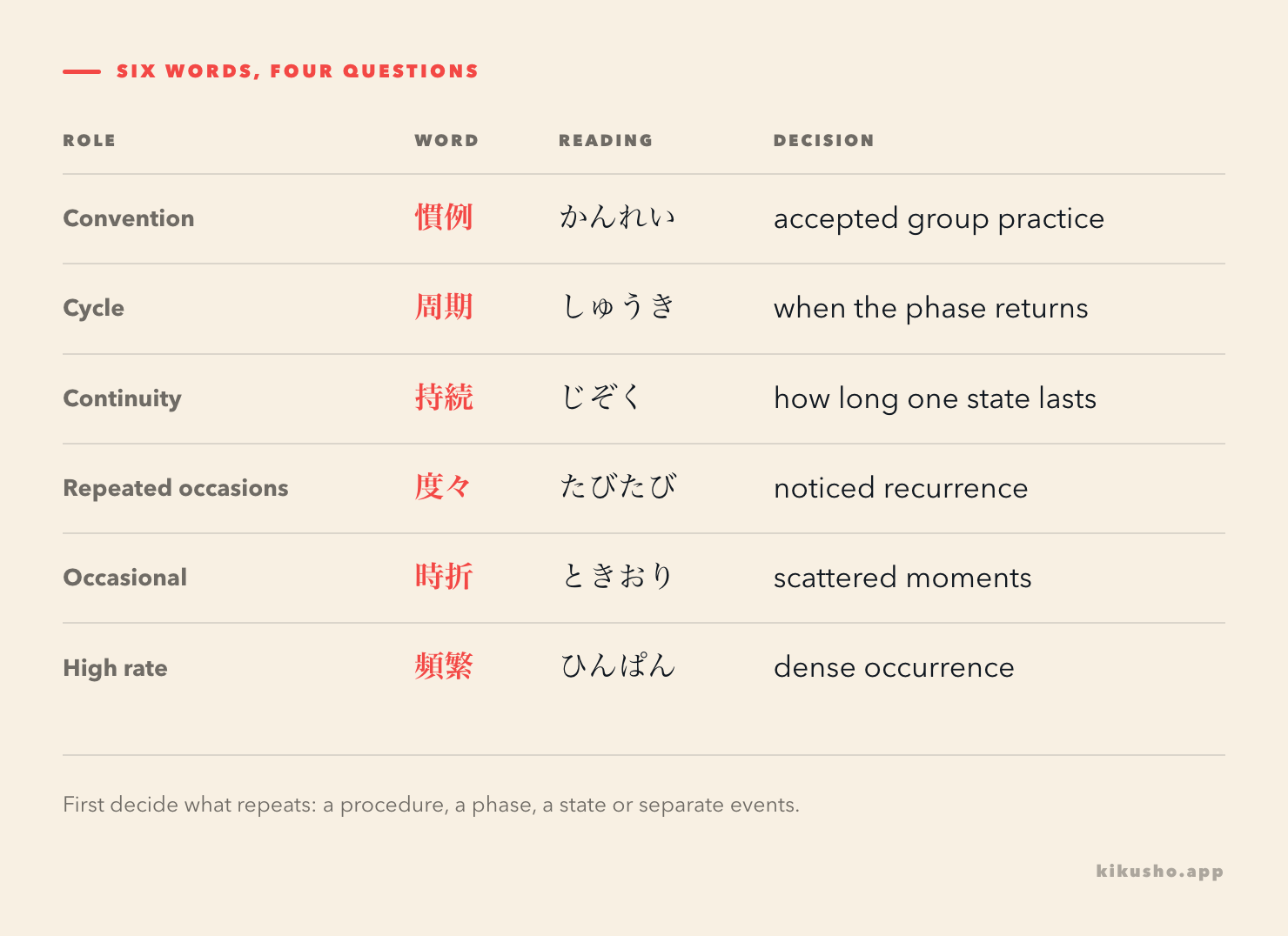
This role test prevents two common errors. 周期 is not merely a formal substitute for “often”: it identifies a repeating interval or structure. 持続 does not count repeated events at all; it presents one condition as continuing.
Form constrains the choice
| Item | Kana | Grammatical use | Main distinction | Typical frame |
|---|---|---|---|---|
| 慣例 | かんれい | noun | established convention or customary procedure | 慣例に従う, 慣例となっている |
| 周期 | しゅうき | noun | cycle; interval until a phase returns | 周期が短い, 一週間の周期 |
| 持続 | じぞく | noun; する-verb | continuity; maintain a state or effect | 効果が持続する, 集中力を持続させる |
| 度々 | たびたび | adverb; noun | repeatedly, on many occasions | 度々起こる, 度々の変更 |
| 時折 | ときおり | adverb | occasionally, from time to time | 時折見かける |
| 頻繁 | ひんぱん | noun; な-adjective | frequent; occurring at a high rate | 頻繁に起こる, 頻繁な更新 |
The syntax is part of the meaning. 度々 and 時折 directly modify a predicate. 頻繁 is more flexible: 頻繁に連絡する modifies a verb, 頻繁な連絡 modifies a noun, and 連絡が頻繁だ makes frequency the predicate.
慣例 is a shared convention, not a personal quirk
慣例(かんれい) is a practice that repetition has established as the accepted way for a group, institution or field to proceed. The agents are often a committee, company, profession or community rather than one person. Common expressions include 慣例に従う (follow convention), 慣例に倣う (model something on convention) and 慣例となっている (have become customary practice).
委員長は慣例に従って、最年長の委員から選ばれる。
いいんちょうは かんれいに したがって、さいねんちょうの いいんから えらばれる。
By convention, the chair is selected from the most senior members.
This sentence does not claim that a written rule legally requires the choice. It says repeated institutional practice has created an expected procedure. The Japanese Wiktionary entry for 慣例 likewise centres a practice that has become customary through repetition.
Compare three neighbouring ideas:
- 癖 is a personal tendency, often unconscious: 緊張すると早口になる癖.
- 習慣 is an established personal habit or broader social custom: 毎朝走る習慣.
- 慣例 is a recognised procedure or precedent within a group: 慣例に従って議長を選ぶ.
慣例 can be challenged. 従来の慣例を見直す means reviewing a former convention, often because the group no longer sees repetition alone as a good reason to keep it. In formal argument, you may also meet 慣例に照らして判断する, “judge in light of convention.” The formal standards lesson explains に照らして and related frames.
周期 measures return; 持続 measures continuity
Both words can appear beside units of time, but they draw different timelines.
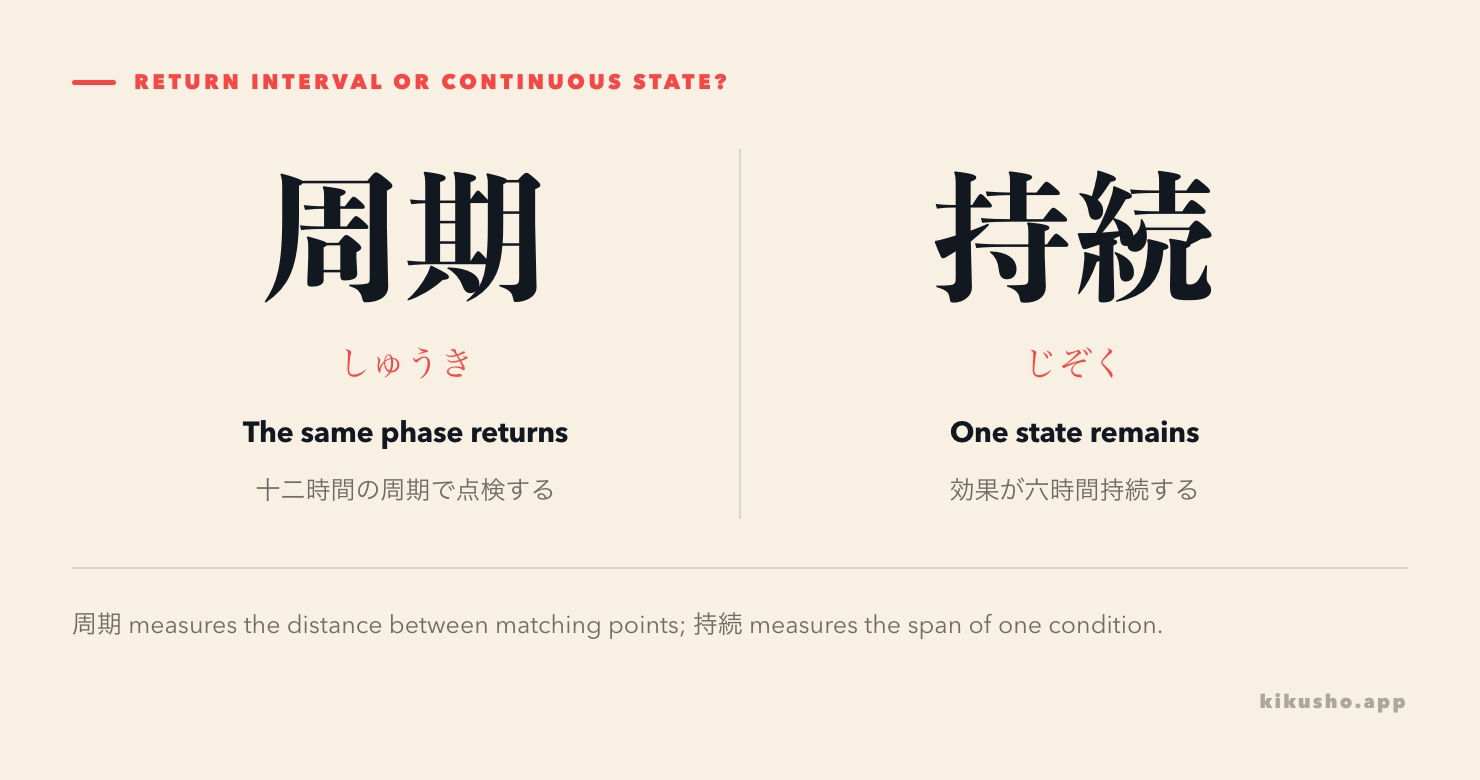
周期(しゅうき) is the time or structure through which a repeating phenomenon returns to the same phase. The Kotobank definition of 周期 covers the interval before a circulating or repeating phenomenon reaches the same state again.
この装置は十二時間の周期で自動的に点検を行う。
この そうちは じゅうにじかんの しゅうきで じどうてきに てんけんを おこなう。
This device automatically runs an inspection on a twelve-hour cycle.
The inspection is not continuous for twelve hours. Twelve hours measures the return from one inspection point to the next. 周期的に変化する similarly says that the same kind of change recurs at roughly fixed intervals. Natural phenomena, machinery, economic activity and biological processes commonly have cycles.
持続(じぞく) instead follows one state, capacity, relationship or effect as it remains active.
この薬の効果は約六時間持続する。
この くすりの こうかは やく ろくじかん じぞくする。
The effect of this medicine lasts for about six hours.
長時間、集中力を持続させるのは難しい。
ちょうじかん、しゅうちゅうりょくを じぞくさせるのは むずかしい。
It is difficult to sustain concentration for a long time.
The first example is intransitive: the effect 持続する. The second is causative: a person 持続させる a capacity. Kotobank's 持続 entry emphasises a state continuing or being maintained without interruption.
The nearby N2 word 継続(けいぞく) focuses on carrying an activity, process or policy forward: 研究を継続する, continue the research. 持続 foregrounds the state or effect that remains: 効果が持続する, the effect lasts. A research programme may be 継続 even when researchers go home each night; the effect of a medicine is 持続 while it remains operative. The N2 routines and frequency lesson develops 継続 in its own set.
度々, 時折 and 頻繁 describe separate events
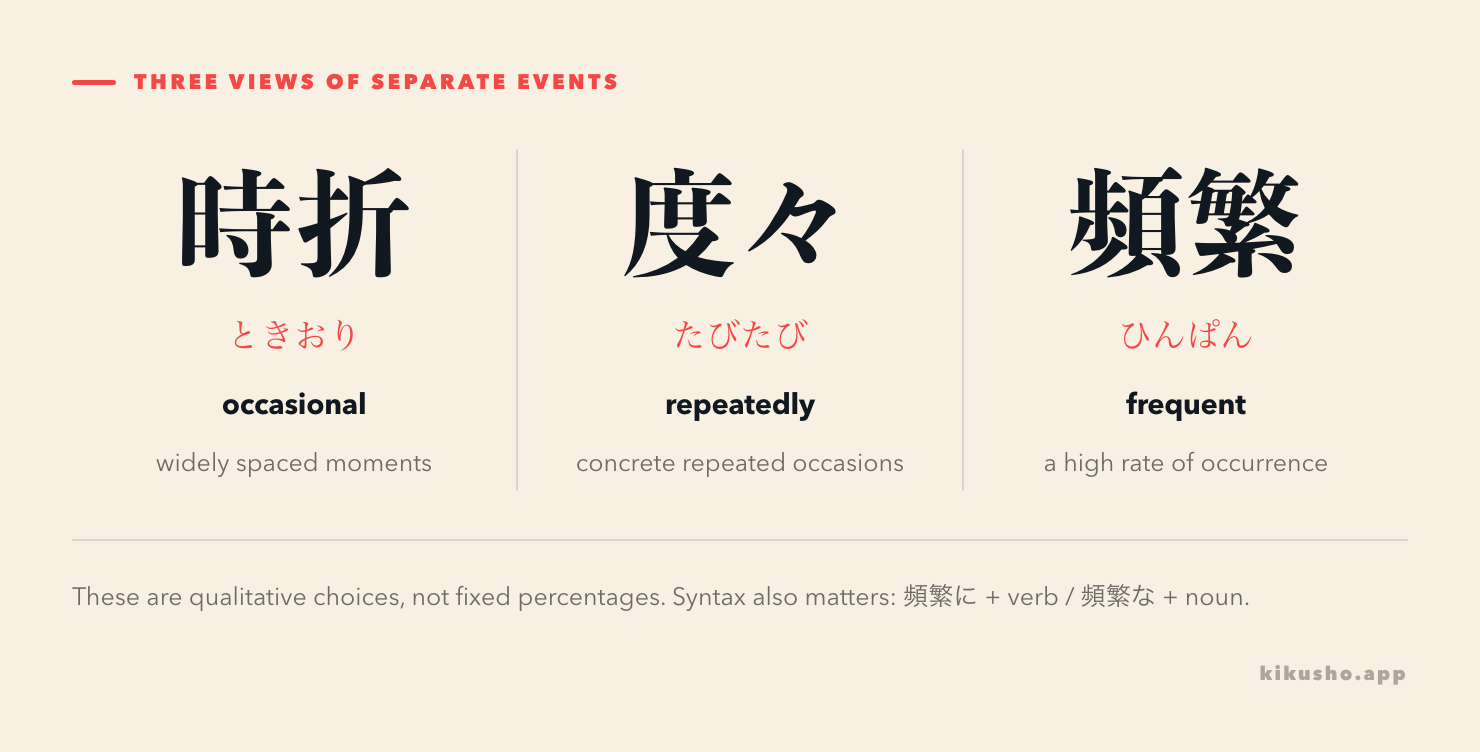
These three words leave gaps between occurrences. None inherently gives an exact percentage, and context decides the time range. Their differences lie in event density, viewpoint and grammar.
度々 counts repeated occasions
度々(たびたび) presents an event as having happened again and again. It is speaker-friendly and often points back to concrete occasions. Kotobank's 度々 entry defines it through repeated occurrence and also records noun-like uses such as 度々の不始末.
度々予定を変更して、申し訳ありません。
たびたび よていを へんこうして、もうしわけ ありません。
I am sorry for changing the schedule repeatedly.
In service messages and email, 度々申し訳ありません politely acknowledges that the writer has contacted, changed or troubled the other person more than once. The hiragana spelling たびたび is also common; the assigned form 度々 makes the word's “many times” structure visible.
時折 leaves wider gaps
時折(ときおり) means occasionally or from time to time. It selects scattered moments without suggesting that the event dominates the period.
在宅勤務の日も、時折オフィスに顔を出す。
ざいたくきんむの ひも、ときおり オフィスに かおを だす。
Even when working from home, I occasionally stop by the office.
The word is natural in reflective description and written narration. Kotobank defines 時折 with “sometimes” and “occasionally”; it does not license a fixed numerical band. Treat it as a qualitative spacing cue.
頻繁 characterises a high rate
頻繁(ひんぱん) presents frequent occurrence as a property of an event, action or period. That analytic viewpoint makes it common in reports, warnings and explanations.
最近、この地域では小さな地震が頻繁に起きている。
さいきん、この ちいきでは ちいさな じしんが ひんぱんに おきている。
Recently, small earthquakes have been occurring frequently in this area.
頻繁な仕様変更が開発の遅れにつながった。
ひんぱんな しようへんこうが かいはつの おくれに つながった。
Frequent specification changes led to a delay in development.
The first example uses 頻繁に + verb; the second uses 頻繁な + noun. Kotobank's 頻繁 entry treats it as repeated occurrence at short intervals, which explains why it usually feels denser and more objective than 時折.
The useful comparison is therefore not a rigid three-point percentage scale. 時折 highlights scattered occasions, 度々 highlights repetition noticed across occasions, and 頻繁 assesses the rate as high. A speaker can choose 度々 to apologise for several contacts even when a statistical report would not call the contact rate 頻繁.
A connected N1 context
この研究所では、年度末に全装置を点検することが慣例となっている。ただし、冷却装置は三か月の周期で部品を交換する。以前は交換後も警告が度々表示され、稼働を一時停止することがあった。調査の結果、電圧が時折不安定になり、その影響で警告が頻繁に発生していたことが分かった。新しい制御装置を導入してからは、安定した状態が長時間持続するようになった。
この けんきゅうじょでは、ねんどまつに ぜんそうちを てんけんする ことが かんれいと なっている。ただし、れいきゃくそうちは さんかげつの しゅうきで ぶひんを こうかんする。いぜんは こうかんごも けいこくが たびたび ひょうじされ、かどうを いちじていしする ことが あった。ちょうさの けっか、でんあつが ときおり ふあんていに なり、その えいきょうで けいこくが ひんぱんに はっせいしていた ことが わかった。あたらしい せいぎょそうちを どうにゅうしてからは、あんていした じょうたいが ちょうじかん じぞくする ように なった。
The year-end inspection is 慣例 because it is the laboratory's established practice. Three months is a 周期 because it measures the return of replacement time. 度々表示される looks back at repeated warning appearances; 時折不安定になる isolates occasional unstable moments; 頻繁に発生する judges the resulting warning rate as high. After the repair, one stable condition 持続する.
Notice that the passage can contain both 時折 and 頻繁 without contradiction. Occasional voltage instability may produce many warning events while it lasts. Each word attaches to a different event and answers a different question.
The N1 label is a teaching boundary
Kikusho's reference inventory places all six spelling-and-reading entries at N1. Independent preparation lists also include 持続 and 頻繁 at N1, but commercial lists do not always agree about when every item should first be studied.
The current JLPT does not publish an official word-by-level catalogue. Its official FAQ explains that the post-2010 test specifications do not include fixed vocabulary, kanji and grammar lists. N1 here therefore marks a practical study stage. The stable learning targets are the readings, syntax and contrasts: かんれい for institutional convention, しゅうき for return interval, じぞく for maintained continuity, and three distinct ways to describe separate occurrences.
Practice: choose the measured relationship
1 · Pronounce the convention
Write 慣例 in kana as it appears in 慣例に従う.
2 · Paraphrase a high rate
Which sentence most closely paraphrases 障害が頻繁に発生している?
A. The fault remains continuously active.
B. Faults are occurring at a high rate.
C. A fault appears only on rare occasions.
D. The fault follows an institutional convention.
3 · Convention or personal habit
Which sentence naturally says that selecting the most senior member as chair is an established convention?
A. 最年長の委員を議長に選ぶ癖がある。
B. 最年長の委員を議長に選ぶ周期がある。
C. 最年長の委員を議長に選ぶのが慣例となっている。
D. 最年長の委員を議長に選ぶのが時折となっている。
4 · Cycle or duration
Choose the pair that fills these two gaps: この衛星は九十分の__で地球を回る。通信可能な状態は約十分__する。
A. 持続 / 周期
B. 周期 / 持続
C. 慣例 / 度々
D. 頻繁 / 時折
5 · Syntax
Which phrase correctly modifies the noun 更新 with “frequent”?
A. 頻繁に更新
B. 頻繁の更新
C. 頻繁な更新
D. 頻繁で更新
6 · Occasional or high-rate
A report says a fault occurs at a high rate, while a diary says the writer occasionally hears the sound. Complete: 故障が__発生する。私はその音を__耳にする。
A. 時折 / 頻繁に
B. 頻繁に / 時折
C. 度々の / 持続
D. 周期に / 慣例
7 · Pragmatic choice
You have emailed a client several times today and want to apologise for the repeated contact. Choose the conventional opening.
A. 周期で申し訳ありません。
B. 持続して申し訳ありません。
C. 時折申し訳ありません。
D. 度々申し訳ありません。
8 · 持続 or 継続
Which pairing best fits the usual focus of each word?
A. 効果が持続する / 研究を継続する
B. 研究が持続をする / 効果を継続がする
C. 周期が持続する / 慣例を継続がする
D. 度々が持続する / 時折を継続する
9 · Passage inference
Read: 点検は半年の周期で行うが、最近は不具合が頻繁に報告されている。 Which statement is supported?
A. Inspections continue without interruption for six months.
B. The established convention prohibits reports.
C. Inspections recur every six months, and faults have recently been reported at a high rate.
D. Faults occur only once every six months.
10 · Production
Write one Japanese sentence saying: “By convention, the ceremony is held every year, but rain occasionally causes a delay.” Use 慣例 and 時折.
Check the ten decisions
1 · かんれい. The compound joins the on-readings かん and れい. The phrase means “follow convention.”
2 · B. 頻繁に characterises the rate of occurrence as high. It does not say one fault remains active without interruption, and it is stronger than rare or occasional occurrence.
3 · C. 慣例となっている presents a repeated institutional practice as an accepted convention. 癖 would make the choice sound like a personal tendency, while 周期 and 時折 do not fit the construction or meaning.
4 · B, 周期 / 持続. Ninety minutes measures the satellite's return interval, so it is a 周期. Ten minutes measures how long one communicable state remains available, so that state 持続する.
5 · C, 頻繁な更新. 頻繁 is a な-adjective before a noun. 頻繁に更新する would also be correct if 更新する were the verb, but A as written does not form the requested noun phrase.
6 · B, 頻繁に / 時折. The report assesses the fault rate as high with 頻繁に. The diary selects scattered occasions with the adverb 時折.
7 · D, 度々申し訳ありません. 度々 acknowledges multiple concrete contacts or inconveniences and is a conventional polite apology. The other choices do not perform that function.
8 · A. 持続 follows an effect that remains operative; 継続 presents research as an activity carried forward. The distinction is about focus, so context can create borderline cases, but A gives the standard contrast.
9 · C. 半年の周期 places inspections six months apart. 頻繁に報告されている characterises recent fault reports as high in frequency; it does not tie each fault to the inspection cycle.
10 · One model is 慣例として式典は毎年行われるが、雨で時折開始が遅れる。 慣例として classifies the annual ceremony as established practice, while 時折 modifies the scattered delays.
In an N1 passage, translate only after deciding what repeats. A group can follow a 慣例, a process can have a 周期, and a state can 持続. When separate events are at issue, 時折 spaces them widely, 度々 notices their recurrence, and 頻繁 evaluates their rate as high.
Common questions
What is the difference between 度々, 時折 and 頻繁?
度々(たびたび)presents repeated occasions and works as an adverb. 時折 (ときおり)means occasionally and leaves wider gaps. 頻繁(ひんぱん) describes a high rate of occurrence and can appear as 頻繁に before a verb or 頻繁な before a noun.
What is the difference between 持続 and 継続?
持続(じぞく)focuses on a state, effect or capacity remaining in force, often without interruption. 継続(けいぞく)focuses on continuing an activity, process or policy; ordinary pauses may still fit the context.
What is the difference between 慣例 and 習慣?
慣例(かんれい)is an established convention or customary procedure of a group, institution or field. 習慣(しゅうかん)is broader and commonly describes a person's established habit or a social custom.
Does 周期 mean frequency?
周期(しゅうき)is the interval needed for a repeating phenomenon to return to the same state, such as a seven-day cycle. Frequency tells how often events occur; a cycle tells the structure or interval of their return.