On this page
A formal Japanese report uses 優先 and 後回し to order work, 区画・分離・結合・統合 to describe structure, and 対比・類似・同等・相応・対応 to state how things relate. 固有 and 独自 identify what belongs distinctively to one thing, while the suffix 等(とう) keeps a list open.
These fourteen N1 words become easier when you ask what decision the writer is making: order the work, change the structure, test a relationship, or describe a distinctive property.
Four decisions organise the complete set
| Decision | Words | Core question |
|---|---|---|
| Set an order | 優先, 後回し | What comes first, and what waits? |
| Change a structure | 区画, 分離, 結合, 統合 | Are the parts divided, detached, joined or coordinated as one? |
| State a relationship | 対比, 類似, 同等, 相応, 対応 | Are the items contrasted, similar, equivalent, suitable or matched? |
| Mark identity or an open list | 固有, 独自, 等 | Is the feature inherent, independently distinctive, or one example among others? |
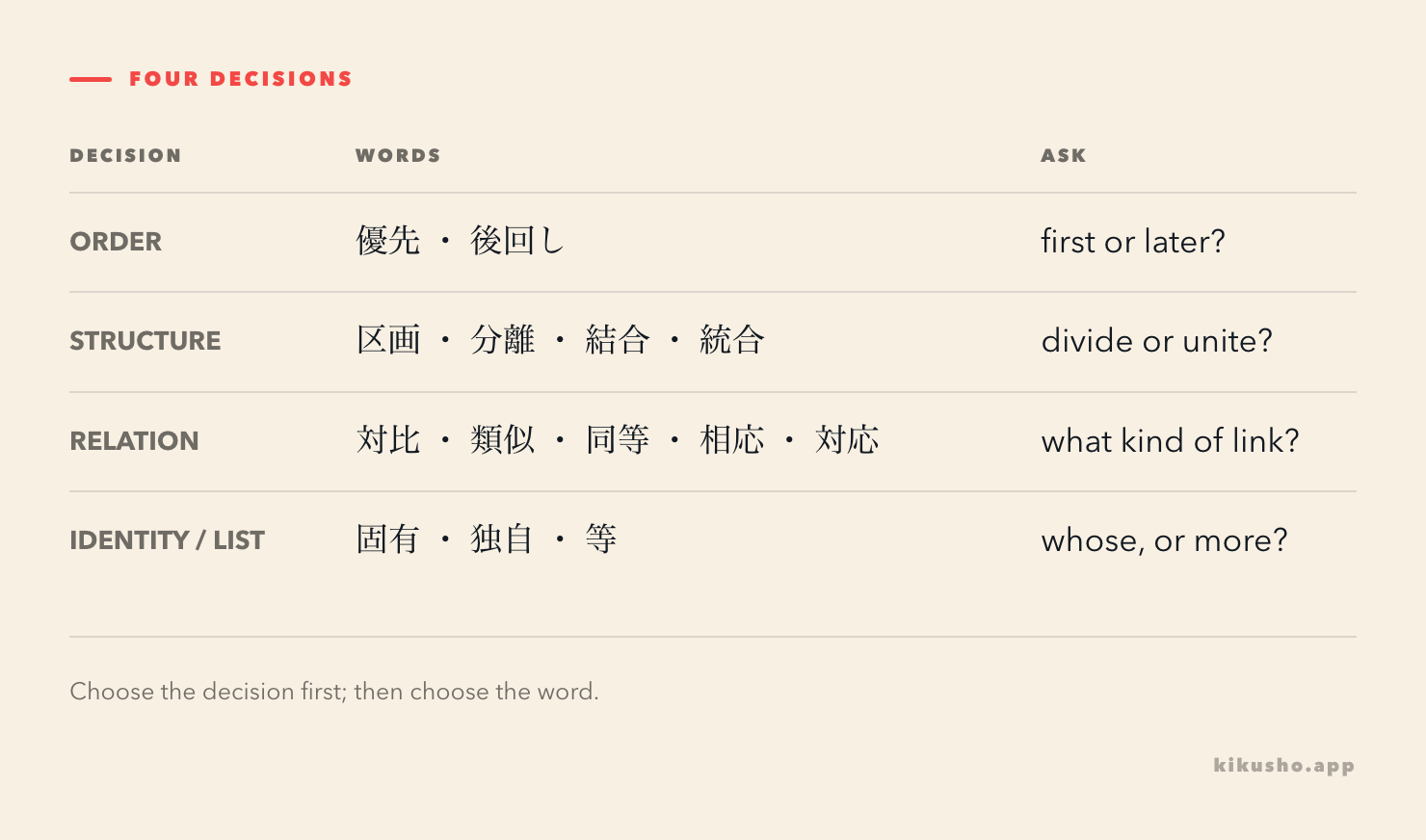
The words are mostly nouns that also form compounds or take する. Their grammar is not identical, however: 固有の, 独自の, 相応の and 同等の commonly modify nouns; 等 attaches after examples; and 対応する changes meaning with the noun marked by に.
優先 puts something first; 後回し moves it later
優先(ゆうせん) means giving something precedence over other candidates. The item chosen takes を, and the alternative can take より.
利益より安全を優先すべきです。
りえきより あんぜんを ゆうせんすべきです。
We should prioritise safety over profit.
後回し(あとまわし) means changing the order so that something is dealt with later. The productive frame is Nを後回しにする.
緊急ではない修正は後回しにしました。
きんきゅうではない しゅうせいは あとまわしにしました。
We postponed the non-urgent revisions until later.
The contrast concerns relative order. 後回し does not necessarily mean cancellation, and 優先 does not say that the other task will never happen. Shogakukan defines 優先 as placing something before other things and 後回し as delaying it by changing the order.
利用者の安全を優先し、画面の細かな調整は後回しにする。
りようしゃの あんぜんを ゆうせんし、がめんの こまかな ちょうせいは あとまわしにする。
Prioritise user safety and leave minor screen adjustments until later.
The N2 lesson on meetings, projects and business agreements places 優先 inside a 方針, a general policy that guides later project choices.
区画 and 分離 create boundaries in different ways
区画(くかく) is a bounded section, or the act of dividing land or space into such sections. It answers “where are the divisions?”
広い会場を三つの展示区画に分けました。
ひろい かいじょうを みっつの てんじくかくに わけました。
We divided the large venue into three exhibition zones.
駐車場を白い線で区画する。
ちゅうしゃじょうを しろい せんで くかくする。
Mark off the car park into sections with white lines.
分離(ぶんり) says that things separate, are separated, or are kept apart. A visible boundary is not required.
個人情報を分析用のデータから分離します。
こじんじょうほうを ぶんせきようの データから ぶんりします。
We separate personal information from the data used for analysis.
区画 can leave every part inside one larger venue. 分離 focuses on the loss or prevention of connection. This explains compounds such as 中央分離帯, a median strip that separates traffic flows, and 政教分離, separation of religion and government. The dictionary entries for 区画 and 分離 preserve this section-versus-separation distinction.
結合 joins parts; 統合 makes a coordinated whole
結合(けつごう) focuses on connection: two or more things join or are joined.
二つのファイルを結合して、一つの資料にしました。
ふたつの ファイルを けつごうして、ひとつの しりょうにしました。
We joined the two files into one document.
統合(とうごう) goes further toward organisation. Several elements are brought together as one ordered or coordinated whole.
重複していた二つの部署を統合しました。
ちょうふくしていた ふたつの ぶしょを とうごうしました。
We integrated the two overlapping departments.
The dictionary definition of 結合 centres on things joining into one. 統合 adds the idea of several elements forming an orderly whole.
| Situation | More likely choice | Why |
|---|---|---|
| Attach two components | 結合 | The connection itself matters. |
| Merge two PDF files | 結合 | Two objects become one file. |
| Unify departments under one operation | 統合 | The resulting organisation matters. |
| Bring records from several systems into one database | 統合 | The data must work together as a system. |
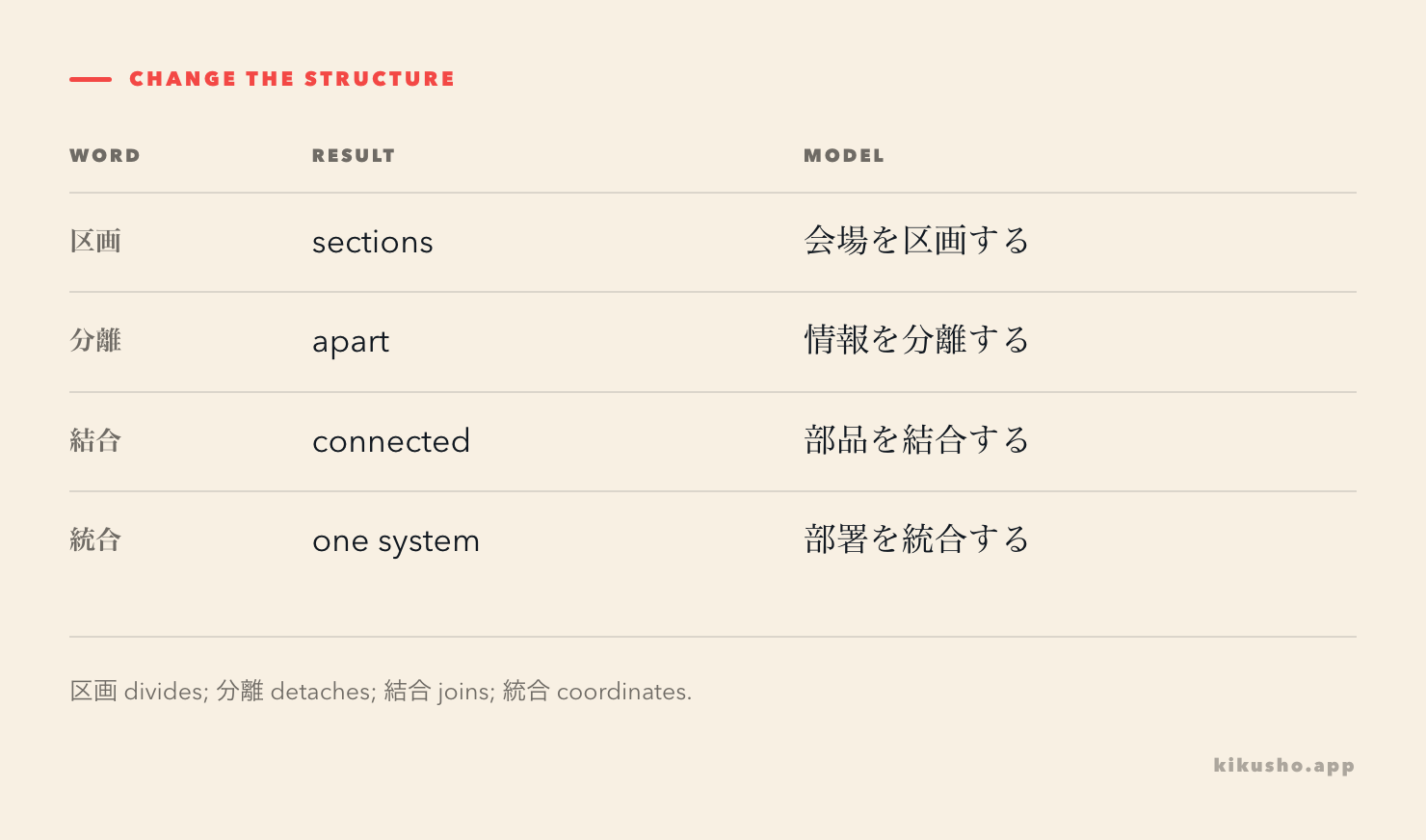
Real usage overlaps. A software tool may call its command ファイルを統合する when it also reconciles formats or duplicates. Look at the result the writer wants to emphasise: contact between parts or operation as one system.
対比, 類似 and 同等 make three different comparisons
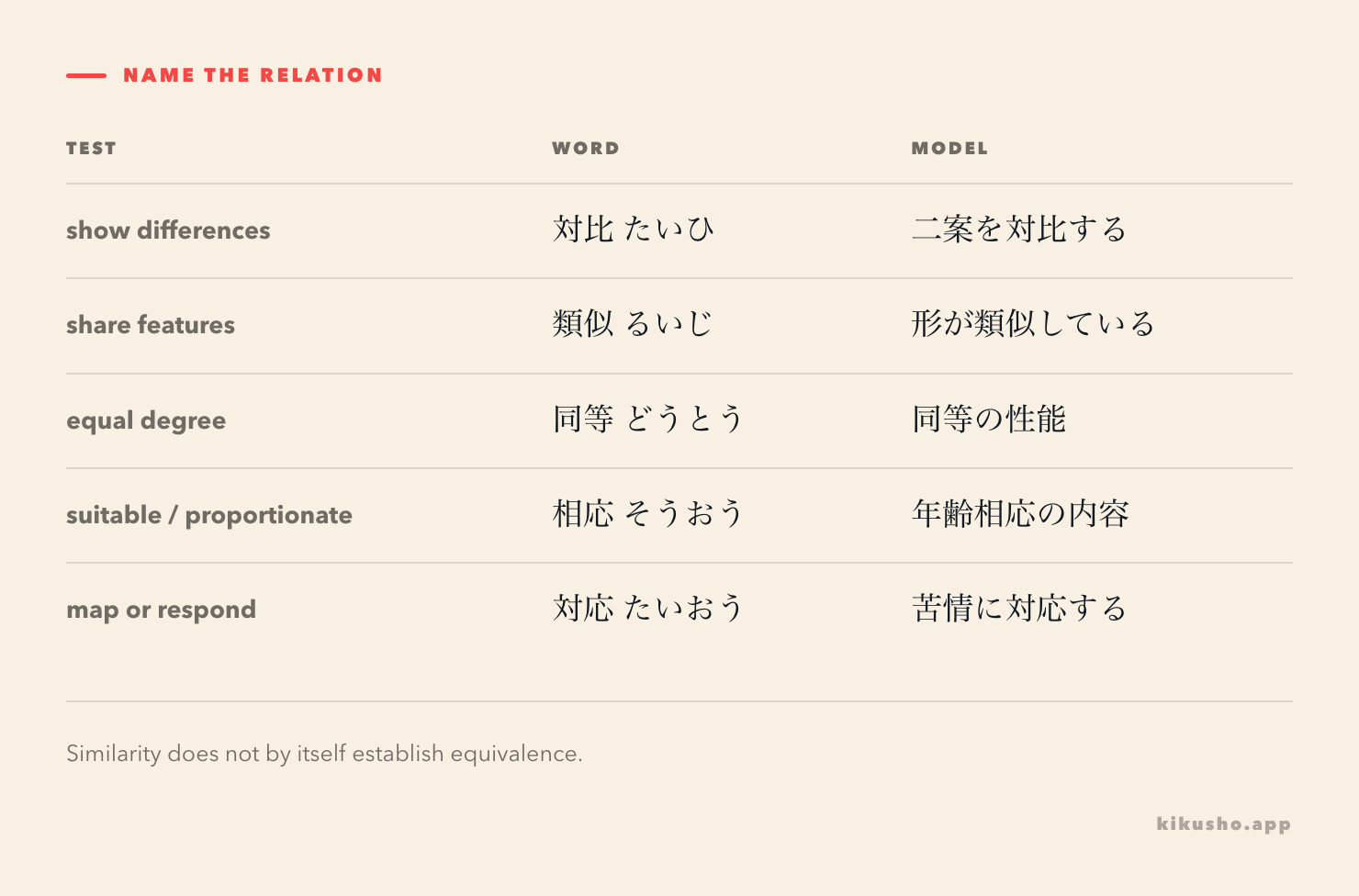
対比(たいひ) places things side by side so that their differences or characteristic effects become clear.
都市部と地方の結果を対比して示します。
としぶと ちほうの けっかを たいひして しめします。
We present the urban and regional results in contrast.
類似(るいじ) says that things share noticeable features.
この二つの案は構成が類似しています。
この ふたつの あんは こうせいが るいじしています。
These two proposals have similar structures.
同等(どうとう) says that degree, rank, value, ability or performance is equal.
新しい材料は従来品と同等の強度があります。
あたらしい ざいりょうは じゅうらいひんと どうとうの きょうどが あります。
The new material has strength equivalent to that of the conventional product.
Two products can be 類似している because they look alike while one performs much worse; they are then not 同等. Two colours can be placed in 対比 even when nobody claims similarity or equality. The definitions of 対比, 類似 and 同等 keep comparison, shared features and equal degree separate.
相応 evaluates fit; 対応 pairs or responds
相応(そうおう) evaluates suitability or proportion. Common patterns are N相応の, Nに相応した, and 相応の + noun.
経験に相応した役割を任せます。
けいけんに そうおうした やくわりを まかせます。
We will assign a role suited to the person's experience.
管理職には相応の責任が伴います。
かんりしょくには そうおうの せきにんが ともないます。
A managerial position comes with a commensurate level of responsibility.
対応(たいおう) can say that one element corresponds to another, or that a person or organisation responds to a situation.
各番号に対応する説明を選んでください。
かく ばんごうに たいおうする せつめいを えらんで ください。
Choose the explanation corresponding to each number.
担当者が利用者からの問い合わせに対応します。
たんとうしゃが りようしゃからの といあわせに たいおうします。
The person in charge will respond to users' enquiries.
Ask whether the sentence judges fit or establishes a mapping or action. 年齢相応の内容 is content appropriate to an age; 年齢に対応した区分 is a classification arranged to correspond to age. 相応 concerns fitness or proportion, while 対応 covers correspondence, balance and action suited to circumstances.
固有 belongs specifically to something; 独自 is its own approach
固有(こゆう) describes something inherent in, native to, or specifically belonging to the thing named with に or の.
この地域固有の文化を守る必要があります。
この ちいき こゆうの ぶんかを まもる ひつようが あります。
We need to protect the culture specific to this region.
独自(どくじ) often describes an independently developed method, viewpoint or feature that distinguishes its owner from others.
研究チームは独自の分析手法を開発しました。
けんきゅうチームは どくじの ぶんせき しゅほうを かいはつしました。
The research team developed its own analytical method.
The contrast is not absolute. Both can translate as “unique.” 固有 directs attention to what originally or particularly belongs to a thing; 独自 often directs attention to independent action or a way unlike others. A 日本固有の種 is a species native or particular to Japan. A 企業独自の制度 is a system the company developed or operates in its own distinctive way.
等(とう) leaves a formal list open
After an example or list, 等(とう) means “etc.,” “and the like,” or “including such things as.” It is especially common in formal notices, reports and rules.
申請書、身分証明書の写し等を提出してください。
しんせいしょ、みぶんしょうめいしょの うつしとうを ていしゅつして ください。
Please submit the application form, a copy of your identification, and similar required documents.
The listed items are examples from a broader class; 等 does not make omitted requirements discoverable. In a high-stakes instruction, consult the complete specification rather than guessing what “etc.” includes. The dictionary entry records this suffix use after one or more nouns. The same spelling can also be read ら in another suffix use or とう as a counter for rank, but those are different jobs.
Read a reorganisation report as a chain of decisions
新制度では安全性を優先し、装飾の変更は後回しにする。利用者を年齢相応の区画に分け、個人情報は行動データから分離する。類似した二つの受付システムは統合するが、地域固有の案内や各施設独自の対応方法等は残す。統合前後の処理時間を対比し、従来と同等のサービスを維持できるか確認する。
しんせいどでは あんぜんせいを ゆうせんし、そうしょくの へんこうは あとまわしにする。りようしゃを ねんれいそうおうの くかくに わけ、こじんじょうほうは こうどうデータから ぶんりする。るいじした ふたつの うけつけシステムは とうごうするが、ちいきこゆうの あんないや かくしせつ どくじの たいおうほうほうとうは のこす。とうごうぜんごの しょりじかんを たいひし、じゅうらいと どうとうの サービスを いじできるか かくにんする。
In the new system, safety will take priority, and decorative changes will be left until later. Users will be divided into age-appropriate sections, and personal information will be separated from behavioural data. The two similar reception systems will be integrated, but region-specific guidance, each facility's own response methods and the like will remain. We will contrast processing times before and after integration and verify whether service equivalent to the existing service can be maintained.
The paragraph moves through a real decision sequence. 優先・後回し order the work. 区画・分離・統合 alter the structure. 相応・類似・対比・同等 justify or test the design. 固有・独自・対応・等 protect necessary variation inside the new whole.
Save the full report excerpt in Kikusho rather than fourteen isolated English pairs. On later reviews, hide one expression at a time: “safety takes priority,” “age-appropriate sections,” or “service equivalent to the existing service.” The surrounding decisions then test which relationship the missing word must express.
N1 is a study placement, not a published official word boundary
Kikusho's September 2026 inventory assigns this complete fourteen-word set to N1. Its retained sources include the Waller/Tanos study-list family, while current JapaneseTest4You entries independently present words such as 対応, 統合, 同等 and 優先 in N1 study material. A current PassJapanese lesson on relationships and change confirms the broader demand for vocabulary that describes abstract relationships, but it does not teach this exact contrast set.
The JLPT's own FAQ explains that the post-2010 test specifications do not enumerate vocabulary and kanji by level. Treat N1 here as a practical study placement. The durable target is choosing the relationship a sentence actually asserts.
Practice: decide the relationship before opening the answers
1 · Priority reading. Write 後回し in kana.
2 · Open-list spelling. Choose the kanji read とう that completes the formal list: 申請書、写真__を提出する.
A. 相応
B. 等
C. 固有
D. 対比
3 · Order the work. A team will fix the safety defect today and adjust colours next week. Complete: 安全上の問題を__し、色の調整は後回しにする。
A. 分離
B. 類似
C. 優先
D. 区画
4 · Draw sections. Which sentence most naturally describes marking a large floor into three bounded work areas?
A. 床を三つの作業区画に分ける。
B. 床を三つの作業類似に分ける。
C. 床を三つの作業同等に分ける。
D. 床を三つの作業固有に分ける。
5 · Join or integrate. A company combines two departments and gives them one management structure. Which word best highlights the coordinated whole?
A. 結合
B. 統合
C. 分離
D. 後回し
6 · Similar is not equivalent. Two batteries have similar shapes, but one lasts half as long. Which statement is supported?
A. 形は類似しているが、性能は同等ではない。
B. 形は対比しているので、性能は相応だ。
C. 性能が固有なので、形は対応している。
D. 形を優先すると、性能が統合する。
7 · Fit or response. Complete with the word that evaluates suitability: 参加者の経験に__した課題を用意する。
A. 対応
B. 相応
C. 対比
D. 分離
8 · Correspondence. Which sentence means “The symbol corresponds to the function on the right”?
A. 記号は右側の機能を後回しにする。
B. 記号は右側の機能と同等にする。
C. 記号は右側の機能に対応する。
D. 記号は右側の機能を区画する。
9 · Inherent or independently developed. Which sequence fills the two blanks in 島__の植物を調べ、研究所__の分類法で記録した?
I. 独自, then 固有
II. 固有, then 独自
III. 同等, then 類似
IV. 相応, then 対比
10 · Read the report. Which paraphrase matches the sentence?
二案を対比した結果、機能は同等だが、設計思想は類似していないことが分かった。
A. The plans have similar design ideas, but their functions differ.
B. The comparison showed equivalent functions but dissimilar design ideas.
C. Both plans were postponed because their functions could not be compared.
D. Each plan corresponds to a different rank.
Answers and explanations
1 · あとまわし. 後 is read あと and 回し is まわし in this fixed noun.
2 · B, 等. Here 等 is the formal suffix とう, which leaves the list open to further documents of the same kind.
3 · C, 優先. The safety problem comes first; the colour work is explicitly moved later with 後回し.
4 · A. 区画 names a bounded section. The other three words cannot form the requested spatial phrase.
5 · B, 統合. One management structure makes the coordinated resulting organisation central. 結合 could describe connecting parts, but it does not express that organisational emphasis as directly.
6 · A. 類似 identifies their shared shape. Different endurance prevents the claim that performance is 同等.
7 · B, 相応. 経験に相応した evaluates whether the assignment suits the participants' experience. 対応した would more naturally say that a design was mapped or adapted to it.
8 · C. AがBに対応する can state a one-to-one or systematic correspondence between A and B.
9 · II, 固有 then 独自. The plants are particular or native to the island; the institute uses its own independently developed or distinctive classification method.
10 · B. 対比 is the comparison, 同等 claims equal function, and 類似していない rejects similarity in the design philosophy.
Common questions
What is the difference between 結合 and 統合?
結合(けつごう)focuses on two or more parts joining or being joined. 統合(とうごう)presents several elements as one coordinated whole. Two files can be 結合した; two departments or data systems are often 統合した. Actual usage overlaps, so treat this as a strong tendency rather than an absolute rule.
What is the difference between 相応 and 対応?
相応(そうおう)evaluates whether something is suitable or proportionate, as in 年齢相応の判断. 対応(たいおう)can pair one item with another or mean responding to a situation, as in 番号に対応する項目 and 苦情に対応する.
How do 対比, 類似 and 同等 differ?
対比(たいひ)is the act or effect of contrasting things, 類似(るいじ) says that things share noticeable features, and 同等(どうとう)says they have the same degree, rank or value. Similarity alone does not prove equivalence.
How is 等 read when it means “etc.” in formal Japanese?
It is normally read とう after one item or a list: 申請書、写真等を提出する. It marks further items of the same kind. 等 also has other readings and uses, including a rank counter, which are separate from this suffix use.