On this page
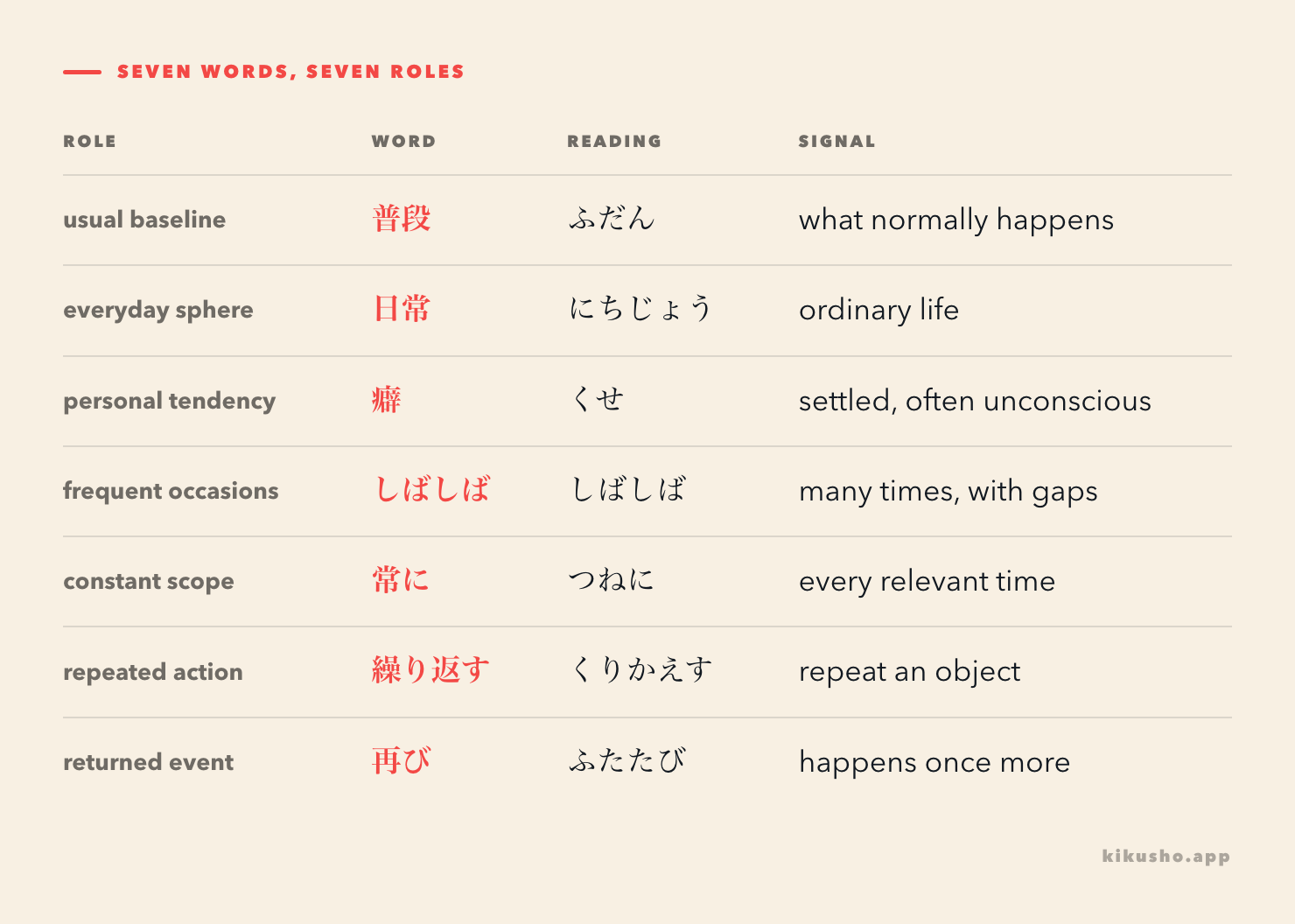
普段 and 日常 establish what ordinary life looks like, 癖 names a tendency that has settled into it, しばしば and 常に say how often something happens, and 繰り返す and 再び describe recurrence. The seven words belong together because each answers a different question about a pattern: what is normal, how frequent it is, who repeats it, or whether it has returned after a break.
One routine needs four different kinds of word
Imagine a person who normally walks to work, often checks the weather, always carries an umbrella in the rainy season, and has a habit of touching their hair while thinking. A single English paragraph may reuse usual, often, always, habit and again loosely. Japanese makes you choose the role before the word.
- 普段 sets the ordinary baseline for this person or situation.
- 日常 names the sphere of everyday life.
- 癖 identifies a settled personal tendency, often unconscious.
- しばしば counts repeated occasions: frequently, but with gaps.
- 常に says the condition holds at every relevant time.
- 繰り返す makes somebody repeat an action or thing.
- 再び says an earlier event or state occurs once more.
The full Japanese frequency scale places common words such as いつも, よく and ときどき from always to sometimes. This lesson stays with the assigned N3 set and asks a wider question: how frequency connects to habits and repetition.
The seven words, with the grammar they carry
| Word | Reading | Part of speech | Central sense | Useful collocation |
|---|---|---|---|---|
| 癖 | くせ | noun | a personal habit, tendency or peculiarity | 癖がある, 爪をかむ癖 |
| 繰り返す | くりかえす | transitive godan verb | repeat or do something over | 練習を繰り返す |
| しばしば | しばしば | adverb | often, frequently, on many occasions | しばしば起こる |
| 常に | つねに | adverb | always, constantly, in every relevant case | 常に確認する |
| 日常 | にちじょう | noun; の-modifier | everyday life; ordinary, everyday | 日常生活, 日常会話 |
| 再び | ふたたび | adverb | again, once more, after an earlier occurrence | 再び始まる |
| 普段 | ふだん | noun; adverb; の-modifier | usual circumstances; usually | 普段は, 普段の服 |
The table matters because the English translations hide the syntax. 日常 can build a noun phrase such as 日常生活, but it does not replace 常に before a verb. 繰り返す is itself the predicate and commonly takes an object with を; 再び modifies another predicate.
普段 is the baseline; 日常 is the everyday sphere
普段(ふだん) answers “what normally happens?” for a person, place or situation. It commonly appears as 普段は when today's exception will be contrasted with the usual case, or as 普段の + noun for the ordinary version of something.
普段は七時に起きますが、今日は六時に起きました。
ふだんは しちじに おきますが、きょうは ろくじに おきました。
I usually get up at seven, but today I got up at six.
面接には普段の服ではなく、スーツで行った。
めんせつには ふだんの ふくではなく、スーツで いった。
I went to the interview in a suit rather than my usual clothes.
日常(にちじょう) names everyday life as a domain. It is especially productive inside compounds and の-phrases: 日常生活 (daily life), 日常会話 (everyday conversation), 日常の出来事 (an everyday occurrence). Shogakukan's dictionary entry glosses it with つねひごろ and ふだん, but shared dictionary definitions do not make the words interchangeable in every frame.
この表現は日常会話でよく使われます。
この ひょうげんは にちじょうかいわで よく つかわれます。
This expression is often used in everyday conversation.
Use 普段 when you are locating a usual baseline and 日常 when you are naming the ordinary-life category. 普段は電車で行く describes someone's usual choice. 日常生活で電車を利用する places train use inside daily life.
癖 is personal, settled and often unconscious
癖(くせ) is a noun for a recurring personal tendency or a characteristic peculiarity. It often suggests that the behaviour happens without deliberate choice, and the tendency is frequently undesirable.
考えるとき、髪を触る癖があります。
かんがえる とき、かみを さわる くせが あります。
I have a habit of touching my hair when I think.
The common frame is V-dictionary + 癖がある. A noun can also appear before it with の, as in 夜更かしの癖. Kotobank's 癖 entry covers unconscious tendencies, habitual conduct and a thing's distinctive character, which explains expressions such as 癖のある味: a taste with a strong, distinctive character.
癖 is not automatically bad. 早起きの癖をつける can describe acquiring a useful early-rising habit. Even so, neutral planned routines are more readily called 習慣(しゅうかん). Compare:
- 毎朝運動する習慣: a deliberate, established exercise habit
- 緊張すると早口になる癖: a personal tendency to speak quickly when nervous
- この味は癖になる: this taste becomes compelling or habit-forming
Do not transfer this noun meaning mechanically to くせに, which expresses critical contrast. The くせに lesson treats that grammar separately.
しばしば has gaps; 常に does not
Both しばしば and 常に(つねに) are adverbs, and both are common in expository prose. Their difference is frequency.
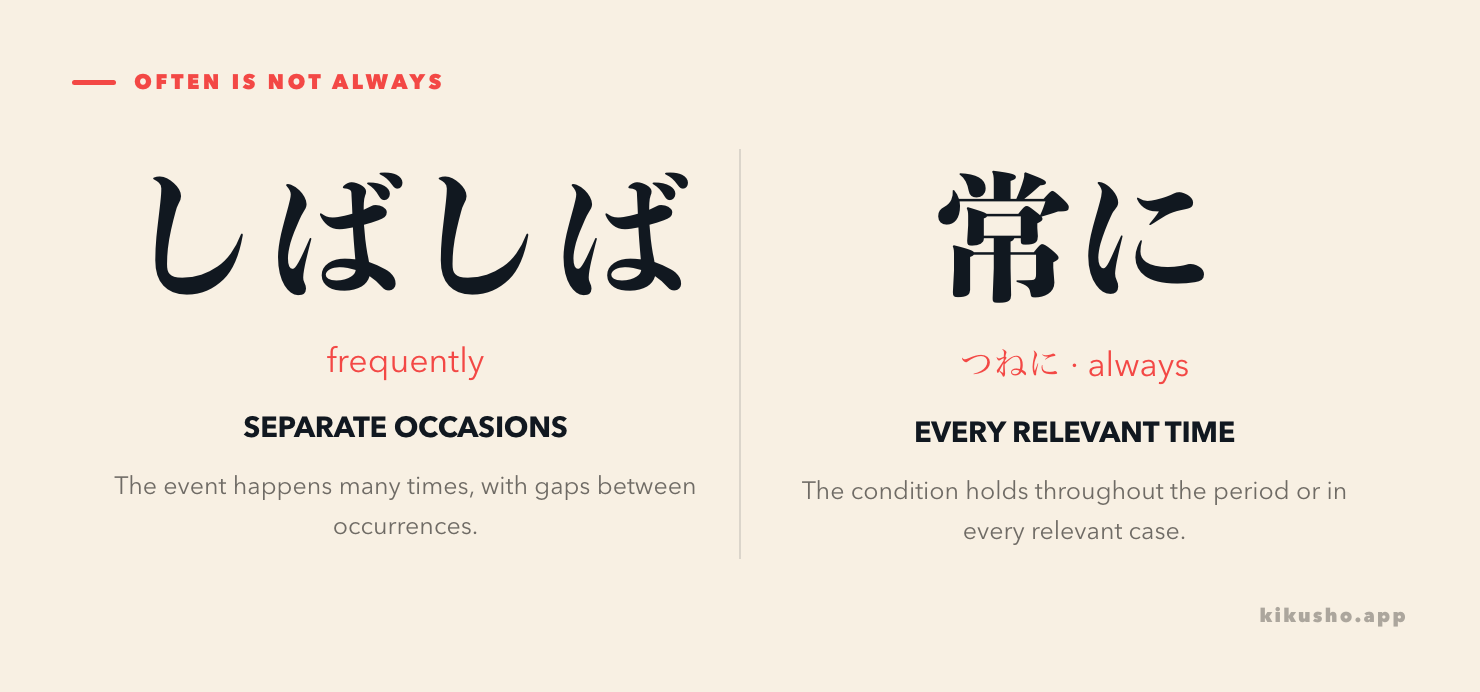
しばしば means that the same kind of event occurs many times. The dictionary definition gives たびたび and 幾度も: repeatedly, on numerous occasions. The word sounds more written or measured than conversational よく.
この地域では冬に強い風がしばしば吹く。
この ちいきでは ふゆに つよい かぜが しばしば ふく。
Strong winds often blow in this area in winter.
There are calm periods between the windy occasions. Replacing しばしば with 常に would claim that strong wind persists throughout every relevant moment, a much stronger statement.
常に means always, constantly or in every relevant case. It is particularly natural in rules, explanations and formal advice.
作業中は常に周囲の安全を確認してください。
さぎょうちゅうは つねに しゅういの あんぜんを かくにんして ください。
While working, always check the safety of your surroundings.
The instruction applies at every point of the work. It does not mean that the worker performs one unbroken physical act of checking. The relevant scope is “whenever and for as long as the work requires it.” This is why 常に正しいとは限らない can mean “is not always correct”: the word ranges over every case, not only continuous time.
In casual conversation, よく often replaces しばしば and いつも often replaces 常に. The difference is partly register, but the frequency boundary remains: often is still weaker than always.
繰り返す names the action; 再び places the return
繰り返す(くりかえす) is a transitive verb. Somebody repeats an object: a practice drill, an explanation, a mistake or the same action. The repetition may happen once more or many times.
発音を覚えるまで、同じ文を繰り返して読んだ。
はつおんを おぼえるまで、おなじ ぶんを くりかえして よんだ。
I read the same sentence repeatedly until I learned the pronunciation.
The stem can work adverbially as 繰り返し: 繰り返し練習する, practise repeatedly. Shogakukan records both doing the same thing once more and doing it many times.
再び(ふたたび) is an adverb. It presents a second occurrence of an earlier action or state, often after an interruption. It modifies the verb that tells you what returned.
工事が終わり、図書館は再び利用できるようになった。
こうじが おわり、としょかんは ふたたび りようできる ように なった。
The construction ended, and the library became available again.
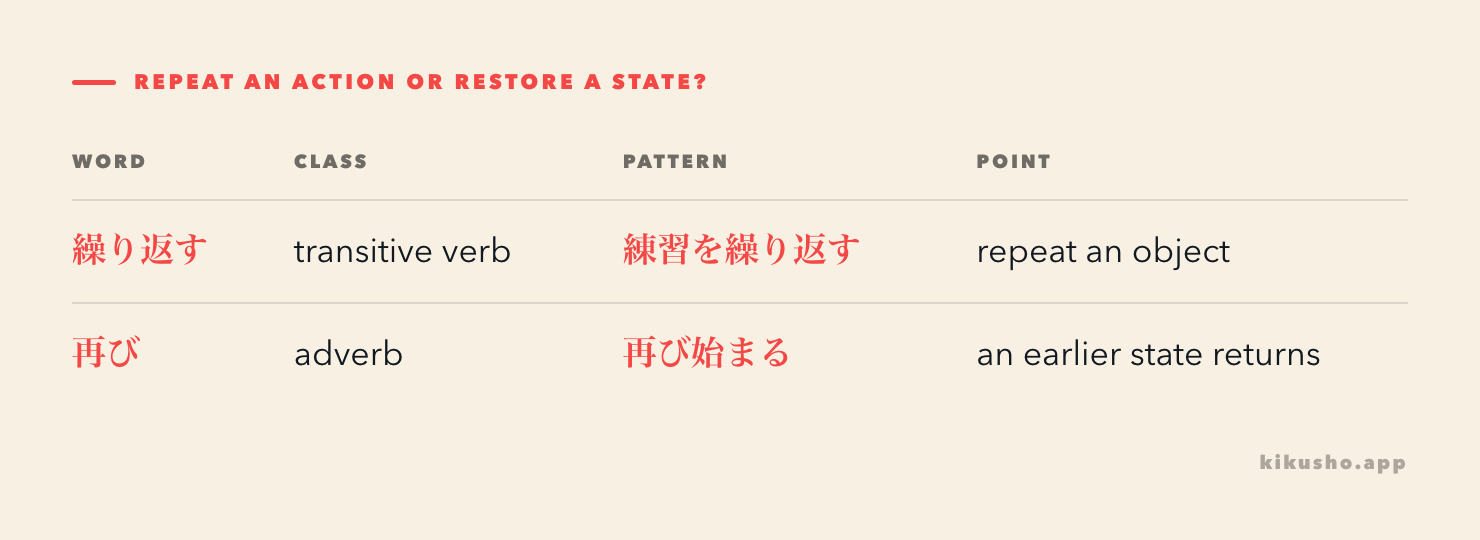
The choice becomes clear if you ask who controls the repetition. 同じ説明を繰り返した says someone repeated the same explanation. 会議が再び始まった says the meeting began again after stopping. また is the ordinary conversational alternative to 再び; 再び is more deliberate and more common in narratives and reports. The 再び, とっくに and やがて comparison follows those adverbs across a longer timeline.
A routine can contain every role
森さんは普段、朝六時に起きる。起きるとすぐに天気予報を見るのが日常の一部だ。大事な予定は常に手帳で確認するが、急いでいる日は時刻を見間違えることがしばしばある。同じ間違いを繰り返さないように、確認した予定には印をつけている。以前は爪をかむ癖もあったが、運動を始めてからやめられた。けがで一か月休んだ後、今週から再び朝の運動を始めた。
もりさんは ふだん、あさ ろくじに おきる。おきると すぐに てんきよほうを みるのが にちじょうの いちぶだ。だいじな よていは つねに てちょうで かくにんするが、いそいでいる ひは じこくを みまちがえる ことが しばしば ある。おなじ まちがいを くりかえさない ように、かくにんした よていには しるしを つけている。いぜんは つめを かむ くせも あったが、うんどうを はじめてから やめられた。けがで いっかげつ やすんだ あと、こんしゅうから ふたたび あさの うんどうを はじめた。
The passage does not use seven near-synonyms. 普段 opens the baseline, 日常 classifies the weather check, 常に gives the planner rule full scope, and しばしば leaves gaps between mistakes. 繰り返す takes the mistake as its object, 癖 names an old unconscious behaviour, and 再び restores an exercise routine after a one-month interruption.
That is the practical test for the set. If the sentence still works after replacing every word with “usually” or “again,” the English translation is hiding the decision you need to make in Japanese.
The N3 label is a study boundary, not an official list
Kikusho's reference inventory places all seven spelling-and-reading entries at N3. Independent preparation lists also place 癖, 繰り返す and 日常 at N3, and Bunpro places 再び at N3. Other resources teach 再び later because its formal narrative use becomes especially useful in longer N2 reading passages.
No official word-by-level catalogue accompanies the current JLPT. These labels therefore describe a useful teaching stage rather than a guaranteed exam boundary. The stable claims are the readings, parts of speech and contrasts above: ふだん for a usual baseline, つねに for every relevant case, and ふたたび for a returned event.
Practice: identify the role before the gloss
1 · Reading
Supply the kana reading of 癖 in 話すときの癖.
2 · Orthography
Which spelling matches くりかえす, “to repeat”?
A. 繰り返す
B. 操り返す
C. 繰り帰す
D. 操り帰す
3 · Ordinary life or usual baseline
Complete both clauses: この言い方は__会話でよく使われる。私は__はもっと短い表現を使う。
A. 普段 / 日常
B. 日常 / 普段
C. 常に / 再び
D. 癖 / しばしば
4 · A settled tendency
Which sentence naturally says “I have a habit of touching my face when I am nervous”?
A. 緊張すると顔を触る癖がある。
B. 緊張すると顔を触る日常がある。
C. 緊張すると顔を触る再びがある。
D. 緊張すると顔を触る普段がある。
5 · Frequent or constant
A report says that small errors occur often, but not every time. Complete: 入力ミスが__起こる。
A. 常に
B. 再び
C. しばしば
D. 日常
6 · Repeat or return
Complete the pair: 同じ説明を何度も__。休憩の後、会議が__始まった。
A. 再び / 繰り返した
B. 繰り返した / 再び
C. しばしば / 普段
D. 日常 / 常に
7 · Scope in a formal instruction
Which line best means “Always wear protective glasses during the experiment” in a formal safety instruction?
A. 実験中はしばしば保護眼鏡をかけてください。
B. 実験中は常に保護眼鏡をかけてください。
C. 実験中は再び保護眼鏡をかけてください。
D. 実験中は普段の保護眼鏡をかけてください。
8 · Paraphrase
Which sentence most closely paraphrases 店は工事の後、再び営業を始めた?
A. The shop often closed during construction.
B. The shop continued operating without a break.
C. The shop resumed business after the construction.
D. The shop repeated the same construction work.
9 · Read the pattern
Read: 普段は電車で通勤するが、電車が遅れることがしばしばあるので、重要な会議の日は常に早く家を出る。 Which account is accurate?
A. The speaker normally commutes by train, trains are often late, and on important meeting days the speaker always leaves early.
B. The speaker always commutes by train, trains never run late, and the speaker sometimes leaves early.
C. The speaker resumed commuting after every meeting and repeatedly missed the train.
D. Train delays are an unconscious personal habit.
10 · Build the contrast
Write one Japanese sentence saying: “I usually exercise in the evening, but after being ill I started again this week.” Use 普段 and 再び.
Answers and explanations
1 · くせ. As a standalone noun, 癖 names a habit or tendency. The on-reading へき appears inside compounds such as 悪癖(あくへき), but it is not the reading here.
2 · A, 繰り返す. The word combines 繰り with 返す. The other choices substitute a different kanji and are not standard spellings of くりかえす.
3 · B, 日常 / 普段. 日常会話 is the fixed everyday-conversation compound. 普段は then sets the speaker's ordinary personal choice against other possible situations.
4 · A. V-dictionary + 癖がある is the natural frame for a settled recurring tendency. 日常 and 普段 can describe the setting of behaviour, but they do not fit the noun slot in this construction; 再び is an adverb.
5 · C, しばしば. The errors occur on many separate occasions, with gaps. 常に would say they occur in every relevant case, which contradicts “not every time.”
6 · B, 繰り返した / 再び. A speaker repeats the explanation as a direct object, so the transitive verb 繰り返した completes the first clause. The meeting returns after a break, so the adverb 再び modifies 始まった.
7 · B. The glasses must remain on throughout the relevant period, so 常に gives the instruction full scope. しばしば would require protection only often, leaving unsafe gaps.
8 · C. 再び営業を始めた says an earlier operating state returned after the construction. It does not count frequent events or make construction the object of repetition.
9 · A. 普段 gives the normal commute, しばしば marks frequent but nonconstant delays, and 常に applies the early-departure rule to every important meeting day.
10 · One model is 普段は夕方に運動していますが、病気で休んだ後、今週から再び始めました。 普段は establishes the normal time for exercise. 再び marks its resumption after the interruption; 始めました supplies the returned action.
When these words appear in a reading passage, do not translate first. Ask whether the sentence establishes a baseline, names everyday life, counts occasions, covers every case, repeats an object or restores an earlier state. The role usually decides the answer before the English gloss does.
The next step is the N1 lesson on convention, cycles, duration and frequency, where 慣例, 周期, 持続, 度々, 時折 and 頻繁 describe institutional practice and more analytical kinds of recurrence.
Common questions
What is the difference between 普段, 日常 and 常に?
普段(ふだん)sets a person's or situation's ordinary baseline: what usually happens or what is normal for them. 日常(にちじょう)names everyday life or modifies something belonging to it, as in 日常生活. 常に(つねに)is an adverb meaning always or constantly and presents something as true at every relevant time.
What is the difference between しばしば and 常に?
しばしば means often or frequently, so the event happens many times but there are gaps. 常に means always or constantly, so the statement holds throughout the relevant period or in every relevant case. Both are more at home in careful writing than casual よく and いつも.
What is the difference between 繰り返す and 再び?
繰り返す(くりかえす)is a transitive verb: a person repeats an action, statement or mistake, perhaps many times. 再び(ふたたび)is an adverb: an event or state occurs again after an earlier occurrence, often after a break, and it sounds more formal than また.
Does 癖 always mean a bad habit?
No. 癖(くせ)often points to an unconscious, personal or undesirable tendency, but it can also describe a neutral peculiarity or an acquired routine. The surrounding noun or verb supplies the evaluation: 爪をかむ癖 is plainly unwanted, while 早起きの癖 can be useful.