On this page
These seven N2 Japanese words for habits, routines and frequency do more than rank events from common to rare. 日課 names a daily routine, 継続 says it continues, 絶えず removes the pauses, 毎度 counts repeated occasions, 稀 marks an exception, and 一旦 plus 改めて describe stopping and approaching something anew.
Seven words divide the timeline in different ways
| Word | Reading | Word class | Core job | Phrase to remember |
|---|---|---|---|---|
| 改めて | あらためて, aratamete | adverb | anew; again in a fresh or formal way | 改めて確認する: check again carefully |
| 一旦 | いったん, ittan | adverb; noun | temporarily; once a state begins | 一旦中止する: suspend for the moment |
| 継続 | けいぞく, keizoku | noun; suru verb | continuation of something already underway | 研究を継続する: continue the research |
| 絶えず | たえず, taezu | adverb | without interruption; constantly | 絶えず変化する: change constantly |
| 日課 | にっか, nikka | noun | a task or routine fixed for each day | 散歩を日課とする: make walking a daily routine |
| 毎度 | まいど, maido | noun; adverb | every occasion; each time | 毎度ありがとうございます: thank you, as always |
| 稀 | まれ, mare | na-adjective; adverbial noun | rare; unusual | この地域では稀だ: rare in this region |
The reading traps are small but consequential. 日課 has a doubled consonant, にっか, and 一旦 is いったん. 稀 is read まれ in this lesson, not the on-reading き found in compounds such as 希少. Modern writing also permits まれ and 希, while 稀 is the spelling in the assigned source row.
The words do not sit on one simple scale. 絶えず, 毎度 and 稀 tell you how an event is distributed through time. 日課 and 継続 name an organised activity or its continuation. 一旦 and 改めて reshape the timeline by inserting a boundary and a fresh approach.
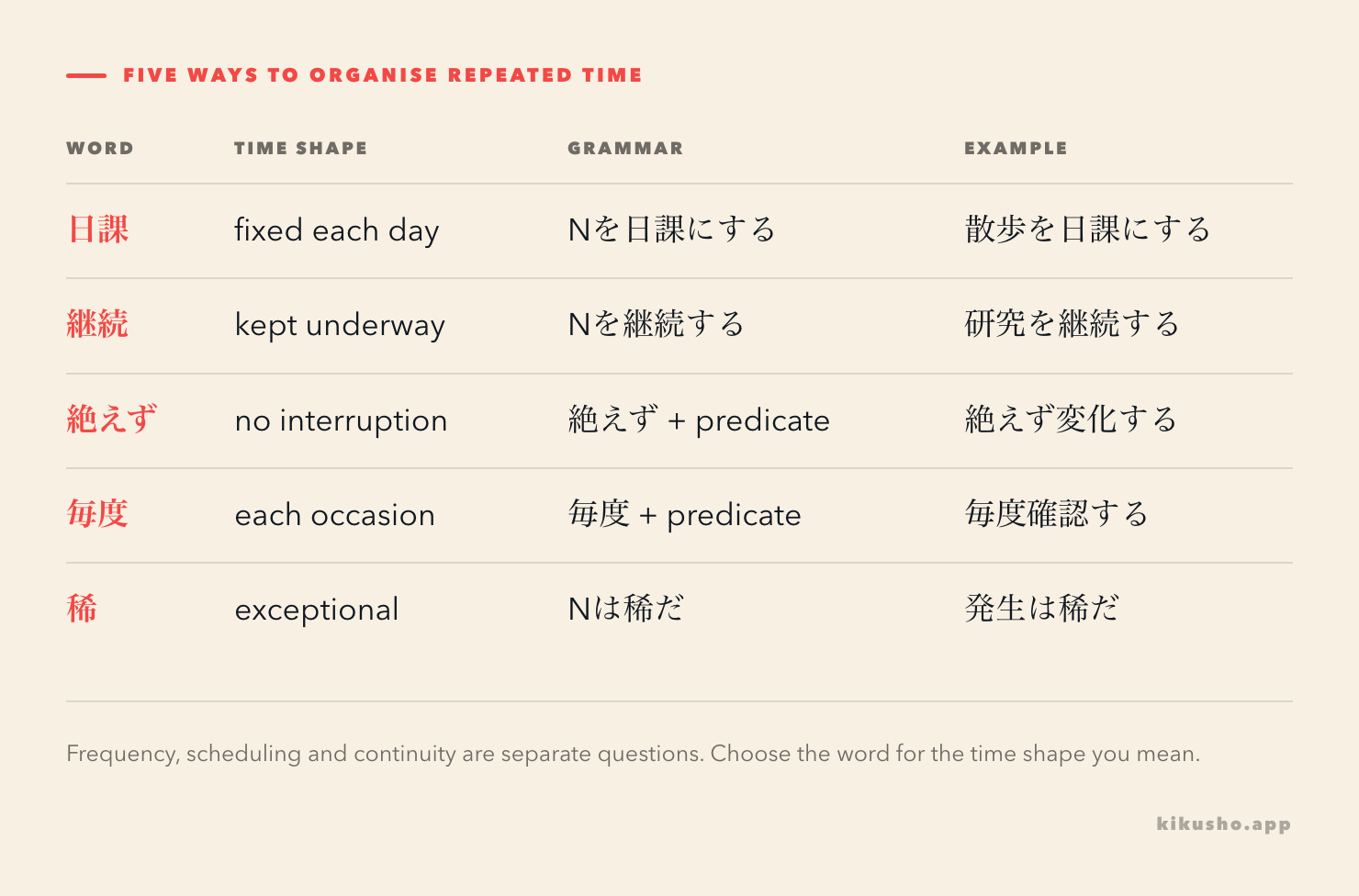
The beginner frequency-adverb scale compares いつも, よく, ときどき, たまに and negative forms such as めったに. This N2 set adds nouns, formal adverbs and timeline boundaries. It does not replace that scale.
Dictionary evidence supports the distinctions used here: 日課 is work fixed for each day, 継続 keeps an earlier activity going, and 絶えず describes something proceeding without interruption. The level labels come from independent N2 study inventories, not an official word list; the JLPT organisers state that they do not publish an exhaustive current vocabulary specification.
日課 is a deliberately fixed daily activity
日課(にっか) names work or an activity assigned for every day. It often suggests a deliberate schedule rather than an unconscious tendency.
私は寝る前に三十分読むことを日課にしています。
わたしはねるまえにさんじゅっぷんよむことをにっかにしています。
I make reading for thirty minutes before bed part of my daily routine.
Two patterns are especially useful:
- Nを日課にする: make N one's daily routine
- Nを日課とする: have N as one's daily routine; slightly more formal
習慣(しゅうかん) is broader. A weekly custom, a social convention or an unthinking habit can all be 習慣, but 日課 is tied to the day. 朝食後に薬を飲むのが日課だ presents the action as a fixed daily item. 夜更かしが習慣になった describes a habit, even if nobody planned it.
Once the routine exists, 継続(けいぞく) shifts attention from its daily shape to whether it keeps going.
健康のため、無理のない運動を継続してください。
けんこうのため、むりのないうんどうをけいぞくしてください。
For your health, please continue exercising at a sustainable level.
継続 can be intransitive or transitive in a suru construction. 交渉が継続する means negotiations continue; 交渉を継続する means someone continues them. Common compounds include 継続的, “continuous or ongoing,” and 継続中, “currently continuing.”
Do not substitute 連続(れんぞく) mechanically. 継続 keeps one activity or state going across time, even if ordinary pauses occur. 連続 focuses on units directly following one another: 三日連続で雨が降った, “it rained for three consecutive days.” A course may be 継続中 even though each class ends at night.
絶えず presents no break in the relevant stream
絶えず(たえず) comes from the negative linking form of 絶える, “to cease or be cut off.” As a settled adverb, it means that the relevant action, supply or change does not stop.
技術は絶えず変化しているため、知識を更新する必要があります。
ぎじゅつはたえずへんかしているため、ちしきをこうしんするひつようがあります。
Technology is constantly changing, so we need to update our knowledge.
Compare it with いつも:
| Sentence | Viewpoint |
|---|---|
| 彼はいつも七時に起きる。 | Seven o'clock is his usual repeated routine. |
| 川の水は絶えず流れている。 | The flow is presented as unbroken. |
| 店には絶えず客が出入りしている。 | The stream of customers does not let up. |
いつも勉強している can mean “always studying” in a conversational, exaggerated sense or “studies as usual.” 絶えず勉強している makes the lack of interruption salient and sounds more formal. It is therefore common in analysis, reporting and careful description.
継続 and 絶えず can describe the same long project from different angles. 調査を継続する states the decision to keep the investigation going. 状況が絶えず変化する describes the uninterrupted change occurring around it.
毎度 counts occasions and also became a greeting
毎度(まいど) means “each time,” “on every occasion” or “as always.” The dictionary entry records both the repeated event and the adverbial “always” use.
同じ質問に毎度丁寧に答えてくれる。
おなじしつもんにまいどていねいにこたえてくれる。
She answers the same question carefully every time.
毎回(まいかい) is the neutral counter for each occurrence and fits tests, meetings and episodes: 毎回参加する. 毎度 can do the same job, but it often sounds more personal, formulaic or mildly evaluative: 毎度同じ間違いをする can carry “the same mistake yet again.”
In customer-facing language, 毎度ありがとうございます is a conventional “thank you for your continued patronage” or “thank you, as always.” In Kansai, a shopkeeper or business contact may use 毎度 by itself as a familiar greeting; the TKG learner's dictionary entry records the related 毎度おおきに shop greeting. That greeting does not mean that 毎度 has lost its frequency sense; it grew from recognising the recurring customer or transaction.
At the other end, 稀(まれ) describes something whose existence or occurrence is unusually infrequent. The dictionary definition of まれ treats it as a na-adjective for something very uncommon in occurrence or existence.
この地域で九月に雪が降るのは稀です。
このちいきでくがつにゆきがふるのはまれです。
Snow in September is rare in this region.
The basic patterns are Nは稀だ, Nは稀にしかない and adverbial 稀に起こる. Unlike めったに, 稀 does not require a negative predicate:
- そのような事故は稀だ。 Such accidents are rare.
- 稀に誤差が生じる。 An error occurs on rare occasions.
- そのような事故はめったに起こらない。 Such accidents seldom occur.
The result is close, but the grammar differs. 稀 characterises the event or case as rare; めったに sets up a negative clause. The lesson on めったに~ない covers that negative frame in detail.
一旦 inserts a boundary; 改めて starts from a fresh position
一旦(いったん) has two connected uses. It can mean “for the moment” when an action is paused or a temporary state is chosen. It can also mean “once” in a conditional sequence, where crossing a boundary makes the next result likely or hard to reverse.
雨が強くなったので、作業を一旦中止しました。
あめがつよくなったので、さぎょうをいったんちゅうししました。
The rain intensified, so we suspended the work for the moment.
一旦決めたことは、簡単には変えない。
いったんきめたことは、かんたんにはかえない。
Once I decide something, I do not change it easily.
The dictionary entry for 一旦 records both a temporary interval and “once; if once.” In 一旦持ち帰ります, the speaker takes the matter away for now. In 一旦始めたら, the focus is the threshold after starting.
改めて(あらためて) then presents an action as new again, moved to a separate occasion, made formal, or understood with fresh awareness. The dictionary definition separates “do anew or on another occasion” from “feel as though for the first time.”
詳しい日程は、明日改めてご連絡します。
くわしいにっていは、あしたあらためてごれんらくします。
I will contact you again tomorrow with the detailed schedule.
この町を歩いて、自然の豊かさを改めて感じました。
このまちをあるいて、しぜんのゆたかさをあらためてかんじました。
Walking through this town made me appreciate its rich natural environment anew.
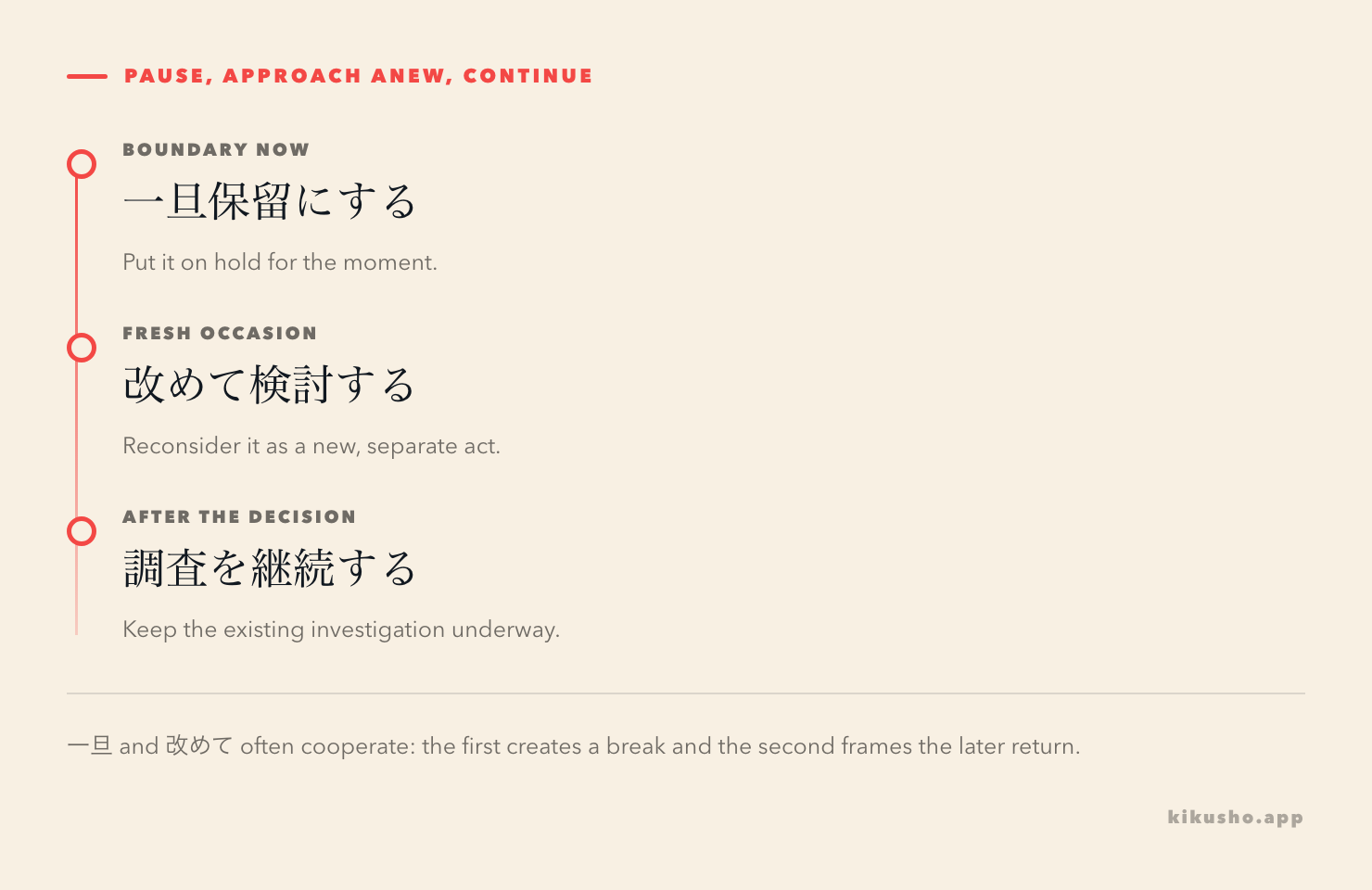
The two adverbs often cooperate rather than compete:
この案は一旦保留にして、来月改めて検討しましょう。
このあんはいったんほりゅうにして、らいげつあらためてけんとうしましょう。
Let us put this proposal on hold for now and reconsider it next month.
一旦 marks the present break. 改めて tells the listener that the later examination will be treated as a fresh, separate act. もう一度 merely counts one more repetition; 改めて adds a change of occasion, stance or formality.
One project puts all seven words on a natural timeline
私たちの研究チームでは、朝のデータ確認を日課にしています。市場は絶えず変化するため、調査を継続するには小さな変化も記録しなければなりません。報告書は毎度同じ形式で提出しますが、重大な問題が見つかることは稀です。先週は数値に不自然な点があったので、分析を一旦中止しました。条件を確認したうえで、翌日改めて分析を始め、現在も調査を継続しています。
わたしたちのけんきゅうチームでは、あさのデータかくにんをにっかにしています。しじょうはたえずへんかするため、ちょうさをけいぞくするにはちいさなへんかもきろくしなければなりません。ほうこくしょはまいどおなじけいしきでていしゅつしますが、じゅうだいなもんだいがみつかることはまれです。せんしゅうはすうちにふしぜんなてんがあったので、ぶんせきをいったんちゅうししました。じょうけんをかくにんしたうえで、よくじつあらためてぶんせきをはじめ、げんざいもちょうさをけいぞくしています。
In our research team, checking the morning data is a daily routine. Because the market changes constantly, we must record even small changes if we are to continue the investigation. We submit each report in the same format, but finding a serious problem is rare. Last week, an unnatural value led us to suspend the analysis temporarily. After checking the conditions, we started the analysis afresh the next day and are still continuing the investigation.
The passage is not seven synonyms packed together. 日課 names the team's scheduled item, 絶えず describes market change, 継続 presents deliberate continuation, 毎度 counts each submission, 稀 judges the exceptional problem, 一旦 stops the process, and 改めて restarts it from a checked position.
Test the words before opening the explanations
1 · Read 日課. What is the standard reading in 運動を日課にする?
A. にちか
B. にっか
C. ひか
D. にちが
2 · Find けいぞく. Which spelling means “continuation”?
A. 継足
B. 経続
C. 継続
D. 系族
3 · Context. The team stops the meeting for now and plans to resume after lunch. Complete 会議を__中断します.
A. 稀に
B. 毎度
C. 一旦
D. 絶えず
4 · Usage. Which sentence most clearly describes an uninterrupted process?
A. 川の水は絶えず流れている。
B. 川の水を日課にしている。
C. 川の水は毎度だ。
D. 川の水を改めている。
5 · Client follow-up. You will give the client the detailed answer tomorrow on a separate occasion. Choose the natural sentence.
A. 明日、改めてご説明します。
B. 明日、稀にご説明します。
C. 明日、絶えずご説明します。
D. 明日、日課をご説明します。
6 · Usage. Which sentence naturally makes walking a fixed daily routine?
A. 散歩を日課にしています。
B. 散歩を毎度しています。
C. 散歩が一旦です。
D. 散歩を稀にしています。
7 · Judge 稀だ. What does この地方では大雪は稀だ mean?
A. Heavy snow continues without interruption here.
B. Heavy snow is rare in this region.
C. Heavy snow is a daily assignment here.
D. Heavy snow has been suspended temporarily.
8 · Usage. A shop thanks a returning customer. Which established expression is natural?
A. 一旦ありがとうございます。
B. 改めてが稀です。
C. 毎度ありがとうございます。
D. 日課をありがとうございます。
9 · Context. The organisation decides to keep an existing support programme running. Complete 来年度も支援事業を__する.
A. 継続
B. 稀
C. 一旦
D. 毎度
10 · Paraphrase. In 一旦保留にして、来月改めて検討する, what is the timeline?
A. Review it constantly without any pause.
B. Reject it permanently and never discuss it again.
C. Put it on hold for now, then reconsider it afresh next month.
D. Make reviewing it a daily routine.
Explanations for the routine and frequency questions
- B, にっか. The small っ represents the consonant doubling before か. 日課 means a task or activity fixed for each day.
- C, 継続. 継 carries the idea of succeeding or carrying on, and 続 supplies continuation. The other spellings are distractors, not this word.
- C, 一旦. 一旦中断する places a temporary boundary in the meeting. 稀に means rarely, 毎度 counts occasions, and 絶えず denies interruption.
- A. 絶えず流れている presents the flow as unbroken. 日課 belongs to scheduled daily activity, while the other choices misuse their words grammatically or semantically.
- A. 改めてご説明します treats tomorrow's explanation as a fresh, separate act. The phrase is common in careful and businesslike speech.
- A. Nを日課にする is the standard pattern for making something one's daily routine. 稀に散歩する would mean walking rarely, the opposite of the prompt.
- B. 稀だ characterises the occurrence of heavy snow as unusual or infrequent. It is a na-adjectival predicate here.
- C. 毎度ありがとうございます is the established customer-facing thanks for recurring patronage. 毎度 retains the sense of “each time” or “as always.”
- A, 継続. 事業を継続する means to continue a programme already underway. The object marker を makes the organisation the party carrying it on.
- C. 一旦 marks the present hold; 改めて marks a later examination approached anew. The sentence promises a new review after a clear break.
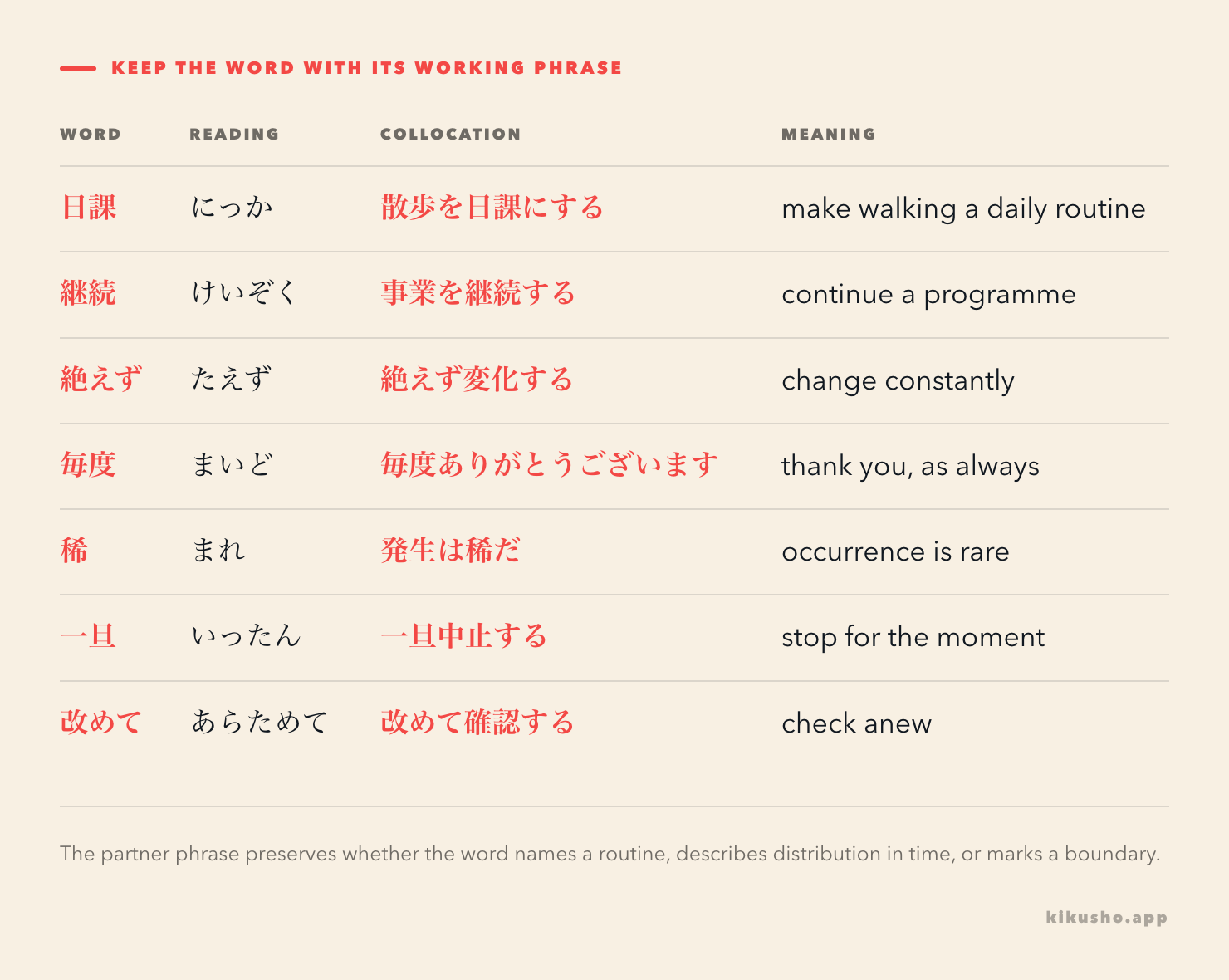
These seven entries all concern repeated time, but each preserves a different structure. Learn the structure with the word: 日課にする, 調査を継続する, 絶えず変化する, 毎度ありがとうございます, 稀だ, 一旦中止する and 改めて検討する.
Common questions
What is the difference between 日課 and 習慣?
日課(にっか) is something assigned or deliberately fixed for each day, such as a morning walk. 習慣(しゅうかん) is a broader habit or custom and need not be daily or consciously scheduled.
What is the difference between 一旦 and 改めて?
一旦(いったん) marks a temporary break or the point after which a condition holds. 改めて(あらためて) marks doing something anew, on another occasion, or seeing it with fresh awareness. They can form a sequence: 一旦止めて、改めて検討する.
How is 絶えず different from いつも?
絶えず(たえず) presents an action or change as continuing without a break. いつも usually describes what habitually or normally happens, even when the action is not literally continuous.
Does 毎度 only mean every time?
Its core meaning is every occasion or as usual, but 毎度ありがとうございます is also a conventional customer-facing expression of thanks. In Kansai speech, 毎度 can additionally work as a familiar business greeting.