On this page
Choose Nに則って when an action complies with an established rule, law or tradition. Choose Nに即して when an action fits actual facts or conditions, and Nに照らして when a case is examined against N as a benchmark.
All three are formal and often become “according to,” “in accordance with” or “in light of” in English. The sentence must reveal whether someone is following a standard, adapting to reality or using a standard to judge something else.
One noun can play three different roles
Start with the relationship, not the English translation.
| Form | Role of the noun before it | Question to ask |
|---|---|---|
| Nに則って | a rule to obey | Did the action comply with N? |
| Nに即して | reality to fit | Was the action adapted to N? |
| Nに照らして | a benchmark for judgment | Was another case evaluated against N? |
規定に則って、申請書を処理した。
きていに のっとって、しんせいしょを しょりした。
We processed the application in accordance with the regulations.
現場の状況に即して、作業手順を変更した。
げんばの じょうきょうに そくして、さぎょうてじゅんを へんこうした。
We changed the work procedure to suit conditions at the site.
審査基準に照らして、申請内容を評価した。
しんさきじゅんに てらして、しんせいないようを ひょうかした。
We evaluated the application against the screening criteria.
The first action follows a regulation. The second changes because the site has particular needs. The third holds one object, the application, up to a separate benchmark.
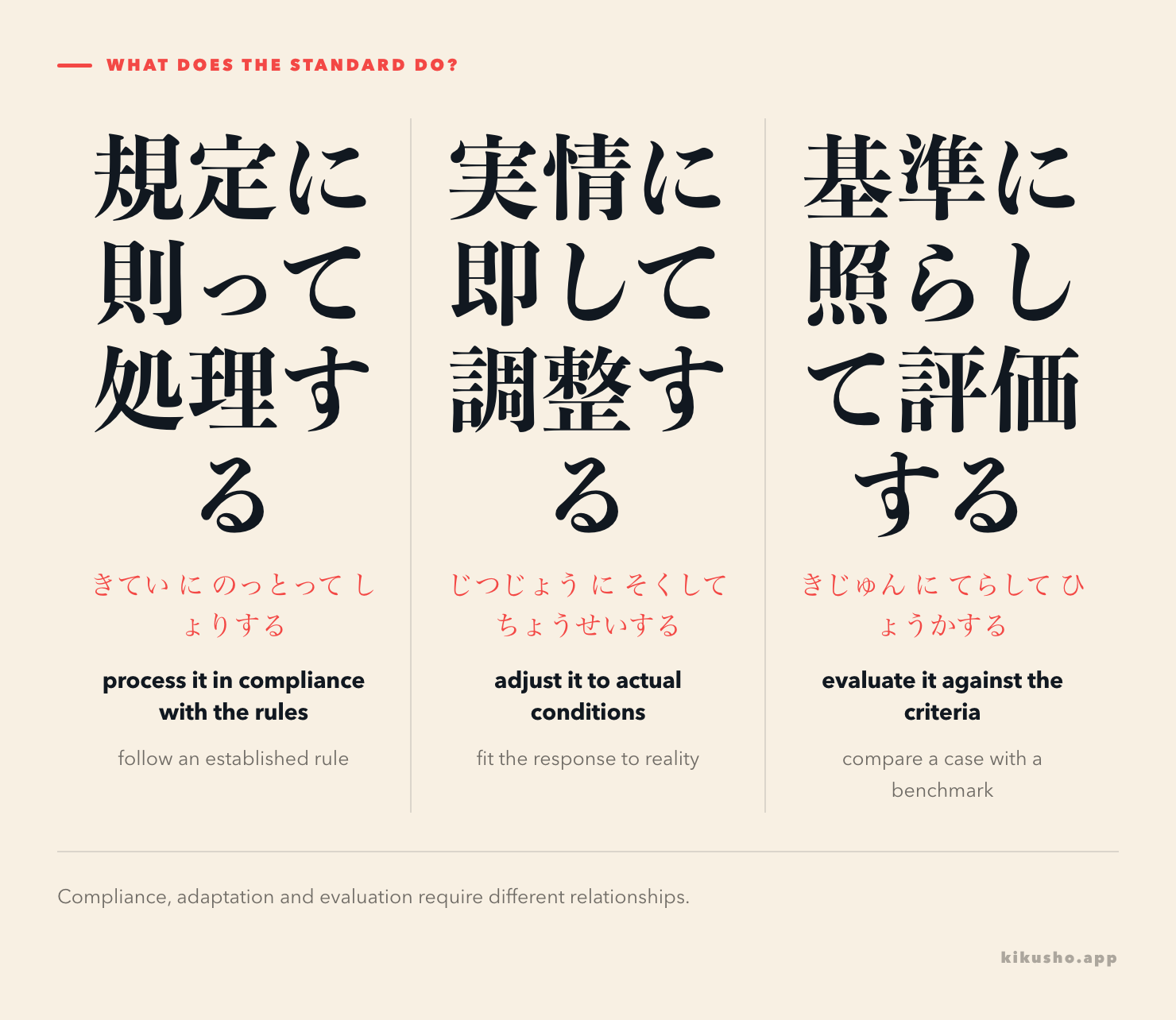
に則って means act in compliance
則る(のっとる) means to follow or conform to a standard. Attach に則って to a noun that has authority over how the later action should be performed.
| Form | Use | Example |
|---|---|---|
| Nに則って + clause | connects the standard to an action | 法律に則って手続きを行う |
| Nに則り + clause | compact written connection | 規定に則り処分する |
| Nに則った + noun | modifies a noun | 原則に則った判断 |
式典は伝統に則って行われた。
しきてんは でんとうに のっとって おこなわれた。
The ceremony was conducted in accordance with tradition.
社内規定に則り、必要な手続きを進めます。
しゃないきていに のっとり、ひつような てつづきを すすめます。
We will proceed with the required steps in accordance with company regulations.
Typical nouns include 法律, 規則, 規定, 原則, 方針, 伝統, 慣例 and 先例. They exist before the action and prescribe its course. JLPT Sensei gives the noun attachment and N1 estimate. Bunpro's reference confirms the formal register, the connective and attributive forms, and the tendency toward laws, traditions and established standards.
You may also meet Nに則して/Nに則し/Nに則したN, using 則する(そくする). It has the same compliance direction as 則って, but its reading makes it look almost identical to 即して. The kanji distinguishes a norm, 則, from present reality, 即.
に即して means fit the facts or circumstances
即する(そくする) describes close correspondence with facts, reality or circumstances. The following response suits what is actually true rather than merely applying a fixed rule.
| Form | Example |
|---|---|
| Nに即して + clause | 実情に即して制度を見直す |
| Nに即し + clause | 現状に即し計画を修正する |
| Nに即した + noun | 時代に即した教育 |
地域の実情に即して、支援の内容を見直す必要がある。
ちいきの じつじょうに そくして、しえんの ないようを みなおす ひつようが ある。
The support program needs to be revised to fit local circumstances.
調査で確認した事実に即した報告書を作成した。
ちょうさで かくにんした じじつに そくした ほうこくしょを さくせいした。
We prepared a report faithful to the facts confirmed by the investigation.
現実, 事実, 実情, 現状, 事情, 時代 and 変化 commonly supply the reference point. The response may need adjustment because those conditions vary. A law can change only through a formal process, but support designed 地域の実情に即して can differ from one area to another.
J-nihongo's N1 comparison states the spelling distinction directly: 即して fits facts or actual conditions, while 則して follows rules, standards or laws. 日本語NET independently supports the N1 placement and the forms に即して and に即した.
に照らして means judge against a benchmark
照らす(てらす) can mean to illuminate, but it also means to compare something with a standard. In Nに照らして, N is the light or benchmark under which another matter is examined.
過去の判例に照らして、この処分が妥当か検討した。
かこの はんれいに てらして、この しょぶんが だとうか けんとうした。
We considered whether this penalty was reasonable in light of past precedents.
現在の証拠に照らして、その説明には疑問が残る。
げんざいの しょうこに てらして、その せつめいには ぎもんが のこる。
In light of the current evidence, doubts remain about that explanation.
The later predicate often reveals an act of judgment: 判断する, 評価する, 検討する, 審査する, 妥当だ, 適切だ, 疑問が残る. The benchmark may be a law or rule, just as with に則って, but the action differs:
規定に則って手続きを進めた。
We followed the regulations while carrying out the procedure.
規定に照らして申請を審査した。
We examined the application against the regulations.
The first is compliance. The second compares a separate case with the rule and reaches or prepares a judgment. Kotomora's N1 reference documents that benchmark relationship and the formal legal, administrative and academic register. 日本語教師の毎日のんびり also distinguishes standards used with に照らして from facts used with に即して and established practices used with に則って.
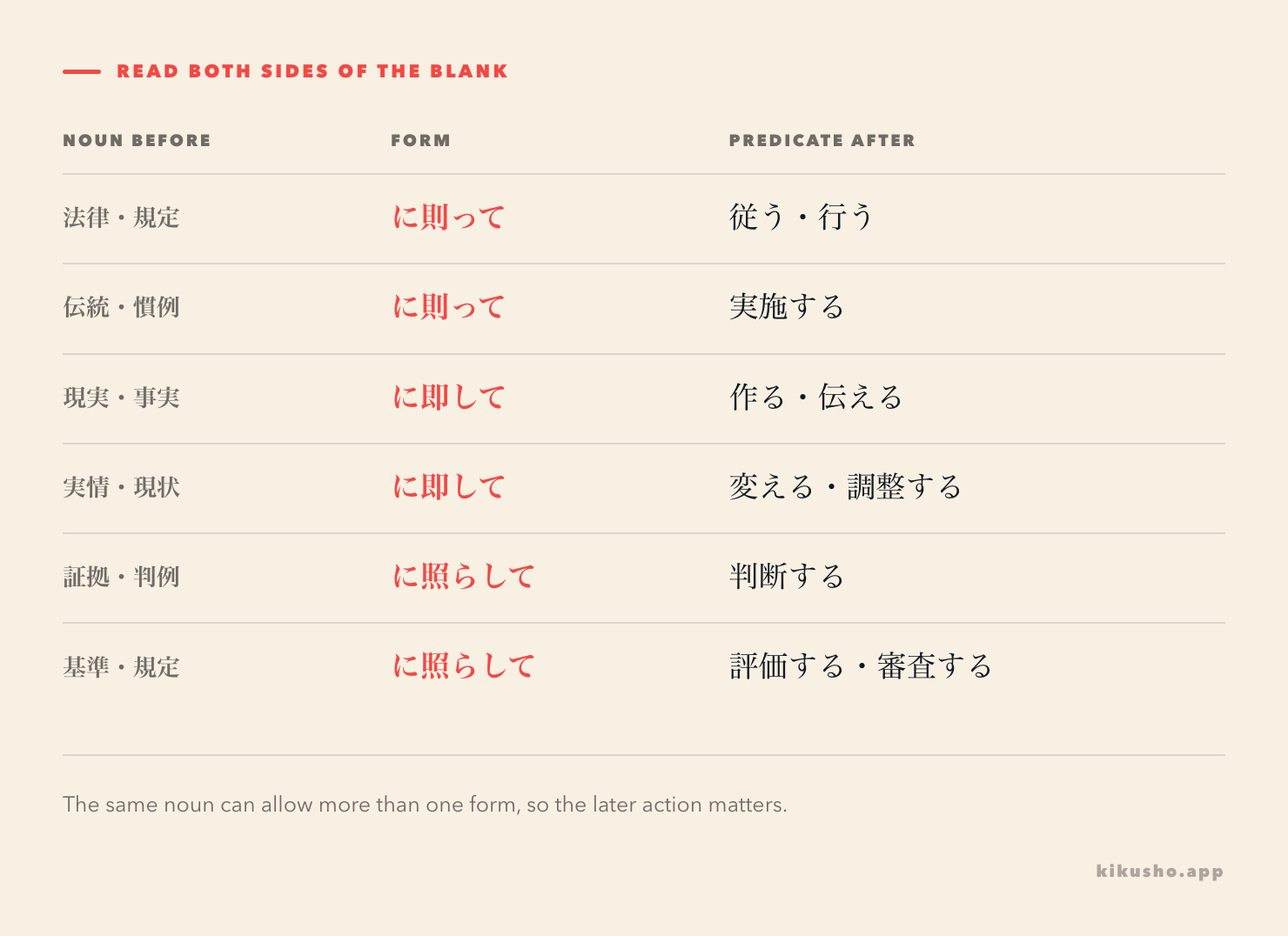
The noun alone does not always settle the answer
A noun such as 法律 can support more than one form. Read the predicate too.
| Sentence frame | Best form | Why |
|---|---|---|
| 法律__手続きを行う | に則って | carry out a procedure in compliance |
| 現状__制度を調整する | に即して | adapt the system to current conditions |
| 法律__行為を判断する | に照らして | evaluate conduct against the law |
This also separates the three forms from に基づいて. A decision 調査結果に基づいて rests on those results as its grounds. 調査結果に即して emphasizes fidelity to what the results show. 基準に照らして emphasizes a comparison between a case and the standard. The に基づいて and をもとに lesson develops foundation versus source material, while に沿って covers following a route, guideline or plan.
For Kikusho review cards, keep the noun and the deciding predicate. 規定に則って shows the form, but 規定に則って手続きを進める preserves compliance. 証拠に照らして妥当性を判断する preserves the benchmark and the judgment. That larger unit prevents three identical English glosses from collapsing into one memory.
Practice: classify the relationship first
Question 1 — compliance
Complete: 大会の規則__、参加者の装備を確認してください。
- に即して
- に則って
- に照らして
- をもとにした
Question 2 — actual conditions
Complete: 地域の実情__、避難計画を修正する必要がある。
- に即して
- に則って
- に照らした
- にもかかわらず
Question 3 — evaluation
Complete: 提出された証拠__、証言の信頼性を判断した。
- に則って
- に即した
- に照らして
- に沿った
Question 4 — the same standard, two actions
Explain why 規定に則って手続きを進める and 規定に照らして申請を審査する use different forms.
Question 5 — kanji and reading
Choose the pair that means “adapted to current conditions.”
- 現状に則って(げんじょうにのっとって)
- 現状に即して(げんじょうにそくして)
- 現状に照らして(げんじょうにてらして)
- 現状に則して(げんじょうにそくして)
Question 6 — sentence composition
Write “The ceremony was conducted in accordance with tradition” using 式典, 伝統, 行う and に則って.
Question 7 — three relationships in one report
Fill the blanks with the three different target forms: まず社内規定__手続きを進めた。次に現場の状況__作業方法を調整し、最後に安全基準__結果を評価した。
Assign one of the three relationships to each blank before opening the panel.
Answers and explanations
The sequence below moves from obeying a rule to fitting reality and judging against a benchmark.
Answer 1: 2, に則って. The tournament rules prescribe how the equipment check should be carried out. This is compliance with an established rule.
Answer 2: 1, に即して. The evacuation plan must be adapted to local circumstances. 実情 names variable reality, not a rule to obey or a benchmark used to judge a separate case.
Answer 3: 3, に照らして. The evidence is the benchmark used to evaluate the reliability of testimony. The predicate 判断した exposes the comparison and judgment.
Answer 4. 規定に則って手続きを進める says the procedure follows the regulations. 規定に照らして申請を審査する keeps the application separate and examines it against those regulations. One clause performs compliant action; the other evaluates a case.
Answer 5: 2, 現状に即して(げんじょうにそくして). 即して fits a response to present reality. Choice 1 follows a rule, choice 3 evaluates something against current conditions, and choice 4 uses 則して, an alternative compliance form that happens to share the reading そくして.
Answer 6. A model answer is 式典は伝統に則って行われた。 Tradition supplies the established pattern that the ceremony follows.
Answer 7. まず社内規定に則って手続きを進めた。次に現場の状況に即して作業方法を調整し、最後に安全基準に照らして結果を評価した。 The sequence moves from compliance with rules, through adaptation to circumstances, to evaluation against a benchmark.
Common questions
What is the difference between に則って, に即して and に照らして?
に則って describes acting in compliance with a rule, law or tradition. に即して adapts an action to facts or actual conditions. に照らして evaluates a separate case against a rule, standard, evidence or precedent.
How do you read に則って, に即して and に照らして?
Read them にのっとって (ni nottotte), にそくして (ni sokushite) and にてらして (ni terashite). The first two are easy to confuse because 則して, an alternative to 則って, is also read そくして.
What nouns commonly come before に則って?
Established standards such as 法律, 規則, 規定, 原則, 方針, 伝統 and 慣例 commonly precede に則って because they prescribe how an action should proceed.
Is に照らして the same as according to?
It can translate that way, but it specifically presents a benchmark used to examine or judge another matter. If someone simply follows a rule, に則って is usually more precise.